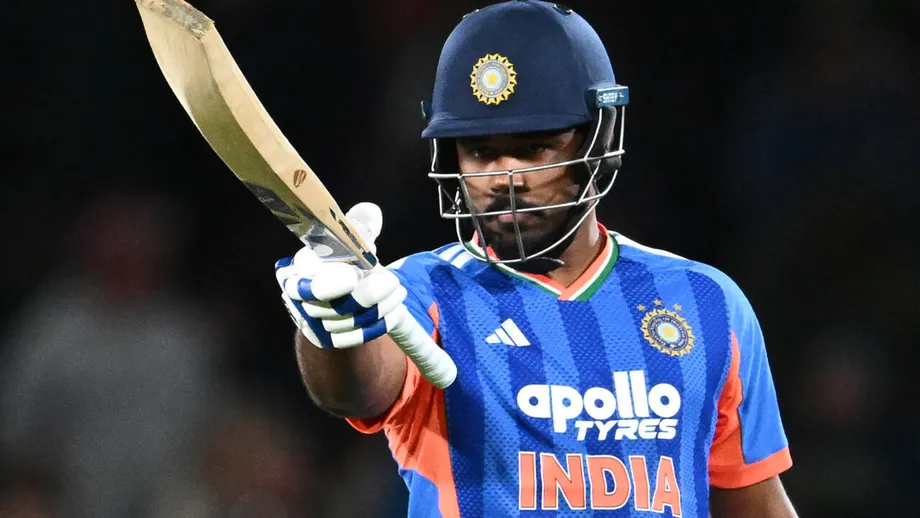
India reach 230 with two balls to spare
Sanju Samson struck 67 from 33 balls and Naman Dhir finished unbeaten on 42 from 15 as India chased a target of 226 to beat New Zealand by four wickets at Hagley Oval in Christchurch on Thursday, October 22, 2026. India finished on 230/6 in 19.4 overs, taking a 1-0 lead in the five match Twenty20 international series.
Contents
- India reach 230 with two balls to spare
- Samson and Sharma turn the powerplay into a platform
- New Zealand's spinners bring the chase back into reach
- Iyer steadies India before Dhir takes charge
- Phillips gives New Zealand a formidable total
- Dew shapes the captains' decisions
- Selection choices and the next Christchurch test
- Key Points
Samson and Abhishek Sharma launched the pursuit with an opening partnership of 93 from just 35 deliveries. New Zealand then recovered through spinners Mitchell Santner and Michael Bracewell, leaving captain Shreyas Iyer, Axar Patel and Dhir to complete a chase that became much tighter than its opening suggested.
Glenn Phillips had earlier made an unbeaten 82 from 40 balls to lift New Zealand to 225/4 in 20 overs. The match brought together the finalists from the 2026 T20 World Cup, with defending champions India again finding enough batting power to overcome New Zealand.
The winning target of 226 was described as India's highest successful T20 chase. The historical benchmark carries conflicting figures: the previous best against Sri Lanka in 2009 is given as 211, while a statistical list puts that chase at 207 and lists targets of 209 against Australia in 2023 and New Zealand in 2026.
The BCCI match centre confirms New Zealand's total as 225/4 in 20 overs and India's reply as 230/6 in 19.4 overs, a four wicket win with two balls remaining at Hagley Oval on October 22, 2026.
Samson and Sharma turn the powerplay into a platform
India reached 94/1 after six overs, compared with New Zealand's 65/1 at the same stage. That gave the visitors a 29 run advantage across the opening powerplay, when fielding restrictions limit how many fielders can stand near the boundary.
Sharma contributed 29 from 12 deliveries, including three sixes. He attacked Adam Milne with consecutive sixes in the fourth over, helping India pass New Zealand's six over total before their own fourth over had ended.
Sharma also struck the first ball he faced for six off Matt Henry. It was recorded as his seventh such start in T20 internationals, moving him ahead of Afghanistan's Shafiqullah Shinwari on six. His innings ended when Milne caught him at short third man off Bracewell, with India 93/1 after 5.5 overs.
Samson reached his half century from 23 deliveries and finished with eight fours and four sixes. Those boundary shots supplied 56 of his 67 runs. He repeatedly attacked straight down the ground, including a flick off Lockie Ferguson that cleared long on.
Samson, India's opening batter and wicketkeeper, described the simple approach he shared with Sharma:
We do have a lot of conversations in the middle but nothing makes sense actually.
His eighth score of at least 50 in 26 T20 innings this year earned him the player of the match award. The early acceleration also changed the arithmetic: after six overs, India needed 132 from the remaining 84 balls, rather than having to sustain the starting requirement of more than 11 runs an over.
New Zealand's spinners bring the chase back into reach
Santner and Bracewell interrupted India's charge by taking four wickets across five overs. From 93 without loss, India slipped to 122/4 in the 11th over, including a passage in which three wickets fell for seven runs.
Samson was bowled by Santner in the ninth over after playing the ball onto his stumps. Ishan Kishan and Tilak Varma also fell while trying to clear the boundary. New Zealand's seam attack had struggled to contain the openers, but its slower bowlers forced India to rebuild.
Santner bowled three economical overs through the middle stages. His spell helped turn a rapid pursuit into a contest in which India had to weigh every attacking shot against the cost of another wicket.
New Zealand captain Santner said his side had recovered well after the opening assault, while acknowledging that the first six overs needed attention:
I think in the middle we did well to kind of squeeze them and then again it was a tight game.
The swing in momentum gave New Zealand a route back into the match. India still had time to reach the target, but the early loss of four batters placed more responsibility on Iyer and the players below him.
Iyer steadies India before Dhir takes charge
Iyer made 42 from 28 balls and shared a fifth wicket partnership of 45 with Patel, who scored 24. Their stand kept India close enough to the required rate for a late burst to decide the game.
Finn Allen gave Iyer a reprieve when he dropped a difficult catch in the 15th over. India needed 55 from the final 30 deliveries with five wickets remaining, a requirement of 11 runs an over.
Dhir supplied the decisive acceleration. His unbeaten 42 from 15 balls came at a strike rate of 280, meaning he scored at the equivalent of 280 runs per 100 deliveries. Iyer fell in the penultimate over, but Dhir stayed to finish the task.
India needed eight from the last over, bowled by Henry. Dhir hit the first ball for four. Two singles followed before he struck the fourth delivery for six, India's 13th six of the innings. The winning shot carried India beyond the target to 230.
Samson credited the full batting group after the victory:
It was really a team game today.
The chase depended on three different contributions: the openers reduced the scoring burden, Iyer and Patel repaired the innings, and Dhir converted a demanding finish into victory.
Phillips gives New Zealand a formidable total
Phillips led New Zealand's innings with eight fours and three sixes in his unbeaten 82. His scoring combined powerful cuts and pulls against the seamers with quick running between the wickets.
That running put pressure on fielders to move closer to the bat to prevent singles. Phillips then found space beyond them with harder shots, giving India more than one problem to solve when setting the field.
Allen and Tim Seifert had provided a strong opening platform. They added 49 before Seifert, who made 24 from 17 balls, was caught behind off Mayank Yadav on the final ball of the fifth over. New Zealand reached 65/1 after six.
Allen struck five fours and two sixes in his 45 from 24 deliveries. Patel dismissed him in the eighth over as he attempted to clear long off. Daryl Mitchell, batting at No. 3, made 28 after Sharma dropped him on 16, before top edging Arshdeep Singh.
Bevon Jacobs added 31 from 16 balls. His first delivery produced a six measured at 96 metres off Arshdeep, an immediate statement of intent from the middle order.
New Zealand collected 67 runs in the final five overs. Bhuvneshwar Kumar conceded 49 from his four overs and Patel gave away 51, leaving India with a target that required sustained aggression rather than a cautious start.
Dew shapes the captains' decisions
Iyer chose to bowl after winning the toss, hoping that evening dew would help India's chase. Moisture can make the ball harder for bowlers to grip and allow it to slide onto the bat more smoothly after bouncing.
Iyer said the surface had initially played slowly, with some deliveries holding up after pitching. As dew arrived during New Zealand's innings, the ball began coming through more readily and the hosts gained momentum.
Samson also described a change between innings. Keeping wicket had given him an early view of the pitch, but batting brought different conditions, with the ball coming onto the bat more comfortably despite movement through the air.
India had arrived in New Zealand on Tuesday and trained only once before Thursday's opener. The match also came less than five days after the end of their home T20 series against West Indies.
Iyer, India's captain, dismissed concerns about the short preparation period before play:
No complaints, we're a bunch of professionals.
Selection choices and the next Christchurch test
India brought Nitish Kumar Reddy and Mayank Yadav into the XI, replacing Shivam Dube and Prince Yadav from the washed out Bengaluru match against West Indies. Mayank delivered an early breakthrough by removing Seifert.
New Zealand placed Mitchell at No. 3 in the injury enforced absence of Rachin Ravindra and selected Jacobs in the middle order. Devon Conway and Josh Clarkson missed out. The hosts chose four seamers, Nathan Smith, Henry, Milne and Ferguson, leaving out Kyle Jamieson, Jacob Duffy and Blair Tickner.
The opening match nevertheless turned on spin as well as pace. Santner and Bracewell gave New Zealand its strongest stretch with the ball, while the seamers faced heavy punishment during India's powerplay.
The series continues at Hagley Oval on Saturday, October 24. Santner identified the opening overs as an area for improvement, while India will seek a smoother passage through the middle after losing much of the advantage built by Samson and Sharma.
- Tuesday, October 20: India arrived in New Zealand before holding one training session ahead of the opener.
- Thursday, October 22: India won the first T20 international by four wickets in Christchurch.
- Saturday, October 24: Hagley Oval hosts the second match of the five match series.
The tour later moves into longer formats. India have already announced a planned ODI captaincy change, with Shubman Gill leading the first three matches before Iyer takes over for the last two as Gill prepares for the Tests.
Key Points
- India reached 230/6 in 19.4 overs to chase a target of 226 after New Zealand made 225/4 in 20 overs and lead the series 1-0.
- Samson scored 67 from 33 balls, while Sharma made 29 from 12 in an opening stand of 93.
- Santner and Bracewell brought New Zealand back into contention during the middle overs.
- Iyer scored 42, Patel added 24 and Dhir finished unbeaten on 42 from 15 balls.
- Phillips led New Zealand with an unbeaten 82 from 40 deliveries.
- The second T20 international is scheduled for Saturday, October 24, in Christchurch.