A larger processing system at Pyongsan
North Korea has increased the number of sample tanks at its Pyongsan uranium refinery from 10 to 11, adding to satellite evidence of continued activity at a plant that supplies the starting material for its nuclear weapons programme. The additional tank was built in August, following imagery showing 10 tanks in May. Freight movements and expanding waste deposits provide further signs that the facility in North Hwanghae province remains active.
Contents
- A larger processing system at Pyongsan
- How ore becomes nuclear feedstock
- Trains, roof repairs and new construction
- A record of activity across several years
- Nearby mines show renewed work
- Growing waste brings attention downstream
- Why production matters in negotiations
- Checking a freeze requires access
- Sanctions relief has several legal routes
- Key Points
High resolution imagery from Planet Labs shows changes in the plant's central processing area, where the tanks are believed to hold acidic and alkaline solutions used to separate uranium from mined ore. The extra tank represents a 10 percent increase in the tank count. Its effect on production depends on its size, function and connection to the rest of the processing system.
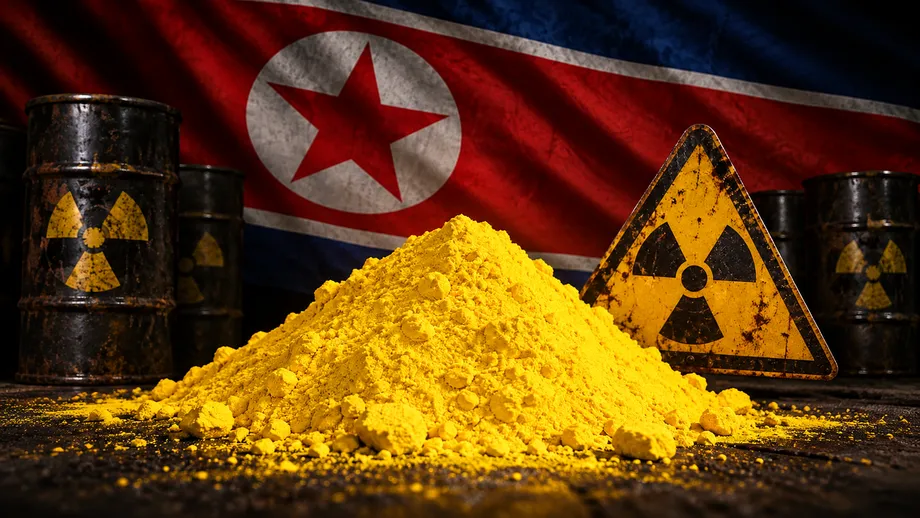
Pyongsan produces uranium concentrate, commonly called yellowcake. This is an intermediate material: uranium extracted from rock must undergo further chemical processing and enrichment before it can become material suitable for a nuclear weapon. Pyongsan therefore sits near the beginning of a much longer production chain.
Jeong Seong-hak, an expert at the Korea Aerospace Security Institute, assessed the changes as part of a continuing effort to expand refining capacity and support greater production of uranium concentrate. The Centre for Strategic and International Studies, or CSIS, identified Pyongsan as North Korea's sole verified producer of that material in its November 2021 assessment. Developments there matter both to efforts to restrain nuclear production and to communities downstream of its waste ponds.
How ore becomes nuclear feedstock
Pyongsan processes uranium bearing material extracted from nearby mines. Crushing and grinding break the ore into smaller particles, while chemical treatment separates the uranium from much of the surrounding material. The resulting concentrate is easier to transport and process elsewhere.
Yellowcake, identified chemically as U3O8, still requires several stages of treatment. Enrichment increases the share of uranium 235, the form of uranium that can sustain the chain reaction used in a nuclear weapon. A refinery and an enrichment facility therefore perform different jobs, even when both support the same weapons programme.
The plant is believed to send concentrate to facilities including the Yongbyon nuclear complex. Satellite observations of the wider network have also drawn attention to expanded uranium enrichment facilities at Yongbyon and Kangson. In September 2026, the International Atomic Energy Agency's assessment described a new building with two storeys at Yongbyon and signs of operation in an expanded annex at Kangson.
For negotiators, the practical issue is the connection between these stages. Stopping additional weapons material would require an agreement that addresses the relevant production facilities and gives inspectors a way to check compliance across the network.
Trains, roof repairs and new construction
A freight train entering the Pyongsan complex adds evidence of continuing logistics activity. Such movements could bring ore, chemicals or equipment into the facility, or carry processed material away. Rail access connects the refinery to the wider industrial system supporting nuclear production.
Imagery captured on April 7, 2026, showed a train of approximately four cars stopped on the plant's rail spur. The same imagery showed a brighter blue roof on the solvent extraction and precipitation building, a central processing structure. The repainting suggested maintenance or waterproofing work.
Construction also appeared south of the coal storage area on ground that remained undeveloped in summer 2025. Cleared land, rectangular grids and regularly spaced foundation frames suggested a small facility was being built. Its purpose and the train's cargo remain unconfirmed; possible uses of the new structure include coal processing, heat supply or waste handling.
A record of activity across several years
Pyongsan's recent changes extend a pattern documented over several years. Joseph S. Bermudez Jr., Victor Cha and Jennifer Jun, authors of the CSIS assessment published on November 8, 2021, examined commercial imagery collected from April through October that year. They found the plant operating and undergoing maintenance.
At least seven of eight outdoor settling tanks beside the leaching and classifying building were in use during that period. CSIS also recorded dust accumulating around the sampling and grinding building and replacement roof panels. Acid vapour condensing beneath roof panels was identified as a cause of deterioration.
The main observations span several dates:
- April to October 2021: CSIS observed active processing areas, waste accumulation and between 28 and 35 locomotives and railcars in the plant's railyards.
- December 1, 2022: More than a dozen railcars were visible inside the concentration plant.
- January 21, 2023: Approximately 20 railcars were queued to enter the complex.
- April 7, 2026: Imagery showed a train of about four cars, roof maintenance and construction near coal storage.
- May to August in the tank comparison: The central sample tank count rose from 10 to 11.
The observations cover different parts of the facility and different viewing dates. The eight settling tanks identified in 2021 and the later count of central sample tanks belong to separately described processing areas. Together, the observations show sustained attention to processing, transport and maintenance over time.
Nearby mines show renewed work
Mining activity helps explain how the refinery can continue receiving raw material. The January Industrial Mine complex begins approximately 600 metres northeast of the plant and covers about 235 hectares, according to CSIS. Its 2021 assessment found one, and potentially two, of the original five shafts operating.
Shaft E had received a covered conveyor belt in July or August 2021. Nearby building work and changing waste piles also indicated continuing investment in the mining infrastructure.
A March 7, 2023, analysis by Peter Makowsky examined five identifiable mines across the surrounding mountains. It found continued activity at the principal mine and renewed work since 2020 at three others that had appeared dormant for years. Mine 5 had developed a large new spoil pile by May 2022, while Mine 4 appeared unchanged since 2003.
Waste rock provides another visible measure of excavation. Between April 2020 and April 2021, a spoil pile measuring 380 metres in length grew by 115 metres, while its width increased from 30 to 40 metres. The uranium content of the excavated material was unknown, leaving production estimates dependent on information beyond the dimensions of waste piles.
Growing waste brings attention downstream
Pyongsan's expanding solid waste storage area is one of the most persistent signs of ore processing. Tailings are the unwanted material left after useful minerals have been extracted. At this facility, waste includes solids, liquids and chemical residues collected in large ponds south of the plant.
CSIS described an approximately 380 metre pipeline carrying waste slurry across the Namch'on River to the tailings pond. Two operating pumphouses distributed the mixture through ditches and movable pipes. In 2021, accumulated solid waste blocked five bays of the pond.
Imagery from January through April 2026 showed sludge deposits spreading across the northern and central portions of the ponds. Winter snow and ice obscured some drainage routes, while spring images showed no definitive wastewater discharge toward the Yesong River during that observation period. Rainfall, drainage conditions and the approach of the summer rainy season make the ponds an environmental concern as well as an indicator of industrial activity.
Later tracking documented substantial changes in a smaller basin downstream. Measurements described in October 2026 coverage of the changing wastewater pond showed its surface expanding from about 0.79 hectares on February 25 to 1.38 hectares in mid-April, then shrinking to 0.85 hectares on September 24. The April area was about 75 percent larger than the February measurement.
Commercial imagery also showed sludge deposits in the main settling pond expanding by about 0.8 hectares, or 8,000 square metres, between September 5, 2025, and June 27, 2026. The Yesong, also called the Ryesong, flows toward the Han River estuary near the border between North and South Korea. South Korean checks near Ganghwa Island and the estuary in 2025 found no unusual radioactivity or heavy metal concentrations.
Why production matters in negotiations
South Korean officials and researchers are considering the refinery's expansion alongside the possibility of renewed dialogue between Washington and Pyongyang. More production capacity could allow North Korea to accumulate additional material while discussions over limits, inspections or sanctions continue.
Cho Han-beom, a senior research fellow at the Korea Institute for National Unification, assessed that expanded nuclear capabilities could strengthen North Korea's position in future arms control negotiations. A larger programme would give Pyongyang more facilities or activities to offer for restriction in exchange for concessions.
South Korean Foreign Minister Cho Hyun said Seoul was coordinating closely with Washington to prevent recognition of North Korea as a nuclear weapon state. That concern sits alongside a more immediate negotiating question: whether an initial agreement would stop additional production while leaving existing weapons in place.
President Lee Jae-myung's proposed approach links a nuclear freeze to sanctions relief, followed by reciprocal steps intended to build trust and reduce nuclear weapons. A production freeze would halt specified future activities. Reductions would require further decisions about existing weapons and material.
Checking a freeze requires access
Gary Samore, a former White House coordinator for arms control and weapons of mass destruction, said a verified halt in additional production could justify a limited economic concession, although he doubted North Korea would accept the exchange.
I think a verified nuclear freeze (i.e. halt to further production of weapons grade fissile material) would justify limited sanctions relief, but I don't believe North Korea would accept such a deal for three reasons.
Ankit Panda, a senior fellow in the nuclear policy programme at the Carnegie Endowment for International Peace, explained why checking production would be harder than detecting a missile launch.
Obviously, any actual launch of a prohibited missile would be very easily detected from space-based infrared sensors. Any freeze involving fissile material or warhead production would be much more challenging to verify remotely.
IAEA inspectors have been absent from North Korea since April 2009. The agency monitors the programme using commercial satellite imagery and public information. Its director general's report dated August 28 identified construction of an additional enrichment facility at Yongbyon and signs of operation in the expanded area at Kangson.
Olli Heinonen, a former IAEA deputy director general, argued that strong verification would require access to facilities, North Korean specialists and original records, including documents involving foreign partners. He also assessed that export controls alone could not fully stop further expansion of North Korea's production of uranium suitable for weapons, given its domestic technical and industrial capabilities.
Sanctions relief has several legal routes
A negotiated freeze would leave governments to decide which sanctions to adjust and under what authority. American sanctions law distinguishes temporary suspension, individual waivers and termination. Each route has its own requirements.
Under Section 401 of the North Korea Sanctions and Policy Enhancement Act, suspension of covered sanctions requires presidential certification of progress in six areas, including financial transparency, verification of compliance with UN Security Council resolutions and conditions in political prison camps. An initial suspension can last up to one year, with extensions subject to further certification.
Section 402 sets broader conditions for termination, including substantial progress toward dismantling weapons programmes and addressing political repression. Section 208 allows specified sanctions to be waived individually for periods ranging from 30 days to one year, with written justification to the relevant congressional committees.
UN sanctions require a separate process. Security Council Resolution 2397 allows measures to be modified, suspended or lifted in light of North Korean compliance. The European Union also maintains sanctions under its own authorities, including measures addressing activities beyond the nuclear programme.
For Pyongsan, any agreement would need to connect these legal choices to practical obligations: which operations stop, how inspectors check them and which economic restrictions change in return. The growing network of mines, processing facilities, enrichment buildings and waste infrastructure makes the scope of those obligations central to a workable deal.
Key Points
- Pyongsan's central sample tank count rose from 10 to 11 after an additional tank was built in August.
- Freight movements, maintenance, construction and growing sludge deposits point to continued activity at the uranium refinery.
- CSIS identified Pyongsan in 2021 as North Korea's sole verified uranium concentrate producer.
- Renewed mining activity and expanding waste piles show investment across the surrounding production system.
- Waste ponds near the Yesong River remain a focus for environmental monitoring.
- A verified production freeze would require access to facilities and records, while sanctions relief would involve separate legal decisions.