From 18 patents to a global industrial force
Chinese applicants filed just 18 internationally competitive clean energy patents in 2000. By 2022, they were filing more than 5,000, moving ahead of the United States and Europe. That change captures a transformation extending far beyond research laboratories: China has become the leading innovator and manufacturer across much of the clean energy economy.
Contents
- From 18 patents to a global industrial force
- Government policy built the foundations
- Research investment moved alongside factory expansion
- Competition sharpened the battery industry
- Green hydrogen opens another field of competition
- Huge projects and rural rooftops expanded deployment
- Coal and electricity networks limit the transition
- Lower prices abroad bring new dependencies
- New technologies face a funding gap
- China's lead is changing economic competition
- Key Points
By August 25, 2025, Chinese companies had established commanding positions in solar panels, wind turbines, batteries and electric vehicles. Their expansion into green hydrogen, smart grids and advanced energy storage was opening another stage of competition, with consequences for electricity prices, industrial jobs and efforts to reduce emissions around the world.
China reached this position through sustained government support, large investments and fierce competition among domestic companies. Factories became bigger, technologies improved and prices fell. Buyers gained access to cheaper equipment, while manufacturers elsewhere faced competitors operating at a scale they struggled to match.
The gains have come with difficult tradeoffs. Excess manufacturing capacity has squeezed company profits. Electricity networks have struggled to absorb growing renewable output. Countries seeking to move away from fossil fuels have become increasingly dependent on Chinese equipment and supply chains, even as trade tensions threaten access.
China also remains heavily dependent on coal. Its position as a clean energy manufacturing leader therefore sits alongside an unfinished transformation of its own electricity system. The next stage involves connecting renewable generation to consumers, storing electricity and developing technologies for industries that cannot easily replace fossil fuels.
Government policy built the foundations
China's industrial strategy took a particularly visible form with Made in China 2025, launched in 2015. The initiative targeted technological sovereignty in renewable energy, electric vehicles, robotics and other strategic industries. In practical terms, that meant building the ability to develop and manufacture important technologies domestically.
Companies received loans, subsidies, tax breaks and support for acquiring foreign competitors. The aim was to build strong positions at home and make Chinese businesses competitive abroad. Government backing helped companies invest in factories and research before those investments could generate reliable returns.
Solar manufacturing shows the scale of the result. China accounts for more than 80% of global manufacturing capacity. In 2023, it produced 861 gigawatts of solar panel modules, exceeding global demand. Gigawatts describe power capacity; the figure conveys how much generating equipment factories produced, rather than the electricity those panels generated.
China also added more new solar and wind capacity in 2023 than the rest of the world combined. Large factories and a large domestic market reinforced each other: manufacturers could expand production while developers installed increasing amounts of equipment.
Financial policy supported the process. Green credit directs loans and financial incentives toward environmental performance. Studies described in the August 2025 account found that these policies boosted technical innovation in clean energy firms, encouraging research spending and the adoption of new technologies.
Research investment moved alongside factory expansion
China's manufacturing strength developed alongside a growing research base. The country now hosts nearly 50 graduate programs focused on battery chemistry and metallurgy, the study of metals and their properties. Chinese researchers also produce the majority of widely cited technical papers on battery technology.
The International Energy Agency says China's annual patent filings for emerging clean energy technologies rose nearly tenfold between 2010 and 2022. Those technologies include batteries, carbon capture, energy storage and smart grids. Carbon capture collects carbon dioxide, while smart grids use digital tools to manage electricity flows.
China's advance therefore reaches beyond the volume of finished products leaving factories. Research, industrial production and deployment have grown together, supporting improvements in technologies already used widely and work on technologies still approaching commercial scale.
The key milestones span more than two decades:
- 2000: Chinese applicants filed 18 internationally competitive clean energy patents.
- 2010 to 2022: Annual Chinese patent filings for emerging clean energy technologies increased nearly tenfold, according to the IEA.
- 2015: Made in China 2025 launched support for strategic industries, including renewable energy and electric vehicles.
- 2022: Internationally competitive clean energy patent filings exceeded 5,000, and China unveiled its national hydrogen strategy.
- 2023: Chinese factories produced 861 GW of solar panel modules, and China added more solar and wind capacity than the rest of the world combined.
- 2024: Combined solar and wind capacity surpassed 1,400 GW, reaching China's 2030 target six years early.
Competition sharpened the battery industry
Government support has operated alongside intense rivalry between Chinese businesses. Authorities backed many companies, following an approach described as letting a hundred flowers bloom, then allowed competition to eliminate weaker producers. The process has been described as economic Darwinism.
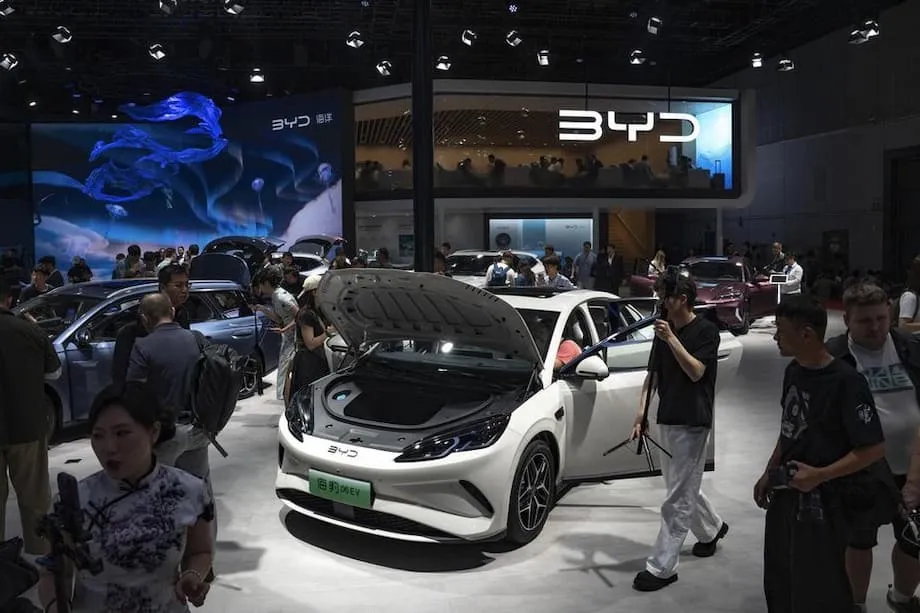
BYD and CATL illustrate how that competition changed battery manufacturing. They overtook global competitors by developing lighter, longer lasting and cheaper batteries using iron and phosphate instead of more expensive and less abundant materials such as nickel and cobalt.
Those improvements made electric vehicles safer, more affordable and more convenient. In 2024, China produced nearly 70% of the world's electric vehicles and held 60% of the global market for batteries used in those vehicles. Chinese companies now manufacture more than half of the world's electric vehicles and the vast majority of its solar panels.
Solar manufacturers face a harsher side of the same competitive system. Factories can produce more panels than buyers need, creating overcapacity. Companies then compete for sales through lower prices, leaving them with slim profit margins.
Consumers and project developers benefit from cheaper equipment, which helps renewable energy spread. Producers face pressure to keep improving efficiency while earning less on each sale. China's industrial success has therefore brought financial strain within some of the sectors driving it.
Green hydrogen opens another field of competition
Chinese companies have expanded from established renewable technologies into green hydrogen, supported by large investments. Green hydrogen uses renewable electricity to produce hydrogen, creating a route to reduce fossil fuel use in heavy industry and transport over long distances, where direct electrification can be difficult.
China has taken the global lead in patents related to low carbon hydrogen, surpassing Japan. Japanese research firm Astamuse ranks China first in green hydrogen competitiveness and says Chinese companies have filed twice as many patents annually as Japanese companies since 2020.
Hydrogen production equipment in China costs about a quarter as much as equivalent equipment in Europe. Lower equipment costs have encouraged domestic demand, while China accounts for 30% of global hydrogen demand, making it the world's largest hydrogen market.
China's national hydrogen strategy, unveiled in 2022, set a target of producing 100,000 to 200,000 tons of green hydrogen annually by 2025. By the August 2025 account, that target had already been surpassed. LONGi and Sungrow were expanding into hydrogen, drawing on strengths developed in solar and wind.
Hydrogen vehicles offer another possible outlet. China already leads in hydrogen truck infrastructure, and hydrogen fuel costs are substantially lower than in Japan. The expansion of equipment manufacturing and supply infrastructure could support further growth in vehicles powered by hydrogen.
Huge projects and rural rooftops expanded deployment
China's western deserts have become sites for vast wind and solar developments, connected to eastern electricity markets through transmission lines designed to carry power across long distances. By the end of 2024, combined solar and wind capacity exceeded 1,400 GW, reaching the country's 2030 target six years ahead of schedule.
The Gonghe Talatan Solar Park in Qinghai Province illustrates the size of those projects. It covers 609 square kilometers and has a capacity of 15.6 GW. Such developments turn renewable resources far from major population centers into electricity supplies for distant consumers.
Rooftops have provided another route. The National Energy Administration's Whole County PV program aims to install photovoltaics, the technology used in solar panels, in half of China's rural counties. By the end of 2022, 676 counties had joined.
By that point, 51 GW of new distributed solar had been installed, much of it on rural rooftops. Distributed solar means generation spread across smaller sites rather than concentrated in a single large power station. The program has helped extend access to clean electricity beyond cities into rural and remote communities.
China installed more renewable capacity in 2024 than the rest of the world combined. Projects ranging from individual roofs to desert solar parks have given domestic manufacturers a market large enough to support continued investment in production and technology.
Coal and electricity networks limit the transition
Fossil fuels, especially coal, still accounted for about 55% of China's electricity generation in 2024. Installed renewable capacity measures what equipment can produce under suitable conditions; actual electricity generation also depends on sunlight, wind, network connections and how the power system is operated.
Grid integration problems and a preference for power plants burning coal have limited the use of renewable energy. A solar farm can be built before the electricity network has enough capacity or flexibility to move all its output to customers.
China's coal generation share is declining, and clean electricity met more than 80% of the growth in electricity demand in 2024. If that trend continues, coal generation could peak and begin a sustained decline. The next task is to make growing renewable capacity translate into a larger share of electricity actually delivered.
Government plans call for breakthroughs in smart grids, advanced energy storage and carbon capture. Digital systems, grid management using artificial intelligence and storage that can hold energy for longer periods are intended to balance variable wind and solar generation and support the electrification of heavy industry.
Electricity storage can keep power produced during sunny or windy periods for use later. More flexible networks can then match that stored power and changing renewable output with demand from homes, transport and factories.
Lower prices abroad bring new dependencies
Chinese solar panels are supplying rural communities in Zimbabwe, while affordable Chinese electric vehicles are gaining buyers in cities from Mexico to Thailand. Lower equipment prices make cleaner technologies more accessible, particularly in developing countries with limited resources for expensive infrastructure.
The World Economic Forum says China spent more than twice as much on its green transition in 2023 as any other country. That investment helped build a manufacturing base whose products now support energy projects far beyond China.
The Belt and Road Initiative provides another channel for supporting green energy projects across the Global South. Affordable Chinese technologies allow countries to expand clean energy use without bearing the full cost of developing their own equipment industries.
Dependence on those supplies creates political and commercial risks. Countries committed to moving away from fossil fuels increasingly need Chinese components and technologies to meet their climate goals. China has tightened export controls on key clean technologies, adding concerns about access and competition.
Governments face competing pressures: keep clean energy affordable, protect domestic industries and secure dependable supplies. Countries that fall further behind in manufacturing and innovation risk economic losses and slower emissions reductions, with consequences for public health and the climate.
New technologies face a funding gap
China's established clean energy industries are encountering diminishing returns from excessive internal competition, a problem described as involution. Trade protectionism and geopolitical tensions are dampening export demand, while wind and solar may be approaching the peak of their growth phase.
Further progress requires broader use of clean electricity and the development of storage serving electricity networks, smart infrastructure, green hydrogen and advanced heating systems that allow factories to replace fossil fuels with electricity.
The IEA says solutions already ready for the market can deliver most emissions reductions needed by 2030. Achieving net zero by 2050, however, will depend heavily on technologies still being developed. Net zero means balancing remaining emissions with their removal.
Global energy transition investment exceeded $2 trillion in 2024, with China accounting for nearly 40% of that total. More than 90% of the investment went into mature sectors such as electric vehicles and solar, while investment in emerging solutions fell 23%.
New technologies face a difficult passage from a working laboratory prototype to a product that customers can afford. Often called the innovation valley of death, this stage requires money for pilot projects, larger equipment and commercial testing before dependable sales begin. More research, expanded pilot projects and stronger policy support are priorities for sustaining progress.
China's lead is changing economic competition
The United States pioneered many foundational technologies behind solar panels, batteries and wind turbines. Its more recent retreat from renewable support in favor of fossil fuels, alongside political gridlock and shifting priorities, has weakened continuity in green industrial policy.
China has continued expanding wind, solar and newer battery technologies. Scale and technical improvements have made its equipment the default choice in many markets. The United States and other countries face rising energy costs and growing climate risks as they seek to compete with that industrial base.
Inside China, clean energy has become a source of growth as real estate and local government spending lose momentum. Solar panels, batteries and electric vehicles, known as the new three, are central to that shift.
In 2024, those sectors grew at three times the rate of the economy and contributed about 13.6 trillion RMB, or $1.9 trillion, to economic output. The value added by high technology and clean energy sectors exceeded 18% of gross domestic product, up from 17.25% in 2021.
The transition is creating employment opportunities and encouraging innovation across industries. More than 800 large Chinese companies have committed to carbon neutrality by 2050, using automation that saves energy and artificial intelligence to reduce consumption and emissions.
Examples include artificial intelligence used to optimize energy consumption in data centers and buildings, automation in agriculture and what is described as the world's first zero carbon factory in Sichuan. The factory uses artificial intelligence to reduce annual emissions by 400,000 tons.
China's experience combines strategic policy, financial support, competitive markets and investment in both established and emerging technologies. Its remaining challenges are concrete: keep companies financially viable, connect renewable power to users, bring new technologies to market and manage trade disputes without slowing access to affordable clean energy.
Key Points
- China's internationally competitive clean energy patent filings rose from 18 in 2000 to more than 5,000 in 2022.
- Government support, research investment and domestic competition helped build leading positions in solar, wind, batteries and electric vehicles.
- China produced nearly 70% of the world's electric vehicles in 2024 and held 60% of the market for their batteries.
- Combined solar and wind capacity surpassed 1,400 GW by the end of 2024, reaching the 2030 target six years early.
- Fossil fuels, especially coal, still supplied about 55% of electricity generation in 2024.
- Affordable Chinese equipment supports clean energy use abroad, while export controls and trade tensions create supply concerns.
- Grid upgrades, storage, green hydrogen and funding for emerging technologies are central to the next stage.