Construction Weakness Pushes Growth Toward a Standstill
South Korea's finance ministry has halved its 2025 economic growth forecast to 0.9 percent as a prolonged construction slump overwhelms improvements in household spending. The Bank of Korea, the Korea Development Institute (KDI) and the International Monetary Fund each project growth of just 0.8 percent, leaving the economy facing a weak year despite government spending intended to support demand.
Contents
- Construction Weakness Pushes Growth Toward a Standstill
- How the Building Downturn Took Hold
- Orders Fall and Completed Homes Remain Unsold
- Workers Feel the Slowdown Directly
- Why Construction Has Such a Large Economic Effect
- Household Spending Improves, but Unevenly
- Exports Face Tariffs and Slower Growth
- Growth Forecasts Show the Scale of the Slowdown
- AI Investment Anchors the Government's Longer Term Plan
- Immediate Support and Infrastructure Remain Central
- Key Points
As of August 25, 2025, the central problem is the widening gap between a tentative recovery in consumption and a deep contraction in building activity. Construction companies have closed, projects have been delayed and workers have lost jobs. Meanwhile, exports, another major engine of the economy, face new U.S. tariffs and uncertainty over global trade.
The government's response combines immediate support, including recovery vouchers and supplementary budgets, with plans for investment in artificial intelligence and other advanced industries. Those measures address different problems: households need spending power now, while new industries are intended to raise the economy's capacity to grow over time.
Neither effort offers a quick solution to the construction downturn. Even reaching the ministry's reduced growth target would require the economy to expand by the mid-1 percent range in the second half of 2025, a pace officials acknowledge will be difficult to achieve.
How the Building Downturn Took Hold
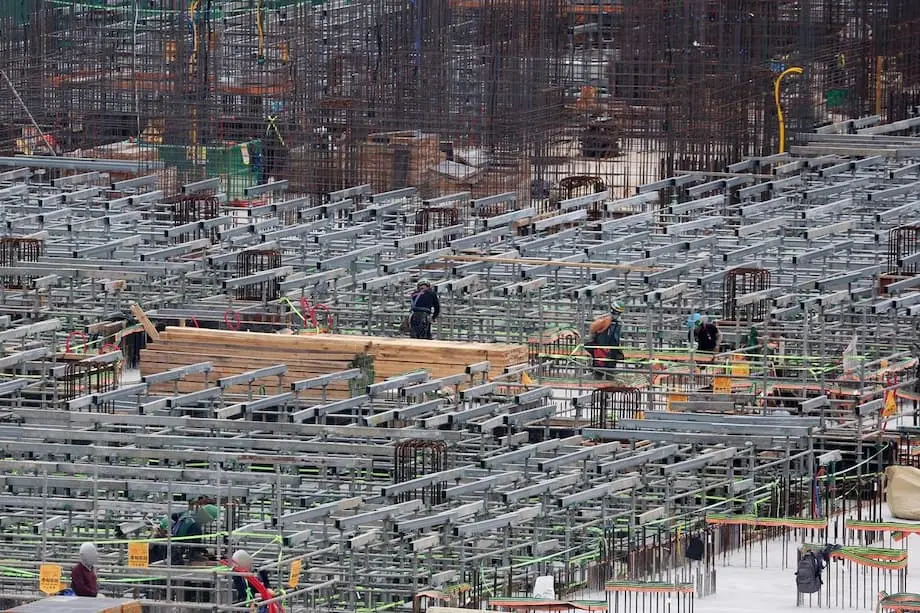
South Korea's construction difficulties have been developing for more than a year. Higher interest rates have made borrowing more expensive, while rising raw material prices have increased the cost of completing projects. The construction cost index climbed 29 percent between November 2020 and November 2024, reaching its highest level in decades.
Builders have faced pressure from both directions: projects cost more to finish, while financing has become harder to obtain. The ratio of nonperforming real estate financing loans more than doubled, signaling growing trouble with repayment and a credit squeeze for developers seeking money for new projects.
Major companies including Shindonga Construction and Daezer Construction have entered debt restructuring or court receivership. These processes involve reorganizing a company's debts or placing its affairs under court supervision as it deals with financial distress. Smaller regional builders have also struggled to stay in business.
In 2024, 2,666 construction companies closed, an increase of 13.6 percent from the previous year. Another measure of the financial strain was the 30 firms that filed for bankruptcy, the highest number since 2019. Closures and bankruptcy filings describe different events, but both show the pressure on the industry.
Orders Fall and Completed Homes Remain Unsold
Nationwide construction orders fell from 230 trillion won in 2022, equivalent to $159.7 billion, to 170 trillion won in 2024. That is a decline of 60 trillion won, or about 26 percent, leaving builders with a much smaller pipeline of work.
Construction output fell for seven consecutive months from late 2024, the longest such run since records began in 1997. Orders indicate work that companies expect to carry out, while output measures building activity taking place. Weakness in both helps explain why the downturn has continued.
Completed but unsold homes reached 18,600 units nationwide, reflecting weak demand and excess supply in some areas. Homes that remain unsold after construction leave developers waiting for revenue even though the expense of building them has already been incurred.
The sequence shows how the pressures accumulated:
- November 2020 to November 2024: The construction cost index rose 29 percent.
- 2022 to 2024: Annual construction orders dropped from 230 trillion won to 170 trillion won.
- 2024: A total of 2,666 construction companies closed and 30 filed for bankruptcy.
- From late 2024: Construction output declined for seven consecutive months.
- Early 2025: Construction employment fell to 2,011,000 workers.
- April to June 2025: Household spending improved, but retail sales remained below their earlier level.
- July 2025: Consumer sentiment reached 110.8, its highest level in nearly four years.
Workers Feel the Slowdown Directly
Construction employment fell to 2,011,000 in early 2025, down 157,000 from a year earlier and the lowest level since the height of the COVID-19 pandemic. In 2024, the sector lost an average of 49,000 jobs per month.
The damage comes as employment growth across the economy has slowed. Total employment increased by 159,000 workers, less than half the increase recorded in 2023. Gains were concentrated in health and social services rather than construction or manufacturing.
For households dependent on building work, the downturn means lost income at the same time that the government is trying to encourage spending. Employment conditions also remain fragile for young people and for workers in manufacturing, limiting how widely the improvement in consumption can spread.
Kang Sung-jin, a professor in Korea University's Department of Economics, described the relationship between construction and the wider economy:
The construction industry is highly sensitive to economic conditions, and the sector's downturn reflects how poorly the domestic economy is doing.
The Korea Institute for Industrial Economics & Trade (KIET) has linked weak construction investment to South Korea's low average economic growth rate of 2.2 percent between 2017 and 2023. The current slump therefore adds to a longer period of disappointing growth.
Why Construction Has Such a Large Economic Effect
Construction investment pays for buildings and infrastructure, while also supporting businesses that supply materials and services. When projects stop or shrink, the effects reach beyond developers and workers at building sites.
KIET estimates that an injection of 5 trillion won into construction could create 32,000 jobs in the sector and 22,000 in related industries, while increasing total output by 5.1 trillion won. The combined employment estimate is 54,000 jobs, illustrating how construction spending can reach other parts of the economy.
Credit remains tight and investor confidence is low, making a recovery difficult. Developers need financing to begin or continue projects, while lenders and investors face an industry already dealing with repayment problems, company failures and unsold homes.
The forecasts also show different assessments of the depth of the investment decline. The Bank of Korea projects construction investment will shrink by 1.3 percent in 2025, while KDI forecasts an 8.1 percent contraction, the worst since the Asian financial crisis in 1998. The finance ministry's reduced growth outlook likewise reflects a projected construction investment fall of more than 8 percent.
New orders are gradually improving, but a meaningful construction recovery is not expected until 2026. Orders need to turn into active projects before they can restore work and spending across the industry.
Household Spending Improves, but Unevenly
Household spending rose 0.5 percent in the second quarter of 2025 after a weak first half. Retail sales, which had declined for 13 consecutive quarters, narrowed their fall to 0.2 percent in April through June. Consumer sentiment then reached 110.8 in July, its highest reading in nearly four years.
Government recovery vouchers and supplementary budgets have supported demand. Supplementary budgets add spending beyond the government's original budget, allowing extra assistance during the year. Lower interest rates have also helped households manage debt and encouraged purchases.
Clothing, cosmetics and other goods used for a limited period have benefited from stronger spending. Sales of durable goods, including home appliances that households generally keep for years, have fallen. The recovery therefore differs across types of purchases.
Better consumer sentiment and higher household spending offer some support for businesses, but construction losses and weak employment continue to weigh on demand. Household debt is another concern, even as lower interest rates ease some of the repayment burden.
The improvement in shopping has consequently been too small to make up for the contraction in building activity and weakness elsewhere. A rise in one part of the economy can coexist with slow growth when other large sectors are losing ground.
Exports Face Tariffs and Slower Growth
Exports are expected to grow just 0.2 percent in 2025, compared with 8.1 percent in 2024. New U.S. tariffs on Korean goods and continuing global trade uncertainty have weakened prospects, particularly for autos and steel.
Semiconductors and shipbuilding show some strength, giving the export picture a mixed character. Their performance offers support, but the forecast for total exports points to a much smaller contribution from overseas demand than in the previous year.
The current account surplus is also forecast to narrow. The current account records trade in goods and services along with income flows between a country and the rest of the world. Concern centers on a "recessionary surplus," in which imports fall faster than exports because domestic demand is weak.
For an economy already struggling with construction, slower export growth leaves less room for overseas sales to compensate. Trade uncertainty also complicates decisions by companies considering investment while facing changes in access to foreign markets.
Growth Forecasts Show the Scale of the Slowdown
The Ministry of Economy and Finance's 0.9 percent forecast is its first projection below 1 percent since the COVID-19 pandemic. Its outlook is slightly more optimistic than the 0.8 percent projected by the Bank of Korea, KDI and the International Monetary Fund.
The OECD expects global growth of 2.9 percent in 2025, with the United States growing 1.6 percent and the eurozone 1 percent. South Korea's forecasts fall below all three, showing how weak its expected performance is even in a slowing international economy.
Inflation is expected to remain around 2 percent, although higher processed food prices continue to cause concern. Stable inflation can reduce one source of household pressure, but it does not replace income lost through unemployment or generate new construction projects.
The ministry's monthly Green Book report has cited continuing downward pressure for four consecutive months. It has highlighted persistent employment difficulties in construction and manufacturing, reinforcing the picture of a recovery that is uneven across industries.
Geopolitical risks, an escalating trade war driven by new U.S. tariffs and domestic political instability add further uncertainty. Together with the construction slump, these pressures explain why supplementary spending and stronger consumer sentiment have yet to produce a convincing recovery.
AI Investment Anchors the Government's Longer Term Plan
President Lee Jae Myung's government is seeking to raise growth through artificial intelligence and advanced technology. The finance ministry has announced projects covering AI, robotics, autonomous driving, smart factories and AI chips that operate directly on devices.
The initiatives form part of Lee's pledge to place South Korea among the world's top three AI powers and raise its potential growth rate to 3 percent. Potential growth means the pace an economy can sustain over time as its workforce, investment and productivity develop.
The government plans to drive AI transformation across 15 areas and strengthen the country's pool of AI talent. Support will also extend to private business efforts in advanced materials, green energy, biotechnology, content, beauty and food.
A planned National Growth Fund would have more than 100 trillion won in capital, financed equally by the state and private investors. It is intended to support investment in the industries selected to drive future growth.
Criticism has focused on the lack of concrete funding measures and on problems that technology investment alone cannot resolve. Population decline, divisions in the labor market and productivity gaps continue to limit growth potential. Some economists also question framing AI as a strategy for the entire economy, pointing to the need for policies that support highly educated workers and business investment.
Immediate Support and Infrastructure Remain Central
The government has pledged to mobilize available resources for job creation, financial support for households on low incomes and assistance to small businesses. It is also preparing support for companies affected by tariffs as part of its response to trade uncertainty.
Construction investment remains central to the immediate growth problem. KIET researcher Park Hoon called for faster progress on major infrastructure and housing projects:
To stimulate investment, the swifter advancement of major projects, such as the development of the 'third new town' or the completion of the Seoul-Sejong expressway, is needed.
Such projects are intended to restart building activity and create jobs. They address a more immediate need than the government's technology ambitions, which focus on the economy's capacity to grow over a longer period.
Most forecasts point to only a modest rebound in 2026, with growth recovering to around 1.6 to 1.8 percent. That would remain well below South Korea's historical average and would be insufficient to reverse the effects of years of stagnation.
The government's strategy depends on encouraging investment in both established sectors such as construction and emerging fields such as AI, while managing trade risks and demographic decline. An aging population, labor market rigidity and productivity gaps remain central challenges to sustained recovery. For workers and businesses facing lost building activity now, the expected improvement is likely to be slow and uneven.
Key Points
- The finance ministry forecasts growth of 0.9 percent in 2025; the Bank of Korea, KDI and the International Monetary Fund project 0.8 percent.
- Construction orders fell from 230 trillion won in 2022 to 170 trillion won in 2024, a decline of about 26 percent.
- In 2024, 2,666 construction companies closed and 30 filed for bankruptcy.
- Construction employment fell by 157,000 from a year earlier to 2,011,000 workers in early 2025.
- Household spending rose 0.5 percent in the second quarter, but the improvement has been too small to offset broader weakness.
- Exports are expected to grow 0.2 percent in 2025, down from 8.1 percent in 2024, amid tariffs and trade uncertainty.
- The government plans AI investment, a National Growth Fund exceeding 100 trillion won and immediate support for jobs, households and businesses.
- Most forecasts expect growth of around 1.6 to 1.8 percent in 2026, with a meaningful construction recovery also expected no earlier than next year.