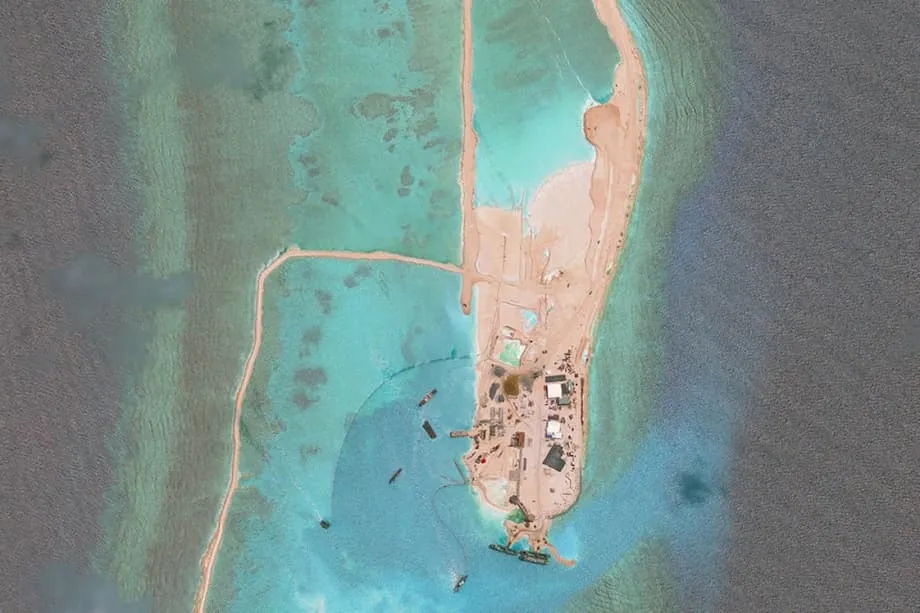
New Land, Harbors and a Second Runway Reshape Vietnam's Presence
Vietnam has extended land reclamation to all 21 of its occupied features in the Spratly Islands, turning a network of small outposts into artificial islands with harbors, storage facilities and stronger defenses. A new runway measuring 2,400 meters, about 8,000 feet, at Barque Canada Reef marks one of the most consequential changes in a construction campaign that accelerated sharply from 2024.
Contents
- New Land, Harbors and a Second Runway Reshape Vietnam's Presence
- How Quickly Has Vietnam Expanded?
- Small Fortifications Become Larger Bases
- Why Harbors Matter Alongside Airstrips
- A Dispersed Defense Against a Larger Rival
- Malaysia, the Philippines and China Respond
- What the 2016 Ruling Left Unresolved
- Coral Damage and a Possible Environmental Case
- Domestic Support Meets the Costs of Staying
- A Stronger Presence Raises the Stakes
- Key Points
Satellite imagery and think tank assessments available by August 25, 2025, describe an expansion that is narrowing the gap with China's much larger island construction program. Vietnam's total dredged and reclaimed land in the disputed South China Sea has reached approximately 3,319 acres, about 71 percent of China's total, according to the Asia Maritime Transparency Initiative (AMTI) at the Center for Strategic and International Studies (CSIS).
The figures also include a comparison specifically for the Spratlys: 2,236 acres of artificial land created by Vietnam against 3,500 acres created by China. With work spreading to previously untouched features, projections suggest Vietnam could eventually match or surpass China's reclamation total in that island group. China, however, retains larger and more heavily fortified bases.
For Vietnam, the immediate change is practical. More land provides space for buildings and defenses. More harbors allow vessels to stay closer to disputed waters for longer. A second airstrip gives Hanoi another location from which aircraft can operate, alongside its existing runway on Spratly Island.
The expansion also carries costs beyond construction. It is drawing objections from other governments, damaging coral reefs and adding permanent military infrastructure to waters where several countries contest ownership and access to oil, gas and fisheries.
How Quickly Has Vietnam Expanded?
Vietnam's current program has roots in a 2007 Communist Party resolution on maritime strategy. That strategy called for developing coastal areas, the country's exclusive economic zone and the 27 land features it occupies in the South China Sea. An exclusive economic zone, or EEZ, is an area where a coastal state has rights over marine resources. The strategy connected national security, economic development and sovereignty claims.
Reclamation began modestly in 2021 before gathering speed. AMTI's measurements put the land created between November 2023 and June 2024 at 692 acres. Another 641 acres followed over the next ten months. Together, those periods account for 1,333 acres of new land.
By early 2025, work had reached every one of Vietnam's 21 occupied Spratly features. New reclamation was underway at eight features that had previously been untouched by such work, including Alison Reef, Collins Reef, East Reef, Landsdowne Reef and Petley Reef.
The main stages of the expansion and the diplomatic responses span several years:
- 2007: A Communist Party maritime strategy set out development goals for coastal areas, the EEZ and 27 occupied features in the South China Sea.
- 2021: Vietnam began the recent phase of reclamation on a modest scale.
- 2023: Reports of Vietnamese militarization prompted protests in Manila.
- November 2023 to June 2024: Vietnam created 692 acres of new land.
- October 2024: Malaysia protested development of the Barque Canada Reef airstrip.
- Late 2024: Vietnam completed the new runway at Barque Canada Reef.
- February 2025: China issued a rare protest over the airstrip.
- The ten months after June 2024: Vietnam added another 641 acres.
Small Fortifications Become Larger Bases
Most Vietnamese positions in the Spratlys looked very different just four years before the latest assessments. They consisted largely of isolated concrete pillboxes, small fortified structures with little living space and limited defensive capacity. Artificial land now surrounds or extends these positions, creating room for a more permanent presence.
Satellite imagery shows recurring building arrangements across the expanded reefs. Each newly expanded reef has a group of six buildings arranged around a central courtyard. Most islands have two such clusters, positioned at opposite ends.
Barque Canada Reef, the largest and most developed Vietnamese feature, contains several groups of these buildings and three munitions depots. Its combination of land, storage and aviation infrastructure points to a central role in supplying and defending Vietnam's wider network.
Administrative buildings, munitions storage containers and other facilities are appearing alongside the new land. These changes turn places once suited mainly to maintaining a small garrison into positions capable of supporting more personnel, equipment and sustained activity.
Why Harbors Matter Alongside Airstrips
Eight of the ten most recently expanded features now have newly dredged harbors. The upgrades have tripled the number of Vietnamese outposts with port facilities since 2021, making maritime access one of the clearest changes in the construction program.
Vietnam's navy, coast guard and maritime militia can use the expanded harbor network to operate in greater numbers and remain in the area longer. Ships that have somewhere nearby to shelter and receive supplies can spend more time around disputed features. China has enjoyed comparable advantages in maintaining patrols throughout the year since completing its artificial islands.
Barque Canada Reef's runway adds an aviation component to that maritime network. Completed in late 2024, it measures 2,400 meters and joins the country's sole previously existing airstrip in the Spratlys, on Spratly Island.
Foundations for airstrips have also been visible in some locations, prompting speculation about further runways. Yet the placement of new buildings and storage depots on other features appears to leave insufficient room for full length airstrips for now. The infrastructure taking shape therefore points to a network with different functions, rather than an identical air base on every reef.
A Dispersed Defense Against a Larger Rival
Vietnam's construction is intended to strengthen its ability to defend its claims, deter Chinese aggression and protect economic interests. Larger outposts provide more space for defensive equipment and make a permanent presence easier to sustain.
China's three principal artificial island bases, often called its Big Three, have long runways and extensive military installations. Vietnam's approach appears to place greater weight on smaller positions that can support one another across the Spratlys.
The military idea behind that approach is area denial: making it harder for an opposing force to enter or operate in a particular area. Dispersing defenses across several outposts could complicate an attack or slow an adversary's movements, rather than concentrating every capability at one base.
New munitions containers and depots are already part of the visible construction. Possible future additions include artillery designed to attack ships, rocket systems, coastal defenses, and more advanced radar and sensing equipment. These remain expected upgrades rather than a completed list of deployed weapons.
Vietnam's navy and coast guard are still much smaller and less modern than China's, limiting Hanoi's ability to match Beijing ship for ship. Vietnam may consequently depend more heavily on its maritime militia, civilian vessels operating in coordination with the military, to maintain a visible presence and respond to Chinese incursions.
Malaysia, the Philippines and China Respond
Malaysia delivered a rare diplomatic protest in October 2024 over the airstrip being developed at Barque Canada Reef. Malaysia also claims parts of the Spratlys, making Vietnam's construction a concern among Southeast Asian neighbors as well as a point of contention with China.
The Philippines has been monitoring the expansion closely, concerned about changes to the existing balance and the possibility of a regional arms race. Reports of Vietnamese militarization had already prompted protests in Manila in 2023.
China publicly denounced Vietnam's construction and, in February 2025, issued a rare protest over the Barque Canada airstrip. Beijing accused Hanoi of building on territory it described as:
illegally occupied
Beijing's objection accompanied its continued assertion of sweeping claims to nearly the entire South China Sea. Its response to Vietnam has nevertheless been relatively muted compared with its aggressive actions against the Philippines. Possible explanations include a wish to avoid simultaneous confrontations with several claimants and an interest in preserving political ties with Hanoi.
Brunei and Indonesia have remained largely silent. The Association of Southeast Asian Nations (ASEAN) has continued to call for restraint and maintenance of the status quo. The United States and its allies have not taken a public position on Vietnam's expansion, although Washington previously advocated a freeze on all construction in the disputed waters.
What the 2016 Ruling Left Unresolved
The 2016 arbitration ruling in The Hague rejected the legal basis for China's expansive nine-dash line claims in the South China Sea. The line is the boundary marking Beijing uses to express its sweeping claims across the waters.
The tribunal did not decide sovereignty over individual features. Ownership of the reefs and islands therefore remains contested, even after the ruling addressed China's broader maritime claims.
Vietnam says its control of its Spratly positions predates China's reclamation campaign. Hanoi presents its activities as defensive work confined to outposts it has held for a long time, rather than an effort to establish a presence at newly occupied locations.
Critics argue that artificial expansion by any claimant makes the disputes harder to manage. Permanent infrastructure gives governments more assets to protect and can make compromises politically more difficult. Construction also complicates efforts by ASEAN and China to negotiate a binding Code of Conduct, an agreed set of rules for managing behavior in the disputed waters.
Vietnam's argument about longstanding occupation and the unresolved question of sovereignty sit at the center of the legal dispute. Its expanding physical presence strengthens its ability to remain on the features while diplomatic negotiations continue.
Coral Damage and a Possible Environmental Case
China and Vietnam have both used extensive dredging and landfill to create artificial islands. Dredging removes material from the seabed, while landfill places material where new land is being built. These operations have caused substantial damage to fragile coral reefs and marine ecosystems.
Coral reefs support marine life, so destruction of their habitat can affect biodiversity and fisheries. For countries that view the South China Sea as an economic resource as well as a security concern, damage to the marine environment adds another cost to the territorial competition.
The Philippines is considering a new legal case against China over environmental harm. Vietnam's similar construction activities could make Manila's position more complicated. A case directed only at China could give Beijing grounds to accuse the Philippines of applying double standards, potentially weakening international support for the action.
No filing date for that possible case is given. The issue connects two pressures already visible across the Spratlys: governments want stronger positions in disputed waters, while the methods used to build those positions damage the natural systems surrounding them.
Domestic Support Meets the Costs of Staying
Vietnam's island construction enjoys broad domestic support. Images of new land and infrastructure circulate widely in Vietnamese media and on social platforms, where they are celebrated as signs of national strength and sovereignty.
The government presents the work as a defensive necessity and a contribution to economic development, consistent with its maritime strategy. The same project can therefore carry several meanings at home: protecting territory, supporting activity at sea and demonstrating the state's resolve.
Questions about military effectiveness and sustainability remain part of the debate. Artificial islands are vulnerable to modern missiles, while saltwater corrosion creates continuing maintenance demands. Climate change, particularly rising sea levels, adds pressure on land built only recently above the water.
China and Vietnam may both need to reinforce their islands continually and raise their height. That would mean further expense and potentially more environmental damage. Completing reclamation is consequently one stage of a longer commitment to maintaining the bases.
A Stronger Presence Raises the Stakes
Vietnam's expansion changes what Hanoi can do in the Spratlys. A larger network of harbors, supply facilities and defensive positions gives it more ways to sustain its presence and respond to pressure from China or regional rivals.
China's islands remain larger and more heavily fortified, but Vietnam's dispersed outposts could complicate an attempt to impose control by force. Both governments also face pressure to avoid appearing weak when their claims are challenged, adding political weight to decisions made at sea.
Other claimants may consider upgrading their own positions or seeking diplomatic arrangements to manage the new balance. For the United States and its allies, a more militarily capable Vietnam could provide a counterbalance to China, while additional military infrastructure increases what is at stake in a confrontation.
As of August 25, 2025, Vietnam's construction campaign has already changed the physical map of its occupied Spratly features. How those positions are equipped and used, and how other claimants respond, will shape whether the stronger Vietnamese presence deters confrontation or contributes to another phase of competition.
Key Points
- Vietnam has extended reclamation to all 21 of its occupied Spratly features.
- Its total dredged and reclaimed land in the disputed South China Sea is approximately 3,319 acres, about 71 percent of China's total.
- The Spratly comparison puts Vietnam at 2,236 acres of artificial land against China's 3,500 acres, with further Vietnamese expansion underway.
- New harbors have tripled the number of Vietnamese outposts with port facilities since 2021.
- A 2,400 meter runway at Barque Canada Reef was completed in late 2024.
- Malaysia and China protested the airstrip, while the Philippines is monitoring Vietnam's expansion.
- The campaign strengthens Vietnam's presence but adds diplomatic tensions, coral damage and continuing maintenance costs.