A radio call that went unanswered off Ilocos Norte
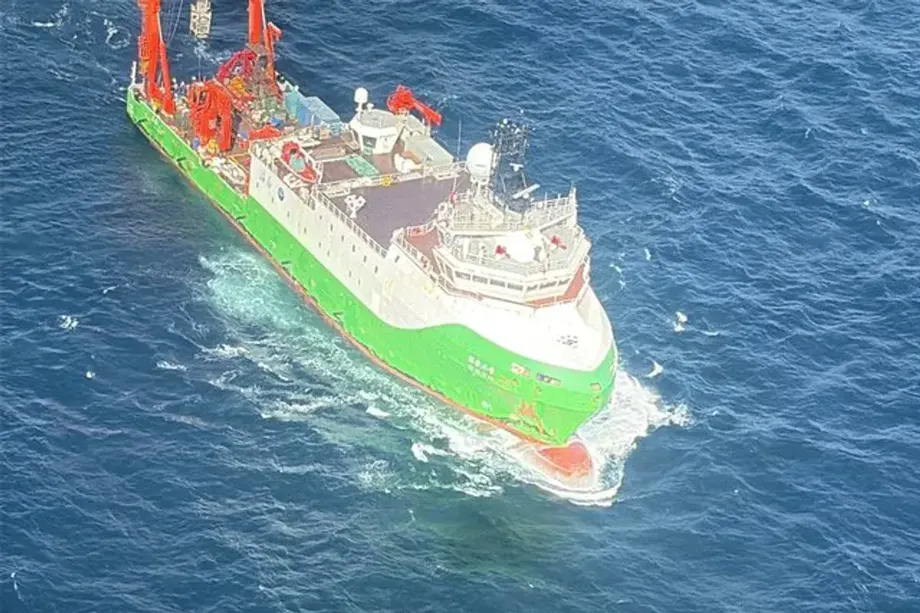
A Philippine Coast Guard aircraft flew out over the South China Sea on Saturday, November 28, and found a white hull about 49 nautical miles northwest of Burgos town in Ilocos Norte, on the northern coast of Luzon. The crew radioed the ship several times. No reply came back. The ship was 90.7 kilometres from the coast, inside the belt of water where Manila says only it can authorise scientific work.
Contents
- A radio call that went unanswered off Ilocos Norte
- A floating laboratory with room for 60 people
- Why a map of the sea floor worries Manila
- Beijing says the work is lawful and open to others
- Warships and aircraft at Scarborough Shoal
- A radar deal with Japan draws a Chinese rebuke
- An unfinished rulebook and a crowded summit calendar
- What to Know
The vessel was Tan Suo Er Hao, Chinese for Exploration No. 2, a deep sea research ship operated by the Chinese Academy of Sciences. The coast guard says it entered the Philippine exclusive economic zone on November 26 after leaving the port of Sanya on the southern Chinese island of Hainan, and that it was still inside that zone when Rear Admiral Jay Tarriela, the coast guard's spokesperson for the West Philippine Sea, described the encounter in a post on X on Sunday, November 29.
An exclusive economic zone, or EEZ, is the band of sea running up to 200 nautical miles from a coastline, where a coastal state holds the rights to fish, minerals and other resources while foreign ships keep the right of passage. A nautical mile is 1.852 kilometres, which puts the ship roughly 90 kilometres off a province that is home to President Ferdinand Marcos Jr. The West Philippine Sea is the name Manila uses for the part of the South China Sea inside that zone.
Tarriela said the flight was ordered by coast guard commandant Admiral Rommel Supangan, that the aircraft issued several radio challenges, and that a coast guard vessel had also been sent to confront the ship. The coast guard's case turns on a single administrative fact. The Department of Foreign Affairs confirmed it had received no application for marine scientific research covering Tan Suo Er Hao.
Tarriela described the ship's track as evidence of what it was doing, saying it had been moving at very slow speed back and forth west of Ilocos Norte, a pattern he called consistent with survey work rather than with a vessel in transit. He set out the consequence plainly.
Any survey undertaken by TAN SUO ER HAO without such consent is illegal. A PCG vessel has also been deployed to directly challenge the ship while it remains within the Philippines' EEZ.
Speaking in Filipino, he added that the Philippines "has the only authority to conduct such research" and that China has no authority to carry out marine scientific research in Philippine waters.
The legal ground Manila cites is the United Nations Convention on the Law of the Sea, the 1982 treaty that defines maritime zones and the rights states hold inside them, together with the Philippine Maritime Zones Act, a law Manila passed in 2024 that requires foreign governments to obtain Philippine consent before research inside the country's EEZ. China is a party to the convention and rejects the Philippine reading of how it applies in these waters.
A floating laboratory with room for 60 people
Tan Suo Er Hao is 87.25 metres long and belongs to the Chinese Academy of Sciences, the government's main civilian research body. It acts as a mothership for manned and unmanned submersibles, the small craft lowered into deep water to film, sample and map the sea floor, and it can stay at sea for about 60 days before returning to port. Its 13 laboratories include rooms for biology, geology, chemistry and geophysics, an acoustic control room and a data processing centre. It sails with 25 crew members and 35 researchers.
The ship is not a newcomer to these waters. The coast guard says it has tracked the same vessel on three earlier occasions: off Ilocos Norte in May 2025, off Cagayan in December 2025, and near the Philippine Rise and Batanes in April 2026.
- November 26, 2026: Tan Suo Er Hao enters the Philippine EEZ after leaving Sanya, Hainan.
- November 28: a coast guard aircraft locates the ship 49 nautical miles northwest of Burgos and radios it without reply.
- November 29: the coast guard goes public and says a patrol vessel has been sent to confront the ship.
- November 29: the Chinese People's Liberation Army's Southern Theater Command announces air and sea patrols around Scarborough Shoal.
Why a map of the sea floor worries Manila
The coast guard's objection reaches past fishing grounds. Tarriela said deep sea surveys matter because they can "map the seabed where critical infrastructure and undersea cables lie", and that this should concern other countries as much as the Philippines. Undersea cables are the fibre optic lines that carry most international internet traffic and payment messages between continents, and their routes are charted with the kind of sonar and seabed mapping a ship like this one carries. Tarriela said the research could also have military applications.
He put the practical fear in Filipino: "That will be our disadvantage kung malalaman nila ito nang hindi nila ipinapaalam sa atin", meaning the Philippines would be at a disadvantage if such information about its waters were gathered without its knowledge.
Tarriela tied the episode to a wider argument about how Beijing justifies its presence. He said that each time the Philippines publicises what it calls a Chinese violation of the convention, the Chinese embassy or the Chinese foreign ministry issues a statement asserting jurisdiction over the same waters. China's position rests in part on a line drawn around most of the South China Sea, known as the nine-dash line, which a 2016 arbitral tribunal found had no basis in the convention. Beijing rejects that ruling and says its rights in the sea are longstanding.
Beijing says the work is lawful and open to others
The Chinese embassy in Manila did not respond to a request for comment on Sunday. Its answer to earlier Philippine complaints is set out in a statement issued on October 11, in which it rejected Manila's objections to Chinese research in the sea and described the coast guard's interference with a working vessel.
The Philippine Coast Guard, invoking its unilateral claims, interfered with the Chinese research vessel that was engaged in normal operations, infringing upon China's sovereign rights and jurisdiction in the relevant waters and violating international law and the norms governing international relations.
The embassy said the expeditions are legitimate and aboveboard, that some are open to scientists from other countries, and that their findings serve marine research, ecological conservation and disaster prevention, benefits it said the Philippines has also drawn on. It accused Tarriela of ignoring those facts and of falling into a "persecution delusion" by sensationalising what it called China's normal scientific work.
Chen Xidi, an expert at the China Institute for Marine Affairs, which sits under China's Ministry of Natural Resources, said Chinese research in waters under Chinese jurisdiction follows international law and Chinese domestic law. He described the Philippine complaints as part of a run of maritime interference and provocation intended to lend legitimacy to Manila's claims, and said the research programme would not be interrupted.
Warships and aircraft at Scarborough Shoal
On November 29, the day the coast guard made its case public, the PLA's Southern Theater Command announced air and sea combat readiness patrols around Scarborough Shoal, the reef Beijing calls Huangyan Dao and Manila calls Bajo de Masinloc. The command issued a similar announcement in late October, when its forces carried out combat readiness patrols around the shoal after Philippine authorities examined a Chinese vessel carrying unidentified equipment inside the reef's lagoon.
The shoal sits about 124 nautical miles west of Zambales province, inside the Philippine EEZ, and both countries claim it. Combat readiness patrols are military movements conducted at a level of readiness for action rather than as routine training, and announcing them is part of the signal. A research ship tracked by a coast guard aircraft and a naval patrol announced around a disputed reef are two instruments in the same argument over who may operate where.
A radar deal with Japan draws a Chinese rebuke
The maritime dispute is running alongside a defence argument. On November 26, Senior Colonel Chen Xi, a spokesperson for China's Ministry of National Defense, criticised Japan for supplying military equipment to the Philippines, including coastal surveillance radars and surveillance drones to be delivered under Tokyo's Official Security Assistance programme, a Japanese scheme that provides equipment and training to partner militaries. He accused Japan of meddling in the South China Sea and of stoking tension in the region.
Manila answered three days later. Defence spokesperson Arsenio Andolong said the Philippines, as a sovereign state, has the sole authority to choose its partners and to decide how to strengthen its defences.
This is not open to compromise of any form.
Marcos has used similar language about the sea itself, saying he "will not preside over any process that will abandon even a square inch of Philippine territory to any foreign power." Tarriela said the coast guard's flights and patrols follow that instruction.
An unfinished rulebook and a crowded summit calendar
The confrontation surfaced as Southeast Asian leaders met in Manila for the 49th ASEAN Summit, with maritime disputes and negotiations on a South China Sea code of conduct on the agenda. Those negotiations ended without a signed code, even as the bloc's own maritime outlook warned that serious incidents at sea were putting people at risk and damaging the marine environment.
Official counts of progress describe paragraphs, not the whole text. The Department of Foreign Affairs said on November 15 that about 80 percent of the draft had provisional agreement, and Marcos said two days later that negotiations were 85 to 90 percent complete, with much of the remaining work on definitions. Talks have been held monthly since November 2025 and are set to continue under Singapore's chairmanship in 2027.
Relations between Manila and Beijing have slid since Marcos took office in 2022, away from the conciliatory approach of his predecessor, Rodrigo Duterte. Manila has accused Chinese vessels of ramming Philippine boats, obstructing resupply runs to troops on Second Thomas Shoal and firing water cannon at personnel, and of directing fire control radar at a Philippine ship and firing flares at an aircraft. Beijing rejects that account and casts the Philippines as the party courting outside powers and raising tension.
The questions the latest episode leaves open are concrete. No deadline has been set for the code talks to conclude. The coast guard did not say how close its patrol vessel came to Tan Suo Er Hao, and China had not responded publicly to the new complaint as of November 29. The ship, as of that day, had not left the zone.
What to Know
- Tan Suo Er Hao, a Chinese Academy of Sciences research ship, was found on November 28 about 49 nautical miles (90.7 kilometres) northwest of Burgos, Ilocos Norte, inside the Philippine EEZ.
- The ship entered the zone on November 26 after leaving Sanya, Hainan, and ignored several radio challenges from a coast guard aircraft.
- The Department of Foreign Affairs confirmed no application for marine scientific research was filed for the vessel.
- The coast guard says the work breaches the UN Convention on the Law of the Sea and the Philippine Maritime Zones Act, both of which require Philippine consent.
- Rear Admiral Jay Tarriela said the surveys could map the seabed where undersea cables and critical infrastructure lie.
- The PLA Southern Theater Command announced air and sea combat readiness patrols around Scarborough Shoal on November 29.
- China's embassy in Manila has called Chinese research legitimate and accused the coast guard of interfering with normal operations.
- The same ship was previously tracked off Ilocos Norte in May 2025, off Cagayan in December 2025 and near the Philippine Rise and Batanes in April 2026.