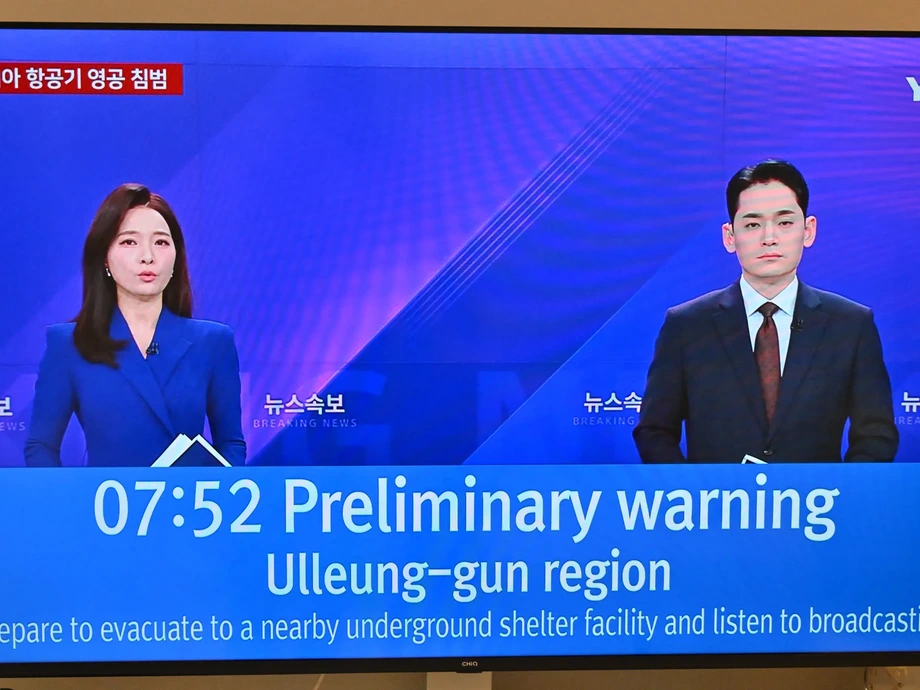
An alert lasting three minutes on Ulleungdo
At 7:52 a.m. on Nov. 24, 2026, residents of Ulleungdo received an emergency message telling them to take shelter. The English portion read: EVACUATION, AIR RAID. Television broadcasts interrupted programmes with instructions to prepare to move to an underground shelter. The Interior Ministry lifted the warning at 7:55 a.m., three minutes after it was issued, but the confusion lasted much longer.
Contents
- An alert lasting three minutes on Ulleungdo
- What Russia says its aircraft were doing
- North Korea's shipbuilding drive goes beyond two destroyers
- The costs and limits of a larger navy
- Why the Tumen River matters to China
- How close is a naval exercise involving all three countries?
- The sequence behind the current tensions
- What Seoul is being urged to do now
- The Bottom Line
South Korea's Joint Chiefs of Staff said about five Russian military aircraft had entered the Korea Air Defence Identification Zone, known as KADIZ, and approached the airspace above the island. South Korean fighters were scrambled and conducted tactical manoeuvres. The Russian aircraft turned away without entering territorial airspace, the military said.
Jang Do-young, a spokesperson for the Joint Chiefs of Staff, explained why the military issued a shelter warning before any territorial violation had occurred.
Airspace intrusion was anticipated. Therefore, to protect the safety of our people, we issued a warning pre-emptively.
Ulleungdo has about 8,700 residents and lies 120 kilometres off South Korea's east coast. North Gyeongsang province added to the alarm by sending a second message about an object presumed to be a North Korean aircraft. Officials later said staff had reused wording from a routine drill and confirmed that no North Korean aircraft was involved.
Jeong Hae-seung, a 41-year-old construction worker, ran outside when the message arrived but could not understand the civil defence broadcast. Another resident, Baek Un-bae, said an elderly neighbour telephoned to ask whether war had begun. Some people heard no sirens because their windows were shut against cold, strong winds. The island experienced a similar fright in 2022, when North Korea fired more than 20 missiles and one heading toward Ulleungdo triggered sirens and evacuations.
What Russia says its aircraft were doing
Russia's Defence Ministry described the Nov. 24 operation as a planned flight over international waters in the East Sea, also known as the Sea of Japan. It said a Tu-160 strategic bomber, escorted by Su-35S and Su-30SM fighters, flew for about 10 hours and strictly followed international airspace rules. Moscow also said foreign fighters shadowed its aircraft during parts of the mission.
The Tu-160 is the world's largest supersonic strategic bomber. It can carry nuclear weapons, fly more than 12,000 kilometres without refuelling in flight, and has launched conventional cruise missiles during Russia's war against Ukraine. The aircraft involved in the East Sea operation was assessed to have departed from Ukrainka air base in Russia's Amur Oblast. Video released by Russia also appeared to show a Su-57 stealth fighter, although South Korea's military believes that aircraft did not enter KADIZ.
The flight was the third Russian entry into KADIZ in eight days, following sorties on Nov. 17 and Nov. 19. The Nov. 17 aircraft travelled through the South Korean and Japanese identification zones toward Vietnam and back, breaching Japanese airspace during the journey. One explanation for the Ulleungdo flight is that crews unfamiliar with the region could have wandered off course. The repeated entries and the bomber's unusual appearance have also produced assessments that Russia was practising routes and signalling its reach to United States forces in South Korea and Japan.
An identification zone is different from sovereign airspace. Countries use it to identify approaching military aircraft early, before they reach national territory. Entering without filing a flight plan may violate a country's expected practice, but it does not by itself constitute a violation of international law. Russia rejects Seoul's authority over KADIZ and says the zone imposes no legal obligations on foreign aircraft.
China accounts for the larger share of such flights. Parliamentary data covering the five years to 2024 recorded about 60 Russian entries without prior notification, compared with about 430 by Chinese aircraft, roughly seven times as many. South Korea nevertheless treats close approaches as an operational danger because fast military aircraft leave controllers little time to respond.
Kim Hak-jo, director general for international policy at South Korea's Defence Ministry, summoned Russian defence attaché Colonel Nikolai Marchenko on Nov. 24 to protest and demand measures against a recurrence. The Foreign Ministry conveyed regret through the Russian embassy but had not summoned Russia's ambassador by Nov. 26. In Moscow, South Korean Ambassador Lee Seok-bae sought talks with Deputy Foreign Minister Andrei Rudenko. Russia maintained that its flight was lawful.
North Korea's shipbuilding drive goes beyond two destroyers
The air incident coincides with an unusually visible expansion of North Korea's navy. Pyongyang commissioned two destroyers of 5,000 tons in 2026. Choe Hyon entered service in June and was assigned to the West Sea, while Kang Kon entered service in September and joined the East Sea Fleet. During a visit to the Nampo shipyard on Nov. 2, Kim Jong Un inspected part of the hull of another large warship, subsequently estimated at about 10,000 tons.
North Korea has also displayed construction work on a submarine of 8,700 tons powered by a nuclear reactor, tested new torpedoes in October and November, and revealed work on a new naval base on its east coast. Kim visited that base himself. The facilities are intended to support ships much larger than the small, ageing vessels that traditionally confined much of North Korea's navy to coastal defence and infiltration missions.
Kim Jong Un, North Korea's head of state, described the naval programme in September as an active plan rather than a distant ambition.
We are now implementing an important plan to strengthen our naval forces.
A base is central to that plan. Large combat ships require maintenance, fuel, ammunition, supplies, trained crews and reliable command systems before they can sustain operations far from shore. Construction at east coast ports and shipyards suggests that Pyongyang is trying to provide that support while also pursuing naval nuclear weapons and new missiles launched from the sea.
Bruce Bennett, a former senior researcher at the RAND Corporation, said mobile warships could give North Korea additional ways to deliver nuclear weapons and make its arsenal harder to target.
North Korea is diversifying its means for delivering nuclear weapons. Its destroyers are designed to carry nuclear weapons, and they will likely do so as part of this diversification process.
Bennett said the resulting number and variety of possible targets could complicate any American attempt to disarm North Korea through an attack. A missile launched from a moving ship or submarine also gives defenders less certainty about its direction and launch location than a missile associated with a known site on land.
The costs and limits of a larger navy
A senior officer in Japan's Maritime Self-Defence Force, speaking anonymously, assessed that North Korea probably drew on foreign technology for the destroyers. He compared their hulls with China's Type 052D destroyers and their radar systems with equipment used on Russia's Admiral Gorshkov class frigates. He also cautioned that large surface ships remain vulnerable to aircraft and submarines unless several protective systems operate together.
North Korea tested an airborne early warning aircraft in March 2025, but South Korea's Joint Chiefs of Staff assessed at the time that its operational threat remained limited. Such aircraft extend surveillance beyond a ship's own radar and help direct fighters. Patrol aircraft such as the P-3C and P-8 perform another task, searching for submarines over wide areas. The Japanese officer said North Korean destroyers would struggle to defend themselves without that support.
The East Sea presents additional difficulties because its currents and distribution of salinity complicate submarine detection. Satellites and reconnaissance drones flying at high altitude can also locate surface vessels, including ships whose shapes are intended to reduce radar visibility. For the submarine powered by a nuclear reactor, reactor safety, reliability and the ability to remain underwater for extended operations still have to be demonstrated.
Money imposes another constraint. Japan Self-Defence Forces officials estimate that building even one destroyer of 5,000 tons would cost at least 50 billion yen (about US$314.2 million), despite North Korea's relatively low labour costs. That is roughly equivalent to North Korea's total exports in 2024, before maintenance, weapons, training and other operating expenses are counted. International sanctions continue to restrict access to markets and technology.
The bill would fall on an economy whose recovery rests on external support. China accounted for 98% of North Korea's official trade in 2024, while weapons production for Russia and trade with China were identified as major sources of recent growth. Those relationships can supply money, fuel and equipment, but they also make an ambitious naval programme dependent on partners with their own priorities.
Why the Tumen River matters to China
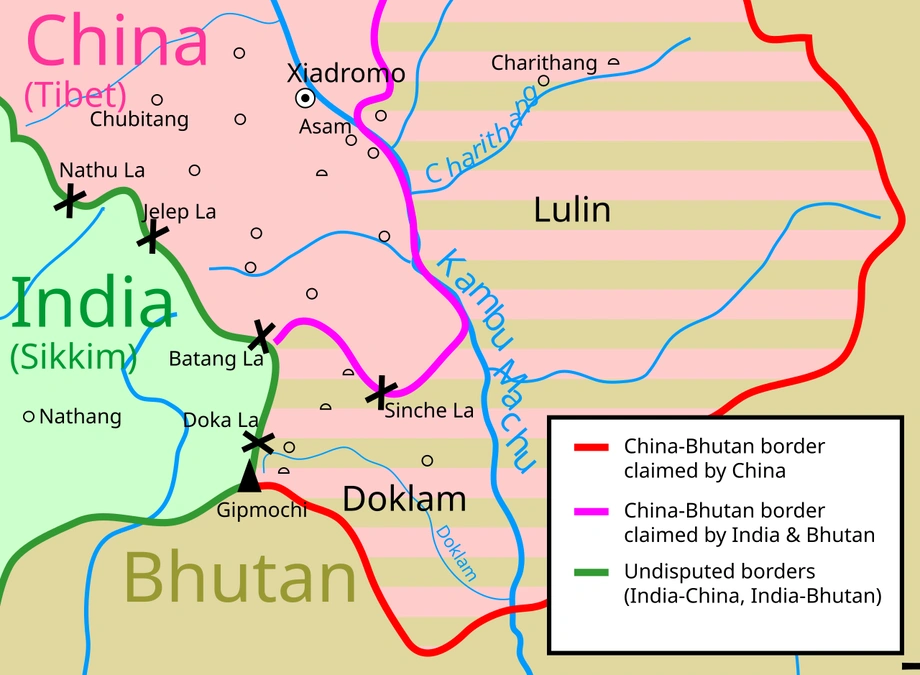
China's interest in the East Sea has a geographical obstacle. Its territory ends at Fangchuan, near Hunchun in Jilin province, before the Tumen River reaches the coast. The river's downstream sections run along the borders of North Korea and Russia, leaving China without a direct coastline there. Beijing obtained navigation rights through a 1991 border agreement with the Soviet Union, but shallow water and bridges have prevented those rights from becoming a practical route to the sea.
At a summit in May, the Chinese and Russian leaders agreed to continue consultations with North Korea about Chinese access to the sea through the Tumen. A Russian government decree signed by Prime Minister Mikhail Mishustin on Sept. 26 provides a more concrete picture of the proposed work. It calls for a joint ecological and navigational survey with North Korea and China to begin in the July following the decree.
The planned survey would measure the river's depth and width, examine underwater terrain and assess whether vessels could navigate it. Researchers would also evaluate pollution and environmental conditions. Work would start at Fangchuan and continue along the border sections toward the estuary. The decree proposes that the Chinese and North Korean embassies in Russia review the plan and help secure approval from their governments.
Specialists examining a possible canal consider one route especially plausible: a channel running from Fangchuan into North Korean territory and connecting Seobeonpo with Dongbeonpo. No construction date has been announced, and the survey proposal does not itself show final approval by Beijing and Pyongyang. The immediate question is whether the river can be investigated and used, not when a finished canal will open.
Mike Bosak, a former deputy secretary of the United Nations Command Military Armistice Commission, described expanded passage as a joint Chinese and Russian concept that requires North Korean consent. He predicted that Pyongyang could accept the initiative in exchange for Chinese concessions on other issues. Peter Ward, a researcher at the Sejong Institute, offered a more cautious assessment: neither Russia nor North Korea is enthusiastic about Chinese access to the East Sea, but neither wants to reject Beijing directly.
How close is a naval exercise involving all three countries?
Russia and China already possess parts of the foundation for wider activity. An academic research review records three large exercises by Russia's Pacific Fleet in the East Sea during 2026. In June, Chinese and Russian bombers and fighters also entered KADIZ without prior notification. Chinese and Russian forces have conducted joint maritime training, and a Chinese submarine has visited Russia's base at Vladivostok.
North Korea remains the missing participant. Kim Min-gyu, a research fellow at the Korean Association for Intelligence Studies, said North Korea had never conducted joint military exercises with either China or Russia, even though Beijing and Moscow have continued to train together. He assessed that the recent Russian flights appeared to practise routes that could be used to support North Korea during a conflict. Familiarity with routes, turns and South Korean responses would be valuable before any contingency.
Jeon Gyeong-ju, a research fellow at the Asan Institute for Policy Studies, expects a gradual beginning rather than an immediate fleet exercise involving all three navies.
The most realistic form would probably be North Korea participating as an observer in the exercises held by China and Russia.
Jeon said observer status would allow North Korean personnel to accumulate experience needed for naval expansion. It would also let North Korea, China and Russia send a message of deterrence to South Korea, the United States and Japan. A fuller exercise would become more plausible if North Korea's new ships demonstrate that they can operate far from shore, communicate with foreign forces and sustain themselves at sea. No exercise involving all three countries has been announced.
The political relationship is still developing alongside the military activity. On Nov. 19, Donald Trump, Xi Jinping and Vladimir Putin discussed Korea in Shenzhen, but their public declaration did not name North Korea or establish a common position on its nuclear weapons. Naval coordination, economic bargaining over the Tumen and nuclear diplomacy therefore remain connected but distinct processes.
The sequence behind the current tensions
Several dated episodes show how Russian flights and North Korean naval expansion have moved onto parallel tracks. They also show why South Korea distinguishes an identification zone entry from the more serious violation of territorial airspace.
- 2019: A Russian A-50 early warning aircraft flying during a joint patrol with Russian and Chinese bombers violated the airspace around Dokdo twice. South Korean fighters fired warning shots, while Moscow denied the violation.
- March 2025: Seoul summoned Russia's defence attaché after eight Russian entries into KADIZ in 10 days. North Korea tested an airborne early warning aircraft during the same month.
- June 2026: Choe Hyon entered service, giving North Korea its first of two new destroyers of 5,000 tons commissioned during the year.
- September 2026: Kang Kon entered service and was assigned to the East Sea Fleet, placing the second destroyer on the coast facing Russia and Japan.
- Nov. 17, 19 and 24, 2026: Russian aircraft entered KADIZ three times, with the final approach producing the Ulleungdo shelter warning.
- The July following the Tumen decree: The proposed Russian, Chinese and North Korean survey is scheduled to begin, subject to the necessary approvals.
Diplomacy has continued between these episodes. Days before the Ulleungdo alert, South Korean President Lee Jae Myung and Russian President Vladimir Putin held a meeting lasting 10 minutes on the sidelines of the Asia-Pacific Economic Cooperation summit. They agreed to pursue cooperation where possible and work toward easing tensions on the Korean Peninsula.
What Seoul is being urged to do now
Yoo Ji-hoon, a research fellow at the Korea Institute for Defense Analyses, argues that South Korea should respond across the entire naval system rather than concentrate on the size of North Korea's hulls. His recommendations include stronger maritime surveillance in both the East Sea and West Sea, better underwater detection, improved submarine warfare capabilities, missile defence at sea and more precise strike capacity. He also calls for sustained investment in personnel, training and maintenance.
Cler cooperation with the United States forms another part of that response. Shared information and more effective joint operations against submarines would help South Korea track moving launch platforms and reduce the burden on either country operating alone. Yoo says future capabilities, including a South Korean submarine powered by a nuclear reactor, should be judged by operational requirements and their contribution to the alliance.
Du Jin-ho, a visiting research fellow at Kyungnam University's Institute for Far Eastern Studies, identifies a separate requirement: preventing an accident. South Korea and Russia agreed in 2021 to create a military hotline, but activation was delayed after Russia invaded Ukraine. Du says the Ulleungdo incident provides a reason to resume talks between military officials and gradually restore diplomatic and defence channels. Such communication would give both sides a practical means of clarifying routes and intentions before an aircraft or ship approaches territory.
The Bottom Line
- A Russian Tu-160 mission on Nov. 24, 2026 brought military aircraft close to Ulleungdo's territorial airspace and triggered a shelter alert lasting three minutes.
- No territorial airspace violation occurred, but it was Russia's third KADIZ entry in eight days.
- North Korea commissioned Choe Hyon and Kang Kon in 2026 and is pursuing larger surface ships, a submarine powered by a nuclear reactor and expanded naval bases.
- A Russian decree proposes a joint Tumen River survey, while China still needs North Korean cooperation for a practical route to the East Sea.
- China and Russia already exercise together; North Korean observer participation is considered a more realistic first step than an immediate three-country naval drill.
- South Korea faces pressure to improve surveillance, submarine detection and alliance coordination while restoring military communication with Russia.