Bhutan-China Negotiations Cause Strategic Concern for New Delhi
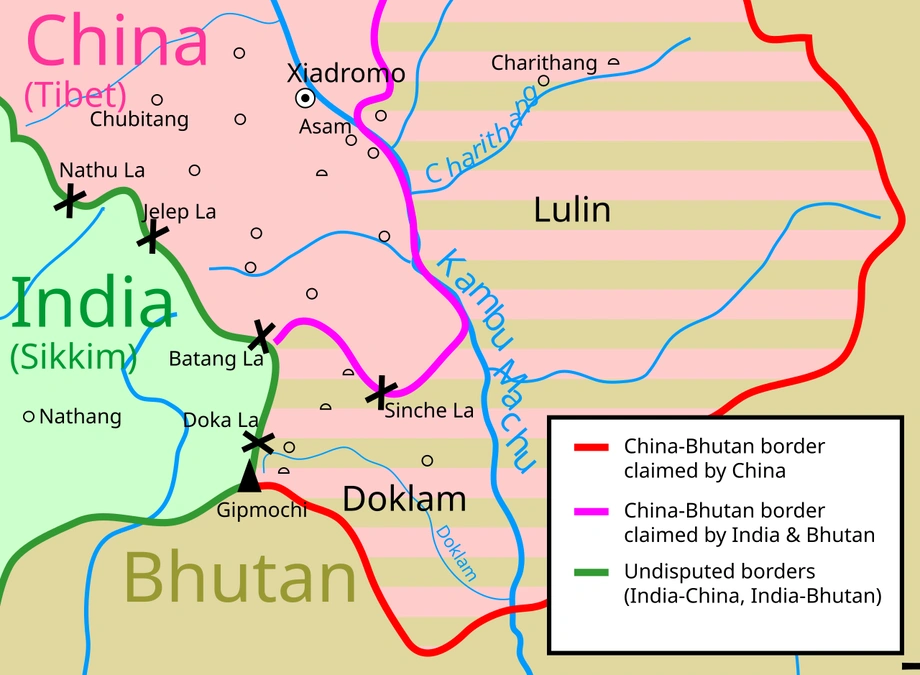
Territorial talks between Bhutan and Beijing are creating unease in New Delhi, where officials worry about a potential land swap near the strategic Siliguri Corridor. The 16th Expert Group Meeting on the China-Bhutan boundary issue took place in Thimphu last month, followed by the fourth meeting of the Joint Technical Team on delimitation and demarcation. During these discussions, both governments reviewed the next stage of a three-step roadmap established by an official memorandum signed on October 14, 2021. Indian government sources familiar with recent assessments believe Beijing may pressure Thimphu to surrender claims in western Bhutan, including the 89-square-kilometre Doklam plateau, in exchange for Chinese relinquishment of about 495 square kilometres in north-central Bhutan, particularly the Jakarlung and Pasamlung valleys. India views any shift in the western sector with extreme caution because Doklam lies near the narrow Siliguri Corridor, a vital passage connecting India's northeastern states to the rest of the country. Probir Pramanik, a Siliguri-based veteran journalist who covered the 2017 Doklam stand-off, noted that changes in territorial control there could give China greater leverage to monitor or pressure Indian supply routes.
Contents
- Bhutan-China Negotiations Cause Strategic Concern for New Delhi
- Historical Roots of the Himalayan Border Disputes
- India Accelerates Frontier Infrastructure in Arunachal Pradesh
- Ongoing Encounters and Differing Perceptions Along the Line of Actual Control
- The Two-Front Challenge and Regional Security Pressures
- Hydropower Developments and Water Security Concerns
- Diplomatic Engagements Amid Unresolved Differences
- The Essentials
Historical Roots of the Himalayan Border Disputes
The boundary tensions stem from decades of unresolved territorial claims across the 477-kilometre Himalayan border between Bhutan and China, which runs through areas originally linked to historical Tibetan administration. China claims approximately 1,504 square kilometres along this frontier, including disputed zones in Doklam, Sinchulumpa, and Gieu. Direct talks between Beijing and Thimphu began in 1984 after years of strained relations following the 1959 Tibetan Rebellion and the arrival of thousands of refugees in Bhutan. In 1996, China previously offered to exchange the Pasamlung and Jakarlung valleys for smaller tracts of disputed land in the west, a formula that resembles current proposals. Tensions escalated significantly in June 2017 when Chinese personnel attempted to extend a road southward on the Doklam plateau toward the Jampheri Ridge, prompting Indian troops to intervene under Operation Juniper on June 18, 2017, to halt the construction. That military standoff lasted 73 days until both sides withdrew on August 28, 2017. More recently, satellite analysis published by China's border villages showed that Beijing has constructed at least 22 civilian settlements and military outposts inside disputed Bhutanese territory, housing state-sponsored guardians who receive annual subsidies to patrol the frontier.
India Accelerates Frontier Infrastructure in Arunachal Pradesh
To counter growing Chinese activities along the border, India is significantly expanding its logistical and tactical capabilities in Arunachal Pradesh. The Indo-Tibetan Border Police recently sanctioned 33 new bridges, comprising 15 foot suspension bridges and 18 log bridges, across remote sectors of the eastern Himalayas where rivers and steep valleys restrict troop movements. Specific construction efforts include a foot suspension bridge over the Dau River and a log bridge at Kizbam Nallah managed by the 25th Battalion. In East Sikkim, engineers are planning log bridges at elevations of 12,600 and 12,200 feet in areas located more than 16 kilometres on foot from the nearest roadhead. Additionally, the Border Roads Organisation recently inaugurated a 460-foot hybrid bridge over the Lohit River in Anjaw district under Project Udayak to improve access to settlements near Walong. These projects complement the broader Indo-China Border Roads programme, which received approval from the Cabinet Committee on Security in February for 26 additional roads along the frontier.
Ongoing Encounters and Differing Perceptions Along the Line of Actual Control
Frontier patrols continue to experience friction due to conflicting cartographic interpretations of the McMahon Line, which was drawn during the 1914 Simla Convention. Arunachal Pradesh Chief Minister Pema Khandu stated that transgressions occur from both sides because New Delhi and Beijing perceive the boundary limits differently. Local organisations have raised alarms regarding these movements, including a June report from the Nah Welfare Society alleging that the People's Liberation Army had expanded its presence in the Taksing circle of Upper Subansiri district and restricted access to traditional grazing points. Although the Indian Army dismissed specific reports of deep incursions as unfounded rumors amplified by external actors, senior security officials have acknowledged ongoing friction. Outgoing Indo-Tibetan Border Police Director General Shatrujeet Singh Kapur confirmed that face-offs between Indian and Chinese troops had occurred at several locations and persisted, echoing details previously discussed in earlier frontier updates regarding specialized Shaurya commando deployments and enhanced high-altitude training.
The Two-Front Challenge and Regional Security Pressures
Strategic planners in New Delhi face compounding security pressures from China's deepening military alignment with Pakistan. A congressional report published by the US-China Economic and Security Review Commission warned that Beijing provides extensive defense support to Islamabad, accounting for 81 per cent of Pakistan's arms imports between 2020 and 2024. The assessment highlighted how the May 2025 India-Pakistan conflict, triggered by an attack in Pahalgam, demonstrated that China could supply real-time intelligence and technical assistance during a crisis, complicating Indian military preparedness for a potential two-front war. Furthermore, Chinese research and survey vessels are increasingly operating near India's exclusive economic zone in the Indian Ocean, where roughly 80 per cent of China's oil imports transit through maritime chokepoints like the Strait of Malacca. These multi-domain pressures are designed to constrain India's rise and force New Delhi to divert critical resources away from economic growth toward border fortification.
Hydropower Developments and Water Security Concerns
Water resource management has emerged as another critical dimension of Himalayan geopolitics following Beijing's inclusion of a massive hydropower initiative on the Yarlung Tsangpo river in its national planning documents. Chief Minister Pema Khandu described the proposed Siang Upper Multipurpose Project as a strategic necessity for India's water security, noting that China reportedly laid the foundation stone for its 60,000-megawatt upstream project in 2025. India's proposed domestic project is intended to feature a storage capacity of roughly 9.2 billion cubic metres, designed to counter a reported 5.2 billion cubic metre capacity on the Chinese side and allow downstream regulators to monitor fluctuating river discharges. While government committees are holding community outreach sessions to address local grievances and potential displacement issues, regional protests underscore the complex domestic challenges accompanying large-scale infrastructure development in fragile mountain ecosystems.
Diplomatic Engagements Amid Unresolved Differences
Despite persistent operational friction and territorial disputes, diplomatic channels remain active at the highest levels of government. Prime Minister Narendra Modi and Chinese President Xi Jinping met on the sidelines of the 18th BRICS Summit in New Delhi, reaffirming a shared commitment to a fair and reasonable resolution of the boundary question. Both leaders emphasized that bilateral ties must be viewed from a long-term perspective and that differences should not escalate into open disputes. However, civil aviation and documentation disputes continue to test the diplomatic thaw, as demonstrated by an incident where an Indian citizen traveling through Shanghai faced an 18-hour airport delay because her passport listed Arunachal Pradesh as her birthplace, mirroring administrative friction reported during previous transit disputes over regional sovereignty.
The Essentials
- Bhutan and Beijing are advancing boundary negotiations through their expert group and joint technical teams to implement a three-step roadmap.
- India is accelerating road and bridge construction across Arunachal Pradesh and Sikkim to improve access to remote border positions.
- The US-China Economic and Security Review Commission highlighted growing two-front security risks arising from Beijing's military and intelligence backing of Pakistan.
- Arunachal Pradesh officials are promoting the Siang Upper Multipurpose Project to manage upstream water flows from China's planned mega dams on the Yarlung Tsangpo.