Border force chief describes continuing confrontations
Indian and Chinese troops are continuing to face off at several locations in Arunachal Pradesh, Indo-Tibetan Border Police Director General Shatrujeet Kapur said on October 22, 2026, bringing renewed attention to a frontier where residents have alleged the loss of access to ancestral land.
Contents
- Border force chief describes continuing confrontations
- What communities around Taksing alleged
- Where the sensitive pockets lie
- India and China give competing explanations
- Talks continued through the summer and autumn
- Why Arunachal remains contested
- The ITBP turns to drones and new tactics
- Political pressure and the wider relationship
- Border residents face pressures beyond patrols
- Key Points
Speaking at the Central Training College in Alwar, Rajasthan, Kapur praised newly introduced Shaurya commando teams and described changes to training, equipment and defensive infrastructure. His remarks at the Himveer Samman Samaroh, an event livestreamed by the ITBP, put continuing confrontations on the public record after months of local complaints and official denials of encroachment.
Kapur, whose force guards the 3,488 kilometres of the Line of Actual Control with China, told personnel that encounters had occurred recently and were continuing:
In the past few days, a situation arose where a face-off happened at several locations in Arunachal, and it still continues.
India's Ministry of External Affairs subsequently attributed periodic border disturbances to changes in Chinese patrol behaviour. China rejected that description, saying its troops were conducting normal patrols under existing agreements.
Defence sources described sensitive pockets as stable and under control, with no violent clashes reported. A face-off means troops confront each other, often because their patrol routes overlap or one side challenges the other's presence. Commanders can manage such encounters while forces remain deployed nearby.
The immediate concern stretches beyond the encounters themselves. Residents around Taksing say land used for grazing, hunting and gathering forest produce has become harder to access. The ITBP, meanwhile, is preparing new tactical training, drone units and reinforced underground positions along the frontier.
What communities around Taksing alleged
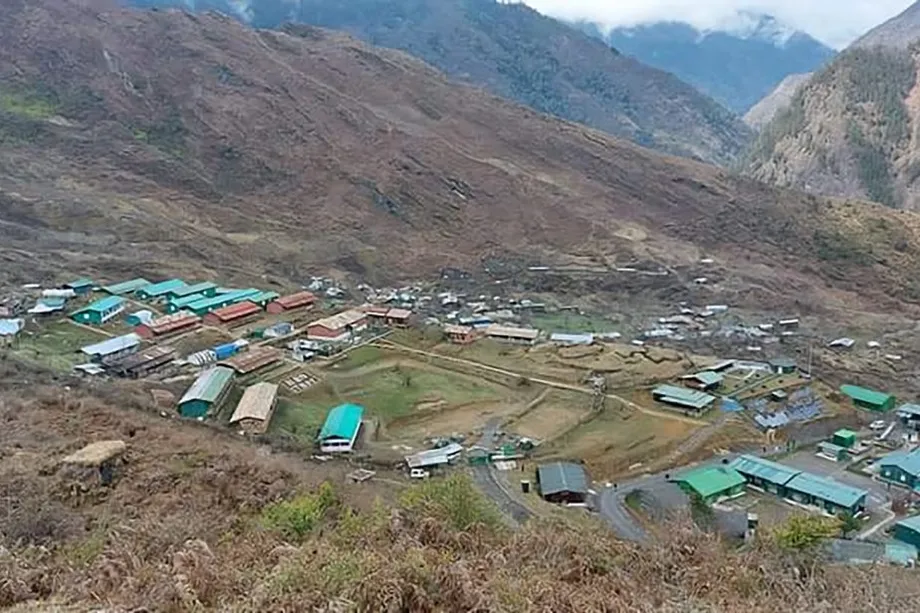
The Nah Welfare Society, a tribal organisation based in Taksing, set out detailed allegations in a letter dated June 26, 2026, to the deputy commissioner of Upper Subansiri district. It named Oying in the Asaphila area, Paniar in the Chujarta area, Marpan in Marnafe, Portrang Lake and Tingdingtang as places where it alleged Chinese occupation.
The society said the People's Liberation Army had built roads, bridges and military camps in areas traditionally used by local communities. It expressed grief over what it described as a gradual occupation of ancestral lands that had intensified since 2020.
The Indian Army rejected the encroachment reports as "incorrect and without any basis". When videos circulated claiming Chinese troops had advanced 50 to 60 kilometres into Indian territory, the Press Information Bureau's Fact Check unit said the videos were unrelated to the India-China border.
Further accounts described a confrontation in Taksing Circle on July 25 and 26 that continued for nearly a week before senior commanders intervened. Arunachal Pradesh Home Minister Mama Natung dismissed reports of Chinese encroachment as "just rumors".
Kapur did not identify the locations of the continuing encounters, their duration or the positions held by either side. The territorial situation at the places named by the society remains unresolved in public statements.
Where the sensitive pockets lie
Asaphila and Longju, in the Taksing area, have been identified by defence sources as particularly sensitive because India and China disagree about the route of the Line of Actual Control, usually shortened to LAC. The LAC is the boundary between areas controlled by the two countries, rather than a mutually agreed international border.
Accounts of the latest tensions described Chinese troops pitching tents six to seven kilometres inside India's perceived LAC near Asaphila and Taksing. Defence sources also described periodic patrol encounters without violent clashes and said commanders were exercising restraint.
Local flag meetings, where military officers meet directly, and telephone hotlines are being used to manage friction. These arrangements give commanders a way to discuss a patrol encounter quickly and seek instructions before it develops into a larger confrontation.
India and China give competing explanations
Indian Ministry of External Affairs spokesperson Randhir Jaiswal said border disturbances occur when Chinese forces "diverge from established patrolling patterns". Asked about specific encounters following Kapur's remarks, he referred questions to the Ministry of Defence.
Jaiswal said both governments were continuing to use existing channels to address outstanding problems and prevent mistakes:
Both sides continue to use existing diplomatic and military mechanisms to resolve outstanding issues and avoid misunderstanding and miscalculation along the Line of Actual Control. The two sides have also agreed to discuss ways to improve understanding of LAC in appropriate areas for better border management.
Chinese Foreign Ministry spokesperson Guo Jiakun said China strictly followed the relevant agreements and understandings and conducted normal border patrol and control activities to protect its sovereignty. He urged India to work with China to implement their shared understandings and maintain peace.
Qian Feng, director of the Research Department at Tsinghua University's National Strategy Institute, interpreted India's accusations as a tactical move partly shaped by domestic politics. He argued that border disputes should be handled through established mechanisms while cooperation continued in less sensitive areas. That was his assessment of India's motives; the Indian government's stated concern was Chinese departures from established patrol patterns.
India's Chief of Defence Staff, General NS Raja Subramani, had described the LAC situation as stable in September. Defence sources later said Kapur's speech concerned routine deployment and preparedness rather than a specific incident. His description of continuing encounters nevertheless made the management of local friction a public issue.
Talks continued through the summer and autumn
India and China held discussions at diplomatic, military and leadership levels during the months surrounding the reported confrontations. The main events followed this sequence:
- June 26: The Nah Welfare Society sent its letter alleging Chinese occupation around Taksing.
- July 25 and 26: Accounts described a confrontation in Taksing Circle, followed by intervention from senior commanders.
- August 6: New Delhi hosted the 36th Working Mechanism for Consultation and Coordination on India-China Border Affairs meeting.
- Late August: National Security Adviser Ajit Doval and Chinese Foreign Minister Wang Yi held boundary talks in Beijing. The meeting was dated August 26 in one account and August 25 in another.
- August 31: Prime Minister Narendra Modi and President Xi Jinping interacted at the Shanghai Cooperation Organisation summit in Bishkek.
- September 6: Corps commander talks took place at the Wacha-Damai border meeting point in Arunachal Pradesh.
- September 12: Modi and Xi met during the BRICS summit in New Delhi.
- October 22: Kapur publicly described continuing face-offs in Arunachal Pradesh.
Wacha is in the Kibithoo sector and is India's easternmost border personnel meeting point. The September military talks followed meetings between local commanders. Some encounters reportedly overlapped with Xi's September visit to India.
Why Arunachal remains contested
China claims about 90,000 square kilometres in the eastern sector, broadly corresponding to Arunachal Pradesh, and calls the area Zangnan or South Tibet. India rejects that claim and describes Arunachal Pradesh as an integral part of the country.
India also claims about 38,000 square kilometres in Aksai Chin, controlled by China, and about 5,300 square kilometres in the Shaksgam Valley, transferred by Pakistan to China under a 1963 agreement that India rejects. The disagreement therefore involves both where troops patrol and sovereignty over much larger areas.
Chinese forces withdrew from territory they had occupied in the eastern sector during the 1962 war. Earlier settlement proposals considered an exchange under which China would relinquish eastern claims while India accepted Chinese control of Aksai Chin. No boundary settlement followed.
Tensions returned in the Sumdorong Chu area in 1986 and 1987. Later confrontations included Doklam, near the junction of India, China and Bhutan, in 2017, and Galwan in eastern Ladakh in June 2020. Twenty Indian soldiers died at Galwan; China acknowledged four military deaths.
Place names have become another arena for asserting claims. China's Civil Affairs Ministry has issued Chinese names for locations in Arunachal since 2017, with another set released in April. India formally identified 27 places and geographical features on its official map in August.
India's list included Longju, which has been controlled by China since 1959 but lies within India's claim line. The Ministry of Home Affairs said the mapping exercise was intended to improve accurate recognition and public awareness of the places.
The ITBP turns to drones and new tactics
Kapur's Alwar address connected the border encounters with an overhaul of ITBP preparation. He praised the Shaurya platoons and commando teams and said a new course called Strike would teach battlecraft and frontline tactics, with the aim of avoiding situations like Galwan.
Training across the force is intended to be completed before late 2027, with equipment supplied to forward border outposts. Kapur also described construction of reinforced underground infrastructure to protect personnel against modern weapons.
Each battalion guarding the border is to receive a drone platoon. Work has begun on manufacturing drones within the force and training pilots. Drones can give personnel a view of difficult terrain without sending a patrol to every location; systems designed to counter drones can help protect troops and installations.
Kapur said the Ministry of Home Affairs had given approval in principle for more than Rs 3,000 crore for drones and systems to counter them, with funding expected by 2030. One crore equals 10 million rupees, putting the proposed amount above Rs 30 billion. Approval in principle is an initial authorisation, while the spending and deployment are planned over subsequent years.
The programme gives the border response two distinct timescales: commanders must manage current encounters through meetings and hotlines, while training and equipment changes are scheduled over the next several years.
Political pressure and the wider relationship
Congress president Mallikarjun Kharge demanded answers from Modi after Kapur's remarks, questioning border security and the results of repeated diplomatic engagement. Congress general secretary and Rajya Sabha member Jairam Ramesh also criticised the government's public handling of the encounters.
Ramesh cited local claims that patrol points had been lost and referred to the September corps commander talks. Those claims remain part of the political dispute over the government's account of conditions along the frontier.
External Affairs Minister S Jaishankar has described relations with China as better than in 2025 and moving towards normality. He has also said peace and tranquillity at the border are essential for normal relations and that disturbances would have consequences for the wider relationship.
China's account of the September 12 leaders' meeting stressed that the countries should be partners and pursue progress in both bilateral relations and border discussions. The continuing encounters leave both governments managing local military friction while attempting a broader diplomatic recovery.
Border residents face pressures beyond patrols
Residents of remote Arunachal villages depend on access to land, dependable transport and basic services. Allegations about lost grazing and hunting areas therefore concern daily livelihoods as well as military control.
Defence sources described work on roads usable throughout the year, bridges, telecommunications and civic facilities. They also cited healthcare camps, emergency evacuations, school construction and employment linked to the presence of security forces.
The historic Tsari pilgrimage circuit, sacred to Buddhist communities on both sides of the border, could become a subject for future discussions on controlled access. Any arrangement would depend on security conditions and agreement between India and China.
Arunachal also faces a separate dispute over a major dam in Upper Siang district. Opponents have raised concerns about displacement, environmental damage and livelihoods, and violence was reported there on October 23. Reports that ITBP personnel had been redeployed from the frontier to Delhi amid protests added to criticism of government priorities, although no deployment figures were given.
For communities near the disputed frontier, security involves both the ability to use traditional land and confidence that development decisions will protect homes and livelihoods. Those concerns sit alongside the immediate military task of keeping patrol encounters under control.
Key Points
- ITBP chief Shatrujeet Kapur said on October 22 that face-offs continued at several locations in Arunachal Pradesh.
- The Nah Welfare Society alleged Chinese occupation at five named locations around Taksing; the Indian Army rejected encroachment reports.
- India blamed changes in Chinese patrol patterns, while China described its activities as normal patrols.
- Defence sources said sensitive pockets remained under control and no violent clashes had been reported.
- Military and diplomatic talks continued through August and September, including corps commander talks at Wacha-Damai.
- The ITBP plans new tactical training, drone platoons and reinforced underground infrastructure, with training targeted before late 2027 and drone funding expected by 2030.