A Five Day Stay Ends Over Earth
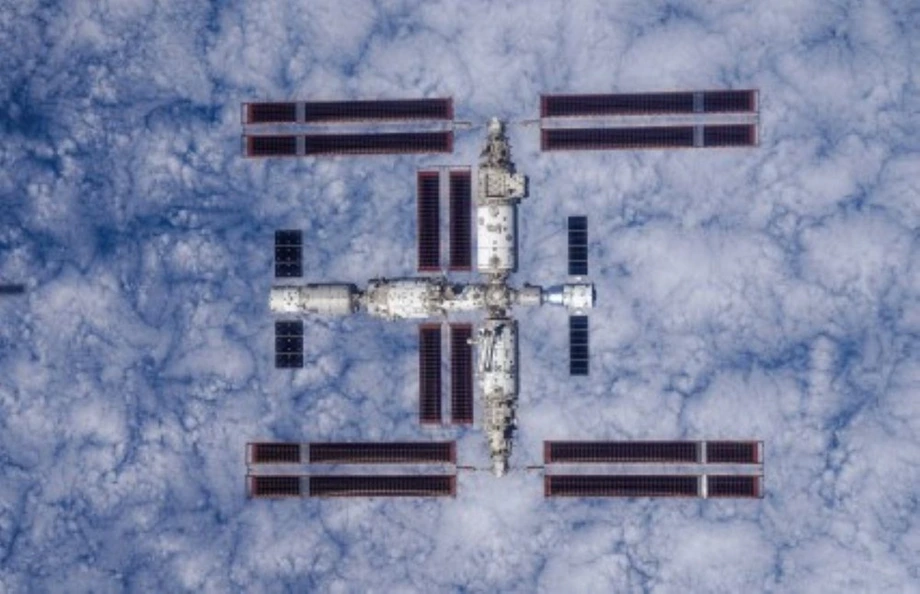
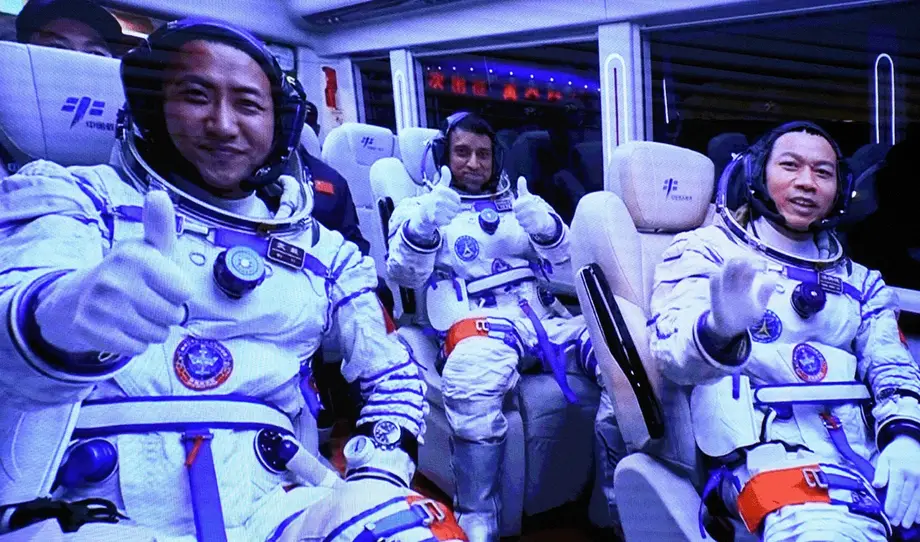
At 11:42pm Beijing time on Sunday, 8:42pm in Islamabad, the Shenzhou-23 spacecraft separated from China's Tiangong space station with three people aboard, among them Muhammad Zeeshan Ali, the first Pakistani to reach orbit. Suparco, Pakistan's Space and Upper Atmosphere Research Commission, said the spacecraft began its journey back to Earth once the crew had finished everything required before departure.
Contents
- A Five Day Stay Ends Over Earth
- Who Is Coming Home and Who Stayed Behind
- Four Experiments in Life Sciences and Materials
- From a Signed Agreement to a Seat on a Chinese Ship
- The Ride Home: Three Orbits and Five and a Half Hours
- A Video Call From Islamabad
- Satellites First, Then People
- In Islamabad, a Mission Control Centre for Children
- Key Points
Ali, 40, is a Pakistan Air Force pilot who flew as a payload specialist. He reached the station on November 25 aboard Shenzhou-24, on China's first crewed spaceflight to include a foreign astronaut, and stayed about five days. No foreigner had entered Tiangong before him. His stay was far shorter than the rotation of roughly six months served by a Chinese astronaut, and it has been a cause for celebration across Pakistan since his launch.
Ground teams and the crew worked through a long list of tasks before the hatches closed. Suparco said the astronauts set the configuration of the station complex, organized and transmitted experimental data, cleared and transferred material kept in orbit, and handed over their duties, passing on what they had learned from working in weightlessness.
Who Is Coming Home and Who Stayed Behind
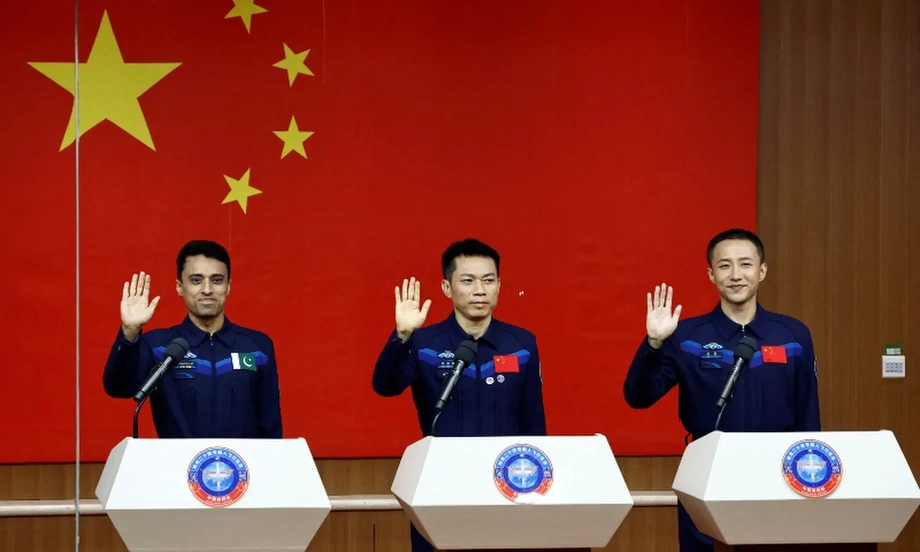
Two crews met aboard the station on Saturday for a handover ceremony at which the Shenzhou-23 astronauts passed the keys of Tiangong to their successors, according to the China Manned Space Agency. Ali returns with Zhang Zhiyuan, commander of the return mission, and Lai Ka-ying, also known as Li Jiaying, the first astronaut from Hong Kong and the fourth Chinese woman in space.
The agency said the three have completed all their scheduled tasks. Zhu Yangzhu stays in orbit for an experiment built around a stay of one year, joining Shenzhou-24 commander Tang Hongbo and astronaut Wu Yi for the rest of the mission.
Ali's presence on the return manifest is the part that matters most in Pakistan. A country that has sent satellites to orbit but never a person now has a national who has lived on a space station, and officials have tied the flight to wider ambitions in science and technology.
Getting there took months of preparation. Suparco and the China Manned Space Agency signed a cooperation agreement in February 2025 under which two Pakistanis would train in China and one would fly to Tiangong. In April, Zeeshan Ali and Khurram Daud were chosen from Pakistan to begin that training.
Four Experiments in Life Sciences and Materials
Ali's work aboard Tiangong was scientific. As a payload specialist he carried out four experiments designed jointly by China and Pakistan, in life sciences and materials science, Suparco said. In orbit, materials science looks at how liquids, metals and crystals set and mix when gravity is not pulling the heavier parts down, and life sciences looks at how living cells and plants cope with weightlessness and radiation.
The experiments were catalogued on the ground as well. Suparco set up a stall at a public exhibition in Islamabad showing what Ali worked on, and a running feed of updates on his experiments was posted there through the week.
The curriculum in China went beyond simulators and procedures. Ali learned Chinese songs and poetry, practised calligraphy and played table tennis in the months before launch.
From a Signed Agreement to a Seat on a Chinese Ship
A day before liftoff, at a press briefing in Jiayuguan, Ali said he had arrived at the Astronaut Centre of China carrying the hopes of 250 million Pakistanis. He said he was 'deeply grateful' to the Chinese government for helping Pakistan 'realise our dream of going into space'.
What comes after this flight matters more than the flight itself.
This mission is not a finish line; it is a launch pad. And I hope the next chapter of China-Pakistan space cooperation will grow from one astronaut, one flight to multiple joint flights, to the Moon, Mars and beyond.
The Ride Home: Three Orbits and Five and a Half Hours
China's return profile for this mission is fast. From undocking to touchdown is expected to take about 5.5 hours, with the capsule circling Earth about three times before it enters the atmosphere. Suparco said the return capsule will re-enter under ground command at an appropriate time.
- November 25: Ali and the Shenzhou-24 crew arrive at Tiangong.
- Saturday: the two crews hold a handover ceremony, the keys of the station pass to the new crew, and Ali speaks by video call with Pakistan's prime minister and army chief.
- Sunday, 11:42pm Beijing time: Shenzhou-23 undocks from the station.
- About 5.5 hours later: the return capsule is due at Dongfeng Landing Site in Inner Mongolia.
Dongfeng, in northern China's Inner Mongolia Autonomous Region, will receive the capsule. The China Manned Space Agency said the site and all supporting systems were making intensive preparations to bring the crew down safely. Officials said the three will bring back what they described as a 'mysterious gift' from the station, without saying what it is.
Timing remains open in two places. Ground controllers will choose the moment of re-entry, and no precise touchdown hour has been published. When Ali travels on to Pakistan after landing has not been announced either.
A Video Call From Islamabad
On Saturday, Prime Minister Muhammad Shehbaz Sharif and Field Marshal Syed Asim Munir, the Chief of Army Staff, held a video call with Ali while he was still aboard the station.
Sharif had marked the launch by congratulating the nation and saying Pakistan had begun a journey 'beyond the stars'. He described the mission as a journey not for one astronaut but for 240 million Pakistanis, naming the young and the country's scientists in particular. Ali had spoken of 250 million.
Satellites First, Then People
Cooperation in space between the two countries dates to the early 1990s, when Chinese launchers began putting Pakistani satellites into orbit, and the partnership has grown from satellite launches to human spaceflight.
The next item on the list is further from Earth. Pakistan is developing a lunar rover for a Chinese mission tentatively scheduled for 2028.
For Pakistan's space agency, the flight is also a teaching tool. Officials have pushed the message that a national can now train for orbit, not just build payloads for someone else's rocket.
In Islamabad, a Mission Control Centre for Children
While Ali circled Earth, a hall at the Pak-China Friendship Centre in Islamabad was turned into a facility called Kehkashan, or Mission Control Centre. It held models of a spacecraft and a rocket, a Suparco stall with details of Ali's four experiments, virtual reality headsets that let visitors step inside a space station, and boarding passes printed for children to give them a sense of what a trip to space feels like.
Organizers staged a children's show titled Jugnu Ka Safar Space Tak and kept a feed of updates on Ali's experiments running through the week. The programme closed on Sunday with a prize giving.
Raeesa Adil, the Principal Information Officer, told the closing ceremony that friendship between Pakistan and China had entered a new phase, with cooperation now reaching into space research, and called Ali's participation in the Shenzhou-24 mission a matter of pride for the country. The programme, she said, was meant to introduce children and young people to space exploration and to Pakistan's own space programme so that they could see themselves as future doctors, engineers and scientists.
Adil pointed to Allama Muhammad Iqbal's poetry about searching for horizons beyond the stars and said Ali's flight reflected the country's growing ambition in space research. She ended the ceremony by giving a shield to staff of the Press Information Department, which organized the event.
Key Points
- Shenzhou-23 undocked from China's Tiangong space station at 11:42pm Beijing time on Sunday, 8:42pm in Pakistan.
- Muhammad Zeeshan Ali, 40, a Pakistan Air Force pilot, is the first Pakistani in orbit and the first foreign astronaut to enter the station.
- He arrived on November 25 aboard Shenzhou-24 and spent about five days aboard.
- He returns with Zhang Zhiyuan, commander of the return mission, and Lai Ka-ying, the first astronaut from Hong Kong.
- Zhu Yangzhu remains in orbit for an experiment built around a stay of one year, alongside Tang Hongbo and Wu Yi.
- Ali ran four joint China-Pakistan experiments in life sciences and materials science as a payload specialist.
- The capsule is expected at Dongfeng Landing Site in Inner Mongolia after about 5.5 hours and three orbits.
- Suparco and the China Manned Space Agency signed their cooperation agreement in February 2025; Ali and Khurram Daud began training in April.
- Pakistan is building a lunar rover for a Chinese mission tentatively set for 2028.