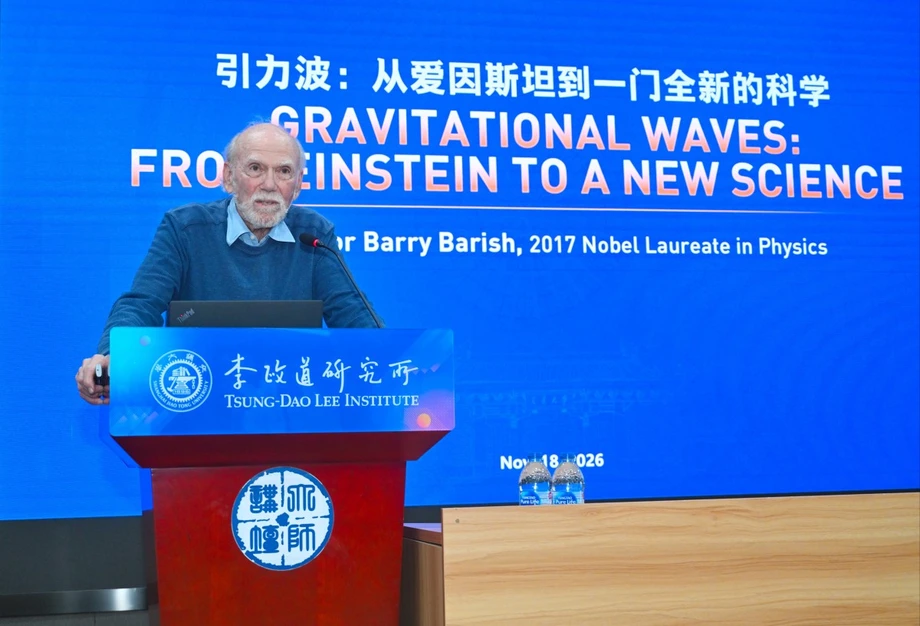
The Announcement in Tianwen Hall
Shanghai Jiao Tong University marked ten years of its Tsung-Dao Lee Institute on November 28 with a conference in Tianwen Hall, a room inside the institute's own building, and used the occasion to declare the start of a laboratory in which artificial intelligence takes part in running physics experiments rather than only reading their results. The AI-driven autonomous physics lab will be steered by major open questions in fundamental physics, and its stated task is to keep raising the ability of large experiments to be designed, operated and analysed, and to pick unknown signals out of their data.
Contents
- The Announcement in Tianwen Hall
- A Machine That Suggests the Next Experiment
- Three Years, Four Deliverables
- The Question at the Centre: Where Matter Came From
- The Machines the Lab Will Lean On
- A Topological Qubit Within Five Years
- Why the Institute Compares Itself to Bohr's Copenhagen
- A Hundred Scientists From Sixteen Countries
- 2027 and the Deadlines That Decide the Plan
- Training People Who Speak Physics and AI
- The Second Decade
- Key Points
The lab is also meant to push AI itself. The Tsung-Dao Lee Institute sets out three qualities its methods should have: they should be trustworthy, interpretable and transferable. A result has to be dependable enough to act on, clear enough for a physicist to see how the machine reached it, and general enough to work on a second experiment after it has been trained on the first. The institute describes the aim as a deep fusion of the laws of physics with artificial intelligence, and as a new model of scientific discovery in which machines carry far more of the work.
A Machine That Suggests the Next Experiment
Ding Mincheng, co-director of the laboratory's advisory committee, told the conference that the shift is already under way in how basic science gets done. He said the lab should be judged on whether it takes on questions that matter and are genuinely hard.
Artificial intelligence is profoundly changing the way basic science is researched and will drive a transformation of research paradigms as a whole. I expect this laboratory to stand on major scientific needs, focus on what is critical, value original work, become a future-facing platform of AI research infrastructure, dare to explore truly important and challenging scientific questions, and contribute China's research strength on the road to discovering the fundamental laws of nature.
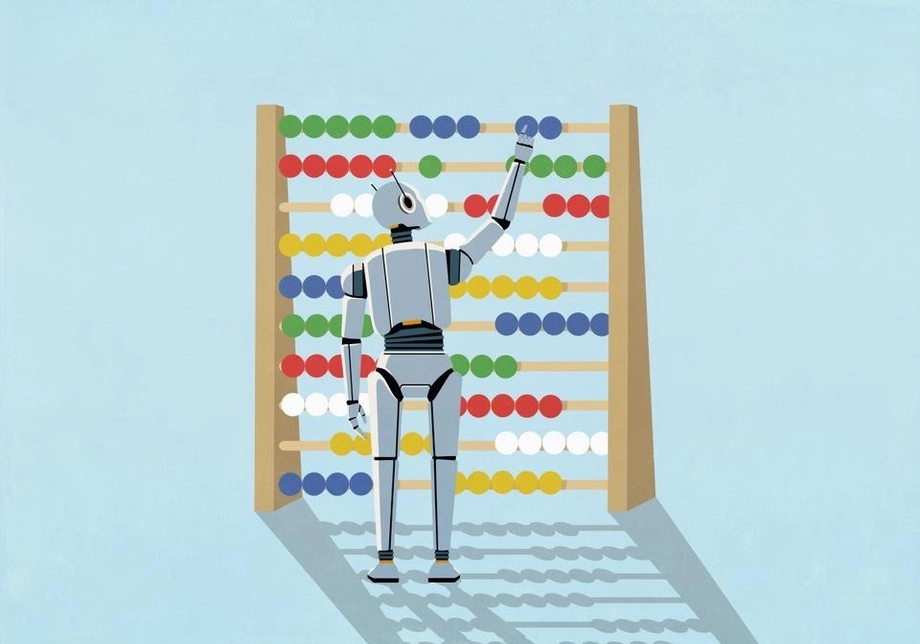
What separates an autonomous laboratory from ordinary computing is the loop it closes. A conventional analysis pipeline receives data that someone else decided to record. An autonomous system helps decide what to record, flags the unusual events worth keeping, tests whether a faint pattern could be a statistical accident, and then proposes a change to the next run of the experiment.
Big physics machines generate far more raw readings than any team can review. A dark matter detector registers flashes from background radiation hour after hour, and a deep sea telescope watches cubic kilometres of water for a rare flicker of light. Software that sorts those events quickly, and that learns which ones resemble nothing seen before, decides what survives to be studied at all.
The institute has named the technical territory the lab will cover in its first phase: scientific agents, which are programs that plan and carry out a sequence of research steps; domain foundation models, large AI systems pretrained on the data and literature of one field; intelligent detection and triggering, meaning decisions made in fractions of a second about which sensor readings to keep; and simulation-based statistical inference, which uses simulated data to judge whether a signal is real.
Three Years, Four Deliverables
Within three years the laboratory intends to have four things standing: a prototype for intelligent detection and triggering, a science data infrastructure, domain foundation models, and scientific agents. The stated purpose of those milestones is to move AI methods out of demonstrations and into real research workflows, where experimental data can judge them.
Institute leaders drew a line between this lab and the general AI for Science platforms that now sit inside many universities. This one is built around particular physical settings, with the work concentrated on dark matter, neutrinos, astronomical observation, laboratory astrophysics and laser fusion instead of spreading across every discipline.
The Question at the Centre: Where Matter Came From
The laboratory's organising problem is the origin and evolution of matter under extreme cosmic conditions. That phrase covers a chain of questions: what the invisible mass holding galaxies together is made of, how the lightest particles in nature behave over cosmic distances, what the earliest structures in the universe looked like, and how matter behaves at temperatures and pressures no furnace on Earth can reach.
Dark matter is the name for mass that pulls on galaxies and bends their light while giving off none of its own. Nobody has yet identified the particle responsible. Neutrinos are ghostly particles produced in nuclear reactions that pass through planets almost untouched, which is why catching a few of them requires a detector the size of a mountain or a stretch of ocean.
The research agenda is set so that these questions are tackled with instruments that are being built now, not with hypothetical ones. The lab's first pilot directions are the PandaX dark matter search, the Hailing neutrino telescope, the JUST spectroscopic telescope and the DCI laser fusion platform.
The Machines the Lab Will Lean On
PandaX sits under the Jinping mountain in Sichuan province, where a deep layer of rock screens out cosmic rays that would otherwise drown the search for dark matter. Its target is liquid xenon, a heavy, dense material in which a passing dark matter particle might strike a nucleus and release a tiny pulse of light and charge. The detector planned for operation uses 20 tonnes of xenon, a size that multiplies the chances of catching such an event.
The Hailing neutrino telescope is being assembled in the South China Sea, where strings of light sensors are lowered into deep water. By 2027 the project is due to complete an array of 10 strings. Farther west, on the high plateau at Lenghu in Qinghai province, the JUST spectroscopic telescope is expected to take its first light by the end of that year. A spectroscope splits starlight into its component colours, which lets astronomers read the chemical makeup and motion of what they observe.
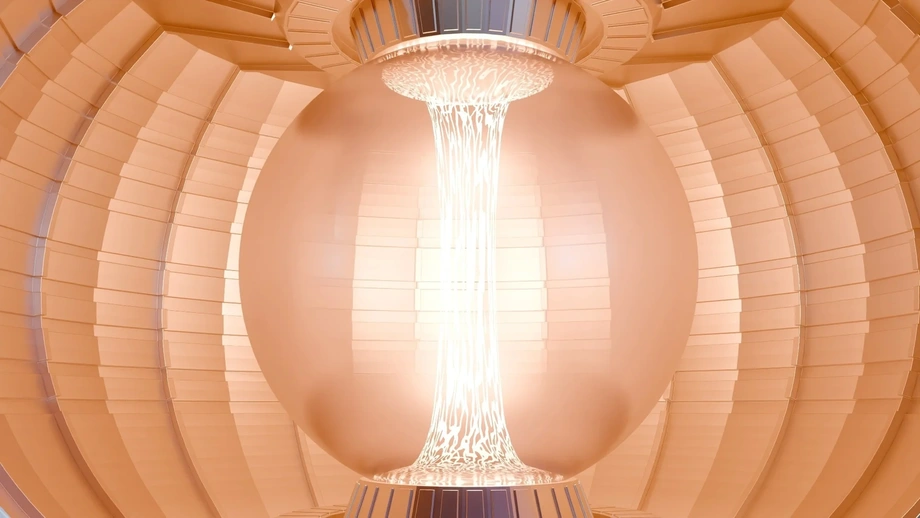
The Zhangjiang Laboratory astrophysics platform is planned as an underground facility that combines an extremely powerful femtosecond laser, whose pulses last a few millionths of a billionth of a second, an extremely energetic nanosecond laser, and a beam of high energy electrons. The institute describes it as the only underground extreme physics platform in the world to bring those three tools together, a combination meant to reproduce conditions like those inside stars and around collapsed objects.
A Topological Qubit Within Five Years
A second track runs alongside the dark matter work. The institute's topological materials platform is working toward a high fault tolerant topological qubit within five years, with the goal of producing the first such device in the world.
A qubit is the basic unit of a quantum computer, and its weakness is that it loses its state when disturbed by the slightest noise. A topological qubit is designed so that its information is stored in the shape of a quantum state rather than in one fragile particle, which in theory makes it far more resistant to error. If the platform succeeds, it would give physicists a building block for quantum machines that need less correction.
The institute frames the two big targets, dark matter and topological quantum behaviour, as the fundamental science its combined detection capability is meant to serve.
Why the Institute Compares Itself to Bohr's Copenhagen
The Tsung-Dao Lee Institute traces its existence to a letter. The Nobel laureate Tsung-Dao Lee wrote to Shanghai Jiao Tong University at the end of 2014 proposing a centre for leading basic research in Shanghai, and the institute was formally established in November 2016. It was modelled on the Niels Bohr Institute in Copenhagen, the Danish centre where quantum mechanics was worked out in the 1920s.
The comparison is about working style as much as prestige. Bohr's institute gathered theorists and experimenters in one building and let them argue, and the Shanghai institute has arranged itself around three research directions: astronomy and astrophysics, particle and nuclear physics, and condensed matter physics. Its director is Zhang Jie, an academician of the Chinese Academy of Sciences.
A Hundred Scientists From Sixteen Countries
The institute now brings together more than 100 scientists from 16 countries across six continents, and about 40 percent of them are international scholars. That mix is unusual for a Chinese basic research centre of its age, and it shapes what the new laboratory can draw on as it builds models trained on data from instruments in several countries.
University leaders have set 2035 as the year by which they want the institute to be a basic science centre with global influence.
2027 and the Deadlines That Decide the Plan
The laboratory's schedule is tied to hardware that arrives on fixed dates. Several of the instruments it depends on come online in the same year.
- November 2016: the Tsung-Dao Lee Institute is formally established at Shanghai Jiao Tong University.
- November 28: the institute holds its tenth anniversary conference and announces the AI-driven autonomous physics lab.
- 2027: the 20 tonne PandaX liquid xenon detector at Jinping in Sichuan is due to begin operation.
- 2027: the Hailing neutrino telescope in the South China Sea is due to complete a 10 string array.
- End of 2027: the JUST spectroscopic telescope at Lenghu in Qinghai is expected to achieve first light.
- 2027: the Zhangjiang Laboratory astrophysics platform is due to be completed as an underground extreme physics facility.
- Within five years: the topological materials platform aims at a high fault tolerant topological qubit.
- Within three years: the AI lab aims at a detection prototype, a data infrastructure, domain foundation models and scientific agents.
- 2035: the target year for the institute to rank among the world's influential basic science centres.
Training People Who Speak Physics and AI
Machines that propose experiments still need people who understand both the physics and the software. The laboratory plans to build that workforce through postdoctoral positions on its platforms, a system in which each young researcher has two supervisors, one from physics and one from AI, dedicated seminars, and courses that combine artificial intelligence with physics.
The arrangement addresses a practical gap. Physicists are trained to distrust a result until they understand the apparatus that produced it, while machine learning specialists are trained to optimise against a benchmark. A researcher who can do both is the person able to tell whether a model has learned a genuine feature of the universe or an artefact of how the data was collected.
The Second Decade
Zhang Jie used the anniversary to set the institute's next goal. For its second decade, he said, it will move on from constructing research capability that can stand with the best in the world and turn toward producing major original discoveries.
The AI-driven autonomous physics lab will work in step with these large science facilities, so that algorithms are continuously tested in real experiments, and the new questions thrown up by experiments in turn push improvements in AI methods.
That exchange is the part of the plan with the clearest test. An AI method that only performs well on prepared datasets proves little. A method that survives contact with a running detector, where backgrounds shift and instruments drift, has to be rebuilt until it holds. The institute's expectation is that the push runs both ways, with the physics questions forcing better AI and the better AI opening questions the instruments could not previously ask.
No date has been given for the first results from the laboratory's pilot directions, and the institute has not said how the four three-year deliverables will be reviewed or by whom. The fixed dates it has published all concern hardware, with 2027 as the year when the detectors the lab depends on begin to deliver data.
Key Points
- Shanghai Jiao Tong University's Tsung-Dao Lee Institute announced an AI-driven autonomous physics lab at its tenth anniversary conference in Tianwen Hall on November 28.
- The lab will improve the design, operation and data analysis of large experiments and the identification of unknown signals, and will develop AI methods described as trustworthy, interpretable and transferable.
- Ding Mincheng, co-director of the lab's advisory committee, said AI is profoundly changing how basic science is researched and will transform research paradigms as a whole.
- Research targets the origin and evolution of matter under extreme cosmic conditions, using dark matter, neutrino, astronomical observation and laser fusion platforms.
- First pilot directions are PandaX, the Hailing neutrino telescope, the JUST spectroscopic telescope and the DCI laser fusion platform.
- Within three years the lab aims at a detection and triggering prototype, a science data infrastructure, domain foundation models and scientific agents.
- The institute was proposed by Nobel laureate Tsung-Dao Lee in a letter at the end of 2014, modelled on Bohr's Copenhagen institute, and founded in November 2016 under director Zhang Jie.
- It holds more than 100 scientists from 16 countries, about 40 percent of them from outside China, and university leaders target global influence by 2035.
- In 2027 a 20 tonne PandaX detector should start running, Hailing should reach a 10 string array, JUST should see first light and the Zhangjiang underground platform should be completed.
- A separate platform aims at the world's first high fault tolerant topological qubit within five years.