Two Donkeys Sold, and a Household's Income Gone
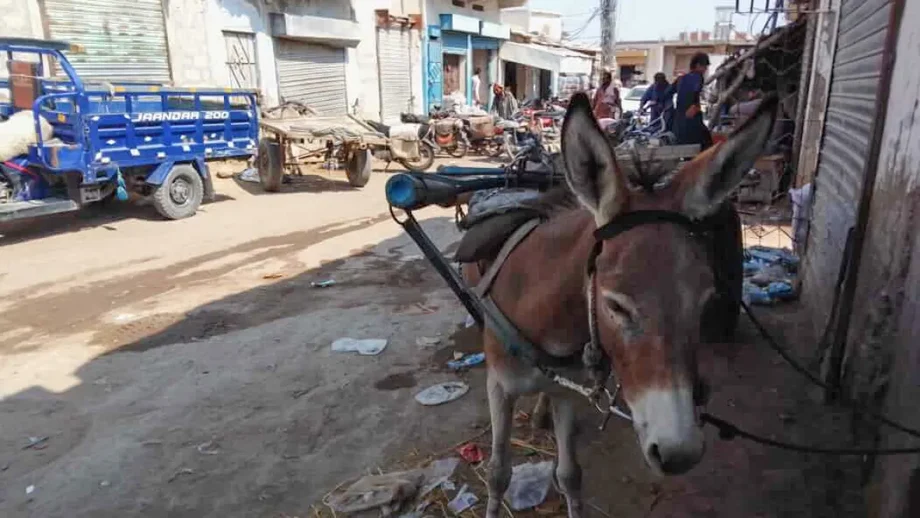
Muhammad Noor sits on a worn charpoy outside his home in Kulahu, a village near Tump in Pakistan's southwestern province of Balochistan, his eyes on a cart with torn tyres and an idle wooden frame. The two animals that pulled it are gone. For years he hauled wood, sand and stones for local customers, and during the date harvest the donkeys carried produce that added to the family's income. In July he sold both to pay for urgent surgery for his wife, whose eyesight was failing. With no savings and few options, he took the offer a local animal trader made.
Contents
- Two Donkeys Sold, and a Household's Income Gone
- Traders Move In on Village Animals
- What Ejiao Is and Why China Is Buying
- How the Export Trade Was Cleared
- Gwadar's Free Zone Becomes the Gateway
- The Warning That Moved the Prime Minister's Office
- An Illegal Abattoir Three Miles From the Capital
- For Owners Who Keep Their Animals, Higher Prices Cut Both Ways
- What the Trade Is Worth, and What It Could Cost
- Key Points
The stronger male fetched 75,000 rupees ($270). The female brought 44,000 rupees ($158). "I thought the money would restore my wife's vision and I could buy another donkey later," Noor says. "But a good working donkey now costs 100,000 rupees ($360) or more. I cannot afford one."
Donkeys carry goods and earn money for families with low incomes across rural Balochistan, and in cities such as Quetta and Karachi they are used to collect and dispose of waste. Noor's pair brought in about 1,000 rupees ($4) a day. The surgery was paid for and the livelihood was not. He now takes casual work that pays 500 rupees ($2) on a good day and nothing on many others. His elder daughter has left school, the family eats less than before, and other medical treatment has been put off. "The trader told me there would always be more donkeys and that prices would come down," Noor says. "He was wrong. I sold my livelihood and cannot get it back."
Traders Move In on Village Animals
Across Kech district, residents say traders are buying stray and underweight donkeys from villages in Dasht, a rural subdistrict that borders the port city of Gwadar, and passing them to intermediaries. Animals bought for 4,000 to 5,000 rupees ($14 to $18) sell for 8,000 to 10,000 rupees ($28 to $36) in Turbat, the district's main town and commercial centre. A trader in Dannuk, who spoke on condition that he not be named, said an animal bought locally for 4,000 rupees can fetch about 15,000 rupees ($54) once it reaches intermediaries in Gwadar.
Some families lose the animal without any sale at all. In Chahsar, on the outskirts of Turbat, Jumma Baloch's only working donkey was stolen a month ago while it was tied outside his home. "I woke up and it was gone," he said. "People say stolen donkeys are taken to middlemen in the city who supply the export business." Jumma now takes irregular daily labour, and the rising price of donkeys has made a replacement impossible to afford.
What Ejiao Is and Why China Is Buying
The animals feed a market built on a medicine. Ejiao is made by boiling donkey hides until the collagen in them turns into a gelatin, which is sold for claimed health benefits that include better blood circulation and the treatment of anaemia. Research published in the Journal of Contemporary China in 2024 estimated that the industry needs between four million and five million donkey hides a year. The Donkey Sanctuary, a British charity, puts the requirement at about 5.9 million skins a year.
China's own herd cannot supply that volume, so buyers look abroad, to Pakistan, Brazil and Australia among other places. Pressure on herds in Africa led the African Union to adopt a continent wide moratorium on mass slaughter for hide exports in February 2024. About 90 percent of China's ejiao is produced in Shandong province, where the product has a history of some 3,000 years and is treated as part of the national cultural heritage.
Pakistan's donkey population was put at 6.2 million in the 2025-26 Pakistan Economic Survey, a figure calculated from the 2006 and 1996 livestock censuses rather than the newer 2024 count. A Pakistan Bureau of Statistics count published in June 2025 recorded 6.047 million animals, up 109,000 from 5.938 million a year earlier. The country sits among the world's largest owners of donkeys, and the survey ranks livestock as the largest part of its farm economy.
How the Export Trade Was Cleared
Pakistan has sold donkey hides to China before. Between 2011 and 2015 it exported 141,075 hides to China, Vietnam and Hong Kong, with 97,201 in 2014-15 alone. The government banned hide exports in 2015 as donkey numbers fell and after reports that meat left over from slaughter was being sold inside Pakistan as beef or mutton.
The route back opened in stages. In October 2024, during a visit by Chinese Prime Minister Li Qiang, the two countries signed a protocol setting quarantine requirements for donkey meat and hides. In April 2025 the government announced that commercial exports would boost trade and allowed Chinese firms to build farms, slaughterhouses and export facilities in Gwadar's Export Processing Zone. In October last year the export policy was amended to permit hides from designated, approved or registered slaughterhouses in the Gwadar Free Zone, and on 3 May this year the Economic Coordination Committee approved exports of donkey meat and hides to China.
- October 2024: a quarantine protocol for donkey meat and hides is signed during Li Qiang's visit.
- April 2025: commercial exports are announced and Chinese firms are allowed to build facilities in Gwadar's export zone.
- June 2025: a national count puts the donkey herd at 6.047 million.
- July 2025: the Islamabad Food Authority raids an illegal abattoir in Tarnol.
- October last year: export rules are amended for registered slaughterhouses in the Gwadar Free Zone.
- May 2026: the Economic Coordination Committee clears exports after a Chinese company threatens to shut its plant.
- July 2026: the first donkey meat shipment arrives at Tianjin Port and the two prime ministers agree an annual target of 200,000 donkeys.
Gwadar's Free Zone Becomes the Gateway
In Gwadar's North Free Zone, a Chinese company, Hangeng Trading Enterprise, has begun exporting donkey products from a processing facility reportedly built at a cost of $50 million. Its first consignments, shipped in July, came to 94.57 tonnes of donkey meat and hides. In October the company dispatched 81 tonnes of meat, bones and hides. On 21 July the first shipment of donkey meat from the zone reached Tianjin Port, which Chinese officials described as the first food product made in the Gwadar Free Zone to reach the Chinese market.
Andy Liao, chief executive of Hangeng Group, said the plant plans to raise daily slaughter capacity to 800 donkeys within months. "The business could generate about $5 million a month in foreign-exchange earnings within six months, rising to $7 million within two years," he said. The company employs nine Chinese managers and about 500 local workers in slaughtering, processing, packaging and transport, spent 5 million yuan (about $740,000) on a digital system that traces each animal from farmer to buyer, and intends to process up to 216,000 donkeys a year before expanding into breeding and laboratory work.
A second Pakistan-China venture, Shahzad and Shao (Private) Limited, secured 4 acres (1.6 hectares) in the North Free Zone in August to build another slaughterhouse and processing plant, with approval reported for a quota of up to 150,000 donkeys a year. No start date for that plant has been given. A Hangeng official, speaking on condition that he not be named, said the company buys animals through five or six registered suppliers in Sindh and two in Islamabad, and that some suppliers originally from Balochistan are registered in Sindh and may also draw on animals from the province. The official declined to give purchase prices, citing commercial sensitivity.
The Warning That Moved the Prime Minister's Office
Approval did not come smoothly. On 1 May 2026 Hangeng issued a public statement saying it was being forced to halt operations in Pakistan because of "non-market factors" and operational barriers, and that it would be "compelled to shut down the factory." The company told employees of planned closures, warned other investors to study gaps in how policy is carried out before committing money, and said its shipments had stalled for three months despite meeting export standards.
Tauqir Shah, an adviser to the prime minister, escalated the matter to the Prime Minister's Office. The hold-up lay in pending approvals from the Ministry of National Food Security and the Animal Quarantine Department, which regulates livestock exports, and officials said those approvals had been delayed for several months. Government officials also said the company had not fully met agreed conditions, including the breeding standards required for exports of international quality.
An Illegal Abattoir Three Miles From the Capital
Regulation has been tested outside Gwadar as well. On 27 July 2025 the Islamabad Food Authority raided an illegal slaughterhouse in Tarnol, about three miles from the federal capital, and recovered 25 maunds, or 1,000 kilogrammes, of donkey meat along with more than 50 donkeys and a large quantity of packed meat. Dr Tahira Siddique, a deputy director of the authority, confirmed that a tonne of meat was seized. A foreign national at the site was taken into custody, the authority's director ordered a police complaint known as a first information report against those involved, and the meat was destroyed.
Officials treat Gwadar as the only legal point for processing and exporting donkey meat and byproducts, so that meat prepared elsewhere cannot slip into the domestic market. Two Chinese companies applied in 2025 for licences to run slaughterhouses and clear exports, the first formal attempt to build a legal supply chain, and the Ministry of National Food Security and Research has said the applications are under review. No decision on them has been announced.
For Owners Who Keep Their Animals, Higher Prices Cut Both Ways
Baksh stands beside his dark brown donkey at a stand near Shaheed Fida Chowk in Turbat, carrying household essentials from nearby shops through lanes too narrow for larger vehicles. "The work brings me around 30,000 rupees ($108) a month," he said. Feed takes about 25,000 rupees ($90), leaving enough for groceries and for schooling his only son at a nearby religious school. Little remains for emergencies. His nephew has sold five donkeys to traders in Turbat for 5,000 to 6,000 rupees ($18 to $21) each, and the animals went on to suppliers in Sindh before entering the Gwadar supply chain.
Baksh has refused offers for his own animal, but he watches the market move. "I have not sold mine, but I can see the market," he said. "People say the animal is worth more now because its skin is supplied to China." The higher price also makes him anxious: if the donkey falls ill, is injured in traffic or is stolen, he doubts he could buy another. Since hearing of Jumma's loss he secures the animal after dark. "Many donkeys have been stolen in our area, and I am concerned," he said. "The loss would jeopardise the income that sustains my household."
What the Trade Is Worth, and What It Could Cost
The stakes are counted in foreign exchange. The two prime ministers agreed in July 2026 on an annual export target of 200,000 donkeys in meat, bones and hides, and the trade is projected to bring in between $375 million and $400 million a year, with about 15,000 tonnes of meat and 20,000 tonnes of bones in the 2026-27 fiscal year. Livestock already anchors the rural economy: the 2025-26 survey puts its growth at 3.75 percent, its share of gross domestic product at 14.6 percent and its contribution to farm value added at 62.4 percent, with more than 8 million rural families drawing 35 to 40 percent of their income from animals. A sanitary protocol for donkey meat exports has been agreed with China, and a slaughterhouse in the Gwadar Free Zone holds approval.
Syed Naeem Abbas, an animal welfare expert in Lahore, says the effect reaches past individual households. Many of the animals entering the export chain were working donkeys rather than animals bred for slaughter, and without breeding programmes and safeguards for working equines, commercial demand could deepen the poverty of rural families. He wants Balochistan to pass animal welfare legislation, as Khyber Pakhtunkhwa did in 2024, becoming the first province to do so, and to explore plant-based and artificial alternatives to ejiao. "What we are seeing is not just the movement of animals, but the quiet collapse of livelihoods," Abbas said.
Several things remain open. Hangeng says it hopes the gap between supply and processing capacity will encourage donkey breeding farms in Pakistan. The licence applications from the two Chinese companies have no announced outcome, and the Shahzad and Shao plant has no opening date. For Noor, the outcome is already settled: his wife's surgery was paid for, and the cart outside his home still has no animals to pull it. For Baksh, the question is how long he can hold on to the donkey that keeps his household afloat. Their livelihoods depend on decisions taken in Gwadar, Islamabad and Beijing.
Key Points
- Muhammad Noor sold his two donkeys for 119,000 rupees ($428) in July to pay for his wife's eye surgery, and now earns 500 rupees ($2) on a good day instead of about 1,000 rupees ($4).
- Donkeys bought for 4,000 to 5,000 rupees ($14 to $18) in villages near Gwadar resell for up to 15,000 rupees ($54) through intermediaries.
- Ejiao, a gelatin boiled from donkey hides, needs four million to five million hides a year, and China's own herd cannot meet that demand.
- Pakistan's herd is estimated at 6.2 million in the 2025-26 economic survey, and a June 2025 count recorded 6.047 million.
- Hide exports were banned in 2015, allowed from registered slaughterhouses in the Gwadar Free Zone in October last year, and cleared by the Economic Coordination Committee on 3 May.
- Hangeng Trading Enterprise shipped 94.57 tonnes of meat and hides in July and 81 tonnes in October, and its first consignment reached Tianjin Port on 21 July.
- The two governments agreed a target of 200,000 donkeys a year, with projected earnings of $375 million to $400 million.
- A second venture, Shahzad and Shao, has approval reported for up to 150,000 donkeys a year and no announced start date.
- An illegal abattoir in Tarnol was raided on 27 July 2025, with 1,000 kilogrammes of donkey meat seized and more than 50 animals recovered.
- Khyber Pakhtunkhwa passed Pakistan's first provincial animal welfare law in 2024; Balochistan has not.