Hong Kong Wants Finance to Do More Than Move Money
Hong Kong will pursue four areas of financial cooperation with its Greater Bay Area neighbours, ranging from a larger offshore renminbi market to credit data checks and greener trading, Under Secretary for Financial Services and the Treasury Joseph Chan Ho-lim said on Nov. 28, 2026. He paired the plan with new market figures: 121 companies held initial public offerings in Hong Kong during the first 10 months of 2026, raising about HK$403.9 billion. Proceeds increased by more than 80% from a year earlier, placing Hong Kong second globally and first in Asia.
Contents
- Hong Kong Wants Finance to Do More Than Move Money
- A Larger Offshore Renminbi Market Supports the First Direction
- IPO Growth Shows Why Companies Still Choose Hong Kong
- Faster Settlement Comes With a Closer Look at IPO Demand
- Treasury Services, Gold and Industrial Metals Extend the Plan Beyond Listings
- Green Finance Reaches Beyond Bonds Into Carbon Market Links
- Credit Records and Data Checks Support the Fourth Direction
- Existing Agreements Provide the Institutional Base
- The Next Dates to Watch
- Key Points
Chan delivered the keynote speech at the eighth Greater Bay Area Financial Development Forum in Foshan, Guangdong. He described two changes in Hong Kong's approach: moving beyond the pursuit of market size to improve financial functions, and developing from a city of finance into a city where finance serves other industries.
Chan said the government wanted capital to produce visible industrial results rather than simply pass through Hong Kong.
Hong Kong must do more than bring capital in and channel it out. We must make sure that every portion of it is put to practical use in industrial upgrading.
The four directions he announced are:
- Expanding offshore renminbi business and connections between financial markets so money can circulate in both directions across the Greater Bay Area.
- Using the government's Finance Plus strategy to support the real economy, technology companies and advanced manufacturing.
- Developing green finance and digital finance together.
- Improving the management of financial risks across borders and financial services that affect everyday life.
Chan argued that trading volumes and rankings attract attention, but an international financial centre ultimately depends on how effectively it serves the real economy, how well its markets discover prices and whether it has international pricing influence over important assets. Price discovery is the process through which buying and selling establish a market price. His message was that size follows from useful financial services, rather than being an end in itself.
The Greater Bay Area operates under what he called one country, two systems and three legal jurisdictions. Hong Kong contributes free movement of capital, a common law system, regulation connected with major overseas markets and a simple tax system with low rates. Those features help explain why the plan repeatedly refers to aligning rules and connecting mechanisms, rather than treating the region as a single legal and regulatory market.
A Larger Offshore Renminbi Market Supports the First Direction
Hong Kong already handles about 75% of global offshore renminbi payments by value and has an offshore renminbi funding pool of about 1.3 trillion yuan, according to Chan. Offshore renminbi are China's currency held and traded outside the mainland. A large local pool gives banks and companies more scope to make payments, borrow, lend and manage renminbi assets without bringing every transaction into the mainland market.
The Hong Kong Monetary Authority's renminbi business funding arrangement has expanded to a total quota of 500 billion yuan, with loan terms extended to three years. Chan said the People's Bank of China provided strong support for the expansion. The funding is intended to meet the needs of companies in the Greater Bay Area and elsewhere on the mainland for trade, daily operations and capital spending. The quota represents the arrangement's capacity, rather than the amount already borrowed.
International investors may eventually be able to manage renminbi assets across different markets through what Chan described as one account and a basket of collateral. Collateral consists of assets pledged to support borrowing or a financial transaction. Allowing several assets to be managed together could reduce the need to administer separate pools for each market. Chan presented this as a future capability and did not announce a start date.
Further refinement of Wealth Management Connect forms another part of this work. The scheme allows eligible Greater Bay Area residents to buy approved investment products across the boundary through linked banking arrangements. Hong Kong is also deepening cooperation with Qianhai under the Qualified Foreign Limited Partner mechanism, known as QFLP, which provides a route for overseas capital to participate in approved investment funds. Together, these measures concern both sides of a transaction: giving companies access to funding and giving investors more ways to hold and manage renminbi assets.
For a manufacturer, the practical distinction is between receiving a short injection of money and obtaining funding that matches a longer investment schedule. A loan lasting as much as three years can support equipment purchases or other capital spending over a different period from day-to-day trade finance. Chan did not provide figures for how much of the expanded quota had been used.
IPO Growth Shows Why Companies Still Choose Hong Kong
The strong 2026 listing figures follow a year in which Hong Kong ranked first globally for IPO fundraising. Chan called the city's capital market the best springboard for mainland technology and advanced manufacturing companies in the Greater Bay Area to reach international capital and build global operations. An IPO is the first sale of a company's shares to public investors, giving the business access to a broad pool of capital while allowing investors to buy shares that were previously private.
Guangdong companies already form a substantial part of the market. More than 350 were listed in Hong Kong at the end of October 2026, with a combined market capitalisation above HK$6.6 trillion. Market capitalisation is the total market value of a company's listed shares. Chan said Hong Kong would use its position under One Country, Two Systems to help Greater Bay Area businesses expand overseas while drawing international capital into the region.
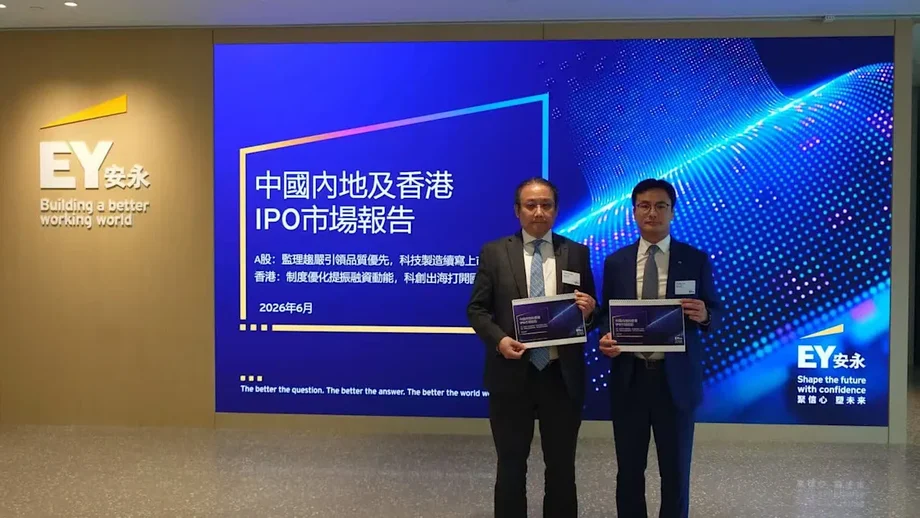
An annual IPO market forecast released by EY on Nov. 25 provides a wider view of the same recovery. EY projected that Hong Kong would raise more than HK$430 billion from more than 140 listings during all of 2026, the highest annual proceeds in five years, and finish second behind Nasdaq. Its review combined actual figures through Nov. 20 with forecasts for the rest of the year. Chan's total of 121 listings and HK$403.9 billion covers the period through October, so the two sets of figures measure different stages of the year.
Several listing changes are intended to sustain that flow. The Tech Enterprises Channel will continue providing mainland technology companies with listing support through a single contact point. Hong Kong has also refined its rules for companies with weighted voting rights, an arrangement under which some shares carry more votes than others. This can allow founders to retain voting control while holding a smaller economic interest.
The government plans to revise the listing regime for specialist technology companies and streamline the disclosures required in a prospectus. A prospectus is the document that explains a company's business, finances and risks to prospective shareholders. Simplifying its presentation can reduce repetition, but investors still need enough information to assess what they are buying.
Faster Settlement Comes With a Closer Look at IPO Demand
Hong Kong Exchanges and Clearing is also preparing to shorten settlement in the cash securities market to T+1. Settlement completes a trade by delivering the securities and money. Under the current T+2 cycle, a purchase made on Monday normally settles on Wednesday, assuming no intervening holidays. Under T+1, it would settle on Tuesday, returning sale proceeds sooner while also requiring buyers to pay sooner.
HKEX set out a T+1 settlement timetable on Oct. 16, targeting the second half of 2028 rather than its earlier proposal for the fourth quarter of 2027. Its consultation conclusions drew on 109 unique responses and identified work involving funding, securities availability, automation and coordination across the industry. The exact launch date has not been set. Implementation depends on regulatory approval, testing and market readiness, while Southbound Stock Connect transactions are due to move to T+1 alongside the local market.
Market growth has also brought attention to the way demand for new shares is assembled. The Securities and Futures Commission announced an IPO book building review on Nov. 16, to be conducted with HKEX. It followed action involving two suspected IPO manipulation groups and restrictions covering as much as HK$4.66 billion in assets.
Book building is the process through which banks collect investor orders, help determine an offering price and decide how shares are allocated. The review examines whether apparently independent demand could instead be supported by an issuer, major shareholders or undisclosed arrangements. SFC chief executive Julia Leung Fung-yee has also said that about 30% of current new listings involve companies without profits. That makes reliable disclosure and genuine investor demand central to a market that is financing many businesses before they become profitable.
Treasury Services, Gold and Industrial Metals Extend the Plan Beyond Listings
Chan said Hong Kong wanted to serve companies after their initial fundraising as well. The government has completed a review of tax concessions for corporate treasury centres and intends to introduce an amendment bill in the first half of 2027. The aim is to attract more leading Greater Bay Area companies to manage their global cash, funding and financial risks from Hong Kong.
He presented this as part of a broader role for the city in serving industrial businesses.
Beyond listing and fundraising, we are working to build an international treasury and supply chain management centre for the real industries of the Greater Bay Area.
A corporate treasury centre coordinates activities such as cash balances, borrowing, currency exposure and payments across a company's operations. The speech did not set out the proposed tax rates or revised eligibility rules, leaving those details for the bill.
Gold provides another set of deadlines. Hong Kong is working to expand its gold storage capacity to more than 2,000 tonnes during 2028. Following trial operations that began in July 2026, the Hong Kong Gold Central Clearing System is scheduled to begin formal operations in the first quarter of 2027. A central clearing system stands between buyers and sellers to complete trades and manage their obligations.
Details of gold futures priced in renminbi and requiring physical delivery are expected by the end of 2026. A futures contract sets terms for a future purchase or sale. Physical delivery means that the contract concludes with gold changing hands rather than only a cash payment.
Hong Kong has also signed a memorandum of understanding with the Shenzhen Local Financial Administration. It supports processing trade cooperation between Hong Kong gold merchants and qualified Shenzhen refining companies. The gold programme is separate from the expansion of industrial metals storage: since the London Metal Exchange added Hong Kong as an approved delivery location in January 2025, the total area of recognised warehouses has exceeded 74,000 square metres. Such warehouses can hold metal used to settle exchange contracts, giving regional manufacturers closer access to international storage, pricing and hedging services.
Green Finance Reaches Beyond Bonds Into Carbon Market Links
Green and sustainable bonds arranged and issued in Hong Kong have ranked first in Asia by volume for eight consecutive years since 2018, Chan said. Bonds allow governments and companies to borrow from investors, while green and sustainable labels connect the borrowing with environmental or sustainability purposes.
HKEX's international carbon market platform, Core Climate, completed two pilot programmes across borders in October 2026. The first enabled Hong Kong companies to buy renewable energy green electricity certificates through the Guangzhou Power Exchange Center. The second tested settlement arrangements for trading Shenzhen carbon emission allowances with the Shenzhen Green Exchange.
A green electricity certificate records electricity generated from renewable sources and can help a company document a renewable energy purchase. A carbon emission allowance permits a holder to emit a specified amount under a trading system. Settlement is the final transfer of money and the certificate or allowance, making it a necessary operational step rather than just an announcement of a trade.
HKEX also signed a comprehensive cooperation agreement with the Guangzhou Power Exchange Center in October. The agreement is intended to develop channels for trading green electricity certificates across the boundary and expand their use among Hong Kong companies. The pilots provide specific examples of the green side of the Finance Plus strategy, linking Hong Kong's financial infrastructure with energy and carbon markets in Guangzhou and Shenzhen.
Credit Records and Data Checks Support the Fourth Direction
The Hong Kong government and local regulators are working with the People's Bank of China and other mainland departments to improve credit reporting across borders and the data validation platform serving Shenzhen and Hong Kong. Credit information helps lenders assess whether companies or individuals can meet their obligations. Data validation concerns the checks used to confirm information when businesses and residents apply for or use financial services.
Chan said the work was intended to benefit more mainland and Hong Kong companies and residents while serving the real economy. He did not announce a completion date, expanded eligibility rules or user targets for the next stage.
He connected this technical work to the safety of businesses expanding outside their home markets.
High quality financial development must serve national priorities and industrial upgrading, while also protecting the safety of companies as they go global.
For companies and residents, the stated value lies in making information usable on both sides of the boundary. A business seeking finance, for example, depends on a lender being able to assess reliable records. The planned improvements therefore address a basic operational barrier alongside the more visible work on listings, bonds and trading platforms.
Existing Agreements Provide the Institutional Base
The latest speech builds on agreements reached with individual Greater Bay Area cities. In November 2025, the Financial Services and the Treasury Bureau and the Shenzhen Local Financial Administration jointly issued an action plan for 2025 to 2027 to develop Hong Kong and Shenzhen as a global financial technology centre. In March 2026, the bureau signed a strategic cooperation framework agreement with the Guangzhou Local Financial Administration to promote financial cooperation between Guangzhou and Hong Kong.
Shenzhen and Guangdong have also used Hong Kong's bond market repeatedly. Since 2021, the two governments have issued offshore renminbi local government bonds in Hong Kong with a cumulative value of 50 billion yuan. The total covers multiple sales and includes green and sustainable bonds. These are debts denominated in China's currency and issued outside the mainland, adding renminbi assets to Hong Kong's market.
Chan said Hong Kong would continue working with Guangdong, the Macao Special Administrative Region and national financial authorities to align rules, connect mechanisms and improve the movement of financial resources. The various agreements matter because cooperation is being built through several channels at once: financial technology with Shenzhen, broader financial services with Guangzhou, gold processing with qualified Shenzhen refiners, and electricity certificate trading with Guangzhou institutions.
Taken together, the measures follow more of a company's financial life than an IPO alone. A mainland technology business could seek capital in Hong Kong, later coordinate international cash and risk through a treasury centre, and draw on regional commodity or green market services as its operations develop. Each activity remains subject to its own rules and approvals; the speech did not create a single automatic route through all of them.
The Next Dates to Watch
Several parts of the programme now have public deadlines or operating targets.
- By the end of 2026: Hong Kong is expected to announce details of gold futures priced in renminbi and settled through physical delivery.
- First quarter of 2027: the Hong Kong Gold Central Clearing System is scheduled to begin formal operations.
- First half of 2027: the government intends to submit the amendment bill covering tax concessions for corporate treasury centres.
- During 2028: Hong Kong aims to expand gold storage capacity beyond 2,000 tonnes.
- Second half of 2028: HKEX is targeting T+1 settlement for the cash market, subject to approval and readiness work, with no exact launch date yet.
Key Points
- Joseph Chan Ho-lim announced four directions for Greater Bay Area financial cooperation at a forum in Foshan on Nov. 28, 2026.
- Hong Kong recorded 121 IPOs raising about HK$403.9 billion in the first 10 months of 2026, up more than 80% from a year earlier.
- More than 350 Guangdong companies were listed in Hong Kong at the end of October, with market capitalisation above HK$6.6 trillion.
- Hong Kong handles about 75% of global offshore renminbi payments by value and has a funding pool of about 1.3 trillion yuan.
- The Hong Kong Monetary Authority's renminbi funding arrangement has a total quota of 500 billion yuan and loan terms of as much as three years.
- Shenzhen and Guangdong have issued a cumulative 50 billion yuan of offshore local government bonds in Hong Kong since 2021.
- Gold clearing, treasury tax legislation and gold storage expansion have targets spread across 2027 and 2028.
- HKEX is aiming for T+1 cash market settlement in the second half of 2028, while regulators are separately reviewing how IPO demand is built.