Hong Kong sets a later target for faster settlement
Hong Kong Exchanges and Clearing Limited plans to shorten its cash market settlement cycle to one business day in the second half of 2028, moving back from an earlier proposal for the fourth quarter of 2027 to give market participants more time to prepare.
Contents
- Hong Kong sets a later target for faster settlement
- What changes when a trade settles sooner?
- How the timetable developed
- Longer processing windows and new settlement tools
- Why overseas investors face a tighter clock
- What retail investors and smaller brokers need
- Banks and industry groups identify practical pressure points
- Stock Connect and ETFs require coordinated changes
- Global alignment brings benefits and more work
- Key Points
HKEX's consultation conclusions, announced on October 16, 2026, drew on 109 unique responses from brokers, custodians, investment managers, industry associations, technology providers, investors and other stakeholders. Respondents broadly supported moving from the current T+2 cycle to T+1, while identifying practical demands involving funding, securities availability, automation and coordination.
The exact launch date has not been set. Implementation depends on regulatory approval and market readiness, with industry testing and readiness assessments to take place before the transition.
For investors, the central change is straightforward: money from a share sale would arrive one business day earlier, while payment for a purchase would also be required one business day earlier. Behind that simple change lies a substantial rebuilding of the processes connecting investors, brokers, banks, custodians and the clearing house.
HKEX Chief Executive Officer Bonnie Y Chan described the expected benefits in announcing the roadmap:
By reducing settlement risk, improving capital efficiency and strengthening market resilience, T+1 will reinforce the attractiveness and connectivity of Hong Kong's markets, whilst keeping our infrastructure aligned with the continued evolution of major international markets.
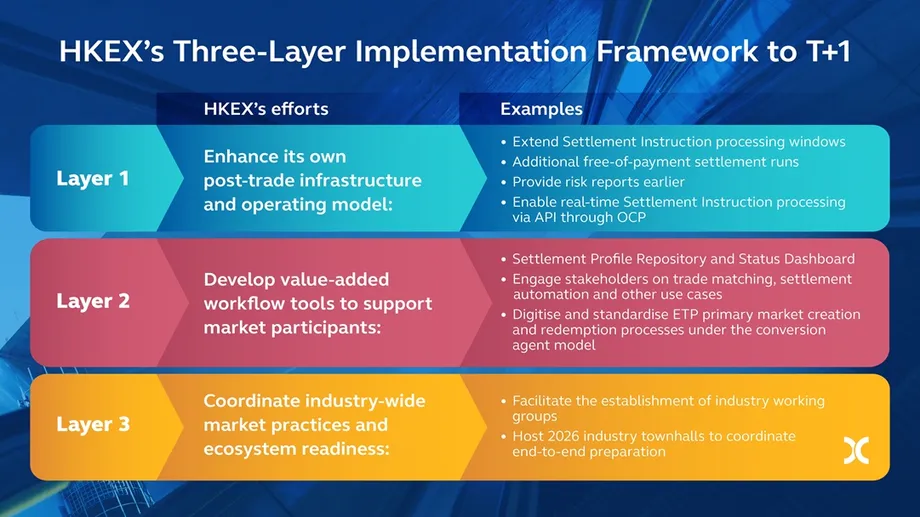
HKEX will pursue three connected areas of work: upgrading its own infrastructure, building tools to improve settlement workflows, and coordinating arrangements across the industry. Southbound Stock Connect transactions, through which Mainland investors buy eligible Hong Kong securities, will move to T+1 alongside the local market.
What changes when a trade settles sooner?
A trade takes place when a buyer and seller agree to exchange securities at a price. Settlement completes the transaction by delivering the securities and the money. The letter T means the trading day; the number tells investors how many business days later settlement occurs.
A purchase made on a Monday currently settles on Wednesday, assuming there are no intervening holidays. Under T+1, it would settle on Tuesday. Hong Kong has operated under T+2 since 1992, according to HKEX's July 2025 discussion paper.
HKEX argues that completing trades sooner reduces the value of transactions waiting to settle and shortens the period during which a payment or delivery problem can emerge. Money can also return to investors sooner, and intermediaries may need to commit less collateral, the financial protection posted against outstanding risks.
The discussion paper cited a reported 23% reduction in US clearing house margins following the American transition to T+1. Any savings in Hong Kong would depend on local trading patterns and risk arrangements. Hong Kong already has a high level of settlement efficiency: the paper put daily average efficiency for Continuous Net Settlement stock positions between 99.88% and 99.95% during 2024.
How the timetable developed
HKEX began formal discussion in July 2025 and published a detailed consultation in April 2026. Its April 2026 consultation paper proposed implementation in the fourth quarter of 2027, allowing about 15 months after publication of detailed specifications.
The later target reflects requests for more preparation time. The sequence now combines infrastructure delivery, participant development and testing:
- July 16, 2025: HKEX published its discussion paper, with feedback closing on September 1.
- April 2026: HKEX consulted on the operating model and timetable, with responses due by May 18.
- October 16, 2026: HKEX announced consultation conclusions and a target of the second half of 2028.
- During 2026: Industry townhalls and working group activities are planned to explain arrangements and coordinate preparation.
- First half of 2027: The roadmap schedules Orion Cash Platform interfaces and functionality for settlement instructions in real time.
- Second half of 2027: Participants are scheduled to develop and prepare their systems.
- First half of 2028: Participants are scheduled to conduct their own testing.
- Second half of 2028: HKEX targets the transition, subject to readiness and approval.
The earlier discussion process received more than 60 formal responses. The 109 unique responses relate to the subsequent consultation, which sought views on the more detailed proposal.
Longer processing windows and new settlement tools
HKEX's first implementation layer changes the infrastructure used after trading. Planned measures include longer processing windows for settlement instructions, additional transfers of securities without an accompanying payment, earlier risk reports and updates through application programming interfaces, or APIs. APIs allow computer systems to exchange information automatically.
The Orion Cash Platform will support instruction entry, status updates and matching in real time. Matching checks that the parties agree on the details needed to complete a transfer. Finding a mismatch earlier gives firms more time to correct it before settlement.
Additional free-of-payment settlement runs will support preparation at 8pm and 10pm on the trading day and 8am the following business day, Hong Kong time. These runs let securities move outside regular money payment hours, ahead of the normal settlement batches.
The April proposal retained four regular settlement batches at 10:30am, noon, 2pm and 3:45pm. It also proposed generating the Final Clearing Statement at 8pm on the trading day rather than 2pm the following business day, giving clearing participants earlier confirmation of their positions.
The same proposal extended instruction input to 10pm and matching to 9:30pm on the trading day, compared with existing deadlines of 7pm and 6pm respectively. Those detailed times describe the April proposal; the October roadmap commits to a refined operating model and further technical specifications.
HKEX's second implementation layer includes a Settlement Profile Repository and Status Dashboard. Standing Settlement Instructions, often shortened to SSIs, contain recurring details about where securities or money should be delivered. Better maintained instructions and a shared view of progress should help firms spot errors and unfinished transfers sooner.
Why overseas investors face a tighter clock
Global institutional investors account for more than 60% of Hong Kong cash market turnover, according to the April consultation paper. Their role makes time zones a central design issue rather than a problem affecting only a small group of overseas customers.
Hong Kong is 13 hours ahead of the US East Coast and 16 hours ahead of the West Coast outside daylight saving time, the July 2025 paper explains. Work completed after a Hong Kong trading session may therefore require attention before the normal American working day begins.
HKEX describes the practical demand on some international firms as a T+0 timeline for funding, allocation and confirmation. Allocation means dividing a large trade among the investment funds or accounts it belongs to. Confirmation checks the agreed details. Both steps must finish early enough for the correct securities and money to reach settlement.
Some firms on the North American West Coast may need staff available on Sunday afternoons to resolve exceptions ahead of Hong Kong's Monday settlements. Automated communication can keep routine processing moving outside office hours, while people handle problems that require a decision.
Currency conversion adds another deadline. HKEX's discussion paper notes that many foreign exchange transactions involving the Hong Kong dollar and offshore renminbi normally settle after two business days. An investor buying securities that settle after one business day must arrange currency funding that arrives in time.
A mismatch can also arise between markets. An investor selling securities in a T+2 market and buying in a T+1 market would need to pay for the purchase one business day before receiving the sale proceeds. That creates an overnight funding gap, requiring available cash or temporary financing.
What retail investors and smaller brokers need
Retail investors who put sufficient money into their accounts before trading should face relatively little change to purchase funding, HKEX says. Customers who pay after placing an order will have less time to transfer money. Sellers should receive proceeds one business day sooner.
Paper cheques require particular attention. The April paper says cheque deposits must be made on the trading day before the relevant bank deadlines because deposited paper cheques settle on the next working day. Broker funding deadlines and bank processing windows will therefore matter to customers who rely on them.
Hong Kong's Acting Secretary for Financial Services and the Treasury, Joseph Chan, addressed preparation in an October 7 Legislative Council reply. He said HKEX would consider the practical needs of smaller and medium sized brokers when setting the implementation timetable and provide sufficient preparation and testing time.
The government's response described technical specifications, operational guidance, briefings, standardisation and testing support. It also said HKEX and the Investor and Financial Education Council would be encouraged to strengthen public education on funding and other trading and settlement changes.
Smaller brokers must assess more than software. They need staff able to resolve late instructions, procedures for identifying client funding shortfalls and reliable links with banks and custodians. A shorter cycle leaves less time to repair the same errors they handle today.
Banks and industry groups identify practical pressure points
The Hong Kong Monetary Authority began urging banks to prepare in August 2025. Its banking preparedness letter, signed by Carmen Chu, Executive Director of Banking Supervision, said many authorised institutions considered themselves well prepared because of experience in overseas T+1 or T+0 markets.
The HKMA nevertheless asked banks to assess operations, liquidity, funding and customer services, particularly for international investors. Banks were expected to allocate resources where necessary, work with service providers and system vendors, and participate in industry testing.
The Hong Kong Securities & Futures Professionals Association supported the earlier fourth quarter of 2027 target in its May 18, 2026 formal consultation response. Signed by Chairman Mofiz Chan, the response recommended at least two market simulation tests in early 2027 covering normal operations and stressed conditions.
The association also warned that extending system hours would leave delays in place if instructions continued passing manually through several custody layers. International investments can involve a fund manager, global custodian, local custodian and broker, each checking and transmitting information.
Its recommendations included earlier technical standards, regular readiness surveys, training and stronger controls over settlement data. The October roadmap's third layer addresses industry coordination through working groups examining securities lending, funding, liquidity, foreign exchange and currency holidays. These are dependencies that an exchange system upgrade alone cannot resolve.
Stock Connect and ETFs require coordinated changes
Southbound Stock Connect will follow Hong Kong's move to T+1. HKEX will work with China Securities Depository and Clearing Corporation and other stakeholders on the transition. Southbound trading represented 23% of Hong Kong turnover in the first half of 2025, according to the discussion paper.
Northbound Stock Connect, which lets investors trade Mainland securities through Hong Kong, remains under Mainland settlement arrangements. The April proposal also excludes initial public offerings and the issuance and final settlement of structured products from the general T+1 change.
Exchange traded funds require additional coordination because trading their units is linked to creating and redeeming those units. Creation adds ETF units, while redemption removes them, through arrangements involving participating dealers and the fund's assets or cash.
Exchange traded products represented 16% of Hong Kong cash market turnover in the first half of 2025. HKEX plans an ETP platform to digitise and standardise ETF creation and redemption under the conversion agent model, helping that market adjust alongside ordinary exchange trading.
The April consultation says ETF primary market settlement should align with T+1 where feasible, or move as close as practicable. The July 2025 discussion model had excluded primary creation and redemption from its general scope; the later proposal gives this activity a specific alignment objective.
ETFs holding overseas assets can face different settlement times for their units and underlying investments. Late delivery of part of an asset basket may delay creation, leaving a market maker short of the units needed to complete a sale. Securities lending faces similar pressure because recalled shares must return within a shorter window.
Global alignment brings benefits and more work
India completed its phased transition to T+1 on January 27, 2023. The United States and various markets in the Americas followed on May 28, 2024. HKEX's April consultation lists October 11, 2027 as the planned transition date for the European Union and European Economic Area, the United Kingdom and Switzerland.
Hong Kong's revised target places its transition after those European plans. The additional preparation time must accommodate international firms working on several market changes, alongside local brokers, banks and technology providers adapting their own systems.
Securities and Futures Commission Chief Executive Officer Julia Leung has also called for greater automation and stronger operational processes as Hong Kong advances T+1. Separately, Hong Kong is studying longer trading hours, beginning with derivatives. The April T+1 proposal keeps order placement, trading hours and trade execution unchanged.
Other proposed adjustments reach company events and administration. The April paper would move the date when shares begin trading without an entitlement, such as a dividend, to the last registration date or applicable record date. It also proposes bringing forward form SD-1 submission and stamp duty payment by one business day.
HKEX's roadmap therefore joins two objectives: reducing the time that trades remain unfinished and ensuring every participant can complete the necessary work within that shorter period. The target is the second half of 2028; systems, funding arrangements, accurate instructions and coordinated testing will determine readiness.
Key Points
- HKEX targets T+1 cash market settlement in the second half of 2028, later than its earlier fourth quarter of 2027 proposal.
- The consultation received 109 unique responses and found broad support for faster settlement.
- Purchases would require payment one business day earlier, while sellers would receive proceeds one business day earlier.
- Planned changes cover infrastructure, settlement data tools, ETF workflows and industry coordination.
- Southbound Stock Connect will move with Hong Kong; Northbound trading retains Mainland arrangements.
- The exact launch date depends on regulatory approval and market readiness, with testing and readiness assessments ahead of implementation.