Hong Kong closes 2026 with a deep pipeline and a cooler second half
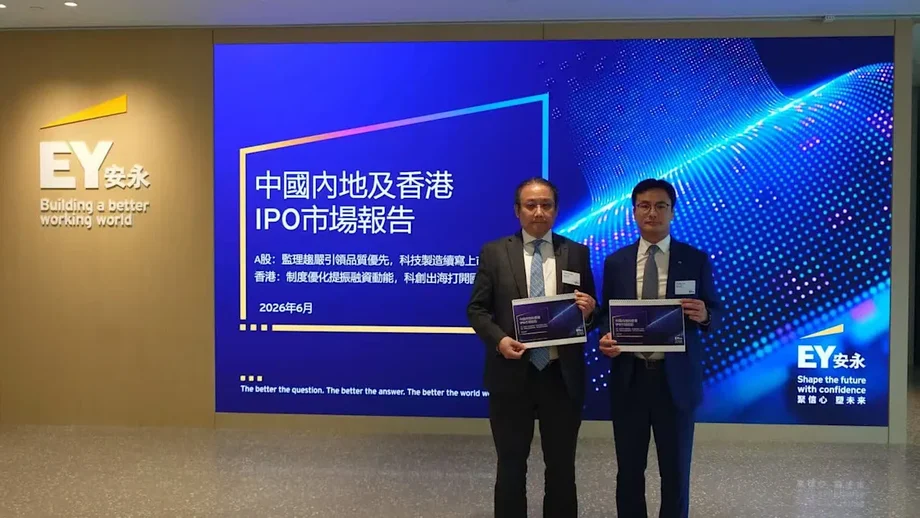
Hong Kong is on course to raise more than HK$430 billion, or about US$54.9 billion, from initial public offerings in 2026, the highest annual total in five years, according to EY's 2026 market review. The firm expects more than 140 listings, about 23% more than in 2025, and a 50% rise in money raised. The Xinhua report said the figures came from an EY report released on Nov. 25.
Contents
- Hong Kong closes 2026 with a deep pipeline and a cooler second half
- What the 2026 forecast covers
- Why large deals shaped the fundraising total
- A+H listings became the engine
- Technology led the listings boom
- How Hong Kong compared with the world
- The second half cooled even as totals rose
- Timeline: a hot start, a cooler finish
- What the 610 company pipeline means for 2027
- Mainland China's market grew in two different ways
- Red chips, withdrawals and pricing remain the tests
- Key Points
An IPO is the first sale of a company's shares to public investors. Companies use it to raise money from a wide pool of investors, while investors get a chance to buy shares that were previously private. EY put Hong Kong second among global venues by funds raised, behind Nasdaq. Nasdaq was expected to raise about US$254.3 billion, close to HK$1.98 trillion, helped by a small number of very large deals.
The Shanghai Stock Exchange was ranked third with about US$25.9 billion, or more than HK$200 billion. The New York Stock Exchange was fifth with about US$18.3 billion, or more than HK$140 billion. For Hong Kong, second place is a strong result because the exchange has rebuilt its ability to attract very large listings after several quieter years.
What the 2026 forecast covers
EY's 2026 Mainland China and Hong Kong IPO Market Review and Outlook combines actual data from Jan. 1 to Nov. 20 with forecasts for Nov. 21 to Dec. 31. That matters because the weakest monthly returns appeared late in the year, while the fundraising total still reached a peak unseen in five years. The forecast is a snapshot of both what happened and what EY expects before the calendar closes.
The estimated number of listings, about 140 or more, is rounded from 22.8% growth from 2025. The money raised is expected to be about 50% higher than in 2025. Those two figures tell different stories. More companies listed, but the sharper rise in proceeds came from larger deals rather than a simple increase in deal count.
When mainland China and Hong Kong are counted together, EY expected more than 310 new listings and more than US$100 billion in fundraising, up 24% and 59% from 2025. The two markets together accounted for 27% of global IPO count and 23% of global funds raised. That share shows how central Greater China has become to the global new listing market this year.
Why large deals shaped the fundraising total
EY said the ten biggest Hong Kong IPOs of 2026 would raise about HK$180.7 billion, equal to 44% of all proceeds in the market. The smallest of those ten was expected to raise HK$8 billion and the largest HK$61.4 billion, compared with a range of HK$6.3 billion to HK$41 billion in 2025. The total for the top ten was about 16% higher than in 2025.
This concentration explains the tension in the market. A market can raise more money while listing fewer companies when a handful of offerings are much larger. For ordinary investors, that means the headline fundraising number is heavily linked to a few issuance windows, not to steady activity across every month.
EY's HK$430 billion estimate leaves about HK$20 billion of additional proceeds in the final six weeks if the forecast is met. Deloitte forecast at least HK$480 billion, KPMG near HK$500 billion and a total above the HK$449.5 billion high set in 2010, while PwC's midyear forecast was HK$380 billion. The final figure will depend on which deals price and list before the calendar closes.
A+H listings became the engine
An A+H listing means a company sells A shares in mainland China and H shares in Hong Kong. The structure gives a company access to two investor bases and two currencies. In Hong Kong, these listings often involve large mainland companies that want an international trading platform.
EY expected 40 A+H listings in 2026, raising more than HK$280 billion. That is about two thirds of Hong Kong's projected IPO proceeds. A+H projects made up nine of the year's ten biggest Hong Kong IPOs, up from six in 2025, led by companies in technology, industry, retail and consumer goods. Mainland companies made up 97.6% of Hong Kong's IPO count and 99.2% of proceeds.
Jacky Lai, EY Hong Kong Capital Market Services Spokesperson, said at a press briefing that A+H listings should remain a main theme in 2027 because mainland industry leaders and technology companies still want to raise money in Hong Kong. He said investor attention had moved beyond listing mechanics toward business models, order books and whether large companies are among customers.
Technology led the listings boom
Technology companies completed 55 IPOs and raised about HK$213.4 billion, ranking first among all sectors by both deal count and money raised. That amount is close to half of Hong Kong's projected IPO proceeds for the year. The sector included companies tied to AI computing power and semiconductor supply chains, along with firms using Hong Kong's specialist technology listing route.
Chapter 18C is the part of Hong Kong's listing rules designed for specialist technology companies, including firms with promising technology but limited profit history. It requires extra disclosure and investor protections. Industrials ranked second with 33 listings and HK$118 billion. Biotechnology and health ranked third with 18 listings and HK$49.6 billion, including 11 under Chapter 18A, Hong Kong's route for biotech companies before they have product revenue.
Li Kang, EY's Greater China technology, media and telecoms joint head, said technology's lead reflected capital spending and listing cycles in AI computing and semiconductors, as well as the pull of special listing routes. He also pointed to changes that could help the sector in 2027.
In 2026, the technology sector ranked first in Hong Kong IPO count and funds raised. This reflects the capital expenditure and listing cycle of AI computing power and semiconductor supply chains, and the continuing appeal of channels such as Chapter 18C.
How Hong Kong compared with the world
Nasdaq led global IPO fundraising with about US$254.3 billion. EY said that was about 8.6 times its 2025 level, even though Nasdaq listed 69 new shares, roughly 57% fewer than in 2025. The exchange's lead came from scale, not from a large number of listings.
EY put Anthropic and SpaceX together at more than US$190 billion. Adding SK Hynix brought the three largest global deals to about US$220 billion in the broader tally. Those deals explain how Nasdaq could raise far more money while bringing fewer companies to market.
Worldwide, around 1,160 IPOs raised more than US$430 billion, with deal count down 13% and proceeds up 143%. This was a market driven by a small group of giant offerings. Hong Kong's second place came from its own cluster of large A+H and technology deals, while Nasdaq's lead came from the biggest global names.
The second half cooled even as totals rose
The headline growth hides a shift in market mood. EY's data showed 84 listings and HK$209.8 billion raised in the first half, up 100% in deal count and 92% in proceeds from a year earlier. The second half had about 56 listings and HK$220 billion, with deal count down about 22% while proceeds rose about 24%.
Returns on the first trading day fell sharply. The average was 126% in April, 98% in May and 79% in June. It then dropped to 7% in July, 32% in August and 31% in September, before turning negative at minus 2% in October and recovering to 27% in November. The average for the whole year was 50%. More than half of the new listings since September traded below their issue price, meaning buyers at the offering were sitting on paper losses.
Lockups on restricted shares also weighed on sentiment. A lockup is a rule that stops early investors from selling shares for a period after listing. EY counted more than HK$1 trillion of lockup expiries for the whole year, with September alone accounting for 34%. He Zhaofeng, EY's Greater China listing services head, said the effect depended mainly on who held the shares and how those holders behaved, rather than the headline amount.
The HK$1 trillion lockup expiry is expected to settle smoothly.
Cornerstone investors remained common. EY said 84% of new listings had them, up from 78% in 2025. A cornerstone investor commits to buy shares before the listing and usually agrees to hold them for a set period. EY also found that companies and industry investors made up 30% of cornerstone allocations, up from 20%, with sovereign funds from the Middle East and Singapore taking part.
Timeline: a hot start, a cooler finish
The year moved from strong investor appetite to more careful pricing. The main dates show how the market changed before EY made its 2027 forecast.
- Jan. 1 to Nov. 20: the actual data period used in EY's 2026 market review.
- April to June: average first trading day returns reached 126%, 98% and 79%; the first half recorded 84 listings and HK$209.8 billion.
- July 9: seven new shares, including Luxshare Precision, Luoshi Robotics and Qiyunshan Food, listed together, the busiest single day of the year.
- September: more than half of listings since that month traded below issue price, and September accounted for 34% of the year's lockup expiries.
- Nov. 20: Hong Kong Exchanges and Clearing Limited was processing around 610 listing applications.
- Nov. 25: EY released its review, forecasting more than 140 Hong Kong listings and more than HK$430 billion in proceeds.
- 2027: EY expects about HK$300 billion in Hong Kong IPO fundraising, with pressure first and recovery later.
For companies planning listings, the timeline changes the practical question. The issue is no longer only whether Hong Kong can attract deals, but whether investors will accept prices after a period of weaker secondary market returns.
What the 610 company pipeline means for 2027
Hong Kong Exchanges and Clearing Limited had about 610 listing applications under review as of Nov. 20, according to EY, and a later description put the figure at about 610 near the end of November. The applications covered technology, industrials, consumer products, retail, biotechnology and health. EY also counted more than 50 companies that had filed but were not yet listed. Applications can be withdrawn or delayed, so the pipeline is a reserve of possible deals rather than a list of completed offerings.
Jacky Lai forecast about HK$300 billion of Hong Kong IPO fundraising in 2027 and a place among the global top three. He expected a pattern of pressure first and recovery later. The first quarter could see fewer IPOs because the secondary market has been correcting since the second half of 2026 and investors need time to absorb this year's large offerings. He saw scope for a breakthrough in the second quarter and a stronger pace in the second half.
Lai also said a possible very large United States IPO, which he described as a market rumor naming OpenAI, could keep Hong Kong competing for second or third place with mainland exchanges. The company identity was not confirmed, and no date was given for that deal. Hong Kong's own large deals could also influence the final ranking.
Investor appetite outside the IPO market remains mixed. UBS's wealth management investment office rated Hong Kong shares neutral in its 2027 outlook. Li Zhiying, its Greater China equities head, said Hong Kong shares were under pressure and she favoured medicine, banks and some utility stocks. That matters for new listings because IPO pricing depends heavily on how public markets value comparable companies.
Mainland China's market grew in two different ways
A shares are shares of companies listed in mainland China and traded in yuan. EY expected more than 170 A share listings in 2026, including public REITs, with fundraising above RMB299 billion. By Nov. 20, the market had recorded 157 listings raising RMB285.3 billion. The Beijing Stock Exchange had 70 listings, Shanghai's main board 27, the STAR Market 20, Shenzhen's main board 17 and ChiNext 23.
Yang Shujuan, EY's Greater China government and infrastructure market leader and Beijing managing partner, said the growth came from two different parts of the market. She linked the rise in deal count to the Beijing Stock Exchange and the rise in funds raised to larger technology projects on the STAR Market.
The A share IPO market is driven mainly by two themes. First, issuance rose sharply after the Beijing Stock Exchange was established as the main venue for innovative small and medium enterprises. Second, the STAR Market's fifth listing standard was expanded to AI large model companies, allowing very large hard technology projects to list and lifting fundraising scale.
Industry rankings changed depending on the measure. By deal count, industrials, materials and technology accounted for 72% of A share IPOs. By funds raised, technology, REITs and industrials accounted for 79%. REITs, or real estate investment trusts, are funds that own properties producing income and trade like shares, so their pricing works differently from ordinary company shares. Regionally, Zhejiang, Jiangsu, Guangdong, Anhui, Beijing and Shandong had 105 listings combined, close to 67% of the total. By money raised, Anhui, Guangdong, Zhejiang, Jiangsu and Shanghai raised RMB207.6 billion, or 73% of the total.
Large mainland deals became more important. The average size of the ten biggest A share IPOs rose to RMB13.5 billion from RMB5.6 billion in 2025, and the overall average first trading day return reached 266%, the highest since 2022. At the same time, only three Chinese companies listed in the United States in the first ten months of 2026, raising US$157 million, a five year low. Financing demand did not vanish; more of it moved to mainland and Hong Kong markets.
Red chips, withdrawals and pricing remain the tests
Red chip companies have mainland roots but are incorporated outside mainland China. Foreign media earlier cited anonymous people saying the China Securities Regulatory Commission had told some law firms it would not approve listings outside the mainland by red chip companies with short operating histories. That claim was not officially confirmed. Lai said the number of red chip companies applying to list in Hong Kong was small, so he expected limited effect on the city's IPO market.
Some companies also withdrew listing plans. Lai said a company's choice of venue can reflect valuation or overseas expansion plans. He said withdrawn cases made up a small share and were expected to have limited impact.
Chapter 18A activity also slowed later in the year. EY counted 11 of the 18 biotechnology and health listings through that route, all by the first half. For companies preparing 2027 listings, EY advised early checks on shareholding structures, compliance reviews and working paper standards from the business source, plus valuation and profit logic that can withstand secondary market trading. It also advised careful timing of issuance windows.
Hong Kong enters 2027 with a large pipeline and a more cautious investor base. The market's next test is whether companies can bring strong deals at prices that hold after listing, especially in the first half when liquidity and sentiment may remain tight.
Key Points
- Hong Kong is forecast to raise more than HK$430 billion, about US$54.9 billion, from more than 140 IPOs in 2026.
- The total would be 50% higher than in 2025 and the highest in five years, ranking Hong Kong second globally behind Nasdaq.
- Nasdaq is expected to raise US$254.3 billion, helped by Anthropic, SpaceX and SK Hynix, even with fewer listings.
- A+H listings are expected to raise more than HK$280 billion, close to two thirds of Hong Kong's proceeds.
- Technology led by deal count and proceeds, with 55 IPOs raising about HK$213.4 billion.
- First trading day returns fell from 126% in April to minus 2% in October, showing a cooler second half.
- Hong Kong Exchanges and Clearing had about 610 listing applications under review, giving 2027 a strong project reserve.
- EY expects about HK$300 billion in Hong Kong IPO fundraising in 2027, with pressure first and recovery later.