Exports power a stronger economic outlook
Hong Kong raised its 2026 economic growth forecast to 4.8% on November 13, after goods exports surged 30.3% in the third quarter and economic output expanded at its fastest pace for the first nine months of a year in five years. The government also lowered its inflation forecasts, giving the city an outlook of stronger growth alongside more moderate price increases than previously expected.
Contents
- Exports power a stronger economic outlook
- What changed between August and November?
- Why AI matters so much to Hong Kong
- Household spending grows at a gentler pace
- Investment and services broaden the expansion
- Jobs remain steady as more people seek work
- Why the inflation forecast fell
- Interest rates, oil and trade remain risks
- Banks expect growth to ease in 2027
- Key Points
The new growth projection replaces the range of 3.5% to 4.5% set in August. It is 0.3 percentage points above the top of that range. Government Economist Irina Fan attributed the improved outlook to strong global investment in artificial intelligence, related trade and steady spending within Hong Kong.
The government's third quarter economic report put real gross domestic product growth at 5.2% compared with a year earlier, up from 4.2% in the second quarter. Growth across January through September reached 5.1%.
Detailed tables titled "Gross Domestic Product and its major components" are available in PDF and Excel formats on the government's economic development page.
GDP measures the value of goods and services produced within an economy. Real growth adjusts for price changes, allowing readers to see whether economic activity increased rather than simply whether prices rose.
Hong Kong's gains reached beyond exports. Private consumption increased 2.9%, investment rose 7.5% and services exports expanded 4.3% in the third quarter. Those figures show several sources of growth, although goods trade was expanding much faster than household spending. For residents, the immediate picture was one of rising employment income and moderate inflation, alongside a small increase in unemployment.
What changed between August and November?
The government upgraded its forecast after receiving stronger economic results for the first three quarters and seeing evidence of continued momentum entering the final quarter. Fan said exports remained buoyant in October, while preliminary visitor figures showed an increase of about 11% from a year earlier.
The November 13 release confirmed the 5.2% annual GDP increase announced in the November advance GDP estimates. Compared with the immediately preceding quarter, output rose 1.9% after adjustment for regular seasonal patterns, following a 0.7% decline in the second quarter.
The main stages in the forecast update were:
- August 2026: The government set its annual growth forecast at 3.5% to 4.5%.
- July through September: GDP grew 5.2% from a year earlier and 1.9% from the preceding quarter after seasonal adjustment.
- November 3: Advance estimates put growth for the first nine months at 5.1%.
- November 13: The government confirmed third quarter GDP growth and raised its annual forecast to 4.8%.
The new annual forecast remains below the 5.1% growth recorded over the first nine months. It therefore allows for a slower annual growth rate in the final quarter while still delivering a stronger year than the government expected in August.
Why AI matters so much to Hong Kong
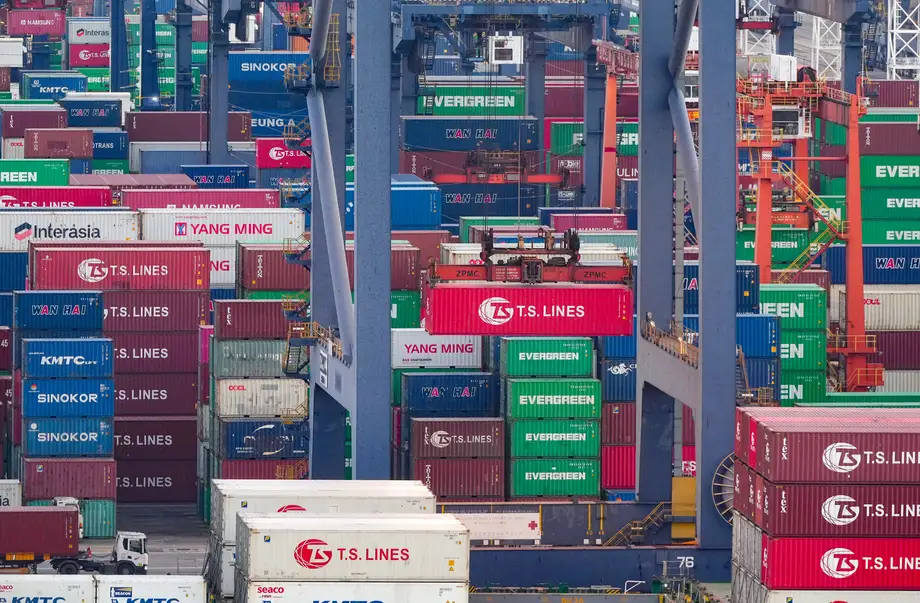
Artificial intelligence related electronic products account for about 75% of Hong Kong's exports, according to Fan. That is roughly three quarters of the total, making demand for this category a central force in the city's trade performance.
Global spending on AI infrastructure and business technology is generating demand for semiconductors and other electronic equipment. Hong Kong benefits through its role in international supply chains and the movement of goods between markets. Goods exports grew 30.3% in real terms in the third quarter, compared with 2.9% growth in private consumption.
Fan pointed to strong October exports in nearby economies that manufacture semiconductors. She also cited Semiconductor Industry Association member sales data indicating high double digit growth in global semiconductor sales in 2027. She expected continued demand to support Hong Kong's exports, including during the first two quarters of next year.
The same concentration creates exposure to changes in AI investment. Fan said recent market volatility around AI spending had not yet affected activity in the real economy, meaning production, trade and business operations. The government was monitoring the risk that overly optimistic expectations could lead to a market correction.
Household spending grows at a gentler pace
Private consumption rose 2.9% from a year earlier in the third quarter, marking its sixth consecutive quarter of expansion. Rising employment income and steady consumer sentiment were among the supports identified by the government.
The pace was much more modest than the increase in goods exports. This helps explain why a strong GDP result can coexist with less dramatic changes in everyday spending: overseas demand for electronics and local purchases of meals, goods and services are moving at different speeds.
Dah Sing Financial Group's chief economist and strategist said spending on consumer goods had slowed for two consecutive quarters, while spending on services remained steady and supported consumption growth. The difference matters for businesses because demand can improve in one part of the local economy while remaining softer in another.
Visitors provide another source of spending. Preliminary figures indicated that arrivals in October were about 11% higher than a year earlier. The government expected continued tourism growth, together with stable demand for international financial and business services, to support services exports in the final quarter.
Investment and services broaden the expansion
Investment spending increased 7.5% in the third quarter, with the government identifying strong private sector investment as the main driver. Business investment includes spending on assets used to produce goods and services, helping explain why it can support both current activity and future capacity.
Dah Sing's assessment also pointed to a large increase in inventories alongside strong trade. Inventories are goods that businesses hold before selling or using them. More goods moving through the trading economy can lead companies to carry larger stocks.
Building and construction remained less buoyant. Dah Sing said the decline in public and private building and construction activity narrowed compared with the first half, while private developers remained cautious about advancing projects.
Services exports grew 4.3%, with all major categories continuing to expand, according to the government. Strong merchandise trade and tourism can support transport services, while demand for financial and business services gives the economy another channel for earning income from overseas customers.
Jobs remain steady as more people seek work
Hong Kong's seasonally adjusted unemployment rate edged up to 3.9% in the third quarter. Both the labour force and total employment increased from the preceding quarter as graduates and school leavers entered the job market.
The labour force grew faster than employment, pushing the unemployment rate slightly higher. In simple terms, more people found work, but the number working or looking for work grew even faster. The government described labour market conditions as broadly stable.
Employment income continued to rise from a year earlier, supporting household purchasing power. Standard Chartered also cited a survey of small and medium sized businesses showing that hiring intentions were steady, despite the slight increase in unemployment.
Residential property prices were broadly stable during the quarter. Transaction volumes remained relatively firm and close to their average over five years. The Hang Seng Index finished the quarter 7.6% above its level at the end of June, although share prices fluctuated. Together, the figures showed stronger equity prices alongside a steadier housing market.
Why the inflation forecast fell
The government cut its 2026 underlying inflation forecast from 2.5% to 1.9%, a reduction of 0.6 percentage points. It lowered its headline inflation forecast from 2.6% to 2.0%, also by 0.6 percentage points.
Headline inflation measures the change in the consumer price index as published. Underlying inflation removes the effects of the government's temporary relief measures, helping show the price pressures households face beyond those measures.
Actual inflation had been lower than expected, partly because earlier increases in international oil prices were taking longer to reach fuel related consumer prices. Government fuel subsidies and related measures also provided some relief.
Underlying inflation nevertheless rose from 1.7% in the second quarter to 2.0% in the third. Fuel related prices were a source of pressure, while price increases across other categories generally remained mild. Fan expected inflation of about 2% in the final quarter.
The delayed effect of higher oil prices is expected to continue into 2027, including the first and second quarters. Households may therefore still encounter fuel related increases even as annual inflation comes in below the government's previous forecast. Lower inflation means prices are rising more slowly, rather than that the cost of living has returned to an earlier level.
Interest rates, oil and trade remain risks
Fan identified geopolitical tensions, trade restrictions and US monetary policy as risks to the outlook. Persistent tensions in the Middle East could raise global inflation pressures and influence interest rate decisions by major central banks.
At the time of the forecast update, markets expected the US Federal Reserve might increase rates by 25 basis points before the end of 2026 and make another increase around the middle of 2027. Twenty five basis points equals one quarter of a percentage point. Those were market expectations; the decisions were still ahead.
Fan said she did not expect a rapid cycle of interest rate increases. She also pointed to ample funds in Hong Kong's domestic market and liquidity in the banking system, saying local banks might not follow every US increase and that the expected economic effect would be relatively mild.
The government was also watching rising sovereign bond yields in major advanced economies with high public debt. A bond yield is the return investors demand to lend money. Higher yields can make borrowing more expensive and influence how investors value shares and other assets.
Renewed trade tensions could affect an economy benefiting heavily from goods moving across borders. Fan said Hong Kong exporters had continued to perform strongly and were seeking new markets, while the government monitored possible changes in restrictions on electronic products.
Banks expect growth to ease in 2027
Dah Sing raised its 2026 growth forecast from 3.9% to 4.9%, placing it just above the government's new 4.8% projection. The bank kept its 2027 forecast at 2.2%, citing uncertainty over China and US trade relations and the Middle East.
The bank also pointed to the high comparison base created by this year's export surge. When exports have already risen sharply, the following year's percentage increase can become smaller even if demand remains healthy. This is one reason strong technology demand can coexist with an expectation of slower GDP growth.
Standard Chartered's baseline forecasts were 4.3% growth for 2026, 3.2% for the fourth quarter and 2.7% for 2027. Its senior economist for Greater China and North Asia said all three forecasts could be revised upward, citing steady consumption, visitor spending and trade linked to AI.
Standard Chartered identified global AI investment as a possible risk for 2027, while expecting projects already committed and related purchasing orders to continue. The pace of future investment remains uncertain. Its assessment also pointed to domestic consumption as support for growth next year.
The forecasts converge on a strong 2026 followed by slower expansion in 2027, though they differ on the pace. For Hong Kong, the practical issue is whether rising local income, visitor spending and private investment can sustain activity as comparisons with this year's exceptional export growth become more demanding.
Key Points
- Hong Kong raised its 2026 real GDP growth forecast to 4.8%, from a range of 3.5% to 4.5%.
- Third quarter GDP grew 5.2% from a year earlier; growth over the first nine months reached 5.1%.
- Goods exports increased 30.3%, supported by demand for AI related electronics, which account for about 75% of exports.
- Private consumption rose 2.9%, investment increased 7.5% and services exports grew 4.3%.
- The unemployment rate edged up to 3.9% as the labour force grew faster than employment.
- The government cut its underlying inflation forecast to 1.9% and its headline forecast to 2.0%.
- Oil prices, trade restrictions, interest rates and changes in AI investment remain the main external risks.