A $5 billion listing faces a $700 million claim
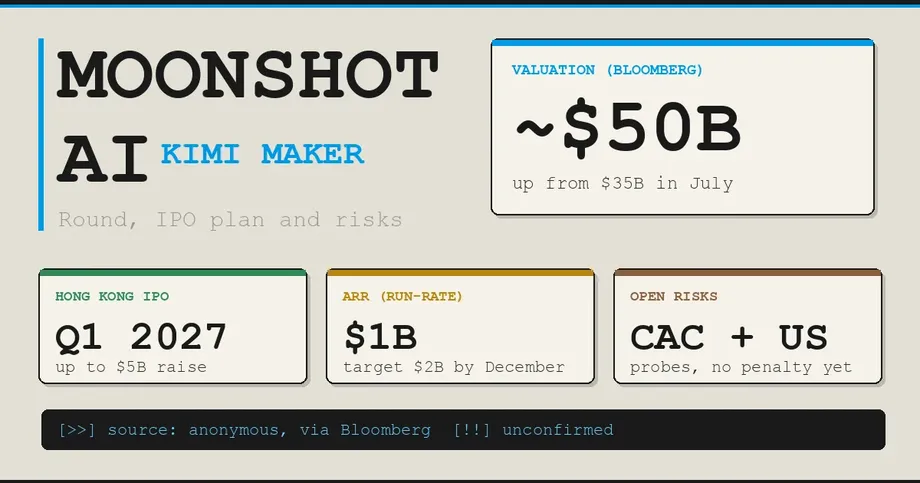
Moonshot AI, the Beijing company behind the Kimi artificial intelligence assistant, is preparing a Hong Kong listing that could raise $3 billion to $5 billion after a private financing reportedly valued it at about $50 billion. The proposed offering, targeted for the first quarter of 2027, comes alongside a legal claim worth more than $700 million, government scrutiny and a push to sell its technology outside China.
Contents
- A $5 billion listing faces a $700 million claim
- How the valuation reached $50 billion
- What the Hong Kong plan involves
- The shareholder dispute behind the offering
- What $1 billion in annualized revenue means
- Kimi K3.1 Pro adds a new commercial test
- Singapore hiring points toward overseas sales
- Government scrutiny adds another risk
- What users and investors can expect next
- Key Points
The company's reported annualized recurring revenue rose from about $300 million in June 2026 to more than $1 billion in August. Its October valuation would put Moonshot at roughly 50 times that revenue measure, a price that places substantial weight on future growth.
Moonshot has not confirmed the latest valuation or committed publicly to a listing date. Its response to reports of a confidential application was that it does not comment on rumors. A public prospectus would give investors a fuller account of its finances, ownership and legal risks before they decide what its shares are worth.
The immediate challenge extends beyond selling a popular chatbot. Moonshot must turn demand for Kimi into lasting customer payments while paying for computing infrastructure, developing new models and addressing a dispute involving assets allegedly transferred from an earlier business.
For users, the most immediate development is a product release rather than a stock sale: Moonshot plans to make the downloadable files for Kimi K3.1 Pro available on November 4. For prospective shareholders, the larger question is how much money the company can retain after serving those users and funding its next generation of AI.
How the valuation reached $50 billion
Founded in March 2023 by Yang Zhilin, Zhou Xinyu and Wu Yuxin, former classmates at Tsinghua University, Moonshot has attracted backing from Alibaba, Tencent, 5Y Capital, Meituan and China Mobile. China's National Artificial Intelligence Industry Investment Fund reportedly participated in its July financing.
The company's reported valuation rose from $2.5 billion in February 2024 to $35 billion in July 2026, then approximately $50 billion in October. The increase from $35 billion to $50 billion is about 43%. Compared with the $20 billion valuation reported in May, the October figure is 150% higher.
Several rounds used different valuation conventions. A valuation before new investment, called pre-money, measures the business before fresh cash arrives. A valuation after investment includes that money. The reported $31.5 billion figure from June was before investment, while the subsequent $35 billion figure came with the July fundraising.
The financing and product timeline shows how quickly Moonshot's ambitions expanded:
- February 2024: A $1 billion financing led by Alibaba reportedly valued Moonshot at $2.5 billion.
- August 2024: A $300 million round involving Tencent and Gaorong Capital reportedly valued it at $3.3 billion.
- October 2025: An approximately $600 million round led by IDG Capital reportedly assigned a valuation of $3.8 billion before investment.
- May 2026: A reported $2 billion round led by Meituan's Long-Z Investments valued Moonshot at $20 billion.
- July 2026: Moonshot released Kimi K3 and raised about $3.5 billion at a reported $35 billion valuation.
- September 2026: Reports of a confidential Hong Kong listing application emerged.
- October 2026: A new private financing reportedly valued Moonshot at about $50 billion.
- First quarter of 2027: The company is reportedly targeting its Hong Kong stock market debut.
What the Hong Kong plan involves
Bank of America is reportedly coordinating the proposed transaction, with China International Capital Corporation, Deutsche Bank and Goldman Sachs also involved. Preliminary discussions with institutional investors were planned for October to gauge demand.
The proposed $3 billion to $5 billion fundraising would be large compared with recent Chinese AI listings. Zhipu, also known as Z.ai, and MiniMax raised approximately $550 million and $600 million respectively when they listed in Hong Kong in January. Moonshot's proposed raise would be about five to nine times either company's proceeds.
Hong Kong recorded 118 listings raising HK$388 billion in the first nine months of 2026, according to reported market figures. That provides a busy setting for Moonshot's plans, although investors would still negotiate its offering price based on its own business and risks.
The exchange's Chapter 18C provides a listing route for qualifying specialist technology businesses that fall outside conventional financial requirements. Temporary thresholds described for qualifying commercial companies include a market value of HK$4 billion and audited annual revenue of HK$250 million. Companies still working toward commercialization must explain a credible route to the required revenue level.
Moonshot has reportedly changed from a limited liability company into a joint-stock company, a common preparation for issuing publicly traded shares. It has also reportedly been dismantling its Cayman Islands holding structure and moving its corporate domicile to mainland China after failing to secure an exemption from the China Securities Regulatory Commission. Its eventual application would clarify the structure and listing route.
The shareholder dispute behind the offering
Recurrent.ai, a software business co-founded by Yang and Moonshot chief technology officer Zhang Yutao in 2016, and some of its investors have brought claims against the two executives over Moonshot's creation.
The claimants allege that server infrastructure and intellectual property were transferred from Recurrent.ai to Moonshot without board approval or reimbursement. They also accuse Yang and Zhang of concealing their Moonshot ownership interests while reducing their involvement in Recurrent.ai.
The compensation sought is described as equivalent to 10.5% of Moonshot's original shares, with a reported value exceeding $700 million based on a June financing. Yang denies the allegations. Settlement discussions are reportedly taking place outside court.
The reference to original shares matters because later fundraising can change ownership percentages. Calculating 10.5% of today's reported $50 billion valuation would require information about the claim's terms, dilution and the relevant share base. The amount sought and the company's current valuation therefore need to be considered alongside the legal documents.
A settlement could resolve a major uncertainty before the offering. Continued arbitration would leave prospective investors assessing possible compensation, the history of important assets and the executives' responsibilities. The prospectus would need to explain material proceedings and their potential financial cost.
What $1 billion in annualized revenue means
Moonshot reportedly passed $1 billion in annualized recurring revenue in August, following Kimi K3's July release. Its target is $2 billion by December 2026.
Annualized revenue expresses a recent pace of business as a yearly figure. If a service generated about $83 million in a month and maintained that pace for 12 months, the annualized amount would approach $1 billion. Audited annual revenue instead records what the company actually earned across its financial year.
Using the reported $50 billion valuation and $1 billion annualized revenue produces a multiple of 50. Reaching the $2 billion target would reduce that calculation to 25. Both figures depend on the reported valuation and revenue run rate; the December amount remains a target.
Investors will also need to understand how much revenue comes from individual subscriptions, developer access and enterprise contracts. Customers who return and renew make revenue more predictable than customers who briefly try a new release.
Computing costs are another central measure. Training develops a model's abilities; inference is the computing work required each time it answers a request. Gross margin shows how much revenue remains after the direct cost of providing the service. An AI assistant that performs several steps, retries work or uses other tools can consume more computing resources before completing a customer's task.
Moonshot's reported growth is rapid. Its annualized revenue increased more than threefold from about $300 million in June to over $1 billion in August. Whether that pace produces a durable business will depend on continued payments, customer retention and the cost of delivering each service.
Kimi K3.1 Pro adds a new commercial test
Moonshot's latest model, Kimi K3.1 Pro, is described by the company as a system with 3 trillion parameters, compared with Kimi K3's 2.8 trillion. Parameters are numerical settings learned during training that help shape a model's answers.
The company is targeting coding, financial research, 3D modelling and game development. Its context window holds up to 1 million tokens, allowing it to process substantial amounts of text or other information in one session. Tokens are the small pieces into which a model divides information for processing.
Developer access is priced at $2 per million input tokens and $10 per million output tokens, according to the reported launch details. Input covers material sent to the model; output covers what it generates. Moonshot also claims its Kimi K3.1 Pro Highspeed version operates two to three times faster than the standard version.
The launch was dated October 23 in one account, while another described an announcement scheduled for October 24. The planned release of the model weights on November 4 would let developers download, run and modify the system on their own infrastructure.
Moonshot says it reduced offensive cybersecurity capabilities by removing related material from training data and reinforcement learning environments. On its own test of finding and exploiting software weaknesses, the model scored 81%, compared with 90.5% for a comparable version without those restrictions, a reduction of 9.5 percentage points. Independent verification of those results has not been published in the reporting.
Singapore hiring points toward overseas sales
Moonshot advertised a Singapore sales position dated October 20, seeking candidates with experience in sales, venture capital, consulting, product development or engineering. The role gives a concrete indication of how the company wants to turn international interest in Kimi into commercial relationships.
In the listing, Moonshot described the successful candidate's task:
translate early wins into scalable revenue, strategic partnerships, and market presence
Business registry records show that a Moonshot entity was incorporated in Singapore in July 2023 and renamed Novascent in June 2026. The company had not publicly detailed the scale of its Singapore operation or its hiring plans.
Moonshot was also reportedly negotiating revenue sharing arrangements in August with Microsoft, Amazon and Google to host Kimi K3 on their cloud platforms. Such arrangements would let customers access the model through cloud services they already use, while giving the cloud provider a share of the resulting revenue.
Singapore is also attracting investment from competitors. OpenAI launched an initiative there in May 2026 backed by more than S$300 million, alongside plans for its first applied AI laboratory outside the United States. Moonshot's sales recruitment places it in the same market for regional business customers.
Government scrutiny adds another risk
China's Cyberspace Administration reportedly summoned seven companies named in an Anthropic report published in September, then focused its inquiries on DeepSeek and Moonshot. Executives and employees were reportedly questioned.
Anthropic attributed about 23 million exchanges with its Claude model between May and July to Moonshot. It also alleged nearly 300,000 requests over ten days through 5,380 fraudulent accounts, saying Claude's responses were presented as though Kimi had generated them. Moonshot has rejected the distillation allegation.
Distillation is a method of using a model's outputs to help train another model. The dispute concerns allegations about access, account use and how responses were obtained and presented. The allegations have not been independently verified.
In the United States, the White House accused Moonshot on July 22 of training Kimi K3 on outputs from Fable 5, without publishing a technical dossier. The Commerce Department is reportedly investigating whether Chinese companies, including Moonshot, improperly accessed American chips and models.
No Chinese penalty or US enforcement outcome against Moonshot has been announced in these accounts. Possible US measures include export restrictions or placement on the Entity List, which can restrict transactions involving American technology. Access to computing resources and commercial partners would be concrete concerns for a company expanding its AI services internationally.
What users and investors can expect next
November 4 is the next specific product date, when Moonshot expects to release K3.1 Pro's weights. The December revenue target and proposed first quarter listing would then provide further tests of its commercial progress.
People using Kimi through its website, app or developer interface will experience the business primarily through service quality, availability and pricing. Developers who download the model weights can operate those files on their own servers, while taking responsibility for the required hardware and operation.
Prospective investors have a different set of needs: audited revenue, cash spending, computing costs, customer renewals, ownership details and a fuller account of the legal claims. Final cloud agreements would also help explain how overseas distribution contributes to revenue and profit.
Moonshot's proposed offering brings those issues together. A company that has raised money around new models and rapid growth is preparing to ask public investors to price the business behind them. Its reported $50 billion valuation sets a demanding starting point for that assessment.
Key Points
- Moonshot reportedly reached a $50 billion private valuation and is targeting a Hong Kong IPO in the first quarter of 2027.
- The proposed offering could raise $3 billion to $5 billion, with final terms unannounced.
- Recurrent.ai and former investors are pursuing a claim reportedly worth more than $700 million; Yang Zhilin denies the allegations.
- Annualized recurring revenue reportedly exceeded $1 billion in August, with a $2 billion target for December.
- Kimi K3.1 Pro's downloadable model weights are planned for November 4.
- A Singapore sales role and reported cloud negotiations point toward efforts to win international customers.
- Government inquiries, computing costs and customer retention are among the risks investors will need to assess.