Export growth gathers speed as China's car market slows
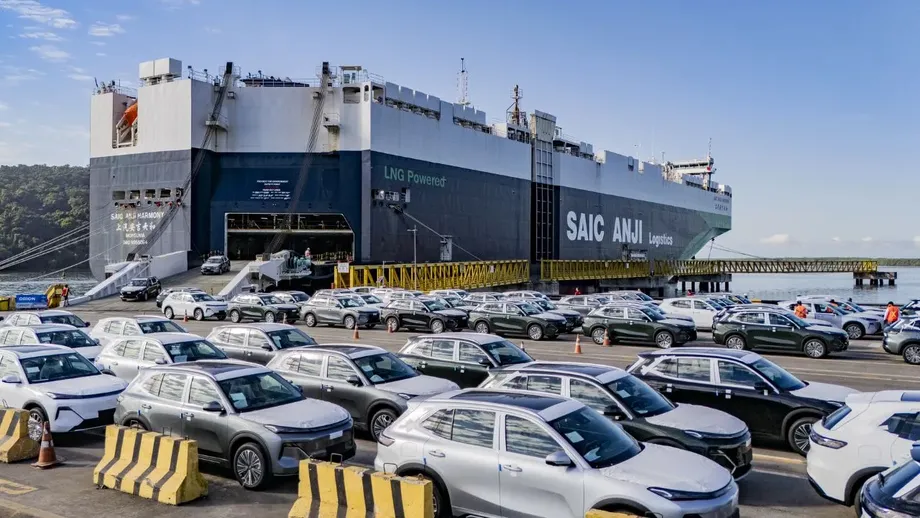
China exported 8.63 million vehicles in the first nine months of 2026, up 52% from a year earlier, according to figures released on October 23 by Cui Dongshu, secretary-general of the China Passenger Car Association. Vehicle exports earned $149.8 billion, an increase of 54%, as manufacturers sold more cars abroad while facing falling demand at home.
Contents
- Export growth gathers speed as China's car market slows
- Why the export totals need their labels
- Electric vehicles and hybrids drive the shift
- More vehicles bring more revenue, but profit stays tight
- Overseas growth cushions a weak home market
- Brazil and Asian markets broaden the customer base
- The export surge reaches shipping companies
- Tax changes and trade restrictions shape the next stage
- What the year end forecasts require
- Key Points
September exports reached 1.182 million vehicles, up 55% from September 2025 and 13% from August. Their value rose 62% to $20.8 billion. Cui forecast exports of 12 million vehicles for the full year, with vehicle export earnings exceeding $200 billion and earnings from new energy vehicles exceeding $110 billion.
The association's September market analysis, published by the passenger vehicle branch of the China Automobile Dealers Association on October 12, identifies three main drivers: high oil prices, stronger Chinese products and continued growth in Global South markets. That term broadly describes developing economies, including major destinations in Latin America, Asia and Africa.
The export surge is changing how manufacturers sustain their businesses. Passenger vehicle exports represented 36% of manufacturers' September sales, compared with 19% a year earlier, according to the official analysis. Overseas customers now account for more than one in three vehicles sold by manufacturers in that series.
At home, passenger vehicle retail sales fell 28% to 1.618 million in September. Manufacturers are increasingly looking abroad for the sales and income that China's domestic market is struggling to provide.
Why the export totals need their labels
Cui's January to September total of 8.63 million vehicles, up 52%, sits alongside a different industry measure: the China Association of Automobile Manufacturers, or CAAM, recorded 8.205 million exports, up 65.8%. For September, Cui's figure was 1.182 million, up 55%, while CAAM counted 1.053 million, up 61.4%.
The passenger vehicle figures also come from separate statistical series. The official passenger association analysis counted 917,000 September exports, up 73.7%, including complete vehicles and completely knocked down kits, known as CKD. These kits contain vehicle parts shipped abroad for assembly. CAAM's passenger vehicle series recorded about 919,000 exports, up 64%, and more than 7.1 million in the first nine months, up more than 70%.
The associations measure different slices of the industry, and the passenger association explicitly includes CKD shipments. A complete reconciliation of the broader totals was not provided. Keeping each number attached to its organisation and vehicle category gives readers a usable picture: all the series show strong export growth, although their totals and growth rates vary.
The main dates show how quickly the expansion developed:
- January to August 2026: the official passenger association analysis recorded 7.45 million total vehicle exports, up 51%.
- September 2026: Cui's series reached 1.182 million exports for the month, while CAAM said monthly exports had exceeded 1 million for four consecutive months.
- October 12, 2026: the passenger association published its September market analysis; the finance and tax authorities also announced a future export rebate reduction.
- October 23, 2026: Cui released the nine month export figures and forecast 12 million exports for the year.
- April 1, 2027: the announced reduction in the new energy vehicle export VAT rebate is scheduled to take effect.
Electric vehicles and hybrids drive the shift
New energy vehicles, or NEVs, are growing faster than total vehicle exports. The category includes vehicles powered entirely by batteries and hybrids that can be plugged in to charge. Conventional hybrids, which cannot be charged from an external power supply, are counted separately.
Cui's figures put September NEV exports at 612,000, up 104% from a year earlier and 23% from August. The January to September total reached 4.07 million, up 75%. CAAM's corresponding figures were 571,000 in September, up 160%, and 4.006 million over nine months.
The official passenger vehicle series gives a closer view of the changing product mix. Manufacturers exported 558,000 new energy passenger vehicles in September, up 163.5%, and 3.887 million during the first nine months, up 138.8%. NEVs accounted for 60.8% of September passenger vehicle exports, an increase of 21 percentage points from a year earlier.
Battery vehicles made up 60.5% of those September NEV exports. Plug-in hybrids accounted for 34.2%, while vehicles with range extenders accounted for 5.3%. A range extender uses a combustion engine to generate electricity, with an electric motor driving the wheels.
Chinese domestic brands exported 812,000 passenger vehicles in September, up 75%, compared with 105,000 for joint venture and luxury brands, up 62%. BYD led the listed NEV exporters with 175,877 vehicles, followed by Chery with 85,990 and Geely with 72,893. Tesla China exported 30,529.
More vehicles bring more revenue, but profit stays tight
Vehicle export earnings grew slightly faster than shipment numbers over the first nine months: 54% against 52%. Dividing $149.8 billion by 8.63 million vehicles gives an average export value of about $17,358 per vehicle. Using the stated growth rates, that average rose roughly 1.3% from a year earlier.
September showed a wider gap. Export value increased 62% while volume rose 55%, suggesting an increase of about 4.5% in average value per vehicle. Changes in the mix of models, including more NEVs and more expensive vehicles, helped lift earnings.
Parts suppliers also benefited. Automotive component exports reached $79.6 billion in January to September, up 10%. September component exports were $9.77 billion, up 24% from a year earlier and 7% from August, following a pullback in July and August.
China's manufacturers nevertheless face narrow profit margins. The official analysis puts the automotive industry's January to August revenue at 7.0062 trillion yuan and profit at 253.4 billion yuan, down 16%. Its operating profit margin was 3.6%, compared with 4.1% in 2025 and 4.3% in 2024. A 3.6% margin means roughly 3.6 yuan of operating profit for every 100 yuan of revenue.
Higher materials and electronic component costs are squeezing manufacturers at the same time as weak domestic demand limits their pricing power. Export revenue is growing rapidly, but businesses still have little room to absorb additional costs.
Overseas growth cushions a weak home market
CAAM recorded total vehicle sales of 2.956 million in September, down 8.4% from a year earlier, and production of 2.99 million, down 8.7%. Over the first nine months, sales reached 23.271 million and production 23.246 million, both down 4.5%.
Chen Shihua, CAAM's deputy secretary-general, said domestic sales remained weak and expected subdued conditions to continue in the coming months. The passenger association's narrower retail measure showed an even sharper contraction: sales fell 21.7% to 13.334 million over nine months.
The official analysis links September's weakness to several specific pressures. Subsidy deadlines had encouraged purchases in September 2025, creating a strong comparison period. The Mid-Autumn Festival holiday reduced sales activity late in September 2026. Higher petrol prices also weighed on purchases of vehicles powered by combustion engines.
New energy vehicles gained market share even as their domestic passenger vehicle retail sales fell. September NEV retail sales declined 16.7% to 1.084 million, while conventional fuel passenger vehicle sales fell 43% to 530,000. NEVs consequently reached 67% of passenger vehicle retail sales, up 9.1 percentage points from a year earlier.
Exports are cushioning this contraction. Passenger vehicle manufacturers' September wholesale sales fell 8.9%, much less than the 28% retail decline. Wholesale sales measure manufacturers' sales to dealers and other buyers, including overseas customers; retail sales measure purchases by consumers.
Brazil and Asian markets broaden the customer base
Russia was China's largest vehicle export destination in January to August, taking 638,224 vehicles, according to the official analysis. Brazil followed with 480,403, ahead of Britain at 365,672, Australia at 326,938, Belgium at 322,562 and Mexico at 320,844.
Brazil ranked first for NEV exports over those eight months, taking 337,104 vehicles, an increase of 207,158 from a year earlier. Belgium received 307,357, Britain 270,090, Australia 237,140, the Philippines 188,170 and Thailand 175,741.
These destinations show the breadth of demand. Developing markets are providing substantial growth, while European destinations and Australia remain major customers. The official analysis also recorded global vehicle sales growth of just 2% in January to August, compared with 20% in India, 16% in Thailand and 28% in Vietnam.
Manufacturers are building assembly networks as well as selling complete cars. CKD shipments accounted for 41.9% of Great Wall Motor's exports, 42.1% of SAIC-GM-Wuling's and 34.6% of Leapmotor's in the official analysis. Sending kits for assembly abroad gives companies another route to serving overseas customers.
The export surge reaches shipping companies
Shipping companies are seeing stronger demand for vessels designed to carry cars and trucks. Longer voyages from China to Europe and Latin America occupy ships for more days, especially when operators travel around the Cape of Good Hope rather than through the Suez Canal.
A September shipping market assessment put the daily charter rate for a vessel with capacity equivalent to 6,500 cars at about $95,000. Some Chinese operators had resumed Suez transits, while major European and Japanese operators continued to favour the longer Cape route.
Exporters are also using containers. Special racks can hold two to four passenger cars inside a standard container measuring 40 feet, depending on vehicle size. COSCO arranged three such shipments carrying a combined 13,052 vehicles from China to Europe during 2026.
Shipowners ordered 82 new car carriers during the first nine months, compared with nine throughout 2025 and an annual average of 35 over the preceding decade. About 64% of ordered tonnage is scheduled for delivery from 2028 onward. Exporters face tight vessel availability now, while a much larger fleet is scheduled to arrive later.
Tax changes and trade restrictions shape the next stage
China's Ministry of Finance and State Taxation Administration announced on October 12 that the NEV export VAT rebate would fall from 13% to 9% on April 1, 2027. VAT is value added tax, and an export rebate returns some tax associated with goods sold abroad. A smaller rebate changes the financial calculation behind export prices and margins.
The announcement gives manufacturers more than six months to adjust contracts, prices and supply arrangements. For companies already operating with narrow margins, the change increases the value of stronger brands, controlled costs and production closer to overseas customers.
European trade negotiations add another uncertainty. EU trade chief Maroš Šefčovič said the sides had reached an interim understanding in October. Descriptions of the proposed annual cap agree on 350,000 vehicles but vary on coverage: one describes electric or hybrid vehicles, while another specifies conventional vehicles and plug-in hybrids, with battery vehicles remaining under separate duties.
The proposed arrangement could begin in December 2026, subject to implementation. One description provides for annual quota increases of 6% over four years. Its final coverage and start date remain unresolved. The official passenger association analysis already expects pressure in the EU market to slow export growth.
Xiao Feng, head of Hong Kong and China industrials research at CITIC CLSA, described the political limits facing manufacturers:
You can't expect BYD or the other OEMs (manufacturers) to export too many cars without facing tariffs or pushbacks from the foreign governments,
BYD executive vice president Stella Li has identified geopolitics as the biggest challenge to the company's overseas expansion. She described production plans in Thailand, Indonesia, Brazil and Hungary. Manufacturing abroad allows companies to supply customers from local factories rather than relying entirely on shipments from China.
What the year end forecasts require
Cui's forecast of 12 million vehicle exports would require another 3.37 million shipments in October to December. That works out to about 1.123 million a month, slightly below September's 1.182 million pace. CAAM expects exports to exceed 10 million, while AlixPartners and some other analysts have also projected roughly 10 million.
The earnings forecast requires a similar continuation of recent momentum. Reaching $200 billion after $149.8 billion in nine months would require $50.2 billion in the final quarter, or about $16.7 billion monthly. September's export value was $20.8 billion.
China's manufacturers therefore enter the final quarter with a strong export pace, but with domestic weakness, shipping costs and trade restrictions shaping their decisions. More sales abroad are supporting factories and suppliers. The next stage involves deciding how much to ship from China, how much to assemble overseas and how to protect margins as tax support changes.
Key Points
- Cui Dongshu put January to September 2026 vehicle exports at 8.63 million, up 52%, with export value reaching $149.8 billion.
- CAAM recorded 8.205 million exports, up 65.8%, in a separate industry series.
- NEVs accounted for 60.8% of September passenger vehicle exports in the official passenger association analysis.
- Domestic passenger vehicle retail sales fell 28% in September, increasing manufacturers' reliance on overseas customers.
- Cui forecast 12 million exports for 2026; CAAM expects more than 10 million.
- The NEV export VAT rebate is scheduled to fall from 13% to 9% on April 1, 2027.