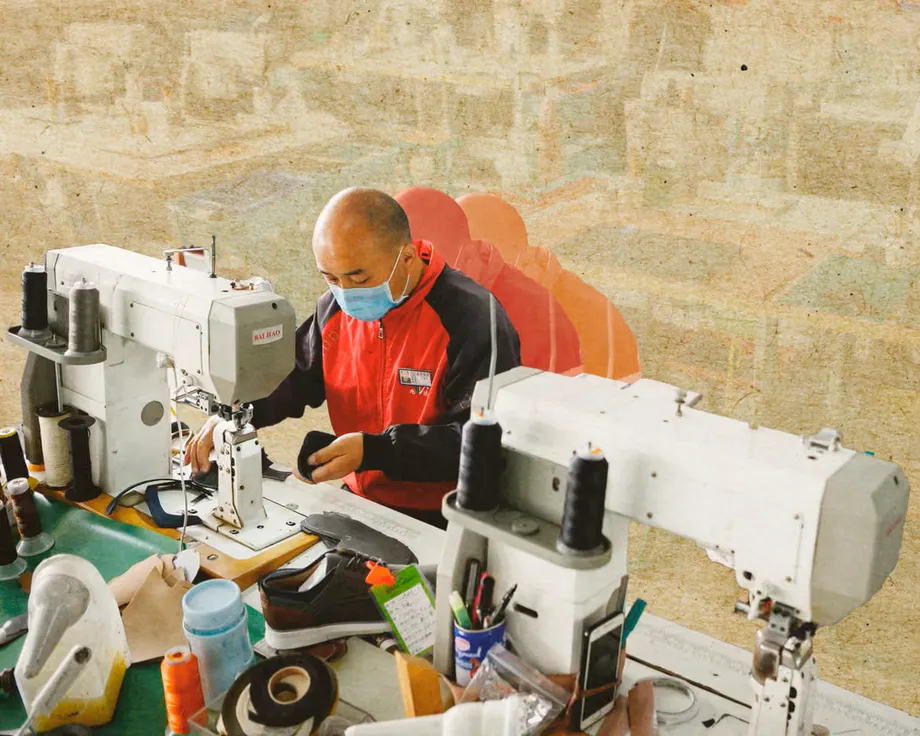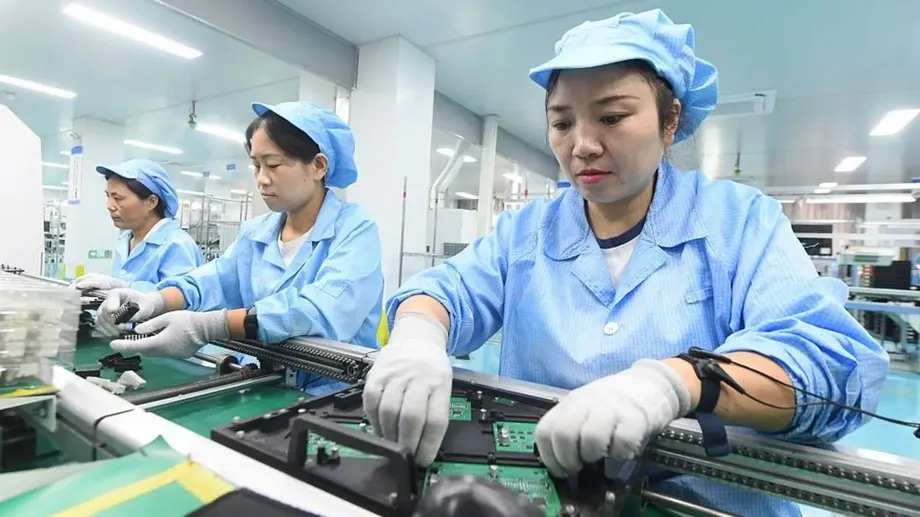
A factory rebound meets a fragile domestic economy
China's economy grew 4.5% in the third quarter of 2026, the National Bureau of Statistics said on October 19, as strong overseas demand for technology goods helped offset a deepening property slump. Growth accelerated from 4.3% in April to June, its slowest pace in more than three years, and exceeded economists' forecast of 4.4%.
Contents
- A factory rebound meets a fragile domestic economy
- How the AI boom is lifting exports
- Industrial upgrading reaches beyond semiconductors
- Why households are still holding back
- The property slump keeps spreading through spending
- Exports find buyers beyond the United States
- Europe pushes back against the trade imbalance
- Beijing adds support while watching borrowing costs
- What comes next for growth and policy
- Key Points
The recovery exposed a sharp divide. September retail sales increased just 1.1% from a year earlier, while property development investment fell 20.6% over the first nine months. Factories benefited from the global rush to build artificial intelligence infrastructure, but many households remained cautious about spending.
China generated about 107.11 trillion yuan in economic output during January to September, with growth averaging 4.6%. That puts the world's second largest economy within Beijing's annual target range of 4.5% to 5%, although the third quarter remained below the 5% expansion recorded at the start of the year.
Gross domestic product, or GDP, measures the value of goods and services produced in an economy. The quarterly figure compares output with the same period a year earlier. Measured against the preceding quarter, China's economy expanded 1.2%, up from 0.9% in April to June.
The statistics bureau described an economy that had sustained development under pressure, while also acknowledging that insufficient domestic demand remained a prominent problem. Its figures show why: advanced manufacturing is expanding rapidly, but investment across the economy is shrinking and consumer purchases are growing slowly.
For Beijing, the immediate challenge is becoming less about reaching this year's growth target and more about spreading the gains from production and exports to household incomes, employment and spending.
How the AI boom is lifting exports
September goods exports reached $447.18 billion, up 36.3% from a year earlier, according to figures attributed to Chinese customs. An 8.3% increase also circulated for the month. The larger figure is consistent with accounts describing export growth of more than a third.
Integrated circuit exports provided a striking example of the technology surge: their value rose 136% to $45 billion, while the number of chips shipped increased just 1%. Integrated circuits are semiconductor chips used in electronic equipment, including the servers and other hardware behind AI services.
Those figures mean the average export value per chip more than doubled. The calculation divides the change in export value, 2.36 times its earlier level, by the change in shipment numbers, 1.01 times. Higher prices and a shift toward more expensive products can both raise that average.
Global spending on data centres, servers and associated components has created demand for Chinese technology exports. The benefit extends beyond chips: machinery, electrical equipment and other manufactured products also supply the infrastructure needed to run AI systems.
Mechanical and electrical goods accounted for 64.3% of China's exports in the first nine months, with their export value rising 23.7%. Technology demand therefore sits within a much broader manufacturing export base, rather than operating as an isolated pocket of growth.
Industrial upgrading reaches beyond semiconductors
China's advanced manufacturing sector grew 14.3% in the first nine months, compared with 5.3% growth in industrial enterprises above the statistics bureau's designated size threshold. Equipment manufacturing expanded 10.2%.
Production figures show where that investment is going. Output of devices used for 3D printing rose 62.5%, lithium-ion batteries increased 39.5%, and industrial robots grew 29.1%. These industries are part of Beijing's effort to direct credit and resources away from property and toward more advanced production.
Mao Shengyong, deputy head of the National Bureau of Statistics, said advanced manufacturing, the digital economy and modern services contributed more than 40% of growth during January to September. He described the period's 4.6% expansion as "hard won".
September industrial output rose 5.5% from a year earlier in the detailed economic breakdown, compared with 5.2% in August; a competing published figure put September growth at 6.5%. Factory surveys also improved, with the official manufacturing purchasing managers' index reaching 50.1 after two months of contraction.
A purchasing managers' index measures changes in business conditions through company surveys. A reading above 50 signals expansion. September's figure suggests a modest return to growth in factory activity, alongside the much faster expansion in selected technology industries.
Why households are still holding back
September retail sales grew 1.1%, up from 0.4% in August and the fastest pace since March. The improvement beat expectations of roughly 0.5% to 0.6%, but remained modest beside the expansion in manufacturing and exports.
Services performed better than goods over the first nine months. Retail sales of goods and services together increased 2.6%, with services retail rising 5% and goods retail growing 1%. Spending on activities and services was therefore providing more support than purchases of physical products.
Average disposable income reached 34,230 yuan per person during January to September, increasing 4.4% after adjusting for inflation. Disposable income is the money people have available to spend or save after taxes and similar deductions. The national average, however, sits alongside very different experiences across households and industries.
Max Zenglein, Asia Pacific senior economist at The Conference Board, said the headline growth figure masks uneven economic conditions. He described the differences as:
widening disparities across industries, regions, and households
Carol Huang, a 26-year-old accountant in Hangzhou, said her employer had almost halved her bonus. She was staying because similar jobs in the city offered 3,000 to 6,000 yuan a month, less than she currently earned. Her situation illustrates how an employed worker can still feel pressure to limit spending.
September's surveyed urban unemployment rate was 5.2%, down 0.1 percentage point from August. The employment measure counts someone working at least one hour a week as employed, so the figure includes people with very limited hours as well as those in regular jobs.
The property slump keeps spreading through spending
Property development investment fell 20.6% in January to September, a deeper decline than the 19.9% fall recorded through August. The floor area of newly built commercial buildings sold dropped 13.2%, while their sales value declined 13.9%.
China's prolonged housing downturn has reduced the value of a major store of household wealth. Families whose homes are worth less may save more and delay purchases, while developers facing weak sales reduce construction and investment.
Sheana Yue, senior economist at Oxford Economics, said stronger industrial activity would have difficulty spreading through the economy while housing remained weak:
The prolonged housing slump will continue to limit the spillover from stronger industrial activity to the wider economy
Yue pointed to home sales, construction starts and prices as offering little indication of a recovery taking hold. Meanwhile, investment excluding property development still fell 4.2% in the first nine months, showing that weak capital spending extends beyond housing.
Total fixed asset investment, which covers spending on assets such as buildings, machinery and infrastructure, declined 7.2%. Private investment dropped 10.4%, infrastructure investment fell 4.2%, and manufacturing investment decreased 2.1%, even as selected technology sectors attracted more funds.
Exports find buyers beyond the United States
China's September exports to the United States rose 9.8%, while shipments to ASEAN countries increased 28.7%, Taiwan 37.3% and South Korea 39.1%. Exports to the European Union rose 16.4% that month. The spread shows how markets elsewhere in Asia and Europe are supporting demand alongside the United States.
Higher American tariffs have encouraged Chinese companies to seek buyers in Southeast Asia, Latin America and Europe. Zhang Chao, who manages Southeast Asian operations for a motorbike headlights company, said overseas orders had doubled this year while the business had largely abandoned domestic sales.
Zhang described the Chinese market's intense competition:
It's too competitive and there's no profit
The shift builds on last year's export redirection, when falling shipments to the United States were offset by stronger sales elsewhere. China's goods surplus had already reached about $1.08 trillion through November 2025.
The January to September 2026 surplus reached $938 billion, with September alone producing a record $133.5 billion. A trade surplus is the amount by which export earnings exceed spending on imports. China is on course to surpass the previous year's $1.2 trillion record.
Imports have also been growing: measured in yuan, they rose 22.3% over the first nine months, compared with export growth of 16.4%. The surplus remains large because exports started from a much higher value, reaching 23.20 trillion yuan against imports of 16.74 trillion yuan.
Europe pushes back against the trade imbalance
The European Union faces a trade deficit with China exceeding $1 billion a day. Chinese exports to the bloc rose about 16% in the first nine months, although a 14% figure also circulated. September's Chinese trade surpluses with Germany and France each increased by more than 200% from a year earlier.
European manufacturers are pressing for protection from lower priced Chinese goods. China and the EU have reached an agreement intended to roughly halve imports of Chinese hybrid vehicles over the next few years, while Brussels is considering further restrictions.
Michelle Lam, an economist at Societe Generale, warned that foreign demand has political limits:
China's export expansion is not without limits amid a more protectionist global trade environment
Gary Ng, senior economist for Asia Pacific at Natixis, said negotiated limits could help China preserve access to European markets while avoiding broader tariff increases. Lynn Song, chief economist for Greater China at ING, said trade imbalances would take time to resolve even with agreements.
Pan Gongsheng, governor of the People's Bank of China, said surplus and deficit economies should work together. He also said China was committed to expanding domestic demand. The policy dispute centres on how to share the adjustment between China buying and consuming more and its trading partners restricting imports.
Beijing adds support while watching borrowing costs
Chinese authorities have introduced targeted interest rate cuts, mortgage subsidies and cheaper financing for infrastructure and technology since late September. They also allocated 550 billion yuan in unused government debt quotas to relieve pressure on local government finances and support investment.
An additional policy financing tool worth 800 billion yuan is intended to encourage infrastructure spending. Authorities have expanded loan interest subsidies for small private companies and consumers, combining support for production with some measures aimed at borrowers and home buyers.
The latest response follows May's rising debt burden, when China's debt outside the financial sector exceeded 302% of GDP. Government and corporate borrowing had increased while households became more reluctant to take on debt.
Prices complicate the policy choice. Factory gate prices rose 5% in September, while consumer inflation remained below 1%. Companies facing higher production costs and customers reluctant to pay more may have to accept smaller profits, Yue said.
Economists surveyed before the GDP release expected benchmark lending rates and banks' reserve requirement ratio to remain unchanged through the first quarter of 2027. The reserve requirement ratio determines the share of deposits banks must hold in reserve. Lowering it can release funds for lending.
Song said support for employment, incomes and domestic demand could still be needed. Government spending may carry more of the burden if officials keep broad monetary settings steady.
What comes next for growth and policy
The International Monetary Fund has forecast 4.5% Chinese growth for 2026. A survey conducted before the GDP release also projected 4.5% for the year and 4.4% in 2027, while Tianchen Xu, senior economist at the Economist Intelligence Unit, forecast 4.7% for 2026 after the latest figures.
The recent sequence shows how growth recovered and where the next policy signals are expected:
- January to March 2026: GDP grew 5% from a year earlier.
- April to June: Growth slowed to 4.3%, its weakest pace in more than three years.
- Late September: Beijing introduced targeted credit support and mortgage subsidies.
- October: Authorities allocated 550 billion yuan in unused government debt quotas.
- October 19: The statistics bureau announced third quarter growth of 4.5% and growth of 4.6% across the first nine months.
- December: The annual Central Economic Work Conference is expected to set out policy priorities for 2027, alongside signals from an expected Politburo meeting.
AI investment is another source of uncertainty. China's exporters are benefiting from spending on computing infrastructure, while the durability of that spending depends partly on whether buyers earn the returns they expect. No precise estimate has been given for how much of China's GDP growth came specifically from AI demand.
For households, a broader recovery would mean more secure work, stronger incomes and less pressure from falling property wealth. For exporters, the immediate task is to retain overseas customers as trade restrictions grow. Beijing's next decisions will show how much support goes toward expanding production and how much reaches the people expected to buy it.
Key Points
- China's GDP grew 4.5% in the third quarter of 2026, up from 4.3% in the preceding quarter.
- Growth averaged 4.6% in January to September, within Beijing's annual target of 4.5% to 5%.
- AI infrastructure demand and advanced manufacturing supported exports, while September retail sales grew just 1.1%.
- Property development investment fell 20.6%, and total fixed asset investment declined 7.2% over the first nine months.
- China's widening trade surplus is increasing pressure from Europe and other trading partners.
- Targeted credit measures and government financing are supporting activity, with December's economic policy meetings the next major milestones.