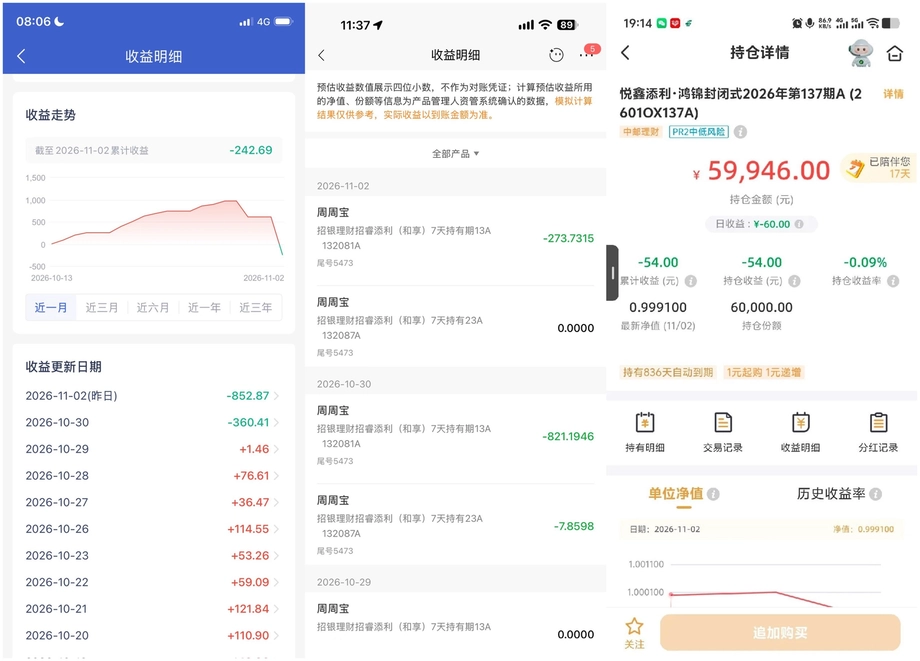
The Green Wave Hits 'Stable' Accounts
Bank wealth management products, long viewed as safe havens comparable to deposits, are undergoing a widespread drawdown. As of late November, over 70,000 R1 and R2 rated products have recorded negative net value changes, with maximum drawdowns exceeding 16 percent in some cases. Social media platforms like Douyin and Xiaohongshu are filled with screenshots from investors showing their "green" accounts, lamenting that the products they bought for steady income are losing principal. The phrase "losing three melons when rising, losing everything when falling" has become a common description of the current sentiment.
Contents
The core of this movement is a rare simultaneous adjustment in the stock and bond markets. Investors who previously held these products with a "deposit mindset" are now facing the reality that wealth management products, under the Asset Management New Rules, no longer guarantee principal. The daily valuation of underlying assets directly impacts the net value, meaning bond price declines and equity volatility are immediately reflected in investors' accounts.
Understanding the R2 Label
A key source of confusion for retail investors is the risk rating label. R2 denotes medium-low risk, but it does not equal no volatility. Many investors mistakenly believe that R2 products are principal-guaranteed. In reality, R2 describes a volatility range, not a safety net. The decline in these products is often due to the duration of their holdings and their equity exposure rather than a fundamental default in the assets.
Research from Puyi Standard indicates that products with longer durations and those with enhanced equity positions are more prone to significant drawdowns. Short-duration pure bond R2 products, which hold less equity and have shorter maturity dates, have shown relatively controlled volatility. The drawdowns are largely driven by the fact that the bond market experienced a阶段性 downturn, dragging down the net value of fixed-income products, while the equity market's volatility eroded the interest income of "fixed income plus" products.
The Negative Feedback Loop
The current situation has triggered a negative feedback loop, a concept where initial small declines lead to widespread redemptions, which in turn cause further declines. When net values drop, retail investors panic and redeem their products. To meet these redemption requests, wealth management companies are forced to sell their bond holdings. This concentrated selling pressures bond prices further down, causing more net values to fall and triggering more redemptions.
China Securities Research highlights that this "stampede" effect amplifies short-term irrational volatility. However, unlike the severe redemption wave of 2022, the current pressure is largely preventive. Wealth management companies have ample liquidity reserves, and bond markets have shown resilience. The central bank's policy tools, including the Bond Non-Bank Swap Facility (BNSF), provide a backstop to break this cycle if necessary.
Data shows that while the total scale of wealth management products decreased by approximately 342.9 billion yuan in late November, cash management products actually saw an increase in scale as investors moved funds from volatile fixed-income products to more stable cash pools. This suggests that capital has not left the banking system but has shifted within it.
Corporate Responses and Market Outlook
Over ten wealth management companies, including Zhaoyin Wealth Management, ICBC Wealth Management, and Pufa Wealth Management, have released statements and public letters to calm investors. They emphasize that the current drawdowns are valuation fluctuations rather than credit defaults. Zhaoyin Wealth Management pointed out that bond interest income can gradually absorb short-term floating losses if held to maturity.
"When markets are volatile, it is even more important to clarify the pulse and firm up direction. It is better to look at the long term amid volatility." - Statement from Xingyin Wealth Management
Analysts from Guotai Fund note that the fundamentals for bond markets remain supportive due to weak economic data and loose liquidity. The ten-year government bond yield is expected to oscillate between 1.55 percent and 1.6 percent in the short term. While credit spreads may widen for lower-rated bonds, high-quality bonds are likely to recover steadily.
Practical Advice for Investors
For ordinary investors, the situation calls for a strategic rather than emotional response. The first step is to examine the underlying assets and duration of their products. If a product is a long-duration pure bond, it may recover as interest income accumulates. If it is a "fixed income plus" product with high equity exposure, it may remain volatile for a longer period.
Investors with short-term cash needs should consider moving to cash management products or short-term deposits. For those with long-term funds, staying the course is often the best strategy to avoid selling at the bottom. The key is to distinguish between floating losses (accounting paper losses) and permanent losses (defaults).
The Bottom Line
- Over 70,000 R1 and R2 bank wealth products have recorded drawdowns in November due to stock and bond market volatility.
- The "negative feedback loop" of redemptions has amplified short-term volatility, though it remains less severe than the 2022 wave.
- Long-duration and equity-enhanced products are seeing the steepest declines, while short-duration products remain relatively stable.
- Wealth management companies are actively communicating with investors to prevent panic selling, emphasizing that current drops are valuation adjustments.
- Investors are advised to check their product's underlying assets and duration before redeeming to avoid selling low.