From Spring Festival to Factory Floor
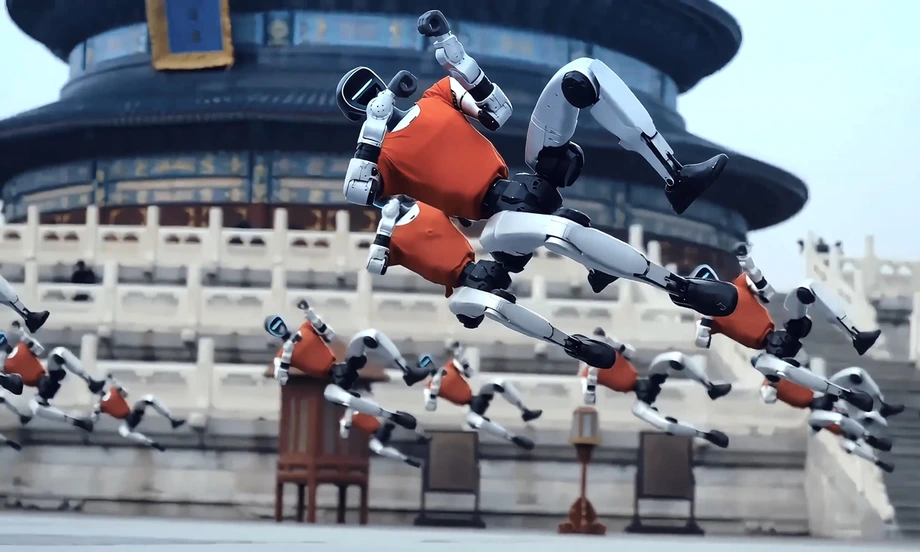
The stage lights dimmed at the CCTV Spring Festival Gala in late January 2026, and hundreds of millions of viewers watched a formation of humanoid robots march in. These machines performed synchronized martial arts and backflips with mechanical precision. The robots were the Unitree G1 models, priced at just 99,000 yuan. Their appearance on the most watched television stage was not just cultural entertainment. It marked a structural shift in how China approaches artificial intelligence. The country is no longer treating AI as a software problem confined to servers and screens. Instead, it is building an industrial infrastructure layer that connects manufacturing dominance, demographic challenges, and geopolitical ambitions into a single strategic framework.
Contents
This framework, known as embodied intelligence, refers to AI operating through a physical body. It senses its surroundings, decides what to do, and acts. The opportunity lies not in a single hit robot but in the reorganized supply chain as AI grows a body and enters real scenarios. The Development Research Center of the State Council calculates that China's embodied intelligence market size will reach 400 billion yuan by 2030 and break through 1 trillion yuan by 2035. The market first sees robots that can ride bicycles, sew, and chat. But the real industrial opportunity lies in models running in data computing power, core components, complete machine integration, training grounds, and real scenes.
Following the boom in large language models, embodied intelligence is the next must win battlefield. The most exciting era for humanoid robots, the era of productivity, is about to begin.
By early 2026, these robots were no longer curiosities. They were running on factory floors, boxing at technology expos, and filing for initial public offerings on the STAR Market. The transformation happened so fast that even seasoned industry analysts struggled to keep pace. In May, the World Intelligence Expo in Tianjin drew over 700 exhibitors across 130,000 square meters. Visitors watched humanoid robots box, perform push ups, and grip packages with dexterous hands. The subtext of this spectacle was economics, and the numbers tell a story of acceleration rather than incremental growth.
Market Valuation and Capital Surge
The scale of China's embodied intelligence surge is defined by rapid capital investment and clear commercialization paths. The market has created 16 companies valued over 10 billion yuan each. This surge is driven by over 200 equity financing events in China in the first half of 2026. The investment amounts in February and March exceeded 10 billion yuan each, and total financing reached 37.3 billion yuan by mid March. Capital is flowing rapidly toward the most prominent players, creating twelve new entities valued over 10 billion yuan.
Established names like Galaxy General Robotics, Unitree, Agibot, and Mecharmind now join a group that includes startups like Qianxun Intelligence, Xinghaitu, and Robot Era. The year 2026 has started with massive enthusiasm for the sector. The transition from four to sixteen elite companies indicates a crucial consolidation in the Chinese market. Investors are using massive funds to filter out the ultimate winners. This intense investment strategy aims to compress a decade long development timeline into just three to five years. Financial resources are essentially purchasing time and ensuring absolute certainty for the coming decade.
Half of the sixteen giants were established within the last three years. Companies founded during the generative AI boom have leveraged new technologies and flexible decision making to disrupt the industry. Qianxun Intelligence reached its monumental valuation in just two years. This dynamic environment proves the immense vitality of the sector. Every single one of these elite companies emphasizes the importance of full stack independent research. Developing both the physical structure and the digital brain ensures better stability and faster product updates.
The Unitree and Agibot Counterpoints
The competitive dynamic between two key players, Unitree and Agibot, mirrors the broader AI landscape. Unitree captures headlines on brand and pricing power, while Agibot leads on manufacturing velocity and industrial integration. Both companies are profitable or approaching profitability, a rarity in the global robotics industry where many Western competitors remain pre revenue despite billions in funding.
Unitree Robotics, founded in Hangzhou in 2016, launched the G1 humanoid in May 2024 at 99,000 yuan. The company shipped approximately 5,500 units in 2025 and has targeted 10,000 to 20,000 units for 2026. Its revenue surged 335 percent year on year, with humanoid robot revenue surpassing quadruped revenue to account for over 51 percent of total sales. Combined gross margins reached 60 percent. In March 2026, the Shanghai Stock Exchange accepted Unitree's IPO application for the STAR Market. The listing committee approved it on June 2, just 73 days from application acceptance to review approval. Unitree intends to raise approximately 4.2 billion yuan to fund research and new intelligent robot designs.
AgiBot, founded by Peng Zhihui, built volume at a staggering pace. The company reached a milestone in late March 2026 with the rollout of its 10,000th general purpose embodied robot, the Expedition A3. Production scaled from 1,000 units in 2025 to 5,000, then doubled to 10,000 within just three months. Agibot captured approximately 39 percent of the global humanoid robot market share in 2025. Its standardized supply chain and order driven manufacturing have shifted the industry from trial adoption to genuine industrial demand.
The deep pipeline of robotics initial public offerings mirrors the fast rise of China's artificial intelligence ecosystem.
Hardware Evolution and Supply Chain Integration
The industrial opportunity of embodied intelligence is a chain opportunity. Models, data, and computing power heat up first. Intelligence cannot exist without three things: models are the brain, data is experience, and computing power is the reaction speed. The model system is divided into cognitive decision making and motion control. VLA and world models are receiving attention as research and development become an important part of the industry.
Data is a key variable. Training data ranges from Internet data, simulation data, and un organism data to real machine teleoperation data. The global high quality real data stands at hundreds of thousands to millions of hours, while embodied intelligence models need at least tens of millions of hours to achieve generalization. This gap drives demand for training grounds, data collection, labeling, and cleaning. By the end of June 2026, more than 70 training grounds had been built and put into use in the country, with more than 40 under construction.
Core components and complete machine integration offer new industrial directions. Computing control equipment needs to be miniaturized and mobile. Force and touch sensors extend to wrists, ankles, and fingertips, while electronic skin expands contact perception. Motors, reducers, and lead screws revolve around drive and transmission upgrades. The repurposing of production lines from home appliances and automobiles has sharply reduced costs across the industry.
Dexterous hands that once cost hundreds of thousands of yuan dropped to between 10,000 and 50,000 yuan in 2025. Joint motors that cost 50,000 to 60,000 yuan in 2018 dropped to between 500 and 600 yuan. LiDAR sensors and the shift toward robotics have created new revenue streams for established suppliers. RoboSense, an established supplier of automotive LiDAR sensors, shipped 185,500 LiDAR units for robots during the first quarter of 2026, representing a 1,459 percent year on year increase.
Policy and Future Projections
China's government has engineered this boom through the 15th Five Year Plan. The plan designates embodied intelligence as one of six national growth engines. It calls for China to coordinate the layout of training grounds, promote virtual real fusion collaborative training, and accelerate the upgrade and deployment of humanoid robots. The Ministry of Industry and Information Technology established a dedicated Humanoid Robot and Embodied Intelligence Standardization Technical Committee in December 2025.
In February 2026, the ministry released the Humanoid Robotics and Embodied Intelligence Standard System, the country's first top level design of standards covering the entire industrial chain. The system comprises six sections: Basic Commonality, Brain like and Intelligent Computing, Limbs and Components, Whole Machine and System, Application, and Safety and Ethics. The plan also aims to raise the value added of core digital economy industries to 12.5 percent of GDP.
Looking forward, the market expects continued expansion. UBS Securities estimates that China's domestic AI accelerator card market could reach approximately 2 trillion yuan by 2030. Shipments are projected to increase from 1.7 million units in 2025 to 10.4 million units in 2030. The compound annual growth rate for the domestic AI accelerator card revenue is projected at around 72 percent. As domestic supply scales up, constraints on advanced process node foundry services and HBM supply are expected to ease starting in 2028.
The embodied intelligence brings not only a batch of new machines but also a new industry chain. The market space can be described in terms of a trillion level market expectation, but more accurately, it is the incremental superposition of multiple links. Who can find their own position between models, data, hardware, integration, and scenarios will catch this round of industrial opportunities.
The Bottom Line
- China's embodied intelligence market is projected to reach 400 billion yuan by 2030 and 1 trillion yuan by 2035.
- Sixteen companies are valued over 10 billion yuan, driven by a 37.3 billion yuan funding surge in the first half of 2026.
- Unitree and Agibot lead global shipments, with Unitree shipping 5,500 units in 2025 and Agibot reaching its 10,000th robot milestone.
- The 15th Five Year Plan designates embodied intelligence as a national growth engine, supported by a 60 billion yuan National AI Industry Investment Fund.
- Hardware costs are dropping rapidly, with joint motors falling to 600 yuan and dexterous hands reaching entry level prices under 6,000 yuan.
- Over 70 training grounds are now operational, addressing the critical gap in high quality real world data for robot training.