A Record Drive Beneath the Yangtze
At about 9 a.m. on Thursday, November 26, 2026, the Jianghai tunnel boring machine passed beneath the southern embankment of the Yangtze River and reached Taicang in Jiangsu province. It had excavated 7.46 kilometres below the river, bringing the right bore of the Haitai Yangtze River Tunnel to the south bank. This is the first of the project's two parallel bores to complete the crossing.
Contents
- A Record Drive Beneath the Yangtze
- The Machine Behind the Crossing
- From Assembly to the South Bank
- Why the Riverbed Was So Difficult
- How Engineers Kept the Ground and Machine Under Control
- A Milestone, Not the Final Breakthrough
- What the Tunnel Could Change for Drivers
- A Link in a Wider Crossing Programme
- What Happens Before Traffic Can Use It
- Key Points
The Chinese built machine, weighing more than 5,000 tonnes and capable of excavating a circle 16.64 metres in diameter, spent about 14 months on the underwater drive. It advanced by an average of approximately 20 metres a day. Its best month produced 664 metres of tunnel, while the completed journey set a project record for continuous excavation beneath the Yangtze.
The achievement does not mean that the entire tunnel is finished. Jianghai must still excavate the remaining section on land south of the river before reaching its reception shaft in Taicang. Even so, the crossing completes the most difficult part of the right bore and moves it into the final push toward a full breakthrough.
The wider Haitai project extends 39.07 kilometres between Haimen in Nantong, on the north bank, and Taicang in Suzhou, on the south bank. Its 11.185 kilometre underwater portion represents about 29 percent of that total. The completed expressway is designed to carry six lanes of traffic, with vehicles travelling at a design speed of 100 km/h.
The Machine Behind the Crossing
China Railway Construction Heavy Industry manufactured Jianghai and developed it with China Railway 14th Bureau Group, the contractor driving the right bore. China Railway Siyuan Survey and Design Group designed the tunnel, while China Railway Construction Corporation is presenting the scheme as the world's longest underwater road tunnel built with shield machines. The project is also described as the tunnel with the largest diameter currently under construction beneath the Yangtze.
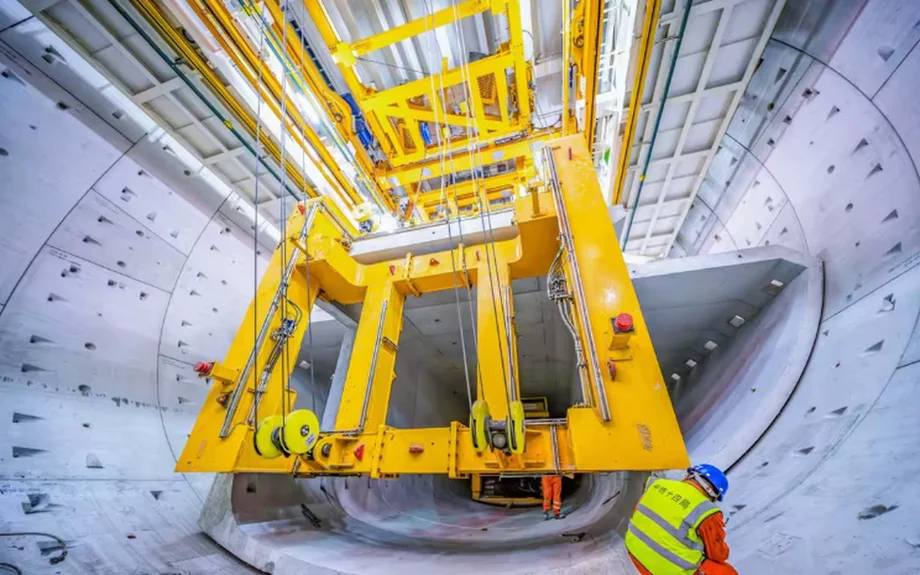
Jianghai is 145 metres long, has installed power of 11,300 kilowatts and carries a cutterhead weighing 460 tonnes. Its name means river and ocean. The concrete lining rings installed behind the machine have an outside diameter of 16 metres, slightly smaller than the maximum excavation diameter.
The machine is a slurry tunnel boring machine. In simple terms, it uses a pressurized fluid mixture to help balance the soil and water pushing against the excavation face. The same circulation system carries excavated material away. A cylindrical shield supports the surrounding ground while workers and machinery install curved concrete segments behind the cutterhead, gradually forming the permanent tunnel.
Preparation was itself a major operation. In January 2025, crews at the construction site in Nantong lowered the enormous cutterhead into position, one of the most delicate assembly stages. More than 200 workers remained on site to assemble components, complete adjustments and conduct initial testing before excavation began.
From Assembly to the South Bank
- September 2022: Construction of the Haitai project began.
- January 2025: Crews installed Jianghai's 460 tonne cutterhead in Nantong and began testing the assembled systems.
- April 2025: The machine started digging from Haimen on the north bank, rather than meeting another machine advancing from the opposite side.
- September 2025: After completing the northern section on land, Jianghai entered the ground beneath the Yangtze.
- May 3, 2026: It reached the lowest point of the route, about 75 metres down. Project descriptions called this the deepest point reached in underwater shield tunnelling at that time.
- November 26, 2026: At about 9 a.m., the machine passed the southern river embankment and completed the 7.46 kilometre underwater section.
The underwater journey had three distinct stages. Jianghai first made a controlled entry into the river ground. It then followed a long descent to the deepest point before climbing toward Taicang. During that ascent, engineers had to adjust the machine's attitude, meaning its angle and position, so that the enormous shield followed the intended tunnel alignment.
The right bore's complete shield section measures 9,315 metres, all assigned to this single machine. The 11.185 kilometre river crossing is longer than Jianghai's underwater drive because the project combines shield excavation with sections dug from the surface near the banks. Completing 7.46 kilometres below the river therefore represents one portion of a larger system of tunnels and approaches.
Why the Riverbed Was So Difficult
The ground below the Yangtze contained silty clay, silt and fine sand, forming composite layers of soft soil. Meng Defeng, who oversees shield tunnelling for China Railway 14th Bureau Group on the project, described this ground as loose and highly permeable. Water can move through it readily, while pressure from excavation can cause settlement and deformation. Opportunities to investigate the geology in advance were also limited beneath the river.
At the lowest point, Meng put the water and earth pressure against the excavation face at 7.5 bar. One bar is approximately atmospheric pressure at sea level. The load was equivalent to roughly 75 tonnes on each square metre, which Meng compared with the weight of 51 cars pressing on every square metre.
Those conditions created several connected dangers. Water and sand could burst into the excavation area, seals at the rear of the shield could leak, and the cutting face could become unstable. The machine's unusually large diameter also disturbed a substantial volume of ground. Allowable settlement was restricted to only 10 millimetres, or one centimetre, leaving little room for uncontrolled movement.
The shape of the route added another challenge. During the deep descent, equipment endured heavy loads and prolonged wear. On the climb out, the soil cover above the tunnel became thinner and water pressure fluctuated, making steering especially sensitive. Because Jianghai was advancing from one end without assistance from a second machine, its main systems also remained under heavy load throughout the long drive.
How Engineers Kept the Ground and Machine Under Control
Before Jianghai entered the river section, crews conducted extensive maintenance and assessed the condition of the complete machine. They inspected and replaced core components, including parts of the cutterhead and cutting tools, while improving resistance to pressure, wear and leakage. During excavation, a monitoring platform known as the digital shield tracked tunnelling settings, equipment condition and changes in the ground around the clock.
A three level support system connected academicians and outside specialists, technical staff at headquarters and crews working at the excavation face. Their task was to respond to monitoring information and adjust the drive as conditions changed. Engineers varied advance speed, pressure inside the excavation chamber and the density of the slurry as soil cover and water pressure shifted.
The manufacturer designed an accessible cutterhead for soft ground, using large alloy cutting tools resistant to wear. A telescopic main drive could detect abnormal loading on the cutterhead, helping protect the main bearing and making cutter changes easier. Technology for changing cutters at normal atmospheric pressure reduced the need for workers to carry out interventions under compressed air. Continuous monitoring watched the main drive, while specially designed seals around the drive and the rear of the shield resisted the external pressure.
Advance geological forecasting helped crews anticipate changes before the cutterhead reached them. As the machine progressed, grout made from two components was injected to fill the space around the new lining and restrain settlement. Settlement markers, instruments measuring tilt and sensors tracking groundwater pressure supplied additional warnings when readings moved toward their limits.
The concrete segments also received a specialized connection system called DDCI. Zhang Shantao of China Railway 14th Bureau's segment prefabrication base explained that its longitudinal joints use interlocking shapes resembling a mortise and tenon rather than relying on conventional bolts alone. Heavy, irregularly shaped components had to be embedded during prefabrication with positioning precision finer than one millimetre. The resulting joints offer greater resistance to slipping out of alignment or opening under high water pressure and uneven settlement in soft soil.
A Milestone, Not the Final Breakthrough
The crossing demonstrated that Chinese equipment of this size could sustain a long excavation through deep, pressurized and variable ground. The 7.46 kilometre continuous drive and the best monthly advance of 664 metres are the two clearest performance figures. Together with the 75 metre depth reached on May 3, they provide measurable evidence of what the machine and its operating methods accomplished.
Those figures should not be confused with completion of the expressway. Jianghai still has landward excavation ahead before the right bore can achieve its full breakthrough at the reception shaft. The announcement of the river crossing did not provide a date for that event, a construction schedule for the second underwater bore or a confirmed opening date for traffic.
Earlier project planning put construction investment at 35.7 billion yuan, approximately US$5 billion, and identified 2028 as the planned year for opening. The crossing announcement did not update that timetable. For now, the certain next step is the remaining excavation on the south bank, rather than an immediate ceremonial breakthrough or the start of road operations.
What the Tunnel Could Change for Drivers
At the design speed, project planning puts the time needed to cross beneath the Yangtze at about 10 minutes. The tunnel is intended to shorten journeys between Nantong, southern Jiangsu and Shanghai, supporting closer travel connections within roughly one hour across the core of the Yangtze River Delta. No updated figure was given for the total time saved on a complete journey between Nantong and Shanghai.
A more predictable crossing could affect daily routines as well as freight schedules. Residents would gain another road connection between communities separated by the river, while logistics operators travelling between the Nantong area and distribution centres around Suzhou and Shanghai could plan journeys with less dependence on detours or congested surface routes. Shorter, more reliable crossings can reduce vehicle running time and make delivery windows easier to manage.
The tunnel should also divert some traffic from the Sutong Bridge, the existing crossing linking Suzhou and Nantong. Its six lanes will add road capacity rather than merely replacing an older route. A separate project, the Chong-Tai railway tunnel, is being built for trains designed to run at 350 km/h, giving the estuary another crossing intended primarily for passenger rail.
A Link in a Wider Crossing Programme
The Haitai tunnel is listed as a priority in China's layout plan for crossings of the Yangtze's main stem during 2020 to 2035 and in Jiangsu's transport corridor plan for the Yangtze River Economic Belt. Those plans treat crossings as parts of connected regional networks, linking roads, railways, hubs and local services rather than as isolated engineering trophies.
The milestone also came during the first year of China's 15th Five-Year Plan period, covering 2026 to 2030. In July 2026, the Ministry of Transport announced a plan intended to establish much of a modern integrated transport service system by 2030. Its measures include better connections between transport modes, easier passenger transfers, improved freight logistics, stronger services at hubs, closer links between transport and tourism, and better rural passenger and delivery services.
Jiangsu has already seen how a new crossing can compress journeys. The Changtai Yangtze River Bridge, opened in September 2025, reduced the trip between Changzhou and Taizhou from about 80 minutes to roughly 20 minutes. When that bridge opened, the province reported 20 completed river crossing passages and nine more under construction, while national planning envisaged about 240 crossings along the Yangtze by 2035.
What Happens Before Traffic Can Use It
Jianghai's immediate task is to finish the southern land section and reach its reception shaft, where the machine can be retrieved. The second bore will also have to be completed for the full twin tunnel arrangement. Only after the civil works can the corridor move through the remaining stages of road surfacing, lighting, ventilation, traffic control, fire protection, emergency access and systems testing.
Those later stages are essential because a bored tube is not yet a functioning motorway. Operators must test mechanical and electrical systems, emergency procedures and safe traffic operation before opening. Instruments are also intended to keep tracking settlement, groundwater and structural performance so that maintenance teams can respond to changes after construction.
The south bank arrival therefore marks a precise transition. The most dangerous underwater excavation for the right bore is complete, but excavation on land, the second bore and the work required for a working expressway remain. No new dates for those stages accompanied the November 26 announcement.
Key Points
- Jianghai completed a 7.46 kilometre drive beneath the Yangtze at about 9 a.m. on November 26, 2026.
- The machine weighs more than 5,000 tonnes, is 145 metres long and has a maximum excavation diameter of 16.64 metres.
- The right bore is the first of two parallel bores to reach the south bank, but it still has a remaining section on land.
- The full Haitai project is 39.07 kilometres long, including an 11.185 kilometre underwater portion.
- The machine reached a depth of 75 metres and faced pressure of 7.5 bar, while averaging about 20 metres of progress a day.
- The expressway is designed for six lanes and a speed of 100 km/h, with a river crossing expected to take about 10 minutes at that speed.
- An earlier plan targeted opening in 2028, but no updated date was given for the final right bore breakthrough, the second bore or the start of traffic.