Public Day Shows How Far the Market Has Moved
On November 28, the 24th Guangzhou International Automobile Exhibition entered its public phase with 220,000 square meters of displays, 1,106 vehicles, 115 debut models and 707 new energy vehicles, 63.9 percent of the total. The show had opened on November 27 under the theme New Tech, New Life and runs until December 6 at the Pazhou exhibition halls in Guangzhou's Haizhu district.
Contents
- Public Day Shows How Far the Market Has Moved
- Why Family Cars Took Center Stage
- What the New Technology Labels Mean
- Cheap Cars Now Carry Costly Equipment
- Fast Charging Moves Into the 200,000 Yuan Band
- Joint Ventures Turn to Chinese Technology Partners
- Domestic Groups Fill Every Price Band
- State Groups and Suppliers Join the Push
- Luxury Uses Craft, Size and Spectacle
- XPENG Takes AI From the Stage to Showrooms
- Safety Rules Set the Next Test for Automation
- How Families Can Read the Show
- Key Points
The floor was no longer built around million yuan flagships. Booths for family cars priced from 100,000 to 300,000 yuan filled much of the halls, and foreign dealers were among the visitors. One visitor described the change in simple terms: advanced driver assistance that once belonged to flagship cars was becoming standard equipment for ordinary families. The 115 debut models set a Guangzhou show record, and the 707 new energy vehicles were 78 more than a year earlier.
- November 5: 2027 Zeekr 7X pre sales opened.
- November 7: Hongqi H9 PHEV pre sales opened.
- November 13: Dongfeng Nissan NX7 pre sales opened.
- November 19: Leapmotor Lafa5 pre sales opened and CATL opened a NING SERVICE center in Türkiye.
- November 24 to 25: BYD Tang EV and New Generation BMW iX3 prices were announced.
- November 27: the show opened and XPENG held its press conference.
- November 28: the public phase was under way.
Why Family Cars Took Center Stage
Automakers arrived under pressure. China Passenger Car Association data showed passenger car retail sales of 14.978 million units in January to October, down 22.3 percent year on year; October retail sales fell 27.1 percent. Wholesale data from the China Association of Automobile Manufacturers showed a 10 percent fall to 2.66 million in October, while new energy vehicle penetration reached 67.4 percent and passenger vehicle exports rose 62.3 percent.
Major groups had reached only 57 percent to 78 percent of annual sales targets by October. The dealer inventory warning index stood at 62.2 percent, above the 50 percent line that separates expansion from contraction. A survey by the China Automobile Dealers Association found that 91.1 percent of dealers expected full year sales declines, including 33.9 percent expecting drops of at least 15 percent and 24.1 percent expecting drops above 25 percent.
Chen Shihua, deputy secretary general of the China Association of Automobile Manufacturers, framed the show as a test of whether visitor interest could become orders. He said automakers and suppliers had to convert show traffic into sales as year end promotions began:
As year-end promotions and events such as the Guangzhou Auto Show roll out one after another, turning temporary customer traffic into concrete orders and sustaining the release of consumer demand have become key priorities for all stakeholders across the industry chain.
What the New Technology Labels Mean
Lidar is a sensor that measures distance with laser pulses. It helps a car see shapes at night and in difficult light, though it is only one part of a driving system. Industry figures put 3.82 million lidar units installed in Chinese passenger vehicles in January to September, almost double the 1.91 million a year earlier. Seven of every 10 newly sold passenger cars in China already had Level 2 driving assistance, which keeps speed and lane position under driver supervision.
NOA, or navigate on autopilot, lets a car steer and adjust speed on approved roads while a driver watches. A world model predicts how traffic may move in the next seconds. Level 3 lets the car drive in set conditions without constant watching, subject to law. An 800V or 900V system lets batteries accept higher charging power, but speed also depends on chargers. CLTC is a Chinese laboratory range test, best used for comparisons.
Cheap Cars Now Carry Costly Equipment
Leapmotor's new Lafa5 opened pre sales at 105,800 to 121,800 yuan. The compact electric hatchback uses an 800V silicon carbide platform, a 69.7 kWh battery for 640 km CLTC range and a fast charge claim of 16 minutes from 30 percent to 80 percent. Mid and high trims add lidar and a Qualcomm SA8650 chip for point to point navigation assistance. A Leapmotor representative said the company had delivered more than 770,000 vehicles worldwide this year and that sales had risen nearly 66 percent under a strategy of lower prices and better technology.
Dongfeng Nissan's NX7 entered the same price fight at 129,900 to 149,900 yuan. The 149,900 yuan version carries roof lidar and Momenta's R7 World Model, supporting city and highway NOA. The midsize plug in hybrid SUV uses a 40.9 kWh CATL battery, 320 km of electric range and 1,666 km combined CLTC range. Its wheelbase is 2,815 mm, a dimension that matters to rear seat space.
SAIC Volkswagen placed its ID. ERA 985 family in Hall 1.1. The plan covers seven new energy models in one year: the ID. ERA 9X flagship, the 8X extended range SUV with double chamber air suspension on Ultra, the 5S plug in hybrid sedan aimed at 120,000 yuan smart driving buyers and the 5X, described as the first production model using CMP, CEA and ADAS, meaning advanced driver assistance systems, with B class space and a price starting in the 100,000 yuan range. The 5X had rolled off the line on October 16 on Volkswagen's local CMP platform.
Fast Charging Moves Into the 200,000 Yuan Band
BYD launched the third generation Tang EV on November 24 at 187,900 to 219,900 yuan, with an optional all wheel drive steer by wire package costing 20,000 yuan more. The large five seat electric SUV uses a second generation Blade Battery, megawatt level flash charging and a top CLTC range of 850 km. It also brings God's Eye B driver assistance and DiSus-A dual chamber air suspension, equipment once common in far dearer models.
The 2027 Zeekr 7X starts at 229,800 yuan and puts a 900V architecture across the whole lineup. Battery choices of 75 kWh, 85 kWh and 103 kWh give 620 to 802 km CLTC range. The all wheel drive Ultra version delivers 585 kW and a 0 to 100 km/h time of 2.98 seconds. The model uses Qianli Haohan G-ASD 4.1 assistance, CCD electromagnetic damping and active noise cancellation. BYD's new Han claimed 875 km CLTC range and about nine minutes from 10 percent to 97 percent charge.
NIO said its LeDao L90 reached 70,000 deliveries on November 26 and claimed three minute battery swaps on some models. Swapping replaces a low battery with a charged pack; it only helps where stations exist.
Joint Ventures Turn to Chinese Technology Partners
BMW launched the New Generation iX3 on November 25 at 269,900 to 339,900 yuan. The China long wheelbase version is 108 mm longer than the overseas car, with a 3,005 mm wheelbase. The top 50L xDrive reaches 919 km CLTC range and 345 kW; BMW said 10 minutes can add 418 km. Every version uses a vision based assistance system developed with Momenta, on a Qualcomm SA8650 chip, with DeepSeek and Alibaba AI in the cabin.
BMW's i3, from 249,900 yuan, also uses Momenta urban assistance. Mercedes-Benz said Momenta's R7 World Model had entered production vehicles, with over the air expansion planned for the first quarter of 2027. Dongfeng Nissan, FAW Volkswagen and GAC Honda showed Chinese assistance suppliers; CATL supplied cells for BMW, Volkswagen and Mercedes models. Chinese suppliers now help define vehicle architecture.
Jin Jinhua, a manager at XPENG, said the old reason for motor shows had faded because electrification had become common. He argued that new technology, not the basic car, now had to persuade buyers:
Until last year, motor shows were a 'feast of new cars,' but now electric vehicles have become standard, making it difficult to stand out with cars alone. We have to win over consumers with new technology.
Domestic Groups Fill Every Price Band
BYD took over Hall 2.1 with Dynasty, Ocean, Fangchengbao, Denza and Yangwang, plus displays for chips, God's Eye assistance and flash charging. The Ocean network's first flagship MPV made its global debut and opened an Ocean 9 series. Yangwang's Dingyao executive sedan made its China debut; the Shanhe Dingyun limited edition was priced at 2.08 million yuan, with four motors above 1,000 kW and CLTC range above 1,000 km.
GAC filled another hall with six brands and unveiled the Dual V Model product approach, driven by market demand and technology. It showed Cartridge Battery 3.0 with two safeguards and three protections. Trumpchi announced a Value Golden Triangle strategy, a new logo and an HEV+ hybrid model with a 5.4 kWh battery. Chery Group brought 35 models under its Globalization 3.0 strategy.
Geely's Zeekr, Lynk and Galaxy brands covered family space and price. The Lynk 900L debuted with EM-P900V hybrid technology, a 2.0T engine and two motors; it is 5,280 mm long with a 3,170 mm wheelbase and a 2 plus 2 plus 3 seven seat layout. Great Wall brought 30 models, including WEY V9X and V8X electric versions with Dragon Scale Armor batteries, due in December.
State Groups and Suppliers Join the Push
Changan released Tianzhu Pilot Ultra 2.0, a Tianzhu Pilot Pro urban NCA over the air upgrade, the Tianzhu cockpit and chassis. Avatr showed the T09, a large luxury SUV planned above 500,000 yuan. Deepal's L07 comes standard with lidar, an 800V platform, 6C charging and ByteDance's Doubao model. Dongfeng Fengshen showed the L8Y and L8+.
IM Motors was the only brand with a wire controlled chassis across its lineup and said the new LS9 will debut on December 10. The supply chain area expanded to 20,000 square meters. CATL opened a NING SERVICE center in Türkiye on November 19 with 1,429 locations in more than 80 countries. Desay SV reported 1.62 billion yuan of overseas revenue in the first half, up 55.71 percent, and opened a plant in Linares, Spain, on November 10.
Gao Chengfei, marketing consulting general manager, said vehicle assembly profits were being squeezed while software, chips and energy systems captured more of the value. He described the changing economics this way:
The profit margins for whole-vehicle assembly will continue to be squeezed thin, and the segments that earn 'system rents' will represent the new profit pool.
Luxury Uses Craft, Size and Spectacle
Mercedes-Benz brought the VLE, its VAN.EA electric MPV, to China for the first time. It is 5.31 meters long, seats seven, uses a 115 kWh battery and has CLTC range near 900 km. A 31.3 inch 8K rear screen, air suspension and rear wheel steering put it in executive territory, but in a minivan body. Its price was not announced.
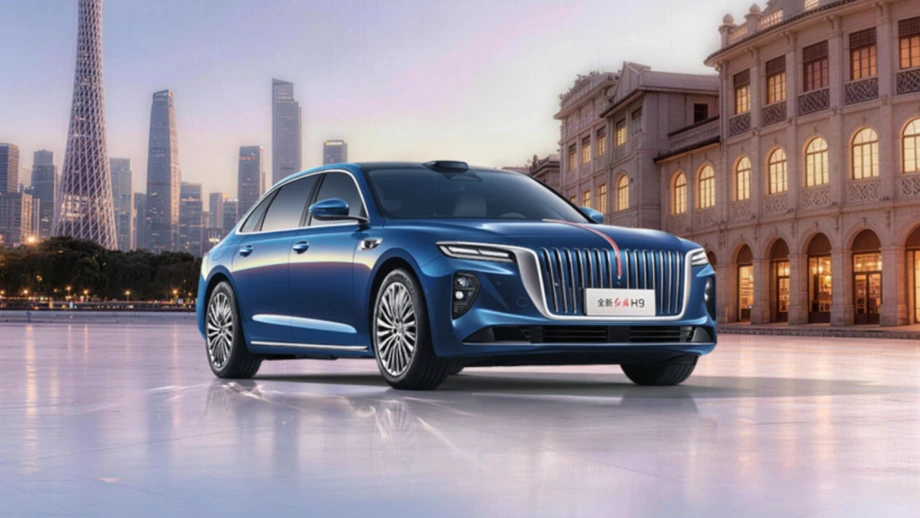
Audi's Q9, due as an import early next year, is its first standard full size SUV, with 3.0T and 4.0T engines and adaptive air suspension. Lexus showed the TZ, its first pure electric three row SUV, with six or seven seats, Direct 4 all wheel drive, 300 kW and 640 km CLTC range. FAW Hongqi's H9 PHEV opened pre sales at 329,800 to 419,800 yuan with Huawei Qiankun ADS 5 and standard 896 line lidar. Roewe also showed the Jia Yue 07 EV among the premium focused debuts.
XPENG Takes AI From the Stage to Showrooms
XPENG used a robot to host its press conference on November 27. IRON, a 170 cm humanoid robot, announced a Hong Kong R&D Centre, its ninth worldwide, for humanoid robotics and general purpose intelligence. Eight other IRON robots worked the booth as sales assistants and guides. Three Turing AI chips, from the same family used in XPENG cars, serve as IRON's brain.
An official XPENG statement, XPENG's global roadmap, said overseas sales were on track to pass 100,000 in 2026 after October deliveries reached 13,326, up 166 percent. Its network covers 83 countries and more than 1,300 stores. The L05 goes to Thailand in December 2026 and Europe in January 2027, the New P7 reaches Europe in the second quarter of 2027, and five models are planned overseas in 2027.
He Xiaopeng, XPENG's chairman and CEO, said Physical AI had to prove itself in daily use rather than stage demonstrations. The official statement quoted him saying:
The true value of Physical AI lies not in what technology can demonstrate on stage, but in what it can deliver in the real world.
Alex, vice president of XPENG International Business, said the overseas plan was about local relationships as well as sales growth. The official statement quoted him saying:
We aim to more than double our overseas vehicle sales in 2027 compared with 2026.
XPENG also plans NGP assistance overseas in the first half of 2027, IRON showroom duty in China in the first quarter of 2027 and international work in the second half, plus a 2027 Robotaxi launch. It plans four X-Energy megawatt charging stations across three continents within three months. The system stores power to deliver up to 1,000 kW peak charging with a grid connection no larger than 240 kW, useful in cities with limited grid capacity.
Safety Rules Set the Next Test for Automation
The show also revealed how far automakers are preparing for conditional automation. Aito's new M7 has 37 driving sensors, including four lidar units, radar and cameras, with redundant systems that can control the car if some devices fail. Casimiro Wei, a manager at Aito, said the hardware was ready for Level 3 functions when rules allow them:
Technically, we have already reached Level 3. We launched a car with the complete hardware first so this feature can be used immediately once regulations are eased.
Zhou Lin, chief technology officer at Aito and Seres, disclosed about 11 million real vehicle test kilometers and more than 1,300 vehicle level safety strategies in the Level 3 program. China's GB 44721-2026 safety standard requires lifecycle verification, staged road testing and third party testing. Level 3 hands more responsibility to the car than Level 2, but only inside defined conditions.
Hyundai showed an Ioniq M concept with ZYT Level 2++ assistance and ByteDance conversational AI, planned for China in the first half of next year. Huawei's Qiankun ADS and HarmonySpace had each passed two million installations by August across 25 brands and more than 60 models. BYD used one hall for its brands and technology displays; Huawei used another with partners including AVATR, EPICLAND and FREELANDER.
How Families Can Read the Show
Families had clear routes. BYD occupied Hall 2.1, Great Wall filled Hall 4.1, Changan was in Hall 4.2, IM was in Hall 19.2 and SAIC Volkswagen was in Hall 1.1. Adults aged 60 to 70 could enter free on weekdays with identification, children no taller than 1.4 meters were free throughout, and students aged 14 to 22 could buy 45 yuan tickets.
The remaining unknowns are practical. Exhibition notices gave public access as November 28 to December 6, while a visitor guide listed November 30 as the first public day; ticket types should follow the organizer's notices. Buyers should also ask which city navigation functions are active in their own city.
Buyers comparing family cars had three checks. Put the people who normally sit in the back into the third row for five minutes. Check chargers on the roads the car will actually use, since 850 km or 875 km CLTC figures are laboratory numbers. Ask whether a driver assistance feature is standard or limited to a higher trim, because lidar and city NOA often appear first at the top of a price range.
Key Points
- The 24th Guangzhou International Automobile Exhibition displayed 1,106 vehicles, including 115 debut models and 707 new energy vehicles, 63.9 percent of the total.
- Family cars in the 100,000 to 300,000 yuan range carried the show, with lidar, 800V platforms, long range batteries and city navigation assistance reaching lower prices.
- Weak retail sales, high dealer inventory and annual target pressure pushed automakers to launch products before and during the show.
- Leapmotor Lafa5, Dongfeng Nissan NX7, BYD Tang EV and Zeekr 7X showed how advanced hardware had moved into mainstream price bands.
- Joint venture brands increasingly used Chinese software, chips and batteries, while XPENG used the show to present robots, overseas expansion and future Robotaxi plans.
- Level 3 driving remains tied to regulation and safety testing, even as automakers display hardware they say is ready.