Robots Move From Demonstration to Daily Shifts
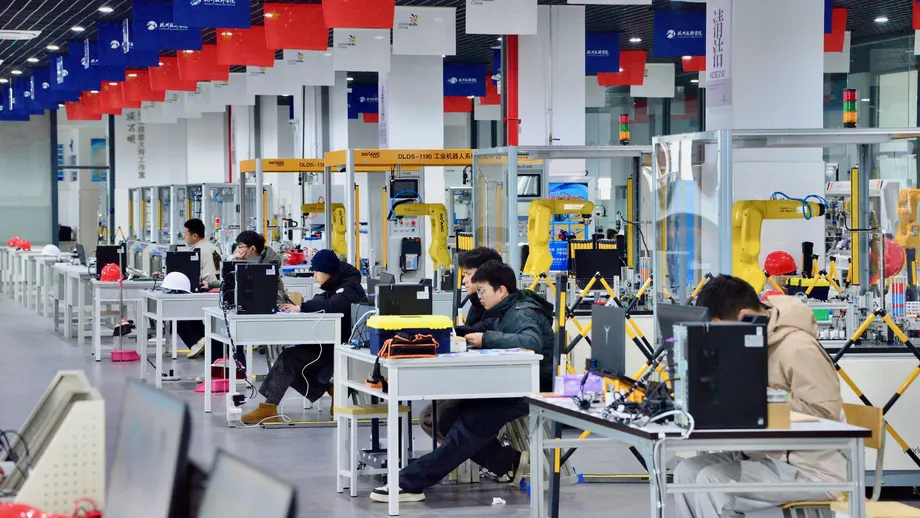
Hangzhou factories are treating artificial intelligence less as a concept and more as a tool with a price tag and a payback date. At Zhejiang Zhaofeng Mechanical and Electrical in Hangzhou, nearly 20 humanoid industrial robots have worked in the workshop over the past year, mainly loading and unloading materials. Chairman Kong Aixiang said the investment could be recovered in two to three years, a calculation that turns a futuristic machine into a practical business decision.
Contents
- Robots Move From Demonstration to Daily Shifts
- From Machine Replacement to AI Factories
- A Short Timeline of the Shift
- The Tire Factory That Runs in Seconds
- Why Zhongce Reaches Beyond One Plant
- Geely and Hangcha Show Automation at Different Scales
- Small Manufacturers Join the Upgrade
- Policy Aims to Lower the Entry Cost
- The Numbers Behind the Push
- Zhejiang Builds a Robot Supply Base
- Innovation Beyond Robots
- What Changes Now
- Key Points
A humanoid industrial robot has a body shaped for spaces built around people. Arms, legs and hands let it move through aisles and handle tools or parts without a full redesign of the factory. Kong said younger workers are less willing to take repetitive carrying jobs, so Zhaofeng is bringing robots in as new workers. He expects them to take on workshop inspection later.
We expect to recoup our investment in two to three years.
The Hangzhou push also fits a broader industrial test. After the Airbus humanoid robot deal put Walker S2 machines into aircraft manufacturing plans, factories in China are looking for jobs where machines with human proportions can work alongside people. Hangzhou's evidence so far comes from ordinary industrial tasks: moving parts, checking quality, planning production and managing energy.
From Machine Replacement to AI Factories
Hangzhou is known for its digital economy, and for years its manufacturing base drew less attention than its internet and service firms. That imbalance led some people to describe the city's economy as lopsided. Local factories kept upgrading anyway, moving from early machine replacement more than a decade ago to connected factory systems, management through cloud computing and what the city calls future factories.
At the end of last year, Hangzhou set a goal of becoming the first city for AI innovation and development. The 2026 Hangzhou AI plus Manufacturing Action Plan then set a target of cultivating more than 50 AI factories this year. An AI factory is not a site with one smart machine. It is a plant where AI links design, scheduling, inspection, logistics and energy use through shared data.
Hangzhou's Several Policy Measures on Accelerating Deep Integration of Scientific and Technological Innovation and Industrial Innovation call for an intelligent manufacturing system with AI as its core engine. They also include equipment subsidies and digital upgrade vouchers, tools meant to reduce the cost of buying machines and software.
A Short Timeline of the Shift
The story stretches across decades because the companies involved are old industrial names that are being rebuilt around data.
- 1958: Zhongce Rubber is founded and later becomes one of the world's ten largest tire companies.
- 1974: Hangcha makes its first trial forklift. It has since put more than 2.8 million units into production and sales.
- 1976: Aoxing Electronics begins making aluminum shells for capacitors, a narrow product that later gives it a 35 percent global market share.
- May: The National Artificial Intelligence Application Pilot Base for Embodied Intelligence opens in Hangzhou's Binjiang district.
- November 19: The Ministry of Industry and Information Technology and five other departments publish the second batch of national leading level smart factory cultivation projects at the 2026 World Intelligent Manufacturing Conference, including Zhongce Rubber's tire project.
- 2026: Hangzhou aims to cultivate more than 50 AI factories.
The timeline shows how policy targets and company histories now meet. Older firms are using data systems to extend businesses that already had scale, while newer robotics policies are trying to supply technology and test sites.
The Tire Factory That Runs in Seconds
Zhongce Rubber's future factory for high performance radial tires in Hangzhou's Qiantang district is one example of how AI is changing the line. The project, named the tire intelligent factory based on flexible customization across the full life cycle, was selected for the leading level of China's national smart factory cultivation system. That level sits at the top of a ladder with four levels: basic, advanced, excellent and leading.
The entry standard is strict. Leading level factories must have core technical and economic indicators that lead worldwide, and AI application scenarios must account for at least 60 percent of the relevant scenarios. At Zhongce's plant, 50 AI agents work across research and development, production, inspection and maintenance. More than 10,000 sensors collect live data from the line, while automated guided vehicles, small robots that move goods around a factory, carry materials in an orderly flow.
The results are measured in seconds. Zhongce says production efficiency across the plant has tripled, and one finished tire leaves the line every six to seven seconds on average. AI quality inspection uses cameras and models to compare products with standards far faster than a human checking each item. AI scheduling chooses the order of jobs, and AI energy control adjusts how machines consume power.
The factory also uses a digital twin, a virtual copy of the plant that helps engineers test changes before touching real equipment. Together with an industrial internet system, which links machines and data across production, the plant can connect research, supply, manufacturing and sales. That matters for customization because customer needs can feed back into design instead of stopping at the sales desk.
Why Zhongce Reaches Beyond One Plant
Zhongce was founded in 1958 and now ranks among the world's ten largest tire companies. Its selection was notable in Zhejiang as well: it was one of only two projects from the province in this batch, the only project in Hangzhou and the only tire industry project nationwide.
What makes the plant transferable is its push into customization at large scale. Data from tires in use can guide new designs, helping the company respond to different customer needs without stopping the whole line for each change. The intelligent manufacturing package has been copied to overseas bases in Thailand, Indonesia, Mexico and Vietnam, and the company has supplied similar systems to more than 70 other firms in the industry.
For manufacturers, that is the real value of AI factories. A system that improves one line can be packaged and sold as a service or a model, turning factory experience into a new business. For Hangzhou, it gives the city a homegrown example of how an old industrial company can become a provider of manufacturing technology.
Geely and Hangcha Show Automation at Different Scales
Geely's manufacturing base in Qiantang shows speed in a different industry. Its body welding workshop alone uses nearly 400 robots, and automation there has reached 90 percent. The fastest cars leave the line every 90 seconds. Welding is a good early use for robots because the work is precise, repetitive and physically demanding.
Hangcha Group, another Hangzhou industrial brand, shows how smart manufacturing supports global sales. The company made its first trial forklift in 1974 and has since put more than 2.8 million units into production and sales. Its smart factory is at the excellent level of the national system, one step below leading level, and uses data links across research, production and supply chains in new energy forklifts, smart logistics equipment and robot production lines.
Hangcha reported revenue in the first three quarters of 15.124 billion yuan, up 8.25 percent. Domestic sales brought in 8.383 billion yuan, up 8.25 percent, while overseas sales brought in 6.527 billion yuan, up 10.51 percent. Those figures put home and overseas business close to a 50/50 split. Since setting up its first overseas subsidiary in 2015, Hangcha has established more than 20 subsidiaries abroad. In overseas markets, the penetration rate for lithium battery forklifts has passed 70 percent. Penetration rate means the share of that market using the product.
Lucas, a Brazilian distributor who has worked with Hangcha for 15 years, said at the company's fourth global agents conference that the team earned trust through quality and design. He described what long cooperation has looked like from his side:
Really great! The Hangcha team is trustworthy. With solid quality and mature design, they can provide each customer with an optimal solution.
Hangcha has also expanded its product range to smart logistics, new energy forklifts, humanoid robots, forklift robots, aerial work platforms, tractors, cleaning equipment and key parts. The company is moving from making forklifts to selling complete intelligent logistics solutions, a shift that depends on software and connected equipment as much as steel and motors.
Small Manufacturers Join the Upgrade
Aoxing Electronics shows that Hangzhou's AI manufacturing push is not limited to famous carmakers and tire giants. The company sits in a township in western Lin'an and has made aluminum shells for capacitors for 50 years since 1976. That narrow focus has made it a hidden champion, a term for a company that dominates a small product category without being widely known by consumers. Its global market share stands at 35 percent.
Over the past two years, Aoxing has invested more than 15 million yuan in an intelligent factory that combines production and material control systems with warehouse robots. AI helps optimise production and operating processes. The company expects its profit margin this year to reach a recent high.
Zhan Yougeng, chairman of Aoxing and 76 years old, said AI has become a formal company strategy and that a dedicated team now promotes its use. He described the new guiding principle this way:
Embracing AI is the general trend. We have set our new production and operation policy as holding the bottom line and being driven by digital intelligence, and we have set up a special team to promote AI use.
Zhan said the company plans to keep investing because efficiency gains from AI can help it handle uncertainty in the outside environment. For a company based in a small town, that is a direct response to rising costs and changing demand rather than a search for publicity.
Policy Aims to Lower the Entry Cost
Hangzhou's approach goes beyond rewarding flagship plants. In the first batch of small and medium enterprise digital transformation city pilots, the city ranked first among 30 pilot cities and districts in the final performance evaluation by the Ministry of Industry and Information Technology and the Ministry of Finance. That result points to work across many factories rather than a few showpiece sites.
Liu Fei, a member of the Standing Committee of the Zhejiang Provincial Party Committee and Hangzhou's party secretary, has said the city will carry out the AI plus manufacturing action, make use of the National Artificial Intelligence Application Pilot Base for Embodied Intelligence and cultivate AI application service providers. The aim is to build model use cases in key industries and offer more shared solutions for whole industries to small firms so upgrades become cheaper and easier.
Shared solutions matter because many smaller manufacturers cannot build an AI team from scratch. A common inspection tool, scheduling system or energy model can be adjusted for one factory and then reused by others. This lowers both the price of technology and the difficulty of finding staff who understand it.
The city has not named all of the more than 50 AI factories or published a complete schedule for them. The concrete target in the plan is to cultivate them during 2026, while the national smart factory list was published on November 19.
The Numbers Behind the Push
Hangzhou's manufacturing effort is showing up in investment more strongly than in broad output. In the first three quarters, the city's second industry value added reached 435.2 billion yuan, up 4.9 percent. Manufacturing investment rose 10.5 percent and had posted double digit growth for eight straight months. Second industry includes manufacturing and construction, so it is a wider measure than factory output alone.
Zhejiang as a whole reported gross domestic product of 7.3224 trillion yuan in the first three quarters, up 5.6 percent. Regulated industrial added value grew 7.8 percent, manufacturing classified as high technology grew 16.0 percent, manufacturing in the core of the digital economy grew 15.8 percent and equipment manufacturing grew 12.9 percent. The provincial figures measure a wider area and a different industrial scope, but they show where new investment and output are concentrated.
The contrast helps explain Hangzhou's strategy. Its second industry grew more slowly than Zhejiang's regulated industrial output, while its manufacturing investment maintained a double digit rate. That combination fits a city replacing older capacity with smarter equipment, not simply adding more of the same production.
For residents and workers, the figures translate into a changing job mix. Repetitive loading and basic inspection can be handled by machines, while more jobs involve maintaining robots, training models, checking data and improving production software. Those roles usually require different skills, which makes training and shared services part of the manufacturing policy story.
Zhejiang Builds a Robot Supply Base
Hangzhou's factories are drawing on a wider provincial base of robots and intelligent equipment. In the first three quarters, Zhejiang's service robot output rose 91.0 percent, industrial control computer and system output rose 50.6 percent and industrial robot output rose 37.5 percent. These are products that go into factories, warehouses, shops and public services, so the growth shows demand beyond a single plant.
Li Hao, a researcher at the Zhejiang Development and Planning Research Institute, said the product mix shows that robots made in Zhejiang have moved beyond demonstration skills. He described the change this way:
Zhejiang made robots have moved from being able to run and jump to being able to work.
Embodied intelligence is the idea behind many of these machines. It means an AI system that senses the physical world, makes decisions and acts through a body, such as a robot arm, wheeled machine or humanoid figure. A chatbot works with text. An embodied system must deal with gravity, distance, timing and safety in real places.
Hangzhou has built rules and infrastructure around that field. The National Artificial Intelligence Application Pilot Base for Embodied Intelligence opened in Binjiang in May, using a mixed ownership model in which a state enterprise takes the lead and industry leaders and application companies join an open partnership. Its public technical platform focuses on computing power, data opening, model services and testing in real scenarios.
The city also put in force the Hangzhou Regulations on Promoting the Development of the Embodied Intelligent Robot Industry, described as China's first local regulation focused on embodied intelligent robots. The rules cover technological innovation, infrastructure, industrial development, application support and safety management. Binjiang alone has gathered more than 100 major companies in embodied intelligent robots and other smart terminals, including Hikrobot, Huarui Technology and Jingye Intelligence. The district has a chain covering core algorithms, key parts, complete machines and end use.
Innovation Beyond Robots
Zhejiang's manufacturing upgrade also includes materials and consumer technology. At Hangzhou Hexing Carbon Fiber Technology in Qiantang, black carbon fiber bundles are made for use in aerospace and new energy equipment. The company adjusted the full high temperature carbonization and graphitization process this year, solving instability in modulus, which measures stiffness, and strength, which measures resistance to breaking.
Jin Hu, the factory's production process manager, said the company tuned the complete process and brought product performance close to international levels. He described the technical goal this way:
Since the start of this year, the company has independently adjusted and optimised the parameters of the whole high temperature carbonization and graphitization process, solved instability in modulus and strength, and matched international levels precisely in product performance.
Qiantang is home to a provincial platform for the aerospace industry, which gives carbon fiber makers access to satellite and rocket customers. That link between a material supplier and downstream manufacturers is one reason local industrial clusters matter: a company can test a product near the people who will use it.
In Tongxiang, the Wuzhen Seven show another version of the same pattern. Seven separate companies cover computing power, data, models and applications, drawing on local strengths in traditional manufacturing. Tongkun and Jushi, large local firms, provide industrial scenes where AI can be tried, showing how older factories can become test sites for new technology.
The same ecosystem has helped consumer technology firms. Zhu Mingming, founder of Lingban Technology and one of Hangzhou's New Eight Horses after the Six Dragons, said his company grew out of Yuhang Dream Town and received help with funding, office space and application scenarios when it needed them. Lingban's smart glasses have reached a leading position in global shipments, and Zhu described the local attitude toward companies like his:
We are the group with the biggest dreams that grew out of Yuhang Dream Town.
Yuhang has shifted from basic support to service that acts like a business adviser, helping companies choose market areas, find resources and break through bottlenecks. Elsewhere in Zhejiang, banks have offered credit based on intellectual property and research progress, while insurers have used innovation scores in coverage for robotics research. Those tools matter because advanced manufacturing needs money before a product reaches the market.
What Changes Now
Hangzhou's next test is scale. A robot that loads parts in one workshop, an inspection model in a tire plant and a shared scheduling tool for small factories all solve narrow problems. Linking them across suppliers, factories and service providers is harder, because each plant has different machines, layouts and product mixes.
The city is trying to reduce that difficulty through pilot bases, local rules, subsidies and shared solutions. The plan sets a clear 2026 target of more than 50 AI factories and a policy direction that puts AI at the center of manufacturing.
For factory owners, the immediate question is payback. Zhaofeng's estimate of two to three years and Aoxing's expected margin high give concrete reasons to invest. For workers, the change means fewer repetitive carrying and checking tasks, and more work around robot maintenance, data quality and process design. For Hangzhou, the shift could make manufacturing a bigger part of its identity, not a side story to the digital economy.
Key Points
- Zhejiang Zhaofeng has used nearly 20 humanoid industrial robots for loading and unloading, and its chairman expects payback in two to three years.
- Hangzhou's 2026 AI plus Manufacturing Action Plan aims to cultivate more than 50 AI factories this year.
- Zhongce Rubber's tire project was selected for leading level in China's smart factory cultivation system, with 50 AI agents and production of one tire every six to seven seconds.
- Geely's Qiantang welding workshop uses nearly 400 robots and reaches 90 percent automation, while Hangcha reported 15.124 billion yuan in revenue in the first three quarters.
- Aoxing Electronics has invested more than 15 million yuan in an intelligent factory and holds a 35 percent global share in capacitor aluminum shells.
- Zhejiang's service robot output rose 91.0 percent in the first three quarters, and Hangzhou opened a national embodied intelligence pilot base in May.