113 Projects, 19 Countries and a Bet on Building
Between September 2024 and June 2026, Chinese companies committed at least $19 billion to 113 manufacturing projects spread across 19 African countries, according to Development Reimagined, a consultancy with offices in China that tracks Chinese economic engagement. The total is nearly double the $10 billion that Chinese firms pledged at the 2024 Forum on China-Africa Cooperation summit in Beijing, and it is counted separately from the $41.2 billion in mining and mineral processing investment identified in a companion study by the same researchers.
Contents
- 113 Projects, 19 Countries and a Bet on Building
- Cement, Food and Batteries: Where the Money Goes
- Is China Deindustrializing Africa?
- The Borrowing Argument That Flipped
- Congo Shuts the Cobalt Tap a Second Time
- Why a Price Fix Can Miss Its Target
- A Continent Closes the Door on Raw Ore
- Washington's Bid and Kinshasa's Own Plan
- What to Watch in 2027
- Key Points
Hannah Ryder, the consultancy's chief executive, links the surge to a return of official encouragement that had faded after the pandemic.
We last saw a big government push on Chinese FDI into Africa around 2015/2016, it seems now, post-COVID, that push is back, and it seems with more gusto than ever.
Three pressures sit behind the money. Chinese manufacturers are wrestling with excess capacity and severe price competition at home, trade barriers in the United States and Europe have made those markets harder to enter, and since May Chinese duty free access covers 53 of the continent's 54 countries. Private firms are doing most of the spending: Chinese investment in Africa reached almost $8 billion in 2025.
African industry has room to grow. The continent's share of global manufacturing output has fallen to less than 2% today from about 3% in the 1970s, according to the UN Industrial Development Organization.
Cement, Food and Batteries: Where the Money Goes
The sector split says a lot about what is being built. Bricks, ceramics, cement and glass take 23% of the projects, food and agricultural processing takes 21%, and clean energy and batteries takes 15%. The money is not going into flip flop and T-shirt factories making the cheapest Chinese consumer goods.
Géraud Neema, Africa editor at CGSP, is not surprised that construction materials lead. Chinese contractors keep winning building and infrastructure work across the continent, and the suppliers follow them. "We see Chinese companies acquiring cement companies from French companies in Nigeria, in Zambia, in Morocco," he said. The pattern of output matters as much as the money. "It's not like they set in Africa to produce goods, to be shipped in China or to be shipped in Europe," Neema said, adding that most of these plants are built in Africa to sell into African markets.
Cobus van Staden, CGSP's head of research, reads the investment as a wager on regional integration rather than on single countries. "China writ large, across its different entities, is currently one of the few international players that seem to be really taking African economic integration seriously," he said. In practice that means treating the continent as one emerging market of 1.2 billion people, where cement plants and glass factories pay off because roads, housing and power lines are being built.
Older investment stock numbers tell a different story. Figures compiled by UNCTAD in 2025 still show former colonial powers and the United States as the largest holders of investment in Africa, much of it in extraction. China's share of the stock is smaller than its weight in trade. Neema points to flows rather than stock, arguing that Chinese investment has been rising year after year while Western stock barely moves.
Is China Deindustrializing Africa?
A familiar charge is that cheap Chinese goods have hollowed out African factories. Van Staden rejects the framing and dates the damage earlier. "I think the deindustrialization of Africa was a Western-made project, not Chinese," he said, pointing to the neoliberal turn of the 1970s and 1980s and the structural adjustment programmes that cut back African states and economies.
Neema makes the same case from the Congolese side, arguing that adjustment policies left many governments unable to raise the capital they needed for their own industry, which is part of why they turned to Chinese lenders later. He is impatient with the idea that Africa should fight for the bottom rung of manufacturing. "Why do we want to fight to be able to make flip-flops? What does it add to us?" he asked, arguing that African governments should use what China builds and exports as a base for the next tier of industry, from processing to components.
Van Staden sees a practical limit to shipping everything from China. Products get localised quickly once they move past basic categories, down to details such as the shape of a bread slice and the toaster built to hold it. Transsion, the phone maker that dominates several African markets, is the reference case, though it still assembles in China. The gap he identifies is in products designed for African buyers that nobody has built yet.
The Borrowing Argument That Flipped
The same roundtable took aim at a shift in lending advice. The Organisation for Economic Co-operation and Development in Paris now says that borrowing to build infrastructure which generates growth can pay down the debt, a position it did not take during the years when African governments were borrowing from China for railways, highways and hospitals.
The numbers behind the complaint come from the UK non governmental organisation Debt Justice, which in 2022 put the average interest rate paid by African governments to private creditors at 5%, against 2.7% for Chinese debt, a mix of concessional and market lending. Chinese repayment terms also run longer, often around 30 years against 10 years or less on Eurobonds. Zambia, Ghana, Ethiopia and Sri Lanka all defaulted after falling behind on Eurobond payments rather than Chinese loans, and Chinese debt was later restructured for Angola, Zambia and Kenya.
"Just in terms of discourse alone, it's galling," van Staden said of the new advice.
Neema questioned how governments are meant to borrow commercially at high rates and still escape a debt cycle while the same creditors' media describe Africa as a permanent debt crisis.
Congo Shuts the Cobalt Tap a Second Time
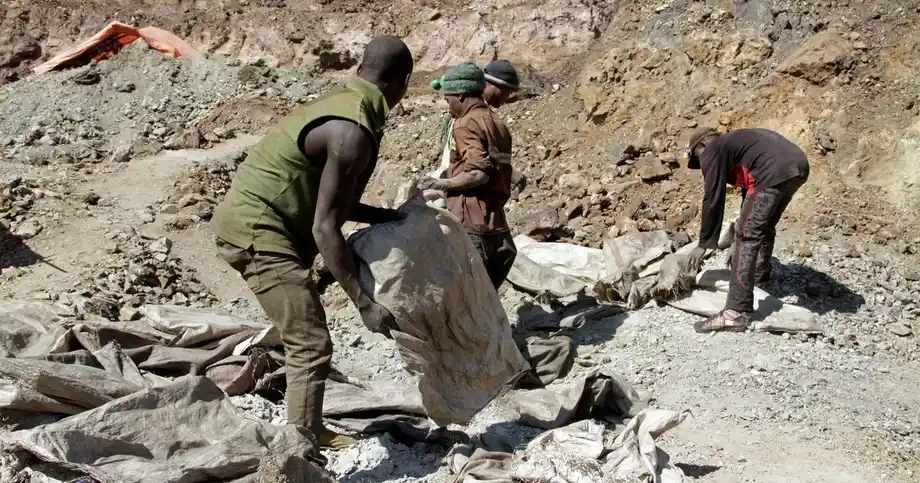
The Democratic Republic of Congo's regulator for strategic mineral markets, Arecoms, decided on 23 November to suspend all cobalt exports from 30 November until further notice. The authority, chaired by Patrick Mpoyi Luabeya, called the move an emergency measure forced by a significant and sustained fall in prices. The suspension covers industrial, semi-industrial and artisanal production and applies even to cargoes already authorised that have not crossed the border by 30 November.
Mines Minister Louis Watum Kabamba announced the decision at a mining conference in Kinshasa and was blunt about the market's reaction to political decisions. "We have again suspended cobalt exports and it will remain that way for as long as we deem it necessary," he told reporters. He also recalled the earlier quota system: "When we decided, for example, to impose quotas, we were able to catapult the price of cobalt."
Prices moved fast. Cobalt traded at $33,000 a tonne on the London Metal Exchange on 24 November, and by Thursday futures reached $43,855 a tonne from $33,080 at the start of the week, a 33% jump noted by BMO analysts Helen Amos and George Heppel. Chinese refining shares rose the day after the announcement: Ganzhou Teng Yuan Cobalt New Material closed up 14%, Nanjing Hanrui Cobalt 8.8% and Zhejiang Huayou Cobalt 5.7%, while CMOC, the biggest cobalt producer from its two Congolese mines, fell 3.6%.
- February 2025: Congo imposes its first blanket export ban as prices slump.
- October 2025: the ban is replaced by quotas capping exports at 96,600 tonnes of contained cobalt a year for 2026 and 2027.
- 23 November 2026: Arecoms announces the second suspension after prices slide again.
- 30 November 2026: the suspension takes effect, including for previously authorised shipments. Unused quotas cannot be carried forward.
- Late March 2027: the regulator reviews the ban four months on. A review does not reopen the border; resuming exports needs a separate decision on volumes and conditions.
Congo mined about 230,000 of the 310,000 tonnes of cobalt produced worldwide in 2025, according to United States Geological Survey estimates, roughly three quarters of the total. Exports of contained cobalt fell to 61,441 tonnes in the first nine months of 2026 from more than 145,000 tonnes in the same period of 2024. China refines about 75% of global cobalt, which is why Kinshasa's decision lands hardest in Chinese plants. CMOC, which operates Kisanfu and Tenke Fungurume, rushed shipments before the deadline, and an employee in its investor relations office told the South China Morning Post that some cargoes were already en route. Glencore produced 13,700 tonnes in the first nine months of 2026, down 52% from a year earlier, largely by keeping cobalt in solution instead of processing it into saleable hydroxide.
Why a Price Fix Can Miss Its Target
Neema puts the fall in context. Between the lifting of the first ban and the quota regime that followed, he said, the price of cobalt fell by around 40%. The official reason for acting again is to push it back up. The doubt is whether supply control alone achieves anything else.
The former head of Gécamines, Congo's state mining company, said the first ban was meant to lift prices high enough to pull midstream processors into the country. Neema said that investment never arrived and the quota regime did not hold prices either, which shows how little Congo controls beyond production volumes.
Demand has also moved. Battery makers are shifting away from nickel manganese cobalt chemistries toward lithium iron phosphate cells, and Chinese manufacturers are bringing sodium ion batteries to market, including CATL's Naxtra line, which uses neither nickel nor cobalt. Cobalt still matters for aerospace components and electronics, but nothing consumes it in the volumes a car battery does.
Marit Kitaw, an economist at the UN Economic Commission for Africa, warns against confusing local processing with blanket export bans, and Claudine Sigam of the African Minerals Development Centre notes that Africa holds nearly 30% of global critical mineral reserves while policy ambition keeps outrunning industrial capacity.
A Continent Closes the Door on Raw Ore
Congo is not alone. Zimbabwe will ban lithium concentrate exports from 1 January 2027 after rejecting producers' requests for more time, and a July 21 directive already bars antimony and tungsten exports in all forms. Its miners plan to spend $1.2 billion on processing in 2027, almost two thirds of planned capital spending, according to the Chamber of Mines of Zimbabwe, which says power costs 14.21 US cents per kWh, about 82% above the regional average. A first lithium processing plant built by a Chinese company is running. "We are not looking at the lithium sub-sector only," Mines Minister Polite Kambamura has warned.
Ghana's President John Mahama told a mining conference in Accra on 19 October that bauxite, manganese, iron and lithium must support processing at home, promising a phased prohibition backed by legislation and an end to unprocessed ore exports by 2030. Ghana supplies about 10% of the world's mined manganese and has already stopped exports of scrap iron and of raw gold from small scale miners. Gabon, the second largest manganese producer, will ban raw ore exports from 1 January 2029 and on 6 November signed a memorandum with Hong Kong listed South Manganese Investment for an XAF116.7 billion ($205 million) processing complex. Malawi banned raw mineral exports in February and Namibia stopped unprocessed lithium ore in 2023.
The bans are easier to announce than to run. Guinea outlawed raw gold exports in June and gave miners 90 days from a July 8 decree to ship unrefined metal. That window closed on 6 October, nearly a month before the state backed Nimba Gold Refinery opened on 1 November, and AngloGold Ashanti and Nordgold have been stockpiling unrefined gold worth tens of millions of dollars.
China runs controls of its own, requiring licences for gallium and germanium exports since 2023, for antimony since 2024, and for seven heavy and medium rare earths since last year. Chinese buyers also spent $8.8 billion on mineral assets abroad in the first nine months of 2026, the most in any year since at least 2018, according to a Rhodium Group report published on 4 November. Armand Meyer, a senior analyst at Rhodium, notes that Chinese firms increasingly build processing plants next to mines rather than buying assets outright, a pattern most visible where host governments require local processing, as Indonesia did with nickel ore.
Washington's Bid and Kinshasa's Own Plan
The United States signed a strategic minerals partnership with Congo in December 2025. Kinshasa identifies a portfolio of mining assets on which American investors hold a right of first offer, in exchange for diplomatic support on security in the country's east. Virtus Minerals, working with India's Lloyds Metals and Energy, has announced the acquisition of the indebted copper and cobalt producer Chemaf, and the Orion Critical Mineral Consortium is negotiating with Glencore for a 40% stake in the Mutanda and Kamoto mines.
Congo wants the deals to turn into shovels. "Our requirement is to move from signed agreements to real investments," Economy Minister Daniel Mukoko Samba said this month. At the Makutano Mining Forum in Kinshasa, banks and funds announced $965 million in new financing commitments, $700 million earmarked for mining and $265 million through the International Finance Corporation, the World Bank's private sector arm. Five banks and two investment funds took part. Among the named deals were a $45 million arrangement with BGFIBank for a contractor at Kamoa Copper and $25 million to expand a copper plant in Lualaba province from 50,000 to 75,000 tonnes. Organisers have not publicly identified the projects behind most of the money.
President Félix Tshisekedi used the same forum to explain the frustration behind the export bans. "Our country has for a long time contributed to the wealth of industries around the world without keeping a sufficient amount of the added value to ensure its own economic transition," he said, promising that domestic processing would deliver lasting prosperity. Watum pledged to triple mining revenue within 10 to 15 years through more local processing and told investors that "there is nothing, absolutely nothing that will leave this country for nothing." Under a roadmap he presented on 23 November, cobalt must be exported at least as hydroxide from 2028 and copper as cathode or anode from 2030.
Existing partners are making their own case. Li Sheng, chairman of Sicomines, defends the 2008 contract with Chinese partners, citing about $3.6 billion in planned mining investment plus $7 billion for infrastructure and saying its output now leaves as processed copper products rather than raw ore. Logistics are changing too: Olivier Binyingo, chairman of Kamoa Copper, says the Lobito Corridor railway to Angola's Atlantic port cuts the trip to under 10 days from 25 to 35 days on older routes. Nicholas Fournier, chief executive of Lobito Atlantic Railway, stresses durability over speed: "It is not necessarily speed that matters most, it is consistency."
China has publicly backed the processing push. Xi Jinping told Botswana's President Duma Boko at a meeting last month that "Africa's resources belong to Africa," pairing support for financing and technology transfer with a warning against turning minerals into a tool of geopolitical rivalry. Development Reimagined found that $16.3 billion of Chinese investment in Africa involved processing, refining or manufacturing, present in 19 of 32 mining, exploration and development projects. Congo's six million tonnes of cobalt reserves, more than half the world's known total according to USGS data, keep both Washington and Beijing at the table.
What to Watch in 2027
Several deadlines will decide whether this year's announcements become factories. Zimbabwe's lithium concentrate ban starts on 1 January, Congo's cobalt suspension faces its four month review around late March, and progress is expected on the rail link connecting Zambia's copper belt to Angola's existing line. Democrats in the new US Congress have said they will open investigations early next year into how the Trump administration negotiated its minerals deals, which a mining source in Congo said could slow implementation without changing the partnerships themselves.
Jacques Mukena of the Ebuteli research institute expects Kinshasa to press for delivery but cautions against fast results, since mines take years to build. "Without progress on security, investors will remain cautious," he said of the war in the east. Arecoms has not said what volumes would be allowed once the ban is lifted, and no date has been given for that decision.
Key Points
- Development Reimagined counted 113 Chinese manufacturing projects in 19 African countries worth at least $19 billion between September 2024 and June 2026, nearly double the $10 billion pledged at the 2024 Beijing summit.
- Construction materials take 23% of the projects, food and agricultural processing 21% and clean energy and batteries 15%, with most output aimed at African buyers.
- Congo's regulator Arecoms suspended all cobalt exports from 30 November, with a review after four months and no automatic reopening.
- Cobalt futures rose 33% to $43,855 a tonne after the announcement, from $33,080 at the start of that week.
- Congo mined about 230,000 of 310,000 tonnes of cobalt worldwide in 2025 and China refines roughly 75% of global supply.
- Zimbabwe, Ghana, Gabon, Guinea, Malawi and Namibia have all restricted raw mineral exports, following a model China itself uses on rare earths.
- Congo secured $965 million in financing commitments at the Makutano Mining Forum, with most of the underlying projects not yet named.
- Average interest on Chinese lending to African governments was 2.7% against 5% for private creditors, with longer repayment periods.