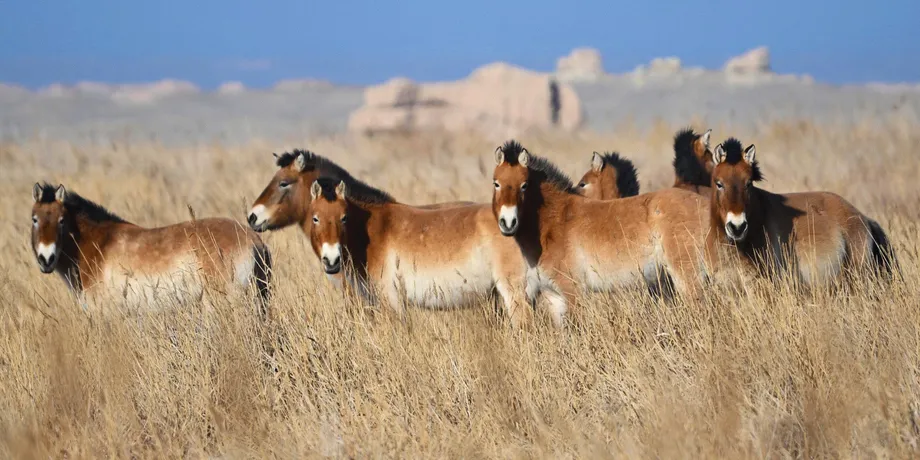
Ten horses arrive, with freedom still to come
Ten Przewalski's horses have been moved from Xinjiang Tianshan Wildlife Park to the Ebi Lake Wetland National Nature Reserve in Bortala Mongol Autonomous Prefecture, giving China's recovery program a new place to attempt a wild release. Officials announced the transfer on November 28. The horses are not roaming free yet: after observation to help them adjust and quarantine checks for disease, they are scheduled for release in spring 2027.
Contents
- Ten horses arrive, with freedom still to come
- Why a growing population needs more room
- How did the horses return after disappearing?
- What the first release taught conservationists
- The genetic work behind every breeding decision
- Why horses have been sent beyond Xinjiang
- What awaits the horses at Ebi Lake
- A recovery still built on careful management
- What to Know
Entemahan Azhanhan, director of the Wild Horse Research Institute under the management center of the Xinjiang Kalamaili Ungulate Wildlife Nature Reserve, said the move creates another wild home for the species in Xinjiang for the first time since releases began in 2001. The Kalamaili management center is carrying out the transfer and preparing the animals for their eventual release.
Xinjiang's forestry and grassland bureau selected Ebi Lake after extended research and expert assessment. The immediate reason was pressure on existing habitat. As the regional population has grown, finding additional space has become urgent. The ten animals are therefore part of a habitat expansion effort, rather than simply a transfer between enclosures.
Przewalski's horse is described by conservation officials as the world's only remaining wild horse species. These stocky, dun colored animals once roamed the steppes and deserts of Central Asia, including the Junggar Basin in what is now northwestern China. That description distinguishes them from free roaming horses whose ancestors were domesticated.
Why a growing population needs more room
The ten horses amount to less than 2 percent of the more than 560 Przewalski's horses in the latest Xinjiang count. Their numerical impact is small, but their destination matters. A successful release would give managers another area in which to establish a population as space becomes tighter elsewhere.
China's total population has surpassed 900, about a third of the global total, officials announced at an Urumqi event marking 40 years since the species returned to China. The announcement from Bortala puts Xinjiang's current population at more than 560. Yu Minghai, deputy director of Xinjiang's forestry and grassland bureau, gave a figure of 546 for the region at the August 7 event.
Yu also said the Xinjiang Wild Horse Breeding and Research Center, Asia's largest breeding center for the species, has bred more than 800 horses. Those births reflect decades of work with climate, diet, reproduction and animal health. The growing challenge is to provide suitable landscapes where animals can gradually rely less on people.
The species remains endangered globally and is included in China's highest national category of protected animals. Population growth has therefore brought a new kind of conservation work. Breeding centers still matter, but habitat selection, genetic planning and careful preparation for life in the wild now carry much of the burden.
How did the horses return after disappearing?
Hunting and habitat loss drove Przewalski's horses towards extinction during the first half of the 20th century. Their survival eventually depended on animals in European zoos. Every horse alive today descends from just 12 wild individuals captured by European explorers in the late 19th and early 20th centuries.
That tiny group of founders created what scientists call a genetic bottleneck. With so few ancestors, later generations had limited genetic variety, increasing the danger that closely related animals would breed and pass on harmful traits. Returning the horses to China required both a breeding program and a way to manage that inherited risk.
- 1969: Mongolian biologists made the last confirmed sighting of the species in the wild, after which it was declared extinct in the wild.
- 1978: The Netherlands based Foundation for the Preservation and Protection of the Przewalski Horse called for the species to be returned to its native habitat.
- 1985: China launched the Wild Horse Homecoming project and established breeding bases in Xinjiang and Gansu. The Xinjiang center was built on the edge of the Junggar Basin.
- December 1986: The first group of 11 horses arrived from the United Kingdom and Germany.
- March 8, 1988: A mare named German No. 2 gave birth to Junggar No. 1, the first foal bred in captivity under the program.
- August 28, 2001: Twenty seven selected horses were released at Kalamaili Nature Reserve.
- Spring 2003: The released animals produced their first surviving foal born in the wild.
- By the end of 2024: Kalamaili had completed 18 releases involving 146 horses, which had formed 27 wild herds.
- November 28: Ten horses were transferred from Tianshan Wildlife Park to Ebi Lake.
- Spring 2027: The new arrivals are scheduled to be released after observation and quarantine.
The birth of Junggar No. 1 was an early turning point. It showed that horses returned from overseas could survive Xinjiang's conditions and reproduce. The 2003 foal marked a different stage: animals released at Kalamaili had begun raising the next generation in the wild.
What the first release taught conservationists
The 27 horses released at Kalamaili on August 28, 2001 did not simply gallop into an easy life. During their first winter, temperatures fell to minus 30 degrees Celsius and the herd faced starvation. Conservation workers drove jeeps through blizzards for three days, scattering alfalfa to guide the animals towards safety.
Food was only one difficulty. Przewalski's horses naturally form harem groups, usually with one male and several females, as well as bands of bachelor males. Released animals had to establish workable social groups. That restructuring can involve the killing of foals and the loss of old or weak individuals, harsh processes that staff could not remove from wild life.
The surviving foal in spring 2003 gave managers evidence that the population could reproduce without remaining in captivity. The 27 herds recorded by the end of 2024 now find water during dry seasons, forage for themselves and organize defenses against wolves. Their recovery has also returned grazing and movement to landscapes shared with Mongolian wild asses, goitered gazelles and argali sheep.
Those lessons help explain the long preparation planned at Ebi Lake. A release date marks the beginning of another demanding stage, when horses must find food and water, form stable groups and cope with weather, illness and predators.
The genetic work behind every breeding decision
Descent from only 12 wild founders makes it nearly impossible to prevent all mating between relatives. The Xinjiang breeding center works with research institutes to reduce that risk through genome sequencing and a database containing each horse's genetic profile. Staff use pedigree records and selected breeding pairs to lower the chance of close relatives mating.
This system has supported breeding through six generations. It cannot recreate the genetic variety lost when the wild population collapsed, but it gives managers information with which to make each pairing and transfer more carefully. Moving animals between populations can also prevent isolated groups from becoming increasingly related.
Monitoring supplies another layer of protection at Kalamaili. Cameras on watchtowers, drone patrols, GPS satellite collars and infrared camera traps allow staff to follow the locations and behavior of collared horses on a digital map. GPS, short for global positioning system, uses satellites to identify an animal's location.
The technology can reduce the need to search vast areas on foot or by vehicle. Reserve staff say it can help confirm that a horse is injured without first tracking down its herd in person, allowing a faster response. Similar patience will be needed at Ebi Lake, although authorities have not announced which monitoring tools will be installed there.
Why horses have been sent beyond Xinjiang
Xinjiang has transferred 41 horses to Mongolia and to the Chinese regions of Gansu, Ningxia and Inner Mongolia. Four were exported to Mongolia in 2012, contributing to that country's own recovery effort. Other transfers have supplied breeding animals to conservation programs across northern and northwestern China.
The receiving landscapes differ considerably. Horses have adapted to wetlands and grasslands at Gansu's Dunhuang Xihu Nature Reserve, desert country in Ningxia's Helan Mountains and mountain steppe in Inner Mongolia's Daqing Mountains. Gansu's population now exceeds 250.
These movements expand the area occupied by the species and reduce dependence on a single landscape. They also give genetic managers more options when selecting animals for breeding or transfer. Ebi Lake extends that approach within Xinjiang, where Kalamaili has carried nearly all of the region's wild release history since 2001.
The national total of more than 900 is consequently spread across breeding facilities, reserves and wild populations in several places. The distribution matters as much as the headline figure because managers must keep animals healthy, genetically varied and capable of living with progressively less assistance.
What awaits the horses at Ebi Lake
Ebi Lake Wetland National Nature Reserve covers more than 3,082 square kilometers and contains 687 species of wild plants. Preparations for the horses include enclosures for isolation and management, along with facilities to supply drinking water. The reserve has invited experts to provide guidance on population care, disease prevention and adaptation to wild conditions.
The ten arrivals will first undergo adaptive observation and quarantine. Quarantine means keeping animals separated while checking for diseases that could affect them or other wildlife. Adaptive observation gives staff time to assess their condition and prepare them for a different environment before the planned release in spring 2027.
Authorities have not announced an exact release day or published detailed criteria that the horses must meet before they can go free. They have also not said whether additional groups will be moved to Ebi Lake after these ten animals.
For reserve staff in Bortala, the immediate work is practical: maintaining the enclosures and water supplies, watching the horses' health and applying the lessons accumulated at Kalamaili. For regional managers, the project offers another destination as the population grows. For the horses, the coming seasons are a period of preparation rather than an immediate return to unrestricted life.
A recovery still built on careful management
Przewalski's horse has an evolutionary history spanning more than 60 million years, according to Chinese conservation officials. Its modern recovery began with a small group of zoo descendants and the arrival of 11 animals in December 1986. China's population has since passed 900, while Kalamaili's releases have produced herds capable of finding food, raising young and defending themselves.
Li Linhai, deputy secretary-general of the China Wildlife Conservation Association, attributed that growth to cooperation among the organizations involved.
"The growth in the Przewalski's horse population is the result of joint efforts by multiple parties," Li said.
Li also described the recovery from the brink of extinction as an example of China's broader wildlife protection work. The next stage at Ebi Lake is narrower and more concrete. Staff must guide ten horses through observation and quarantine, then attempt the release planned for spring 2027.
Kalamaili's experience shows which later developments will carry the greatest weight: survival through difficult seasons, the formation of stable social groups and foals that survive after being born in the wild. Reaching those stages would turn a new reserve into a functioning wild home and give Xinjiang more room to continue the recovery.
What to Know
- Ten Przewalski's horses have moved from Xinjiang Tianshan Wildlife Park to Ebi Lake Wetland National Nature Reserve.
- The horses will undergo adaptive observation and quarantine before a planned release in spring 2027.
- Ebi Lake is Xinjiang's first additional wild home for the species since releases began at Kalamaili in 2001.
- The reserve covers more than 3,082 square kilometers and has prepared enclosures and drinking water facilities.
- China's population exceeds 900, about a third of the global total, while the latest Xinjiang count is more than 560.
- Kalamaili had released 146 horses in 18 batches by the end of 2024, forming 27 wild herds.
- Every living Przewalski's horse descends from 12 wild founders, making genetic management central to the recovery.