A Bone on a Cliff in the Gonghe Basin
On 7 August 2026, a team from the Qinghai Geological Survey was tracing fossil bearing rock layers across the Gonghe Basin in Gonghe County, in Hainan Tibetan Autonomous Prefecture, when it reached a cliff of bare Gobi slope. A piece of bone about 15 centimeters long was showing in the face of the cliff. The team cleared the rock around it and found the fragment was attached to something far larger.
Contents
- A Bone on a Cliff in the Gonghe Basin
- An Elephant Built for Warm Country, Not for Ice
- Fourteen Ridges of Enamel
- Why a Skull From the Far East Changes the Picture
- A Warm Basin With Fish, Horses and Rhinoceroses
- An Anchor for the Gonghe Movement
- Glue, Plaster and a Closed Store Room
- What Happens Next
- Key Points
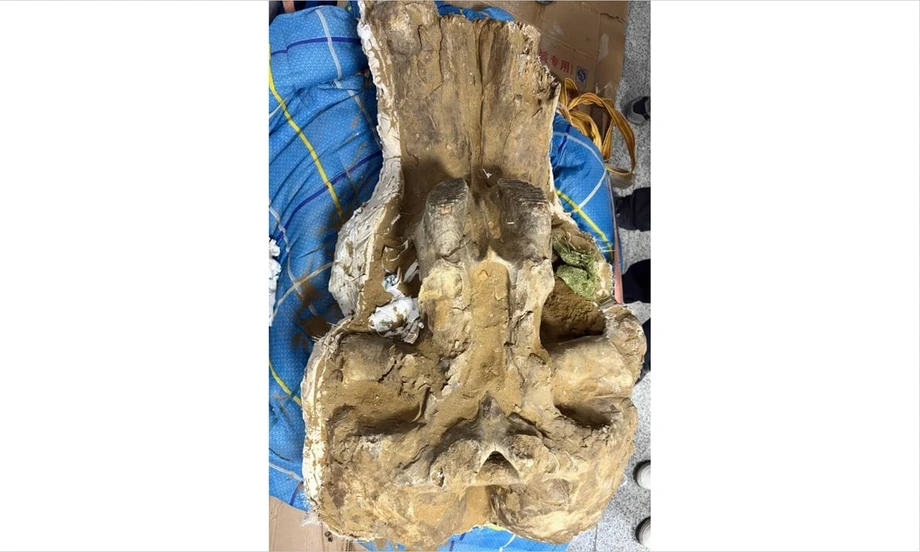
What came out of the ground is a skull 75 centimeters long and 70 centimeters wide, with tusks 175 centimeters long. The tusks reach 20 centimeters at their widest point and sit 210 centimeters apart. Qinghai's Department of Natural Resources announced on 28 November 2026 that the specimen is the first complete skull of a southern mammoth (Mammuthus meridionalis) found in China. The Institute of Vertebrate Paleontology and Paleoanthropology, part of the Chinese Academy of Sciences, identified the animal and placed it in the Early Pleistocene, between roughly 2 million and 1.3 million years ago.
Earlier southern mammoth finds in China amounted to isolated molars, tusks and pieces of lower jaw. A skull with the upper and lower tooth rows still in place had never turned up, which is why the Gonghe specimen is being treated as a benchmark rather than another bone in a drawer.
An Elephant Built for Warm Country, Not for Ice
Southern mammoths were among the most representative large animals of Early Pleistocene Eurasia, and they were bigger than the woolly mammoth that lived much later. Pan Tong, chief scientist at the Qinghai Bureau of Geology and Mineral Exploration and Development, describes an elephant without the long cold resistant coat of its famous cousin, an animal at home in warm, humid woodland, grassland and lake shore. Its range stretched from southern Europe across to East Asia.
Proboscideans, the group that includes elephants and their extinct relatives, are named for the trunk that defines them, and the southern mammoth stood at the large end of that group. European fossil beds have produced its bones for more than a century, and the finest skulls come from Valdarno in Italy, long treated as the reference site for the species.
Previously the southern mammoth fossils found in China were mostly scattered tooth fragments, and there was no record of a complete skull," Pan said. "This discovery can achieve the first comparison between skull specimens of the same level from East Asia and Western Europe, adding key eastern evidence for verifying the west to east dispersal route of the southern mammoth and for calculating when it reached the northeastern margin of the Qinghai-Tibet Plateau.
Fourteen Ridges of Enamel
A mammoth tooth is a stack of enamel plates bound together in cement, and the number and shape of those plates change along the evolutionary line. Specialists read them much as a reader reads a date stamp. The Gonghe skull's upper third molar, known as the M3 and the last tooth to erupt in the jaw, carries 14 plates and lacks a small extra fold of enamel called an intermediate protuberance.
Fourteen plates and no intermediate protuberance put the animal among the more advanced southern mammoths, a form later in the species' evolutionary sequence with more specialised features. The team also reported that the skull's three dimensional shape survived burial intact, that the compression it suffered is slight and that the tooth rows are complete. Those are the qualities that make a fossil comparable with the Italian Valdarno material, because a crushed or half fossilised skull cannot be measured against another one with any confidence.
Pan's team found the bones of the skull walls, the tusk sockets and the palate in their original arrangement. A single tusk, even a large one, tells a researcher little about the size of the animal or the shape of its head. A complete skull gives the length of the face, the width of the forehead and the angle at which the tusks leave the jaw, and those are the measurements that let two populations be set side by side.
Why a Skull From the Far East Changes the Picture
The European collections are rich and old, and the working picture of the species has southern mammoths spreading from Europe eastward across Asia. What the record lacked was a skull from the far eastern end of that range, taken from a rock layer whose age could be pinned down.
Gonghe supplies both. The skull came out of a layer whose position in the local rock sequence is clear, and the animal's age range is constrained by the fossils and sediments around it. Pan's point is that the eastern end of the route now has a specimen of the same grade as the western end, so the timing of the spread can be argued with bones rather than with inference from European sites alone.
Qinghai's rocks are also a hard place for a wandering animal to leave a trace. The plateau's northeastern margin has been rising and eroding for millions of years, and bone that survives there is often fractured and scattered. A skull that reached the museum in one piece, from a known layer, is rare enough that researchers describe the find as filling a blank space rather than adding a data point.
A Warm Basin With Fish, Horses and Rhinoceroses
The skull lay in river and lake deposits of the Early Pleistocene Gonghe Formation. The same beds hold fossil fish, an extinct horse known as the Sanmen horse, woolly rhinoceros, fossil wood and abundant pollen grains. Read together, those remains describe a basin of broad old rivers and lake side grassland, a warm and humid climate, and water and grass in quantity.
Southern mammoths, on that reading, were residents of the old lake ecosystem rather than passing visitors. Uplift and later climate change shrank the water and the grassland, and the basin turned into the dry, windy Gobi crossed today.
Zhang Zhongyue, deputy director of the Qinghai Provincial Natural Resources Museum, where the skull is now held, draws the wider lesson from the animal's presence.
This mammoth fossil shows at least that 2 million years ago the climate of the Gonghe Basin in Qinghai was warm and humid, with lush vegetation," Zhang said. "Later, as the Qinghai-Tibet Plateau kept rising, the basin's altitude grew higher and the climate turned relatively cold and dry, no longer suitable for elephants to live here. Through this elephant fossil we can see that the uplift of the Qinghai-Tibet Plateau brought enormous changes in climate, environment and living things.
An Anchor for the Gonghe Movement
The Gonghe Movement is the name geologists give to a phase of uplift and crustal deformation on the northeastern margin of the Qinghai-Tibet Plateau, recorded in the folding and lifting of these same rock layers. Fixing its timing has depended on dating rocks and sediments directly. A fossil with a known age range, pulled from a bed whose position in the sequence is secure, gives the layers around it a reference point. Geologists call the method biostratigraphy: reading the animals and plants preserved in a bed to place it in time.
Pan called the skull a "time anchor" for that work, and the phrase has a practical meaning. A date from volcanic ash or magnetic readings can drift with the method used. A fossil assemblage that matches a known fauna acts as a cross check, tying the local rock sequence to a wider regional timeline.
The skull's value is narrower than the headlines suggest, and the researchers are careful about it. It does not date the Gonghe Movement on its own. It supplies one fixed point in the layers that the movement lifted, which is what a chronology is built from.
Glue, Plaster and a Closed Store Room
The skull sat in an open Gobi cliff with no protective barrier of any kind, and the team judged it exposed to damage from weather and from anyone who walked past. Workers first applied adhesive to harden the bone surface, then wrapped the specimen in a plaster field jacket, a rigid shell of plaster and cloth that keeps the fossil from shifting or cracking in transit. They recorded the coordinates of the find and photographed the skull in place before lifting it. It now sits in closed storage at the Qinghai Provincial Natural Resources Museum.
The site also produced separate elephant leg bones and rib bones. The research team says it is handling and studying those remains in line with the rules that cover palaeontological fossils in China.
What Happens Next
Zhang Hailong, who heads the research team at the Qinghai Geological Survey, said the specimen meets the standard for the national level one protected palaeontological fossil category, the highest class in China's system for such finds. Restoration, 3D scanning and a set of tests across several scientific disciplines are planned. The implementation plan must pass approval procedures first, and the team has said research and public outreach will go ahead with protection as the priority.
The excavation grew out of a provincial project paid for by a special fund for geological exploration: Investigation and Evaluation of Palaeontological Fossils in Eastern Qinghai, run by the Qinghai Geological Survey under the Qinghai Department of Natural Resources with support from the provincial bureau of geology and mineral exploration.
No date has been given for the restoration to finish, for the test results, or for any public display of the skull. Li Wufu, a senior engineer at the Qinghai Geological Survey and a palaeontological fossil expert for the Ministry of Natural Resources, set out what the specimen changes once the work is done.
"It fills the gap in complete southern mammoth skull fossils in China, builds a bridge for comparative research between East Asia and Western Europe, provides key vertebrate evidence for reconstructing the living communities and climate of the northeastern margin of the Qinghai-Tibet Plateau between 2 million and 1.3 million years ago, and gives a core basis for protecting geological heritage in the Gonghe Basin and for applying for protected area status," Li said.
The last item has consequences beyond the laboratory. A specimen of this grade gives local authorities a concrete reason to mark and guard the ground it came from, in a basin where wind, grazing and road building have reshaped the surface for decades.
Key Points
- A team from the Qinghai Geological Survey found the skull on 7 August 2026 at a Gobi cliff in Gonghe County, Hainan Tibetan Autonomous Prefecture, Qinghai.
- The specimen measures 75 centimeters long and 70 centimeters wide, with tusks 175 centimeters long, 20 centimeters at maximum diameter and 210 centimeters apart.
- The Chinese Academy of Sciences Institute of Vertebrate Paleontology and Paleoanthropology identified it as a southern mammoth from the Early Pleistocene, about 2 million to 1.3 million years ago.
- It is China's first complete southern mammoth skull, replacing a record that held only scattered molars, tusks and jaw fragments.
- Its upper third molar has 14 plates and no intermediate protuberance, marking an advanced form of the species.
- The skull came from Early Pleistocene Gonghe Formation lake and river deposits that also hold fish, Sanmen horse, woolly rhinoceros, wood and pollen.
- Researchers compare it with classic Valdarno specimens from Italy, the first such East Asian to Western European comparison of skulls at the same evolutionary stage.
- The fossil gives a dated marker for the timing of the Gonghe Movement, the uplift phase on the plateau's northeastern margin.
- It is held in closed storage at the Qinghai Provincial Natural Resources Museum and meets the standard for the national level one protected fossil category.
- Restoration, 3D scanning and multidisciplinary testing are planned, with no dates yet announced.