Unexpected Shortage of Dark Matter Found in Large Galaxies
A team of Chinese scientists has revealed a significant discrepancy in how dark matter is distributed within massive galaxies, challenging the foundations of modern cosmology. The research, published in the journal Nature Astronomy on November 27, demonstrates that the centers of large galaxies contain less dark matter than most computer simulations predict. This finding suggests that our current understanding of how visible matter and dark matter interact may be missing key physical mechanisms.
Contents
The new study, led by Yu Lei from the Shanghai Astronomical Observatory, involved a massive collective weighing of 136 nearby galaxies. By combining observations from the MaNGA and CALIFA surveys with radio data from the Five-hundred-meter Aperture Spherical radio Telescope (FAST), the team mapped the gravitational pull from the galaxy centers out to their distant outskirts.
The results indicate that as galaxy mass increases, the region where dark matter density is lower than expected also expands. In the most massive galaxies, this deficit extends up to 50 kiloparsecs from the center, covering an area equivalent to about 160,000 light-years.
How Scientists Measured the Invisible
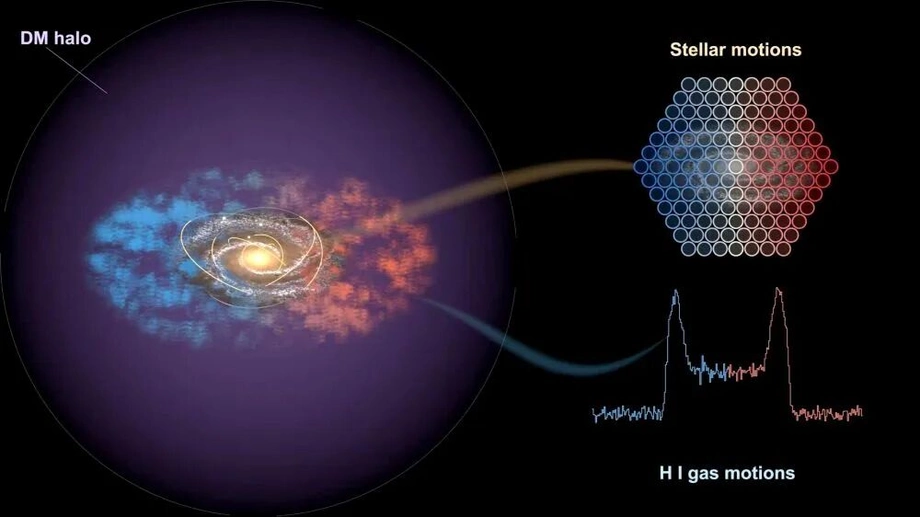
Dark matter does not emit light, making it invisible to traditional telescopes. However, its gravity influences the motion of stars and gas within galaxies. By measuring these movements, astronomers can reconstruct where dark matter lies.
Yu Lei explained that stars and gas provide complementary views of a galaxy gravitational pull. He noted that bringing these two data sets together allows researchers to trace dark matter much farther out and test whether simulated galaxies resemble those actually observed.
The study analyzed galaxies with stellar masses ranging from approximately 1 billion to 300 billion times the mass of the sun. The team used stellar motions to trace the inner regions and neutral hydrogen gas to probe the outer regions. This combined approach provided a unified mass distribution profile, significantly improving measurement reliability compared to previous studies that often focused on only one region.
Jesus Falcon-Barroso, an investigator at the Instituto de Astrofisica de Canarias and a co-author of the article, emphasized the demanding test this result poses for current models. He stated that simulations must now reproduce both the visible galaxy and the specific distribution of dark matter revealed by the motions of its stars and gas.
Simulations Fall Short in Massive Systems
When comparing their observational data with leading cosmological simulations, including IllustrisTNG, EAGLE, and SIMBA, the researchers found a persistent mismatch. These simulations generally predict that as stars and gas accumulate toward a galaxy center, their gravity draws dark matter inward, increasing its density.
The new observations suggest that the balance between processes that concentrate dark matter and those that redistribute it is not fully captured in current models. The discrepancy grows with galaxy mass, extending from roughly 10 kiloparsecs in moderately massive systems to around 50 kiloparsecs in the most massive ones.
The findings do not imply that dark matter does not exist or that the cold dark matter theory is incorrect. Instead, they highlight a gap in how existing galaxy formation models describe the interaction between ordinary matter and dark matter.
Possible Physical Explanations
Several physical mechanisms could explain the observed shortage of dark matter in galaxy centers. One prominent theory involves supermassive black holes. As matter falls toward a supermassive black hole, it releases energy that can push gas away. This process may reshape the surrounding dark matter distribution, preventing it from concentrating as much as simulations predict.
Another possibility is that dark matter particles interact with each other. Simulations that include self-interacting dark matter reproduce some of the observed trends but still do not match the measurements quantitatively. These interactions could cause dark matter particles to collide or scatter, altering their distribution.
Future observations will be crucial to determine whether the low densities reflect an extended central region or a dark matter halo that is less massive or less concentrated overall. The study establishes a new observational benchmark to help next-generation simulations incorporate these physical ingredients.
Context and Implications for Cosmology
Previous studies had identified similar issues in small dwarf galaxies, known as the core-cusp problem. However, this new research focuses on massive galaxies, which are better described by standard fluid dynamics in simulations. The fact that the discrepancy appears in these larger systems suggests that the missing physical mechanisms are significant on a larger scale.
The research provides a critical test for the Lambda cold dark matter model. By establishing a clear observational baseline, the team has set a new standard for evaluating future simulations. Upcoming surveys, such as WEAVE-Apertif, which combine stellar and hydrogen-gas observations, will help refine these measurements.
The study underscores that while the standard cosmological model explains large-scale structures well, it may not adequately characterize what is observed on the scale of individual massive galaxies. Understanding these details is essential for building a complete picture of how the universe evolves.
The Bottom Line
- Chinese scientists led by Yu Lei analyzed 136 nearby galaxies and found less dark matter in their centers than simulations predict.
- The discrepancy is most prominent in massive galaxies, extending up to 50 kiloparsecs from the center.
- The study combined stellar motion data from MaNGA and CALIFA with gas data from the FAST radio telescope.
- Current simulations overpredict dark matter density in galaxy centers, missing key physical interactions.
- Supermassive black holes or interacting dark matter particles are potential explanations for the observed deficit.
- The findings challenge existing galaxy formation models but do not invalidate the cold dark matter theory.
- Future surveys will test these mechanisms to improve the accuracy of cosmic simulations.