A shortfall that widens with galaxy mass
The centres of the heaviest nearby galaxies hold less dark matter than the leading computer models of the universe predict, a team led by Yu Lei at the Shanghai Astronomical Observatory of the Chinese Academy of Sciences has found after measuring 136 galaxies. The results appeared in Nature Astronomy on November 27, 2026, and the shortfall grows with the size of the galaxy, a pattern first reported in late November.
Contents
- A shortfall that widens with galaxy mass
- How astronomers weigh something that gives off no light
- FAST supplies the outer edges
- What the 136 galaxies showed
- Three simulations that put too much dark matter in the middle
- Why the simulated centres come out too heavy
- Two possible culprits, and no verdict yet
- What the result does not say
- A benchmark for the next generation of simulations
- Key Points
Smaller galaxies behave much as the models expect. Above roughly 10 billion times the mass of the sun in stars, a central zone appears in which the measured dark matter density sits below the simulated value, and that zone spreads outward as mass rises. For galaxies of about 10 to 30 billion solar masses it reaches out to some 10 kiloparsecs, or about 33,000 light years. For those between 30 and 100 billion solar masses it covers 20 to 30 kiloparsecs, roughly 65,000 to 98,000 light years. In the heaviest galaxies the low density region runs beyond 50 kiloparsecs, close to 160,000 light years, a figure the authors treat as tentative.
A kiloparsec is a distance used in astronomy equal to about 3,260 light years. A solar mass is the mass of the sun, so 10 billion solar masses means ten billion suns' worth of stars.
How astronomers weigh something that gives off no light
Dark matter makes up about 85 percent of all matter in the universe and emits nothing a telescope can collect. Astronomers locate it by watching how fast stars and gas move: the faster they travel around a galaxy, the more mass must be pulling on them, whether or not that mass is visible.
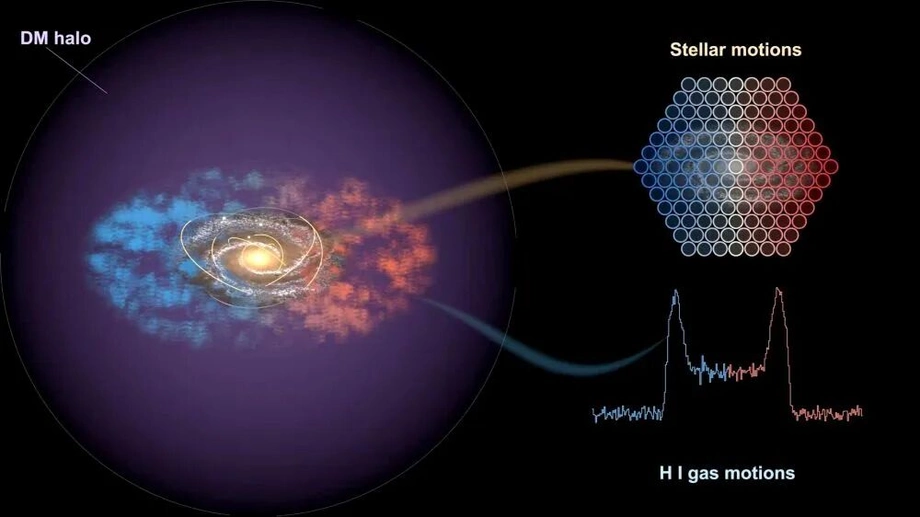
The team drew on two sets of stellar motions. Integral field spectroscopy, which records a spectrum for each position across a galaxy rather than one reading for the whole object, supplied velocity maps for 107 galaxies from the MaNGA survey and 29 from CALIFA. A model that follows stars on orbits in three dimensions, run through the publicly available DYNAMITE code, then reproduced those maps.
Stars alone pin down only the inner part of a galaxy. To reach the outskirts, the researchers used neutral hydrogen gas, which radiates at a wavelength of 21 centimetres and extends far past the visible stars. Rather than map the gas across each galaxy, they fitted a single radio spectrum per object. The shape of that spectrum, with two clear horns, records how fast the gas rotates, and the fit forces the gas and the stars to sit in one shared gravitational field.
FAST supplies the outer edges
New radio observations came from FAST, the Chinese radio telescope with a dish 500 metres across, which spent about 12 minutes on each target under a programme the team calls PROMISE. The remaining spectra were taken from the HI-MaNGA survey and from archival single dish measurements.
Combining the two tracers cut the uncertainty on the dark matter mass within 20 kiloparsecs, about 65,000 light years, to roughly 30 percent, down from about 90 percent when stellar motions were used alone. The joint fit also stretched the measurement from the centre out to between 20 and 50 kiloparsecs, a span that earlier samples rarely covered in one consistent analysis.
What the 136 galaxies showed
The sample runs from about 1 billion to 300 billion solar masses in stars and includes galaxies of several shapes, from thin discs to bulging ellipticals. The paper's logic is simple: a simulation that matches the visible part of a galaxy has not necessarily matched the dark halo around it, and the new sample was built to test that gap directly.
Jesús Falcón-Barroso, a co-author at the Instituto de Astrofísica de Canarias in Spain, pointed to the reach of the effect rather than its size as the surprise.
What makes this result particularly interesting is how far the discrepancy extends.
The comparison with models was made in two ways. One asks how many galaxies fall below the simulated spread at a fixed radius, the other how much dark matter the galaxies hold within that radius compared with a typical simulated galaxy. Both point the same way.
Three simulations that put too much dark matter in the middle
The measurements were set against three widely used simulation suites: IllustrisTNG, specifically its TNG100 run, EAGLE and SIMBA. If data and simulation agreed, about 16 percent of galaxies would fall below the lower edge of the simulated spread at a radius of 5 kiloparsecs. Between 31 and 88 percent do across the four mass bins the team examined, and in the heaviest bin of EAGLE the share reaches 97 percent.
The gap holds farther out too. Among galaxies above about 32 billion solar masses in stars, 90 percent have a lower dark matter fraction within 20 kiloparsecs than the median simulated galaxy, and 84 percent sit below the 16th percentile of the simulated population.
SIMBA produces the most centrally concentrated dark matter of the three and departs furthest from the measurements. The team also checked a class of models in which dark matter particles collide with one another, and those, too, placed too much dark matter in the middle of massive galaxies.
Why the simulated centres come out too heavy
Simulations are tuned to reproduce how bright a galaxy is and how quickly it forms stars. Getting those visible properties right has not forced the dark halo to come out right as well.
Small galaxies have posed a puzzle for decades. Cold dark matter models predict a sharp peak of density at the centre, while dwarf galaxies appear to have flatter cores. Energy released by exploding stars and by the black hole at a galaxy's centre, known together as baryonic feedback, can push gas and dark matter outward and soften that peak.
The same feedback carries a cost in big galaxies. As gas settles into the middle and drags dark matter inward, a process called adiabatic contraction, simulations end up with steeper density profiles and a higher dark matter share in the inner regions than the new measurements show. Until this sample existed, no single data set covered the inner and outer parts of a large number of galaxies in the same way, so the effect could not be tested across a wide range of masses.
Two possible culprits, and no verdict yet
What creates a zone of thin dark matter is not settled. Energy from a central black hole that drives gas out of the galaxy could do it. Dark matter particles that interact with each other could also rearrange the halo. Current simulations cannot tell the two apart.
The outcome points to a gap in how galaxy formation models handle the exchange between ordinary matter and dark matter. The measurements give those models a target: a central density that falls short of what they now produce, over a region whose width depends on stellar mass.
What the result does not say
The finding is not evidence that dark matter is absent, and it does not overturn the cold dark matter framework that cosmology rests on. It says that the simulations built inside that framework misplace dark matter in the middle of massive galaxies.
Several matters remain open. The physical origin of the low density regions is unclear, and the outermost figure of 50 kiloparsecs is treated as tentative. The team gives no date for the simulations that would separate the competing explanations, and no further observations have been announced.
A benchmark for the next generation of simulations
The study comes from the Shanghai Astronomical Observatory with the National Astronomical Observatories, Beijing Normal University, Tsinghua University and Peking University. The observatories run FAST as well as the LAMOST optical survey, and in 2020 they took part in a simulation of dark matter halos that stretched from halos as small as the Earth to the largest structures in the universe.
For observers, the value lies in uniformity: 136 galaxies, one analysis method, one set of assumptions, and a density profile that runs from the centre to the edge. For theorists, it supplies a fixed target. Any simulation that claims to reproduce massive galaxies now has to reproduce both the stars inside them and the dark matter that the stars' motions reveal.
Dark matter halos have been measured one galaxy at a time for decades, mostly where the tracers were brightest. Pairing stellar velocity maps with radio spectra from a dish 500 metres across turns that scattered evidence into a sample wide enough to rank simulations against each other, and to say which of them carries too much invisible mass in the middle.
Key Points
- A team led by Yu Lei of the Shanghai Astronomical Observatory measured dark matter in 136 nearby galaxies, with results published in Nature Astronomy on November 27, 2026.
- The galaxies span about 1 billion to 300 billion solar masses in stars, and the measurement reaches from each centre out to 20 to 50 kiloparsecs.
- Low density regions extend to about 10 kiloparsecs in galaxies of 10 to 30 billion solar masses, 20 to 30 kiloparsecs at 30 to 100 billion, and beyond 50 kiloparsecs in the heaviest systems.
- Stellar motions came from MaNGA (107 galaxies) and CALIFA (29), fitted with the DYNAMITE orbit model; gas data came from HI-MaNGA, archival spectra and FAST, with about 12 minutes per target under the PROMISE programme.
- Combining the two tracers cut the uncertainty on dark matter mass within 20 kiloparsecs from about 90 percent to about 30 percent.
- At 5 kiloparsecs, 31 to 88 percent of galaxies fall below the TNG100 lower bound against 16 percent expected, and EAGLE's heaviest bin reaches 97 percent.
- Above about 32 billion solar masses, 90 percent of galaxies hold a lower dark matter fraction within 20 kiloparsecs than the median simulated galaxy; SIMBA deviates most.
- The result does not argue against dark matter's existence, but suggests galaxy formation models are missing a mechanism in how ordinary matter and dark matter interact.