Dust From the Half of the Moon Nobody Sees
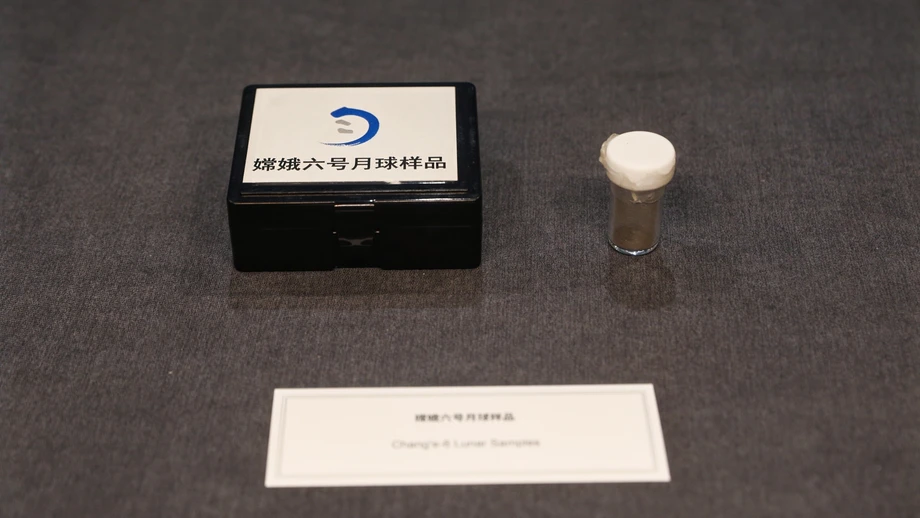
A case in a public corridor on the underground level of the Shanghai Science and Technology Museum now holds 85.5 milligrams of gray powder taken from the hemisphere of the Moon that never turns toward Earth. The sample was unveiled on the evening of November 28 and goes on show to the public on December 1 inside an exhibition titled From Earth to Tiangong. It stays for two months, until January 31, 2027, and visitors do not need to buy a museum ticket to see it.
Contents
- Dust From the Half of the Moon Nobody Sees
- Why Less Than a Tenth of a Gram Is a Big Deal
- How to See It, and What Else Is in the Hall
- Only Two Places on Earth Show This Material
- The Mission That Made the Display Possible
- What the Rocks Say About the Moon's Largest Scar
- Two Kinds of Rock Rich in Magnesium, Two Histories
- A Challenge to the Late Heavy Bombardment
- A Time Capsule for a Planet That Erased Its Own Past
- From Display Case to Building Site
- Key Points
Chang'e-6 carried the material home in June 2024, on the first mission in history to bring back rock and soil from the lunar far side. The 85.5 milligrams on display comes from the same batch of fragments that scientists used to fix the age of volcanic eruptions on that hemisphere, so the case contains a working piece of the evidence behind published dates rather than a ceremonial souvenir.
Why Less Than a Tenth of a Gram Is a Big Deal
The mission returned 1,935.3 grams of lunar soil, roughly two kilograms. What Shanghai put behind glass is less than one twenty thousandth of that haul. Spread thin, 85.5 milligrams would barely coat a fingernail, and yet the museum treats it as the centrepiece of the hall.
Ni Minjing, director of the Shanghai Science and Technology Museum, introduced the sample at the unveiling and framed the powder as an archive rather than a curiosity.
"It looks like nothing but dust, yet it carries China's thousand year dream of reaching the moon, and it holds the code of billions of years of lunar evolution," he said.
Researchers reading that archive have already used material from the far side to show that volcanoes were active on the Moon's hidden half about 4.2 billion years ago and again about 2.8 billion years ago. Comparisons of soil from the two hemispheres turned up more carbon structure defects in the far side material, a sign that the two halves did not evolve in the same way and that the hidden half may have absorbed heavier bombardment by tiny meteorites. The same samples are feeding work on how the lunar magnetic field behaved and how much water the Moon's interior holds.
How to See It, and What Else Is in the Hall
The exhibition sits in a shared public area on the museum's underground level, and the museum charges nothing extra to walk past the case. It is supported by the lunar exploration and space engineering centre of the China National Space Administration and by the Chinese Natural Science Museum Society.
The regolith shares the space with hardware from China's human spaceflight and lunar programmes. Visitors can see the national flag that flew on Shenzhou-15, a fragment of the payload fairing from a Long March 2 rocket, and a space pen used on the Shenzhou-10 mission. Food carried into orbit is on show too: tea bags, mooncakes and ice cream formulated for astronauts, with some of the same products on sale at the venue. The museum has not said where the regolith goes after January 31.
Only Two Places on Earth Show This Material
Shanghai's claim on the sample is unusual. According to Ni, the public can see regolith from the far side in exactly two places worldwide, and his museum is one of them.
"So far, of the far side samples on display, there are only two in the world where the public can see them: one is here with us, and the other is at United Nations headquarters," he said.
Lunar soil is not new to Shanghai's museums. In July 2021, when the Shanghai Astronomy Museum opened, it displayed material that Chang'e-5 had brought back from the near side. What changed in 2024 is the address on the sample label. All ten sample return missions completed before Chang'e-6, by the United States, the Soviet Union and China, had collected from the near side, the half that faces Earth.
The Mission That Made the Display Possible
Chang'e-6 left the Wenchang space launch site on Hainan island on May 3, 2024, and its lander set down on June 1 inside the southern part of the Apollo basin, a crater 492 kilometres wide on the far side, at about 41.6 degrees south latitude. The Apollo basin itself lies inside the far larger South Pole-Aitken basin, the biggest impact scar on the Moon.
- May 3, 2024: Chang'e-6 launches from Wenchang
- June 1, 2024: the lander touches down on a dark volcanic plain at the southern edge of the Apollo basin
- June 7, 2024: NASA's Lunar Reconnaissance Orbiter photographs the lander on the surface
- June 25, 2024: the return capsule lands in Siziwang Banner, Inner Mongolia, carrying 1,935.3 grams of soil
- July 2021: soil from the near side, collected by Chang'e-5, goes on show at the Shanghai Astronomy Museum
- November 20, 2026: a study led by the University of Hong Kong appears in Science Advances
- November 28, 2026: 85.5 milligrams of regolith from the far side is unveiled in Shanghai
- December 1, 2026: the exhibition opens to the public
- January 31, 2027: the exhibition closes
Reaching the far side takes more than a bigger rocket. The Moon blocks direct radio contact with Earth, so engineers route commands and data through a relay satellite, and the sampling sequence has to be planned without live control. That difficulty is why no far side material existed in any laboratory before 2024.
What the Rocks Say About the Moon's Largest Scar
The South Pole-Aitken basin stretches roughly 2,200 kilometres from end to end, about the length of mainland China from north to south, and drops as much as 10 kilometres below the surrounding surface. A description from the Hong Kong team puts its footprint at about 2,050 by 2,400 kilometres with depths near 12 kilometres. The basin formed when something enormous struck the young Moon, and its age has been argued over for decades, with estimates landing between 4.35 billion and 4.2 billion years.
A team led by Guochun Zhao, holder of the Mok Sau-King professorship at the University of Hong Kong, and first author Yuqi Qian combined the Chang'e-6 samples with measurements from the Chang'e-4 rover, satellite observations and computer models. Their paper, published in Science Advances under the title Postimpact evolution of the South Pole-Aitken basin revealed by Chang'e-4 and Chang'e-6, dates three separate collisions.
- South Pole-Aitken basin: about 4.34 billion years ago
- Apollo basin: about 4.2 billion years ago
- Orientale basin: about 3.87 billion years ago
The middle date explains the old disagreement. The Apollo impact was a separate, slightly later event, and rock melted by it had been skewing estimates for the older, larger basin.
Two Kinds of Rock Rich in Magnesium, Two Histories
The original impact released enough energy to melt a vast volume of lunar rock, possibly reaching more than 80 kilometres down and digging into material from the lunar mantle. That molten sheet cooled over millions of years, and minerals crystallised out in layers as temperatures fell, a process geologists call differentiation. The moderately magnesian norites in the Chang'e-6 soil, made mostly of plagioclase and pyroxene, appear to be leftovers of that cooling lava lake.
A second group of fragments holds far more magnesium and carries a different story. These rocks most likely formed through magnesium suite magmatism, in which magma rose and solidified beneath the crust after the basin impact fractured it. The Apollo impact then excavated them along the basin's western peak ring about 4.2 billion years ago, and a later collision at Chaffee S crater threw some of that material to the spot where Chang'e-6 landed.
The accounting behind those conclusions came from a single gram of soil allocated to the Hong Kong team by the China National Space Administration. Researchers worked through 1,092 larger rock fragments and 2,935,175 microscopic particles. Pyroxene made up about 37 per cent of the material examined and plagioclase about 30.3 per cent, with ilmenite at 3.8 per cent and olivine at 1.6 per cent. Noritic material accounted for an estimated 35 to 45 per cent of the soil, and under 5 per cent came from the bright highland crust.
Modelling of the landing site's history put local volcanic deposits at 54 to 61.3 per cent of the soil, with 38.4 to 45.7 per cent arriving from elsewhere. The team screened more than a million mapped craters and found 67 that formed after the local lava plains solidified about 2.83 billion years ago and could have thrown debris onto the site. Chaffee S alone appears to have laid down about 15 centimetres of material, or 16.1 to 18.2 per cent of the soil.
Chang'e-4, which landed in the 186 kilometre wide Von Karman crater in January 2019, sampled a different mixture. An impact that carved the 73.1 kilometre wide Finsen crater about 3.1 billion years ago is estimated to have dropped 4.6 metres of debris near the rover, burying volcanic deposits that date back roughly 3.6 billion years.
A Challenge to the Late Heavy Bombardment
A companion study took a different route through the same material. Researchers led by the State Key Laboratory of Deep Earth Processes and Resources at the Guangzhou Institute of Geochemistry, part of the Chinese Academy of Sciences, dated tiny fragments of impact melt rock, the glassy residue left when a collision liquefies the surface. Their tool was argon-argon dating, which measures argon gas trapped inside a rock to establish when it last melted, turning each fragment into a timestamp for one impact.
First author Wan-Feng Zhang and colleagues, with Fred Jourdan of Curtin University in Australia as a co-author, found impacts spread from about 4.33 billion to 1.13 billion years ago, a record covering more than three billion years. The pattern points to a long, gradual decline in asteroid strikes rather than a short, catastrophic spike. That result sits awkwardly with the Late Heavy Bombardment hypothesis, which holds that a burst of impacts struck the inner solar system around 3.9 billion years ago. The paper appears in Science Advances under the title The bombardment history on the lunar farside revealed by 40Ar/39Ar geochronology of Chang'e-6 impact melt rocks.
The wider consequence concerns how planetary scientists date surfaces elsewhere in the solar system. Chronologies built from samples collected on the near side assumed one hemisphere spoke for the whole Moon. Dates from the far side now provide a second reference point to test that assumption, though the researchers have not yet calculated how much age estimates for other worlds would move.
A Time Capsule for a Planet That Erased Its Own Past
Jourdan, a geochronologist at Curtin's School of Earth and Planetary Sciences and the John de Laeter Centre who has directed the Western Australian Argon Isotope Facility since 2007, argues that the hidden hemisphere is valuable for what it did not lose. Earth's oldest rocks have been recycled by erosion, volcanism and the slow churn of tectonic plates. The Moon has none of that machinery, so its surface still carries a readable record of ancient collisions.
"The Moon is like a time capsule. It has preserved a record of events that have been erased from Earth by erosion, plate tectonics and other geological processes," he said.
Because the two bodies formed in the same neighbourhood, the lunar record works as a proxy for conditions on the early Earth. Jourdan said the far side keeps a cleaner version of the earliest impacts because the near side was disturbed more heavily by later geological activity.
"Until now, almost everything we knew came from the side facing Earth," he said.
"Studying lunar rocks allows us to look back billions of years and better understand the events that shaped the environments of both worlds and helps us understand the role asteroid impacts played in planetary evolution and the conditions that may have influenced the emergence of life on Earth," he said.
From Display Case to Building Site
Ni ties the research to a practical goal. Reading the composition of real regolith lets scientists manufacture simulated lunar soil on Earth, test materials against it, and work out how to build on the Moon with what is already there.
"We bring the regolith back to study it, so that when we build a base on the Moon in the future, we can use local materials," he said.
Techniques such as 3D printing could one day turn lunar material into structural components, cutting the mass that has to be launched from Earth. Ni described the two hemispheres as different worlds, with broad, smooth plains on the near side and rugged, cratered terrain on the far side, a contrast produced by tidal locking that keeps one face permanently turned toward Earth.
"A grain of lunar soil is like a natural lunar history book. Volcanic activity, meteorite impacts and the solar wind may all leave traces of billions of years inside it. It answers some old questions and keeps raising new ones," he said.
The museum's ambitions for the case are educational as much as scientific. Ni said children should meet the material directly rather than through photographs and models, and he expects human work to move off the planet over the coming century.
"Earth is our cradle, but we will not live in the cradle forever. Landing on the moon is only humanity's first step, and in the future we will go on to a wider universe. In 50 or 100 years, a great deal of our work will happen in space. I hope this small sample opens up children's imaginations," he said.
Key Points
- 85.5 milligrams of lunar regolith from the far side went on display at the Shanghai Science and Technology Museum on November 28, 2026
- The exhibition, From Earth to Tiangong, opens December 1 and runs until January 31, 2027, with no museum ticket needed for the underground public area
- Chang'e-6 returned 1,935.3 grams of soil from the South Pole-Aitken basin in June 2024, the first material ever collected from the lunar far side
- Ni Minjing, the museum's director, says only Shanghai and United Nations headquarters show such samples to the public
- A study led by the University of Hong Kong in Science Advances dates the South Pole-Aitken basin to about 4.34 billion years ago, the Apollo basin to 4.2 billion and Orientale to 3.87 billion
- Argon-argon dating of impact melt rocks records strikes from 4.33 billion to 1.13 billion years ago, pointing to a gradual decline rather than a Late Heavy Bombardment spike
- The hall also displays the Shenzhou-15 flag, a Long March 2 fairing fragment, a space pen from Shenzhou-10 and foods made for astronauts