A shine that hides a crumbling edge
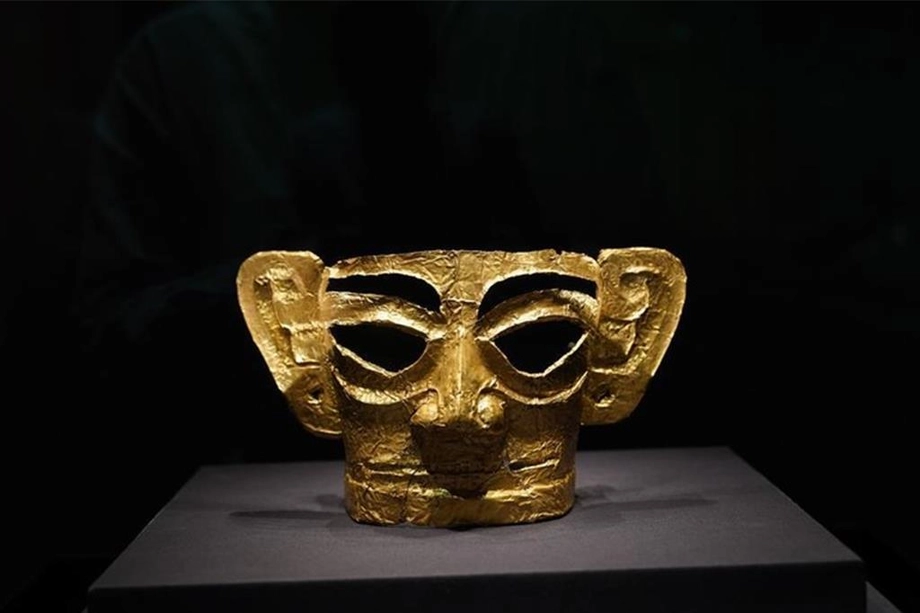
In 2023, during a conservation project on the gold masks unearthed at Sanxingdui in Sichuan province, restorers found that parts of the masks were failing in a way gold should never fail. Two objects were affected: mask K3QW:300, recovered from ritual pit 3, and mask K8⑨:16, from ritual pit 8.
Contents
- A shine that hides a crumbling edge
- Why would gold, of all metals, become brittle?
- A glass probe 3 micrometres wide draws a corrosion map
- The order of attack: Au-Ag, then Au2Pb, then AuPb2
- Testing three candidate inhibitors, one spot at a time
- A new yardstick for choosing conservation materials
- Who is behind the work
- From silver to gold: how the method travelled
- What the work leaves open
- Key Points
The damage appeared on the cheeks and at the corners of the eyes, where scaly flakes had lifted away and left mottled gaps. In some areas whole patches were missing. Sanxingdui, found in 1929 and famous for its bronze masks, statues and ceremonial objects of the ancient Shu civilisation, had produced gold work that conservators had always treated as among the most stable material in the collection. Gold is exceptionally ductile and resists corrosion, and corrosion problems on gold artifacts are rarely reported at all.
What puzzled the team was the appearance of the damage. The failing fragments kept their metallic luster, and no corrosion traces were visible on the exterior, so nothing on the surface told a restorer where the weakness was. The description of the flakes in the 2024 Corrosion Science paper is blunt:
These flakes, when lightly touched, displayed almost no mechanical strength, akin to decayed paper.
That combination, a bright surface over a body that has lost its strength, set the conservation problem. A mask can look ready for exhibition while its edges are close to turning to powder, and museum conditions bring their own pressures: handling, and volatile organic compounds in the air of display and storage spaces, are both named in the study as risks for further deterioration.
Why would gold, of all metals, become brittle?
Microscopy gave the first clue. Fragments that had flaked off K8⑨:16 showed cracks running between the grains of the metal, a feature never before reported in this material, and one that points to intergranular corrosion.
Intergranular corrosion is a selective form of decay. It runs along the boundaries between the tiny crystals, or grains, that make up a metal, because the material at those boundaries has a different composition and different electrochemical behaviour from the grain interiors. When the boundary material corrodes away, the grains lose the glue that holds them together, and a piece can keep its colour while losing its strength.
The masks are not pure gold. Metallographic microscopy and scanning electron microscopy with energy dispersive spectroscopy (SEM-EDS) showed that they are a gold and silver alloy with small amounts of lead rich structure left between the grains. Those lead rich regions are the likely source of the trouble, and the 2024 paper in Corrosion Science reports the first study of the microstructure and corrosion mechanism of the embrittled masks.
Because the masks themselves cannot be cut up and tested, the team rebuilt the material. Using gold of 99.99 percent purity, silver of 99.99 percent and lead of 99.999 percent, they made a simulated gold, silver and lead alloy that reproduced the key microstructure, and worked on that instead.
A glass probe 3 micrometres wide draws a corrosion map
Standard corrosion tests were useless here. Electrochemical workstations measure a whole sample at once, and long ageing tests follow changes in weight or colour. Both describe the average behaviour of an object. Intergranular corrosion happens in a region a few micrometres across, and the question the conservators needed answered was which phase, at which grain boundary, reacts first.
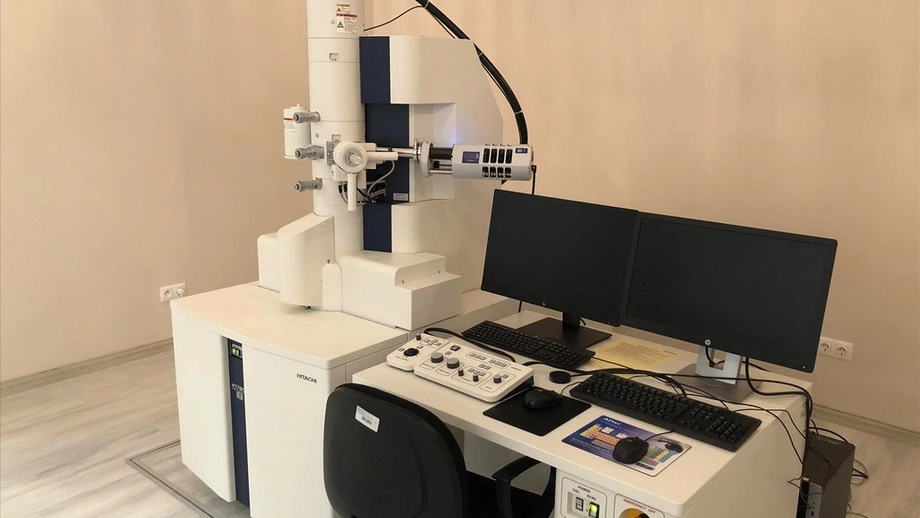
The answer came from scanning electrochemical cell microscopy, or SECCM, a technique developed in 2010. Instead of dipping a sample into a bath of electrolyte, SECCM uses a fine glass pipette whose tip holds a tiny droplet of liquid. The droplet touches only the spot chosen for measurement, so the reaction is confined to a microscopic area, and the probe can then be moved point by point across the surface.
The tip used on the simulated alloy measured about 3 micrometres across. On the Sanxingdui work the team used a single channel version of the instrument, stepping it across the sample to build a map of where corrosion activity is high and where it is low. The result is a corrosion map at the scale of individual grains and structures, produced with methods described in the inhibitor study that followed.
That resolution changes the kind of question a conservator can ask. A bulk test says whether a treatment worked on average. A map says which microstructure is the weak link, and whether a weak spot remains after protection.
The order of attack: Au-Ag, then Au2Pb, then AuPb2
Comparing the main phases in the simulated alloy produced a clear ranking of electrochemical activity: Au-Ag, the continuous phase that forms the body of the mask, is the least active; Au2Pb comes next; and AuPb2 together with lead oxides (PbxOy) is the most active.
The ranking explains what the conservators saw. The gold and silver matrix is relatively stable. The lead rich material sitting between the grains corrodes first and keeps corroding, and as it is lost the bond between neighbouring grains weakens. Eventually the metal can no longer hold together, and the mask flakes while still glittering.
The finding also gave the conservation team a target. If the residual lead rich phases are the weak point, a protective treatment has to work on those phases, not on the gold and silver around them.
Testing three candidate inhibitors, one spot at a time
A follow up study, published in Corrosion Science in 2025 as volume 256, article 113242, took up that target. The authors, Shengyu Liu, Siyuan Sun, Xiangyu Sun, Haizi Lu, Qianxuezi Yin, Zixuan Wang, Danyang Xu, Yanru Ma, Gang Hu and Meiqin Zhang, tested three corrosion inhibitors on simulated gold, silver and lead alloy samples, using SECCM alongside SEM-EDS and Raman spectroscopy.
The three candidates were sodium n-decanoate (NaC10), a saturated fatty acid sodium salt; L-cysteine (Cys), an amino acid; and phytic acid (PA). The team compared corrosion at specific micro regions before and after treatment, then checked the microscopy and the composition to see whether a protective film had formed and whether the original structure had survived.
The results split the field sharply. NaC10 formed compact organic films on the lead rich regions and lowered the susceptibility of those regions to corrosion. L-cysteine and phytic acid did the opposite: their acidity caused the lead rich phases to dissolve and left surface defects, the very damage the treatment was meant to prevent.
The molecule explains the success of NaC10. One end of the molecule binds to lead at the surface, while the carbon chain at the other end stands up as a water repelling barrier that keeps moisture away from the reactive phase.
A new yardstick for choosing conservation materials
Comparing the three inhibitors led the team to propose a way of judging candidate materials that goes beyond the usual test. They call it effective interfacial reactivity, and it weighs three things together: how the molecule adsorbs on the surface, how easily a lead atom can be pulled out of its original structure, and whether the reaction products stay on the surface or drift away.
Older screening compared how well a treatment performed on the object as a whole. The new approach asks why a material works, which lets conservators compare and optimise candidates on a reasoned basis and use calculation to predict how an untested molecule will behave before it is tried. That saves time in a field where every experiment competes for access to irreplaceable objects.
Between experiment and calculation, saturated fatty acid sodium salts came out with the best protection potential, and sodium n-decanoate in particular combined high local inhibition efficiency with stability, making it the recommended choice among those tested.
Who is behind the work
The Sichuan Provincial Institute of Cultural Relics and Archaeology coordinates the conservation and restoration of Sanxingdui's gold objects. Yanru Ma, a research professor at the National Museum of China, is chief scientist on the project, and she is also a co-author of the 2025 inhibitor paper. The research itself was carried out mainly through the Institute for Cultural Heritage and History of Science and the School of Chemistry and Biological Engineering at the University of Science and Technology Beijing, together with the School of Archaeology and Museology at Peking University.
Funding came from the National Natural Science Foundation of China under grants 22274008 and 11295031, and from the China Postdoctoral Science Foundation under grant 2024T170020. Samples and archaeological information were provided by the Sichuan institute and by Ma.
From silver to gold: how the method travelled
The technique was not new to Chinese conservation science when the masks were examined. The same team had already used SECCM in 2020 to study intergranular corrosion in unearthed silver objects and to look for protective materials for them.
- 1929: Sanxingdui is discovered in Sichuan.
- 2020: the team applies SECCM to intergranular corrosion in unearthed silver.
- 2023: embrittlement is identified on gold masks K3QW:300 and K8⑨:16 during conservation work.
- 15 August 2024: the corrosion mapping study appears in Corrosion Science, volume 237, article 112301, DOI 10.1016/j.corsci.2024.112301.
- 2025: the inhibitor screening study appears in Corrosion Science, volume 256, article 113242, DOI 10.1016/j.corsci.2025.113242, naming NaC10 as the strongest of the three candidates.
What the work leaves open
No schedule has been given for applying sodium n-decanoate to the actual masks, and the studies do not state whether K3QW:300 and K8⑨:16 will be treated with it. A laboratory result on a simulated alloy is a first step; a treatment on a 3,000 year old object has to be tested for how it ages, how it can be reversed if needed and how it behaves under display lighting and in storage.
The team's method does give conservators a way to watch those questions at the scale where the damage happens. Comparing local corrosion under different environments, identifying the spots most at risk and quantifying how well a coating holds up are all now possible on a single object without destroying it, which matters for complex metal artifacts far beyond Sanxingdui.
The masks that started the inquiry remain in restoration. Their surfaces still shine, and the map of where they are thin is now on paper.
Key Points
- Two Sanxingdui gold masks, K3QW:300 from pit 3 and K8⑨:16 from pit 8, were found in 2023 to be embrittled, with flakes that crumbled like decayed paper while keeping a metallic luster.
- The masks are a gold and silver alloy holding small lead rich phases between grains; those phases corrode first, loosening the grains until the metal fails.
- Researchers mapped the corrosion with SECCM, using a glass probe with a tip about 3 micrometres wide that carries a droplet of electrolyte and measures one tiny spot at a time.
- Electrochemical activity rises from the Au-Ag matrix to Au2Pb and then to AuPb2 with lead oxides, explaining why lead rich boundaries vanish first.
- Sodium n-decanoate formed compact films on the lead rich regions and reduced corrosion; L-cysteine and phytic acid were too acidic and dissolved the lead rich phases.
- The 2024 and 2025 papers appeared in Corrosion Science, with funding from the National Natural Science Foundation of China and the China Postdoctoral Science Foundation.
- No date has been announced for treating the real masks with the chosen inhibitor.