A final investment decision with a date attached
Oil companies spend years studying a field before they commit money to it. The moment they stop studying and start ordering steel is called a final investment decision, or FID, and it is the point after which a project has a schedule, a budget and a countdown. Timor-Leste reached that point on 27 November 2026, when Finder Energy and the state oil and gas company Timor GAP announced they would go ahead with the Kuda Tasi and Jahal fields, known together as KTJ.
Contents
- A final investment decision with a date attached
- How the oil gets out of the ground
- What Timor-Leste expects to earn
- From Eni's consortium to a Timorese licence
- A first under Timorese authority
- What the market made of it
- Jobs, local suppliers and the next fields
- What is still open before the rig arrives
- Key Points
The partners estimate capital spending at $583 million and expect first oil in the second half of 2028. Finder Energy, listed in Australia and based in South Perth, operates the project with a 66% interest. Timor GAP holds the remaining 34%. The two fields sit in the production sharing contract area TL-SO-T 19-11, a block of 662 square kilometres in the Timor Sea off the country's southern coast.
Approval came in stages. The National Petroleum Authority (Autoridade Nacional do Petroleo, or ANP) received the Field Development Plan from Finder on 22 May 2026 and approved it on 8 July 2026 after meetings and technical reviews. The regulator cleared the project's Environmental Impact Statement on 28 September 2026. On 26 November 2026, the day before the ceremony, it approved the development work program and budget of $282,253,286, covering 1 December 2026 to 31 December 2027, along with seven main contracts.
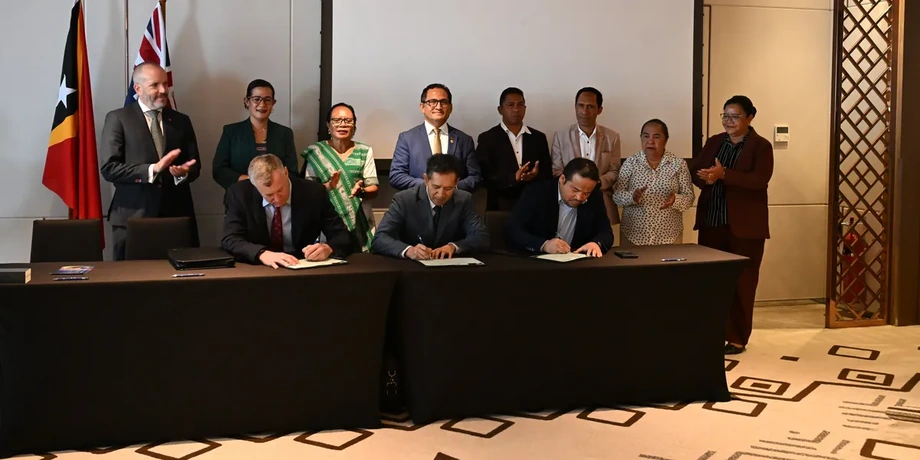
The announcement was made at the Palm Springs Hotel in Dili. Damon Neaves, chief executive of Finder Energy, said the decision followed more than two years of joint work with Timor GAP and the regulator on technical, commercial, regulatory and financial questions, and that both boards had reviewed and approved the project's readiness.
Reaching FID reflects the confidence that Finder and Timor GAP have in the KTJ project development strategy, and the shared commitment to ensure its successful execution. Finder and Timor GAP will continue to work together to advance the development and meet the target of first oil in 2028.
How the oil gets out of the ground
The development is built around three production wells: two in the Kuda Tasi field and one in Jahal. Instead of a fixed platform, the wells will be connected to a floating production, storage and offloading vessel, or FPSO, a ship that takes oil from the seabed, separates it from water and gas, stores it in its hull and loads it into tanker ships for export.
The vessel is the Petrojarl I. It will first be moved to Batam in Indonesia for rehabilitation and technical modification before taking up position over the fields. Rui Soares, president and chief executive of Timor GAP, said the project was designed to produce crude oil, not natural gas. Everything drawn from the three wells will be processed and stored on the FPSO before being exported and sold on the international market.
Drilling will be handled by the Hakuryu-5, a semisubmersible rig that floats on pontoons and is held in place over the wellhead. Finder signed a conditional contract with ENEOS Drilling for the first three wells, with options for two more. The rig is due to be mobilised at the end of 2027 and drilling is scheduled to start in December of that year.
The regulator's 26 November approval covered seven contracts:
- supply of an offshore drilling unit
- rehabilitation and modernisation of the floating production facilities
- mooring equipment
- marine transport services
- subsea production systems
- installation of subsea infrastructure
- operations and maintenance
One of the largest, with OneSubsea for the supply and installation of subsea production equipment, has already been signed. The next steps are the purchase of major equipment, construction of the production system on the seabed and preparation for the drilling campaign. The partners have said the design leaves room to connect other discoveries in the block to the same vessel later, an approach the industry calls a tie-back.
What Timor-Leste expects to earn
Beyond the capital figure, the documents filed with the regulator hold a second set of numbers: what the project is expected to return. Carlos Liborio Alves, vice president of the ANP, said the economic evaluation included in the addendum to the Field Development Plan projects total economic benefits of $232 million for the government and Timor GAP.
Of that, $167 million is expected to reach the state through royalties and taxes, and $65 million as net income for Timor GAP as a partner. The combined figure equals 46% of the project's total net present value.
Net present value is how oil projects compare money spent now with money received years later. A dollar earned in 2032 is worth less than a dollar today, so future cash is discounted back to today's terms. The KTJ calculation uses an 8% discount rate and covers the whole life of the field, not a single year of revenue.
Based on the net present value calculation, with a discount rate of 8%, the government's revenue from royalties and tax from the project is projected to reach $167 million. Timor GAP, as a partner in the project, is projected to receive net income of $65 million.
The rest of the value goes to Finder, which carries 66% of the cost. Soares said the two companies had committed to fund development in proportion to their shares.
As a partner, Timor GAP holds a 34% participating interest, while Finder, as operator, holds 66%. The investment commitment of both parties is aligned with each one's participating interest in the project.
From Eni's consortium to a Timorese licence
The KTJ block has changed hands, and changed countries, twice. A production sharing contract is the arrangement under which a state keeps ownership of the oil underground and a company pays the cost of finding and producing it in exchange for a share of what comes out. In this case, the contract area was originally inside the Joint Petroleum Development Area, a zone Timor-Leste and Australia administered together before their maritime border was settled.
- 2013: the contract was signed by a consortium led by Eni, with INPEX and a subsidiary of Timor GAP, while the area sat inside the joint development zone.
- 2019: after the Maritime Boundary Treaty between Timor-Leste and Australia came into force, the whole contract area moved into Timorese jurisdiction.
- 2024: regulators approved the transfer of interests and a change of operator; Finder took 76% and Timor GAP kept 24%.
- September 2025: Timor GAP acquired a further 10%, reaching 34% and leaving Finder with 66%.
- 22 May 2026: Finder submitted the Field Development Plan to the ANP.
- 8 July 2026: the regulator approved the development plan.
- 28 September 2026: the Environmental Impact Statement was approved.
- 26 November 2026: the work program, budget and seven contracts were approved, and the partners signed the joint statement on the investment decision.
- 27 November 2026: the decision was announced in Dili.
Since the September 2025 agreement, the partners reprocessed seismic data, certified resources, ran reservoir studies, settled a development concept and planned the drilling. Seismic data is acoustic imaging of rock layers far below the seabed, and it is the basis for deciding where to place a well.
A first under Timorese authority
Francisco Monteiro, the Minister of Petroleum and Mineral Resources, called the decision a historic milestone for the national oil industry. His reason: it is the first offshore oil field development to move into production under the full authority of the Timorese state since the Maritime Boundary Treaty took effect.
This marks the first FID after the Maritime Boundary Treaty came into force, and it is the first offshore oil field project managed and developed through to the full production phase under the authority of the Government of Timor-Leste and its institutions.
Monteiro thanked Finder for deciding to invest, Timor GAP for preparing the different parts of the project and the ANP for its handling of technical, legal, commercial and contractual questions. He said KTJ fits the government's policy of treating petroleum, gas and minerals as pillars of economic development, and that the executive wants to speed up work on fields already discovered so they can produce, be sold and generate revenue for the country. He said the government would give the support needed in the next phases so that first oil can be reached in 2028.
The state company has been buying its way into more of that future. Last month Timor GAP agreed to acquire Woodside's stake in Greater Sunrise for up to $200 million. Offshore Timor-Leste, Sunda Energy has won an extension of 12 months for its Chuditch production sharing contract.
What the market made of it
Finder's shares rose 7.50% to A$0.215 on 26 November 2026, the day the joint statement was signed, while the S&P/ASX 200 Energy index gained 3.03% to 10,158.50. Brent crude traded at $90.56 that day, down 0.29%.
The reserve base is modest by global standards but firm. An independent assessment by RISC put gross proved and probable reserves for the first three wells at 22.2 million barrels, a category the industry labels 2P, meaning oil considered likely to be recovered from known fields with existing technology. A further 2.2 million barrels of contingent resources, classed 2C, sit in a possible fourth well at Kuda Tasi that has not been sanctioned.
Finder reported cash of A$25.4 million at 30 September 2026. Against a $583 million development, that balance makes the debt package central to delivery. The farmin agreement with Timor GAP had been extended to 30 November 2026 to allow contracting, financing and joint venture approvals to close, and debt financing has been moving forward with clearer project cost estimates.
Neaves said the company recognised the chance to create a new offshore oil development in Timor-Leste when it took over as operator in 2024, and described reaching the decision in a little over two years as a major accomplishment for its team and for the work with Timor GAP and the regulator.
Jobs, local suppliers and the next fields
Soares told the ceremony that project teams had worked intensively for two weeks to keep preparations on schedule, and thanked the National Petroleum Institute and the relevant ministry for their support. He described the decision as an important strategic achievement for the state company and an advance for the country's oil industry, and urged the teams to keep working toward the planned objectives.
Alves said the project is expected to create lasting employment, training and professional development for Timorese citizens, and to bring local companies into the oil industry supply chain.
This project will create lasting employment opportunities, training and capacity building for Timorese citizens, while at the same time raising the participation of local companies in the oil industry supply chain through the implementation of a local content strategy.
Gualdino do Carmo da Silva, president of the ANP, said the project is now moving toward production and creating new opportunities for the country and its people.
The infrastructure argument carries weight beyond the first three wells. The FPSO, the subsea equipment and the export route built for KTJ could serve later fields, which would lower the cost of the next developments. Neaves said the partners expect concrete action on a field that creates lasting value for shareholders, partners and the people of Timor-Leste.
What is still open before the rig arrives
Financing terms are not final. Cost, schedule and debt conditions remain open, and the rig contract is conditional on the remaining approvals. How much each well will produce, and the field's peak output, have not been published.
The physical work has a sequence. The Petrojarl I must travel to Batam for its refit. Subsea construction and drilling preparation are due to begin in December 2026. The Hakuryu-5 is due to be mobilised at the end of 2027, with the first well spudded in December 2027. The partners are working to a target of first oil in the second half of 2028, without a month or a day attached.
Two dates sit closest. The farmin agreement extension runs to 30 November 2026, the point at which contracting and financing must close. Then comes the spending: $282,253,286 approved for the 13 months to 31 December 2027, the phase in which money starts to leave the bank and the project's schedule becomes visible in steel, ships and wells.
Key Points
- Finder Energy and Timor GAP took a final investment decision on the Kuda Tasi and Jahal oil fields, announced on 27 November 2026 in Dili.
- Capital spending is estimated at $583 million, with first oil targeted for the second half of 2028.
- Finder holds 66% and operates the project; Timor GAP holds 34%.
- The ANP approved the Field Development Plan on 8 July 2026, the Environmental Impact Statement on 28 September 2026 and a work program and budget of $282,253,286 for 1 December 2026 to 31 December 2027.
- Three production wells, two at Kuda Tasi and one at Jahal, will be tied back to the FPSO Petrojarl I, to be refitted in Batam, Indonesia.
- Drilling will use the semisubmersible Hakuryu-5 from ENEOS Drilling, with operations due to start in December 2027.
- Projected lifetime benefits total $232 million: $167 million for the state in royalties and taxes and $65 million in net income for Timor GAP, at an 8% discount rate.
- Gross 2P reserves for the first three wells are 22.2 million barrels, with 2.2 million barrels of 2C contingent resources in a possible infill well at Kuda Tasi.
- The 662 square kilometre contract area was signed in 2013 by a consortium led by Eni and moved fully into Timorese jurisdiction after the 2019 Maritime Boundary Treaty.