A Vote That Reopens Taiwan's Energy Debate
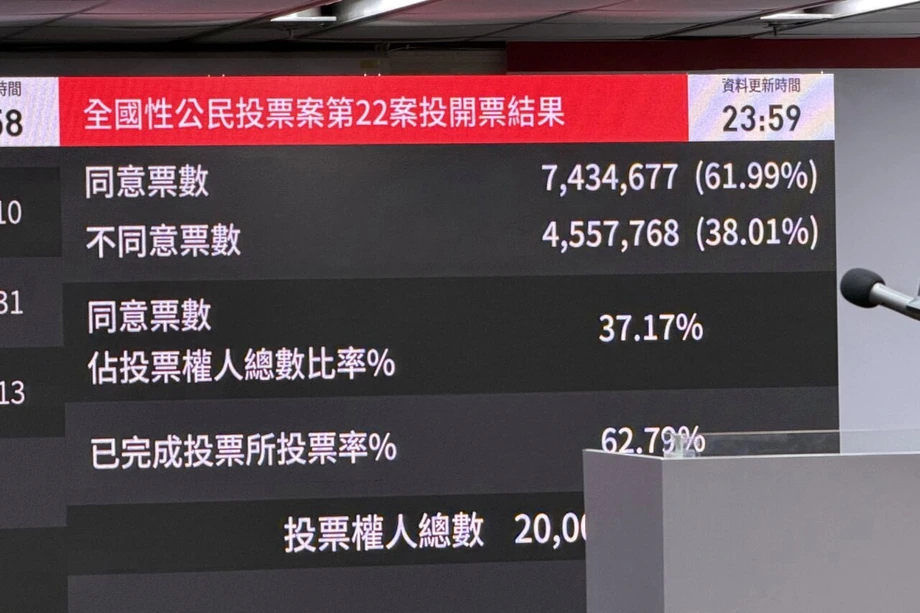
Taiwan voters gave nuclear power a decisive political opening on Saturday, November 28, 2026, approving a nationwide referendum that calls for using nuclear energy to revive the economy and abandoning the nuclear-free homeland policy. The Central Election Commission finished counting at 11:58 p.m. across 18,248 polling stations. It recorded 7,434,677 yes votes and 4,557,768 no votes, with turnout at 62.79 percent. Valid yes votes made up 61.99 percent of ballots cast in the referendum and 37.17 percent of all eligible voters.
Contents
- A Vote That Reopens Taiwan's Energy Debate
- What Did Voters Actually Approve?
- How the Yes Vote Crossed the Threshold
- Reactors Are Already in the Restart Queue
- Why Taiwan's Power Demand Is Rising Faster
- Gas Imports and Energy Security Shape the Choice
- Opponents Focus on Waste, Faults and Cost
- The Political Message Behind the Ballot
- Eight Years of Nuclear Referendums
- What Happens Next for Government and Regulators
- Key Points
The margin mattered because Taiwan law sets two gates. With 20,003,835 eligible voters, the proposal needed at least 5,000,959 valid yes votes and had to win more yes than no votes. The final yes total was about 2.43 million votes above the legal threshold. Counting had already crossed that threshold early in the evening, with 5,044,088 yes votes at 7:39 p.m., then reached 7,297,939 at 9:28 p.m.
The vote was held alongside the local races and energy ballot that sent voters to choose city and county leaders, councilors and local officials. The result gives the government a public instruction to move away from its nuclear phaseout policy, but it leaves the physical work of restarting reactors, safety reviews and waste planning to separate decisions. For households and businesses, the immediate meaning is a shift in political direction at a moment when Taiwan's chip and data center industries are asking for more electricity.
What Did Voters Actually Approve?
The ballot question was narrow in form and broad in effect. It asked: "Do you support the government's use of nuclear power to revitalize the economy as a means of abolishing the 'nuclear-free homeland' energy policy?" The Kuomintang legislative caucus proposed the measure, and the Legislature approved it on August 14 with support from the Taiwan People's Party. The two opposition parties hold a majority of seats.
National Referendum No. 22 was a policy referendum, not a vote on a named reactor. Voters made a broad statement about energy policy. Under Article 30 of the Referendum Act, a passed policy referendum requires the president or the competent authority to take necessary measures to carry out its content. That makes the vote different from an opinion poll, even though anti nuclear groups described the wording as a leading poll.
Legal experts read the result more narrowly than campaign slogans. Chan Shun-kuei, a former deputy minister of the Environmental Protection Administration, said only the main text of a referendum has binding force. He said the reasoning statement, which discusses a plan to raise the nuclear share and build new units at the Lungmen site or use small modular reactors, explains why the proposal was submitted and does not have the same legal force. Small modular reactors are nuclear plants designed in smaller units that can be built in stages, but they still need fuel, safety oversight and waste arrangements.
The question also collides with existing statutes. Provisions in the Basic Environment Act and the Climate Change Response Act still set a nuclear-free goal. Those provisions can be changed only by the Legislature, where the Kuomintang and Taiwan People's Party hold the seats needed to amend them.
How the Yes Vote Crossed the Threshold
The 2026 result is best understood beside the August 23, 2025 referendum on keeping Maanshan operating if regulators found no safety concerns. That proposal won 4,341,432 yes votes against 1,511,693 no votes, or 74.17 percent of valid votes. It still failed because yes votes reached only 21.70 percent of eligible voters, short of the one quarter rule.
Saturday's yes share among valid votes was lower, at 61.99 percent, but the number of yes votes rose by 71.3 percent and reached 37.17 percent of eligible voters. No votes also more than tripled, from 1,511,693 to 4,557,768. Turnout climbed to 62.79 percent from 29.53 percent in 2025. The higher participation was linked to a change in election rules: the Legislature voted 56 to 44 to restore referendums alongside nationwide elections, and the amendment was promulgated on December 3, 2025. The practice had been suspended in 2019 by the then DPP controlled Legislature and restored last year. It was the first referendum held with a major election since 2018, and the only referendum on the ballot this year.
The electorate also included 402,980 voters aged 18 and 19, who could take part in a national referendum under Taiwan's lower voting age. The combined ballot changed the math of the one quarter threshold, which makes broad turnout decisive. A campaign that could mobilize ordinary election voters had far more people to reach than a stand alone referendum.
Reactors Are Already in the Restart Queue
The government had started moving toward restarts before the vote. President Lai Ching-te said on March 21, 2026, that preparations had begun to secure approval for restarting the decommissioned Kuosheng plant in New Taipei's Wanli District and the Maanshan plant in Pingtung County. State run Taiwan Power Company began preparatory work and submitted a restart plan for Maanshan on March 27.
Taiwan's last operating reactor closed at Maanshan on May 17, 2025, completing the phaseout under the DPP policy that began in 2016. The last reactor closed after the Electricity Act's 2025 deadline had been removed by the 2018 referendum, but plant licences still expired on their own schedules. Kuosheng's last reactor had shut down in March 2023. A May 2025 change to reactor rules allows expired licences to be renewed for up to 20 years, which gave Taipower a route to apply again. The Ministry of Economic Affairs assessed in November 2025 that both Maanshan and Kuosheng were feasible to restore, with Kuosheng taking longer.
The Nuclear Safety Commission completed its initial review of Taipower's Maanshan restart plan on September 24, 2026. That approval accepted the plan for further work. Permission to generate electricity still requires a separate operating licence. Taipower must inspect aging equipment, replace defective parts and study earthquake resistance before regulators verify the findings on site. Economy Minister Kung Ming-hsin said Taipower could submit its report in the middle of 2027 at the earliest, with operation possible in 2028 if the checks go according to plan.
Kuosheng is further behind. Its last reactor shut down in March 2023, and spent fuel still has to be moved from reactor pools into dry storage, a system that uses sealed steel and concrete containers outside reactor buildings. The Commission approved the storage facility in 2015, but New Taipei authorities gave consent only in 2024 after nearly a decade of dispute. The facility was completed in August 2026. By November 12, 174 fuel bundles had been moved. Internal inspection of the reactors cannot be completed until the fuel is out, so no Kuosheng restart timetable has been set.
Why Taiwan's Power Demand Is Rising Faster
Electricity demand is the central reason nuclear power returned to the agenda. The Ministry of Economic Affairs estimated in June 2026 that Taiwan's electricity use would grow by an average of 2.5 percent a year until 2035, mainly because of new chip factories and data processing centers. That equals about 7 billion additional kilowatt hours each year. A kilowatt hour is the standard unit on household power bills, and it measures one kilowatt of power used for one hour.
The scale becomes clearer in comparison with one company. TSMC and its affiliate VisEra consumed about 26 terawatt hours in 2025. A terawatt hour is one billion kilowatt hours. Maanshan's two reactors, each rated at 951 megawatts, would generate about 15 terawatt hours a year at 90 percent use. If Kuosheng's two reactors, rated 985 megawatts each, also returned, the two plants together would produce about 31 terawatt hours a year, only slightly more than TSMC and VisEra used in 2025.
Supporters argue that nuclear electricity provides baseload power, meaning electricity that can run steadily day and night. Chip factories and artificial intelligence data centers need that steady supply because interruptions can disrupt expensive production lines. At the final nuclear debate, Taiwan People's Party legislator Hung Yu-hsiang linked national strength to computing capacity and electricity.
A country's strength depends on its computing power, which in turn depends on electricity.
The same argument appeared in debate over nuclear fuel costs. Supporters said restarting four reactors and generating more electricity could save large sums on imported fuel each year. Earlier in the campaign, a debate over AI power needs put those savings claims against equipment and geological risks. Opponents said foreign nuclear projects often take far longer and cost far more than planned, making new construction a poor answer to short term industrial demand.
Gas Imports and Energy Security Shape the Choice
Taiwan's reliance on imported gas gives the energy argument a security dimension. In 2025, gas fired plants generated 138.2 terawatt hours, or 47.7 percent of Taiwan's electricity. That was 15.7 terawatt hours more than the year before. About 9 terawatt hours of the increase replaced power once supplied by retired nuclear plants, while coal generation declined at the same time, according to energy administration data.
All gas arrives by ship as liquefied natural gas because Taiwan has no pipeline to another country. The law requires reserves equal to at least 11 days of consumption, rising to 14 days from 2027. Coal reserves must cover 30 days and oil 90 days. CPC, the state owned oil and gas company, has long term contracts with Cheniere and QatarEnergy for about 7 million tonnes a year, mostly running to 2045. Qatar supplied about one third of Taiwan's LNG imports in 2025.
Geopolitical risk makes those shipping routes a concern for opponents of the phaseout. In late December 2025, Chinese military exercises around Taiwan practiced blocking major ports and sea approaches. A blockade would prevent gas from reaching terminals, even if Taiwan had already bought the fuel overseas. Nuclear fuel can be stored for much longer than gas, which is one reason KMT and TPP supporters say nuclear power strengthens energy resilience.
The government's own plan still keeps renewables at the center. The Cabinet and the Ministry of Economic Affairs said after the vote that Taiwan would continue a second energy transition, accelerating wind, solar, geothermal, hydrogen, biomass and ocean energy. They also promised a digital and green transformation of industry. Premier Cho Jung-tai thanked the Central Election Commission, local election commissions, election workers and police. The Cabinet listed six regional plans: the Taipei New Taipei Keelung Yilan capital circle golden corridor; Taoyuan Hsinchu Miaoli greater silicon valley; Taichung Changhua Nantou Yunlin precision smart new core; Chiayi Tainan Kaohsiung Pingtung greater southern silicon valley; Yilan Hualien Taitung Pingtung eastern slow living city and countryside; and Kinmen Matsu Penghu low carbon leisure offshore islands.
The Ministry of Economic Affairs used the same three conditions for any nuclear step: nuclear safety assured, nuclear waste solved and social consensus. Cabinet spokesperson Li Hui-chih relayed the government's response after the vote and said professional departments would proceed carefully under those principles.
Opponents Focus on Waste, Faults and Cost
The National Nuclear-Free Action Platform responded with three objections. It said the ballot question was rushed, vague and backed by no concrete energy policy. It also said the campaign failed to show a clear link between nuclear power and economic revival. Anti nuclear groups called the wording a push poll and said the government should keep safety reviews and licensing decisions separate from the vote.
The group's second objection concerns money. Restarting old reactors, building new ones and adopting small modular reactors all require large budgets and carry schedule risk. The platform said the vote could become a reason to raise nuclear budgets while cutting renewable energy, storage and grid projects. It put the public cost of the referendum at NT$810 million. Chao Chia-wei, director of the Taiwan Climate Action Network, warned of nuclear green crowding out, in which support for nuclear power weakens support for renewable electricity. He noted that renewables already account for more than 14 percent of generation.
Waste is the third objection. The platform said Taiwan has no final disposal site for low level nuclear waste even though siting rules have existed for 20 years. It also said the government had planned to submit a high level waste siting bill by the end of last year but has not sent it to the Legislature. No new date has been given. The group wants full disclosure of geological surveys, earthquake risks, aging equipment, waste plans, costs, environmental effects and accident response, along with publication of review comments and the reasons officials accept or reject them.
Opponents also point to the plants themselves. Maanshan and Kuosheng sit near geological faults, and anti nuclear groups say earthquake resistance has not been fully settled. They argue that Taiwan reached zero nuclear power in May 2025 while electricity supply stayed stable and the economy kept growing. For them, the referendum result reflects a political choice, while the engineering questions remain with regulators and the public.
The Political Message Behind the Ballot
The vote strengthens the Kuomintang, which proposed the referendum, and the Taiwan People's Party, which backed it in the Legislature. KMT Chairwoman Cheng Li-wun said the result formed a new national consensus on an energy dispute that had divided Taiwan for decades. She urged the government to restart nuclear power as quickly as possible and said Taiwan should not fall behind because of ideology.
President Lai had already softened the DPP's position. In March 2026, he cited rising electricity demand from artificial intelligence, international carbon reduction requirements and geopolitical risks. He said work had begun on approvals for Kuosheng and Maanshan, while repeating that renewable energy remained a government commitment. After the vote, the Cabinet said it respected the result and would proceed with the same three conditions.
Pro nuclear campaigners want more than restarts. Huang Shih-hsiu, founder of Nuclear Myth Busters, said the vote set a new record for yes votes and opened a new phase in Taiwan's energy politics. He said the next task is to use nuclear power to support renewable energy.
Next comes the era of using nuclear power to support renewable energy.
Huang also pointed to the referendum reasoning statement, which calls on the Cabinet to set a plan to raise the nuclear share, build new large reactors at the Lungmen site or introduce small modular reactors as steady low carbon power for artificial intelligence and high tech industries. Chan, the former deputy environment minister, said that reasoning statement cannot be treated as binding law. The government now has to decide how much of that agenda it will pursue through budgets, licences and legislation.
Eight Years of Nuclear Referendums
Taiwan has now held four nationwide nuclear referendums in eight years. Each vote addressed a different question, and only two passed. The sequence shows why the 2026 result matters: earlier votes changed one statute or one plant decision, while the latest vote targeted the policy goal itself.
- 2018, Referendum No. 16: Voters backed ending the Electricity Act requirement that all nuclear generation stop by 2025. The proposal won 59.49 percent of valid votes with turnout of 54.83 percent. The legal deadline disappeared, but reactors still closed when their licences expired.
- 2021, Referendum No. 17: Voters rejected activating the Fourth Nuclear Power Plant in Gongliao, New Taipei. Turnout was 41.09 percent, and yes votes fell short of both the majority and one quarter rules.
- August 23, 2025, Referendum No. 21: Voters were asked whether Maanshan should keep operating if the competent authority confirmed no safety concern. Yes votes totaled 4,341,432 against 1,511,693 no votes, or 74.17 percent of valid votes, but only 21.70 percent of eligible voters. Turnout was 29.53 percent, and the measure failed.
- November 28, 2026, Referendum No. 22: Voters backed nuclear power as a way to revive the economy and abolish the nuclear-free homeland policy. Yes votes totaled 7,434,677 against 4,557,768, with 62.79 percent turnout. The measure passed.
The difference between 2025 and 2026 is not simply a change of opinion. The 2025 proposal was more popular among people who voted yes, but the one quarter rule makes broad turnout decisive. Holding the 2026 vote with local elections, after the law change, brought many more voters into the referendum.
What Happens Next for Government and Regulators
The Cabinet must now turn the referendum into administrative steps. Article 30 gives the president or competent authority the duty to take necessary measures to implement a passed policy referendum. The first practical tasks are to reconcile the vote with the Basic Environment Act and Climate Change Response Act, decide which agency drafts amendments and set out how nuclear generation fits with the second energy transition.
For Maanshan, the next visible date is the middle of 2027, when Economy Minister Kung Ming-hsin said Taipower could submit its safety report at the earliest. Regulators will then verify equipment condition, radiation protection and earthquake resistance before considering an operating licence. Kung's estimate for Maanshan operation is 2028 if the work stays on schedule.
Kuosheng needs fuel movement before full internal checks, and Taipower has asked to begin some checks before all fuel is removed. That request needs Nuclear Safety Commission approval. The Fourth Nuclear Power Plant at Lungmen has never entered commercial operation, so any new unit there would be a construction project rather than a restart.
The waste plan remains the hardest open item. The high level waste siting bill has not reached the Legislature, and no new submission date was given. Unless Parliament changes the laws that keep the nuclear-free objective, Taiwan will have a passed referendum pointing one way and statutes pointing the other. The next political fight is therefore likely to be fought in committee rooms and licence reviews, not at the ballot box.
Key Points
- Final CEC tally: 7,434,677 yes votes and 4,557,768 no votes, with 62.79 percent turnout.
- Yes votes equaled 61.99 percent of valid ballots and 37.17 percent of eligible voters, above the 5,000,959 vote threshold.
- The referendum approved a broad policy direction, not a specific reactor restart or a repeal of every nuclear-free provision in law.
- Maanshan restart work is under safety review, with a possible report in the middle of 2027 and operation in 2028 if checks go to plan.
- Kuosheng remains further behind because spent fuel must be moved before full internal inspections.
- Supporters point to AI demand, gas imports and energy security; opponents point to waste, fault risks, aging equipment and cost.
- The result follows three earlier nuclear referendums in 2018, 2021 and 2025, and it passed after referendum voting was restored alongside elections.