A margin of 64,925 votes settles a close race
Lee Shu-chuan of the Kuomintang (KMT) received 1,120,555 votes, or 51.21 percent, in New Taipei's mayoral election, according to the completed count announced by the New Taipei City Election Commission at about 10 p.m. on Saturday, Nov. 28, 2026. Democratic Progressive Party (DPP) lawmaker Su Chiao-hui received 1,055,630 votes, or 48.25 percent, while independent candidate Su Hui-huang received 11,833. Lee finished 64,925 votes ahead of Su.
Contents
- A margin of 64,925 votes settles a close race
- From a brief Su lead to two speeches in 22 minutes
- How Lee's strongholds outweighed Su's 12 districts
- Su's million votes mark a gain despite defeat
- The KMT streak that Lee now inherits
- An engineer's route to a first campaign
- What Lee promised for transport and daily life
- Turnout rose as voters also weighed nuclear policy
- Key Points
Both leading candidates surpassed one million votes after a count that remained tense for hours. Su conceded at 8:49 p.m., and Lee declared victory 22 minutes later at his campaign headquarters in Banqiao District. Lee, 68, is set to succeed Mayor Hou Yu-ih, who served two terms. This was Lee's first campaign for elected office despite a long career in local and central government administration.
The outcome extends KMT government over Taiwan's most populous city and its predecessor, Taipei County, to nearly 21 years since 2005. It also preserves the party's record of winning every New Taipei mayoral election since the area became a special municipality in 2010. The Central Election Commission (CEC) is scheduled to formally announce the winners on Dec. 4, so official confirmation still follows the election night count.
From a brief Su lead to two speeches in 22 minutes
The completed percentages do not capture how uncertain the contest appeared during the afternoon. Su was candidate No. 1 on the ballot and Lee was No. 3. Lee held a narrow advantage through much of the early count, but television tallies briefly showed Su moving ahead at around 5 p.m.
- At about 5 p.m., approximate television tallies put Su on slightly more than 552,000 votes and Lee on slightly more than 551,000. Fewer than 1,000 votes separated them while counting continued.
- At 8:49 p.m., Su conceded defeat. She accepted the result before Lee made his victory declaration.
- At 9:11 p.m., Lee declared victory in Banqiao and thanked Su for the campaign. He said the two candidates had spoken by telephone.
- At 9:43 p.m., preliminary CEC figures showed Lee with 1,113,980 votes, or 51.21 percent of valid votes counted, Su with 1,049,643, or 48.25 percent, and Su Hui-huang with 11,760, or 0.54 percent.
- At about 10 p.m., the city election commission announced the completed totals of 1,120,555 for Lee, 1,055,630 for Su and 11,833 for Su Hui-huang.
- On Dec. 4, the CEC is scheduled to make its formal announcement of the election winners.
The television numbers at 5 p.m. were approximate, and the CEC figures at 9:43 p.m. were an interim snapshot. The later city commission announcement added thousands of votes for both Lee and Su without reversing their order, leaving Lee with a winning margin of just under 65,000.
How Lee's strongholds outweighed Su's 12 districts
Lee led in 17 of New Taipei's 29 districts, while Su won the other 12. His campaign built especially large advantages in Zhonghe and Xindian, where he beat Su by more than 30,000 votes in each district. He also won Yonghe by more than 20,000 votes. Those margins helped turn a narrow race into his citywide advantage.
Xindian gave Lee his highest district share at 61.3 percent, according to CEC statistics. Su's strongest showing came in Gongliao District, where her support exceeded 60 percent. The mayoralty is decided by adding votes across all 29 districts, so the size of each candidate's advantage matters alongside the number of districts won.
Su prevailed in Shulin and Yingge, areas closely associated with her own political base, as well as Sanchong, Luzhou and Banqiao. Her victory in Banqiao created a striking election night contrast: Lee delivered his victory speech at his headquarters there even though Su had won more votes in the district.
Su's million votes mark a gain despite defeat
Su's 1,055,630 votes exceeded the 1,004,900 won by Tsai Ing-wen in the 2010 New Taipei mayoral race by 50,730. Her total was also roughly 365,000 votes higher than the approximately 690,000 received by DPP candidate Lin Chia-lung in 2022. Those comparisons show a substantial increase in the raw DPP vote, even though Lee's own million vote haul left Su 64,925 votes short.
Speaking before Lee declared victory, Su said she had conducted a positive campaign and had hoped to put her policies into practice as mayor. She accepted the electorate's decision, described Taiwan as a democratic society and said she had given the campaign everything she had. She also thanked Lee as a strong opponent.
How I wanted to make New Taipei a city that shines. I really did," she said.
"As long as it is for a better New Taipei, I will keep working.
Su said she had known from the beginning that the campaign would be difficult. Although she rejected the idea that she had simply failed to work hard enough, she said victory might have required an effort rated at 120 or 150 points. Her concession combined disappointment with a promise to continue working for the city.
The KMT streak that Lee now inherits
The KMT has governed New Taipei or Taipei County since December 2005. Before that, the DPP governed Taipei County from December 1989 to December 2005. Su's father, former Premier Su Tseng-chang, served as county magistrate from December 1997 to May 2004. A victory for his daughter would have made her New Taipei's first DPP mayor and ended the KMT's long period in power.
Taipei County became New Taipei special municipality on Dec. 25, 2010, the same day Taichung and Tainan received that status. A special municipality occupies a top tier in Taiwan's local government system. Eric Chu and Hou Yu-ih subsequently served two full terms each, giving the KMT 16 years of continuous government in the municipality before Lee's victory.
Eric Chu defeated Tsai Ing-wen in 2010 and narrowly beat former Premier You Si-kun in 2014. Hou defeated Su Tseng-chang in 2018 and won reelection against Lin Chia-lung in 2022. Su Chiao-hui, 50, was the second woman nominated by the DPP for the office, following Tsai.
Hou received about 1.15 million votes and 62.42 percent of the vote in 2022. Lee's winning share of 51.21 percent was 11.21 percentage points lower, although his vote total still passed 1.12 million. He will now inherit both the KMT's long governing record and the closer margin produced by this election.
An engineer's route to a first campaign
Lee trained as an electrical engineer and began his public career in Taipei's public works administration. He later headed Taipei County's Public Works Department and became deputy county magistrate. His subsequent posts included New Taipei deputy mayor under Eric Chu, secretary-general of the Executive Yuan and Kaohsiung deputy mayor under Han Kuo-yu.
On March 10, Lee resigned as Taipei deputy mayor under Chiang Wan-an. The KMT nominated him for the New Taipei race the following day. In two polls whose results were released on April 28, he defeated Taiwan People's Party (TPP) Chairman Huang Kuo-chang in the selection process, becoming the candidate backed by both opposition parties.
Taipei Mayor Chiang promoted his former deputy's candidacy at a Nov. 8 event in Sanchong. Chiang portrayed Lee's transfer from Taipei City government to the New Taipei campaign as a personal contribution to the neighboring municipality.
"I personally sent Taipei's most precious treasure to New Taipei," Chiang said.
Chiang cited Lee's experience in engineering, flood control, urban planning and budgeting. He also pointed to Lee's ability to coordinate central and local governments. Those administrative roles supplied the foundation of Lee's campaign, but Saturday's vote was the first time he had sought an elected mandate of his own.
What Lee promised for transport and daily life
At his Banqiao headquarters, Lee thanked residents for giving a native of Liuqiu, an island township off Pingtung County, the opportunity to serve New Taipei. He pledged to continue projects that had benefited the city and said his work to repay the voters' trust would begin the next day.
This honor is not mine alone. It represents your trust in me," Lee said. "Starting tomorrow, I will work hard to repay that trust.
Lee also thanked Hou for his support and for eight years of construction, describing the outgoing mayor as "more serious than I was about my own campaign." Hou appeared at the headquarters to encourage him, urged him to begin working for New Taipei immediately and thanked residents for their care over 16 years. Lee promised to build a happier and safer city.
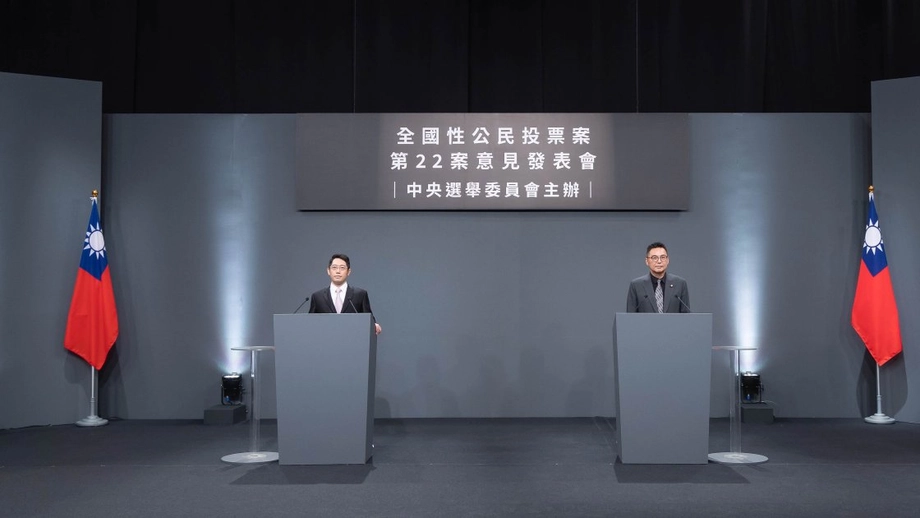
At a Nov. 13 televised policy forum, Lee proposed treating Taipei and New Taipei as one metropolitan area for transportation planning. He set a goal of reducing travel times between key areas of the two cities to 30 minutes or less. One part of that plan would connect the Xizhi-Donghu mass rapid transit line to the eastern section of the Circular Line. Mass rapid transit, commonly called MRT, is the urban rail system used by commuters across the region.
A second proposal would build a bridge between New Taipei's Luzhou District and Taipei's Shezi Island, improving access to the Beitou Shilin Technology Park. For residents, these plans place transfers, travel time and access to jobs at the center of Lee's incoming agenda. No construction start dates for the rail connection or bridge were announced with the election result.
Turnout rose as voters also weighed nuclear policy
Turnout reached 64.31 percent, with 2,208,656 votes cast among 3,434,625 eligible voters. The comparable figure in 2022 was 56.6 percent, an increase of 7.71 percentage points. In practical terms, about 64 of every 100 eligible voters cast a ballot this time, compared with about 57 of every 100 four years earlier.
A separate New Taipei referendum asked whether to abolish the existing policy of a homeland without nuclear power. The yes side received 1,296,610 votes and the no side received 816,546, a difference of 480,064. Turnout for that ballot was 62.72 percent.
Gongliao, Wanli and Shimen are the three districts where the city's nuclear plants are located. Only Gongliao recorded more no votes, while Wanli and Shimen each recorded more yes votes. The referendum figures therefore revealed a different local pattern within a city that had just elected a KMT mayor.
In another local contest, independent Shih Chun-hsiung defeated incumbent Wulai District chief Chou Chih-kang. That result added an independent victory to an election night otherwise dominated by the close contest between Lee and Su.
Key Points
- Lee Shu-chuan received 1,120,555 votes, defeating Su Chiao-hui by 64,925 votes in the completed city count.
- Su conceded at 8:49 p.m., and Lee declared victory at 9:11 p.m. in Banqiao.
- The CEC is scheduled to formally announce the winners on Dec. 4.
- Lee led in 17 districts and Su in 12, with both leading candidates surpassing one million votes.
- The result extends KMT rule over New Taipei and Taipei County since 2005.
- Turnout was 64.31 percent, up from 56.6 percent in 2022.
- Lee campaigned on faster transport between Taipei and New Taipei, a new MRT connection and a bridge from Luzhou to Shezi Island.
- Referendum voters backed abolishing the policy of a homeland without nuclear power, while independent Shih Chun-hsiung won the Wulai District chief race.