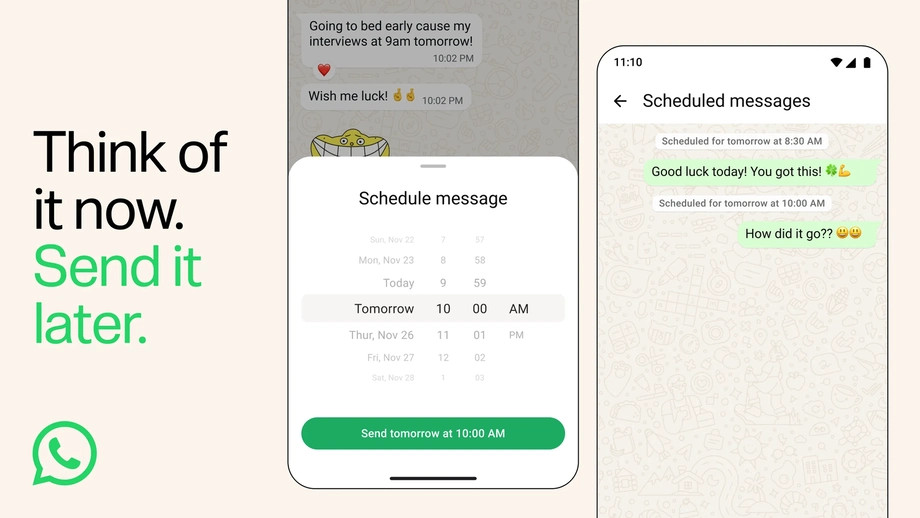
A Message Written Now, Sent Later
WhatsApp has begun adding a tool that lets people write a message today and choose exactly when it reaches someone else. The feature, called scheduled messages, works in individual chats and group chats. Users can set delivery from 10 minutes to 14 days after they write the message. The rollout was announced on November 25, 2026, and WhatsApp says it will reach accounts around the world over the coming weeks.
Contents
- A Message Written Now, Sent Later
- What the Rollout Actually Changes
- How to Schedule a WhatsApp Message
- What Senders Can Check Before Delivery
- Why the Phone Can Be Off
- Privacy and End-to-End Encryption
- Group Chats and the New Member Problem
- Timeline: From Early Code to Global Rollout
- Why WhatsApp Is Catching Up
- Why Scale Matters in India and Beyond
- What Is Still Unclear
- Key Points
For children and adults alike, the idea is simple. A person can write a birthday wish at 11 pm and have it arrive at midnight where a friend lives. A student can prepare a good luck note before an exam. A worker can write a reminder in the evening and have it appear the next morning. The sender does not have to stay awake, keep WhatsApp open, or set a separate alarm to press send later.
WhatsApp described scheduled messages as one of its most requested features. In practical terms, the update moves the timing decision into the chat itself. A normal tap sends now. A long press on the send button opens a choice of when to send later.
What the Rollout Actually Changes
Meta owned WhatsApp announced the update on Wednesday, November 25. The company said the feature is rolling out globally on Android and iPhone over the coming weeks. That means the option may appear on one account before another, even in the same family group or office.
The rollout is gradual because large app updates often reach people in phases. A phased rollout lets a company release a feature to small groups first, watch for problems, then widen access. WhatsApp has not given a firm completion date. Users who cannot see scheduling may need to wait or check for the latest app version through the Google Play Store or Apple App Store, but installing an update does not guarantee immediate access.
The feature is available inside existing conversations rather than through a separate scheduler. That matters because people do not need an outside app, a calendar alert or a reminder note to make it work. They write the message where they would normally write it, then choose a future delivery time.
How to Schedule a WhatsApp Message
Once the option reaches an account, the steps are short:
- Open the individual or group chat where the message should go.
- Type the text, or attach a photo or video.
- Press and hold the send button instead of tapping it once.
- Choose the date and time for delivery.
- Confirm the schedule.
The message then waits in a queue, which means WhatsApp keeps it ready until the selected time. The recipient sees it like any other message. There is no special label saying it was written earlier, and recipients are not told when a queued message is cancelled before delivery.
The supported content is specific. WhatsApp announced scheduling for text, photos and videos. Voice notes, documents, stickers and other attachment types were not included in the announced list. A maximum of 14 days makes the tool useful for plans in the near future, while a minimum of 10 minutes means it cannot send something just one minute later.
What Senders Can Check Before Delivery
WhatsApp says people can view all messages they have scheduled. That gives senders a chance to check both the wording and the delivery time before a message goes out. A birthday greeting can be reviewed after the party plans change. A work reminder can be removed after the meeting is cancelled.
Deleting a scheduled message stops it from being delivered at all. It is not merely hidden from the sender. If a message is deleted before its delivery time, the recipient receives no notification that it had ever been prepared.
Pending messages can be found in a dedicated section of the chat information screen. That is useful when several messages are queued for one event. An old reminder can be removed after the details have already been settled elsewhere.
Why the Phone Can Be Off
One of the most useful details is that scheduled messages do not depend on the sender's phone being on at the delivery time. WhatsApp says a queued message will still be sent if the phone is switched off, out of battery or outside network coverage. The sender can be on a flight, asleep or without power, and the message can still arrive at the chosen moment.
This works because the message is handed to WhatsApp's systems before the chosen time. The app does not need to wake the phone later. That is different from a reminder on a phone, which only alerts the user to come back and press send.
The change is most clear across time zones. Someone in India can write a message late at night for a friend in another country and choose the friend's morning. A person who remembers an exam wish at midnight can schedule it for the next morning without losing sleep.
Privacy and End-to-End Encryption
WhatsApp says scheduled messages keep the same end-to-end encryption that protects personal chats. End-to-end encryption is a privacy system where the message is scrambled on the sender's device and can only be read by the devices in the conversation. In plain language, even WhatsApp cannot open the message and read the words, photos or videos.
That protection still applies while a message waits to be sent. A scheduled birthday note is not placed in a public queue for anyone to inspect. Only the people in the chat receive it, although the sender can see the pending schedule in the chat information screen.
The recipient experience stays familiar. WhatsApp said a scheduled message will look like any other message to the person receiving it. The company explained the design in a short statement.
A scheduled message "will look like any other message to the person receiving it".
That means a person receiving a greeting cannot tell from the message itself that it was written days earlier. The sender is responsible for checking that the message still makes sense when it arrives.
Group Chats and the New Member Problem
Scheduled messages also work in group chats. That is useful for family reminders, class updates, travel plans and work groups, where the right time can matter as much as the message itself.
There is one important group rule from the testing phase. In beta use, a scheduled group message went only to people who were members of the group when the message was scheduled. Someone added later did not receive that earlier queued message, even if they joined before it was sent. WhatsApp's launch description did not spell out this rule.
For group organisers, the practical step is simple. If a new member needs an address, joining link or schedule, send that detail again after adding them. A queued message should not be treated as a message for every future member.
Timeline: From Early Code to Global Rollout
The feature did not appear in one day. Its path ran from early app evidence to beta tests and then to a public announcement.
- February 2026: Evidence of message scheduling appeared in the iOS app during development.
- Early October 2026: Selected Android beta users began receiving scheduling, with Android beta version 2.26.40.7 identified as a compatible build.
- October 24, 2026: iPhone beta testing reached selected users through TestFlight version 26.42.10.19, including messages sent at a chosen time even when the phone was offline.
- November 25, 2026: WhatsApp announced scheduled messages as one of its most requested features.
- Coming weeks after November 25: Android and iPhone users worldwide are expected to receive the option in phases.
The timeline shows the difference between a feature appearing inside an app and a feature becoming usable. Early code or test sightings meant work was underway. The public rollout means ordinary accounts can begin using the tool, though not all at once.
Why WhatsApp Is Catching Up
Scheduled sending is not new across the wider messaging world. Telegram has offered native scheduling since September 2019. Signal added a similar feature in 2023. Google Messages and other messaging apps have also allowed people to send texts or RCS messages later. RCS is a newer text message standard used by many Android messaging apps.
The delay helped drive the reaction online. Telegram marked the late arrival with a sarcastic GIF on X, while WhatsApp's own account joked that users could rest because the scheduled message would be delivered. Indian users turned the launch into memes about family groups, early morning good wishes and wedding questions.
There was also a debate about birthdays. Some people welcomed exact midnight greetings. Others argued that a late wish from someone who truly remembered felt more personal than a message arriving at 12:00 because it had been queued.
Signal's scheduling requires the sender's device to remain on and connected at the delivery time. WhatsApp says its scheduled messages go out even when the sender's phone is off. For users who travel, sleep or lose battery, that is a concrete change.
Why Scale Matters in India and Beyond
WhatsApp has more than 3 billion users globally and is available in more than 180 countries. Meta CEO Mark Zuckerberg has said more than 2 billion people use WhatsApp every day. India alone has over 500 million WhatsApp users, about one sixth of the global base, making it one of the most important markets for any new feature.
The option was already appearing on some Indian phones while other users waited for the phases to reach them. In a country where families, small businesses, schools and government services use WhatsApp for daily communication, scheduling can affect ordinary routines. A shopkeeper can prepare a festive greeting for customers. A parent can send a school reminder early in the morning without waking before dawn. A worker can schedule an update for a team in another time zone.
WhatsApp global head Kunal Shah also used the launch to point toward a broader product push. Days earlier, he described plans to simplify the app, add more artificial intelligence features and expand financial technology services. On the day of the rollout, he wrote on X about birthdays.
Be the first one to wish for their birthdays now. Scheduled messages on WA now.
What Is Still Unclear
WhatsApp has not given a firm date when every account will see scheduled messages. It has also not said whether scheduling will work in WhatsApp Channels, WhatsApp Web, desktop apps or WhatsApp Business. No specific release date was given for Malaysia, and the same uncertainty applies to other markets waiting for the phased rollout.
Editing also remains open. Users can review and delete pending messages, but WhatsApp has not confirmed whether they can change the wording or move the delivery time after scheduling. An early launch description included editing, while the public rollout description did not confirm it.
The group membership rule was visible in testing but absent from the public launch description. Until WhatsApp explains it more fully, organisers should send key details again to anyone added to a group after a message was queued.
Key Points
- WhatsApp began rolling out scheduled messages on November 25, 2026, with global access arriving in phases over the coming weeks.
- Users can schedule text, photos and videos from 10 minutes to 14 days ahead in individual and group chats.
- A long press on the send button opens the date and time picker; a normal tap still sends immediately.
- Senders can view queued messages and delete them before delivery, which stops delivery entirely.
- Messages still arrive if the sender's phone is off, out of battery or outside network coverage, and they remain end-to-end encrypted.
- Recipients see scheduled messages like ordinary messages, with no label showing they were prepared earlier.
- Voice notes, documents, Channels, Web, desktop apps and Business support were not confirmed in the launch details.