Two speed limits, five metres apart
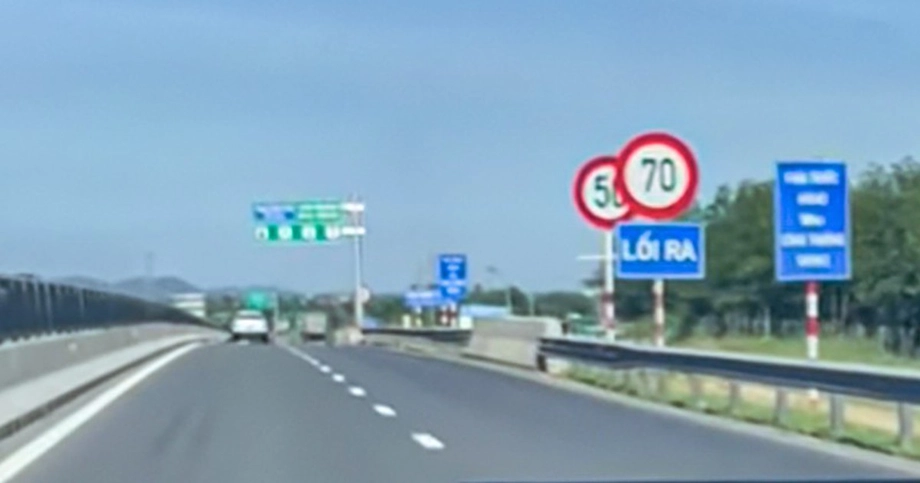
Road managers in Khánh Hòa province are reviewing staff and considering discipline after drivers found a sign limiting traffic to 70 km/h and another imposing 50 km/h only about five metres apart on the Vân Phong - Nha Trang expressway. Tạ Thanh Tình, head of Road Management Office III.3, said on 28 November 2026 that his office had begun the formal review process and would choose an appropriate disciplinary measure.
Contents
- Two speed limits, five metres apart
- Why drivers feared sudden braking and fines
- A temporary sign stayed after construction ended
- Removal, enforcement and a brief timeline
- Who accepts responsibility?
- The delayed rest stop project tied to the signs
- The expressway and the network around it
- Readers press for checks beyond Km1389
- Key Points
The signs stood at Km1389 on the South to North carriageway, just before an area where a rest stop is being built. For drivers, the problem was immediate and practical: they could encounter two different legal maximums almost simultaneously while travelling at an operating speed of up to 90 km/h.
The confusing pairing has already been corrected. At noon on 26 November, road managers and traffic police removed the 50 km/h sign and retained the 70 km/h limit. Police also assured drivers that they would not be fined over speed at the location because of the unreasonable signs, since the mistake did not originate with the people driving.
Tình attributed the physical error to the unit constructing the rest stop, which he said had forgotten to remove a temporary construction sign. He also accepted that his office carried responsibility for state management of the road. No final disciplinary decision had been announced when he spoke.
Why drivers feared sudden braking and fines
Images of the signs spread on social media, while drivers raised concerns about the short distance between them. One driver, identified as N.V.H, described noticing an overhead sign for the rest stop and then seeing the two circular speed signs beside the right edge of the road.
I was very surprised because just as I reached this section, there was an overhead sign for the Vân Phong - Nha Trang expressway rest stop. Right below, on the right edge of the road, were signs for 70 km/h and 50 km/h only about five metres apart. I have driven a lot, but I have never seen speed signs placed so close together.
Five metres is roughly the length of a large car. A vehicle travelling at 90 km/h covers 25 metres every second, so it passes a five metre gap in about one fifth of a second. At that speed, the second instruction arrives almost as soon as the first has been read.
Drivers said they feared being unable to reduce their speed smoothly from 90 km/h to 70 km/h and then to 50 km/h. The full reduction amounts to 40 km/h. Their concern was not simply that the photograph looked strange. Abrupt braking on an expressway can surprise following drivers, while uncertainty over which limit applied also raised fears of an unfair speeding penalty.
A temporary sign stayed after construction ended
The 50 km/h sign had originally served construction under an approved traffic plan, according to Tình. The contractor installed speed signs while building the rest stop and its connection with the expressway. Such temporary instructions are meant to match conditions around a work area.
By the time drivers complained, the junction between the rest stop and the expressway had been completed, inspected, accepted and handed over for use. Tình said normal traffic organisation should then have used the 70 km/h sign, making removal of the 50 km/h construction limit necessary.
Tình explained the failure in his own words.
The 50 km/h sign should have been pulled out so the road could operate normally with the 70 km/h sign. However, the construction unit forgot to remove the 50 km/h sign.
Although the temporary sign had been used during construction, Tình said the conflicting pair existed side by side for only a few hours. Once the problem was detected, Road Management Office III.3 ordered the obsolete sign removed. His explanation placed the immediate cause at the handover from construction to normal use, when the temporary instruction should have disappeared.
Removal, enforcement and a brief timeline
Road Management Office III.3 worked with Expressway Road Traffic Patrol and Control Team No. 6 and other relevant bodies to correct the site. The team is associated with Division 6 of the Traffic Police Department, known as C08 under the Ministry of Public Security.
A leader of Team No. 6 said drivers would not be punished for failing to follow the unreasonable sign arrangement. Tình similarly said traffic police had determined that the drivers were not at fault. The assurance concerned the speeding concerns created by this particular location and signing error.
- During construction: the contractor installed speed signs, including the 50 km/h limit, under an approved plan for the work area.
- After the junction was accepted: the connection entered use, but the temporary 50 km/h sign remained beside the 70 km/h sign.
- On 26 November 2026: following complaints and an inspection, authorities removed the 50 km/h sign at noon and retained the 70 km/h limit.
- On 28 November 2026: Tình explained the forgotten removal, while his office announced staff reviews and possible discipline.
Who accepts responsibility?
Road Management Office III.3 sits within Road Management Area III of the Vietnam Road Administration. Tình said the people involved in installation might have lacked a sufficient understanding of the law, but he did not use that explanation to remove his office from the chain of responsibility.
He described both the contractor error and the management duty resting with his office.
The person who had the signs installed may not have understood the law well. We will work with the parties involved to correct this. However, responsibility for state management belongs to Road Management Office III.3.
The employee directly involved could be assessed as not having completed assigned duties in 2026. The employee could also receive a lower emulation ranking, a workplace commendation classification considered at the end of the year. Tình said the staff member would not be regarded as having completed the year's assigned tasks, while other details of discipline remained under consideration.
A leader of the office set out the standard expected from staff during the review.
Everyone must be responsible for their own work. We cannot be perfunctory, careless or irresponsible and allow mistakes to happen.
The review covered officials connected with the error as well as the person directly involved. The office had not announced a final penalty or provided a date for completing the process, so the employment consequences remained proposals within an unfinished review.
The delayed rest stop project tied to the signs
The rest stop is listed at Km334+900 in Tân Định commune, Khánh Hòa, in the project description provided by the road managers. Drivers located the conflicting signs separately at Km1389 on the South to North carriageway, immediately before the work area. The P. consortium is the project investor.
The development covers 7.8 hectares, equivalent to 78,000 square metres. The station on the right side of the route, serving the South to North direction, occupies more than 4.2 hectares. The station on the left covers nearly 3.6 hectares.
Total investment exceeds 225 billion Vietnamese dong. Construction began in August 2025, with operation planned from June 2026. The project is now behind schedule, and no revised opening date was given.
The completed and accepted junction did not mean that every part of the wider rest stop project had been finished. The sign dispute arose from that transition: the connection was ready for use, the broader project remained delayed, and a temporary traffic instruction had been left in place after its purpose at the junction had ended.
The expressway and the network around it
The Vân Phong - Nha Trang expressway runs for more than 83 kilometres through numerous communes and wards in Khánh Hòa. It forms part of Vietnam's North - South expressway system and has a total investment of more than 11.8 trillion dong.
Construction started in January 2023. About 70.35 kilometres were completed and opened for operation in April 2025. The remaining 13 kilometres were connected on 1 January 2026, bringing the full route into operation during that month. Together, those figures describe approximately 83.35 kilometres, consistent with the stated length of more than 83 kilometres.
The route was initially built with four lanes and an operating speed of 90 km/h. Its present operating range is described as 60 to 90 km/h, and tolls are already being collected from road users. The completed design provides for six lanes and a maximum speed of 120 km/h, a figure for the finished configuration rather than the current operating range.
Road Management Office III.3 also works within a much larger expressway network stretching from Quảng Ngãi to Khánh Hòa. The five sections under its management are Quảng Ngãi - Hoài Nhơn, Hoài Nhơn - Quy Nhơn, Quy Nhơn - Chí Thạnh, Chí Thạnh - Vân Phong and Vân Phong - Nha Trang. The sign error therefore surfaced within an office responsible for several busy routes, not just a single construction junction.
Readers press for checks beyond Km1389
Readers responding to the incident demanded accountability beyond the decision to spare drivers from fines. A reader named Than argued that discipline should apply to road managers as well as road users. Tèo urged punishment for irresponsible work without shifting responsibility elsewhere, while another reader proposed that whoever caused the error should personally cover the cost of buying, installing and removing the sign.
Đào An said protecting drivers from penalties was the natural response, but maintained that the person who installed the second sign should also be punished. Ongh drew a distinction between a road user who might not understand the law and a knowledgeable person who performs the work incorrectly.
Tam, another reader, presented public complaints as a complement to official supervision.
The people are eyes and ears alongside the supervision of state agencies.
Readers also described problems elsewhere. Some said signs showing 50 km/h and 70 km/h stood very close together on National Highway 1 through Khánh Hòa. Others pointed to closely spaced 60 km/h signs around Long Khánh. Trung Tin described inconsistent signs installed by different levels of local government along the same road.
Nghia Pham said expressway sections built by different contractors between Đồng Nai and Nha Trang appeared to use different signs. The reader proposed a national standard publishing the required images, dimensions and lettering, with mandatory use throughout Vietnam. These wider inspection and standardisation requests remained reader proposals; no nationwide measure was announced alongside the disciplinary update.
Key Points
- Signs showing limits of 70 km/h and 50 km/h stood about five metres apart at Km1389 on the Vân Phong - Nha Trang expressway.
- The 50 km/h sign had served construction and was left behind after the rest stop junction was completed and accepted.
- Authorities removed it at noon on 26 November 2026, leaving the 70 km/h limit in place.
- Traffic police said drivers would not be fined over the unreasonable signing because the error was not theirs.
- Road Management Office III.3 is reviewing connected staff, with possible effects on the 2026 performance assessment and commendation ranking.
- Tình accepted his office's state management responsibility while attributing the forgotten removal to the construction unit.
- The delayed rest stop covers 7.8 hectares, costs more than 225 billion dong and has no newly announced opening date.
- The expressway is more than 83 kilometres long, fully operational since January 2026 and already collecting tolls.