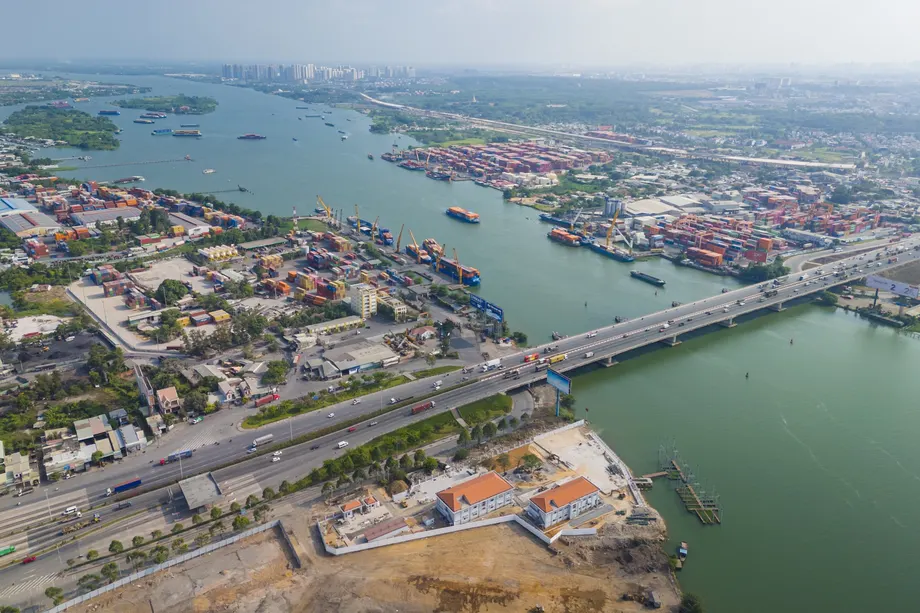
A legal runway for a new growth pole
Dong Nai has received a new package of legal powers to pursue one of Vietnam's most ambitious urban and industrial plans. Decree No. 422/2026/NĐ-CP, signed on 26 November 2026 by Permanent Deputy Prime Minister Pham Gia Tuc on behalf of the government, took effect on 1 December. It follows Politburo Resolution No. 16-NQ/TW, which sets development goals to 2035 and a vision to 2065.
Contents
- A legal runway for a new growth pole
- The decisions that changed the city's status
- What can the city now decide for itself?
- Why is Long Thanh airport at the centre?
- Can an industrial base support higher value growth?
- How will goods move through the new logistics network?
- Four economic corridors extend beyond the airport
- What will a city of several centres look like?
- Which projects and deadlines come next?
- What to Know
The central proposal is to turn Dong Nai into a special urban area and a growth pole with several functions. Aviation and aerospace are assigned the leading industrial role, alongside advanced technology, logistics, border trade, innovative agriculture and digital change. Long Thanh International Airport is the physical centre of that plan, but the policy also covers housing, public services, river landscapes, seaports and transport across southern Vietnam.
The decree also places Dong Nai within a special urban region with Ho Chi Minh City. In practical terms, the two localities are expected to coordinate investment, project management, environmental protection and responses to climate change. For businesses, the package brings new planning mechanisms and tax incentives. For residents, it raises the prospect of more jobs and better services, while making land protection, public transport and the quality of new neighbourhoods immediate planning concerns.
The decisions that changed the city's status
The airport project began years before the new legal framework. The administrative merger with Binh Phuoc province in 2025 subsequently gave the enlarged city a direct trade route to Cambodia through Hoa Lu International Border Gate.
- Early 2021: Construction of Long Thanh International Airport began in Dong Nai.
- 1 July 2025: The administrative merger with Binh Phuoc province added Hoa Lu and other border gates with Cambodia to the city's trade network.
- 18 May 2026: General Secretary and President To Lam told the city Party leadership to move beyond the limits of a traditional industrial centre and use the airport to reorganise development.
- 21 July 2026: To Lam signed Resolution 16 on behalf of the Politburo, establishing the 2035 goals and the vision to 2065.
- 24 August 2026: The National Assembly passed the Law on Urban Development, No. 18/2026/QH16. It took effect on 1 October.
- 27 August 2026: The city Party executive committee issued Plan No. 179-KH/TU to implement Resolution 16. Resolution 27 on regional development and national spatial organisation followed on 28 August.
- 26 November 2026: The government issued Decree 422, effective from 1 December.
- 2027 tax period: The specified tax incentives under Article 39 of the urban development law begin to apply.
Plan 179 calls for a change from administrative management to development governance. Nguyen Van Ut, chairman of the Dong Nai People's Committee, described an open urban structure with several centres and levels, using rivers and natural ecosystems as principal landscape axes. Science, technology, innovation and digital systems are intended to support that structure rather than sit apart from it.
What can the city now decide for itself?
Article 4 of Decree 422 applies six groups of mechanisms and policies to Dong Nai, with detailed references and exclusions in the urban development law:
- Organisation of the government apparatus and the civil service regime.
- Planning, construction, urban development, urban order and safety.
- Economic development.
- Culture, sport, tourism, education, training, health and social security.
- Science, technology, innovation and digital change.
- Resources for developing the special urban area.
The permitted economic and planning tools include transit oriented development, free trade zones, integrated logistics zones, controlled policy trials and measures to attract strategic investors. Transit oriented development means concentrating homes, jobs and services around public transport so that residents have practical alternatives to travelling by private vehicle.
The People's Council, People's Committee and chairman of the People's Committee may issue local legal rules to carry out powers delegated under the decree. Rules that differ from central legislation are excluded from defence, security, foreign affairs, ethnic and religious matters, and fields directly related to national sovereignty. Drafts require an impact assessment, consultation with ministries and affected people, publication of the dossier and an explanation of how comments were handled. Shortened procedures are generally unavailable, except when suspending or repealing a document.
Tax incentives begin in the 2027 tax period for eligible activities. Qualifying innovative startup income can receive a corporate income tax exemption lasting five years from the point when tax becomes payable. Eligible experts, scientists, people with exceptional talent and innovative startup founders can receive a personal income tax exemption on qualifying salaries and wages for five consecutive years. The city People's Council will set the applicable criteria, conditions and procedures.
The decree includes safeguards for work already underway. Approved programmes and projects can continue under their existing decisions, while eligible projects may move to the new mechanisms without fresh approval. Administrative applications received but not yet settled remain under the rules in force when they were received. The People's Council will supervise implementation, and the People's Committee must report annually to both the council and the government.
Why is Long Thanh airport at the centre?
The Dong Nai People's Committee puts the airport site at roughly 5,000 hectares, which it describes as among the six largest airport sites in the world. Planned investment exceeds 16 billion USD. The airport is designed to ICAO's 4F standard, the highest aerodrome reference code used by the International Civil Aviation Organization, covering facilities intended for the largest aircraft.
After all stages are completed, annual capacity is expected to reach about 100 million passengers and 5 million tonnes of cargo. Construction began in early 2021, and work is being accelerated for the first stage. The passenger terminal, whose design draws inspiration from a lotus flower, has taken shape. City statements on preparations for operation did not give an opening date for the first stage.
During his 18 May working session, To Lam called for an overall plan for the Long Thanh airport city, Nhon Trach and surrounding areas. He also requested coordination to protect the schedule for the airport's second stage, the Bien Hoa to Vung Tau railway, routes serving the airport and other regional infrastructure.
Nguyen Van Ut said the city was accelerating its master plan, zoning plans and functional areas, together with industrial, digital and strategic infrastructure projects. The chairman of the People's Committee expressed confidence in the city's national role:
Dong Nai city has the capacity to take on the role of an important growth pole for the country.
Khuong Van Muoi, former vice chairman of the Vietnam Association of Architects, said an airport city should be an economic ecosystem with several functions, rather than simply a residential development beside runways. His recommendations include quality services for investors, international specialists and workers, strong links to seaports and border gates, and use of rivers, lakes and ecological assets for tourism and better living conditions.
Can an industrial base support higher value growth?
Dong Nai enters this transition with 44 operational industrial parks. In the first nine months of 2026, exports reached nearly 28 billion USD. Cargo transport volume was estimated at 92.7 million tonnes, while revenue from warehousing and transport support services reached an estimated 11.82 trillion dong, up 27.53 percent from the same period a year earlier.
Resolution 16 sets a target for gross regional domestic product, the local equivalent of national GDP, to grow by at least 10 percent annually during 2026 to 2030. The city is expected to reach a GRDP of 44 billion USD by 2030, with value added by the digital economy accounting for at least 30 percent.
The industrial priorities extend beyond conventional assembly. They include aviation, aerospace, semiconductors, artificial intelligence, digital technology industries and new materials. City policy also identifies aviation services, logistics, finance, international trade, green production, the circular economy and advanced agriculture. The circular economy seeks to keep materials in use for longer and reduce waste.
Huynh Ho Dai Nghia, a public policy specialist at the University of Social Sciences and Humanities under Vietnam National University Ho Chi Minh City, identified five advantages: location within the southern economic region, Long Thanh airport, links to Phuoc An and the Cai Mep and Thi Vai ports, regional road and rail networks, and an industrial workforce built over decades. Economist Tran Du Lich separately pointed to Dong Nai's place in the development quadrilateral formed with Ho Chi Minh City, Binh Duong and the former Ba Ria and Vung Tau area. He recommended using a free trade area associated with the airport and Phuoc An Port to deepen participation in global supply chains.
How will goods move through the new logistics network?
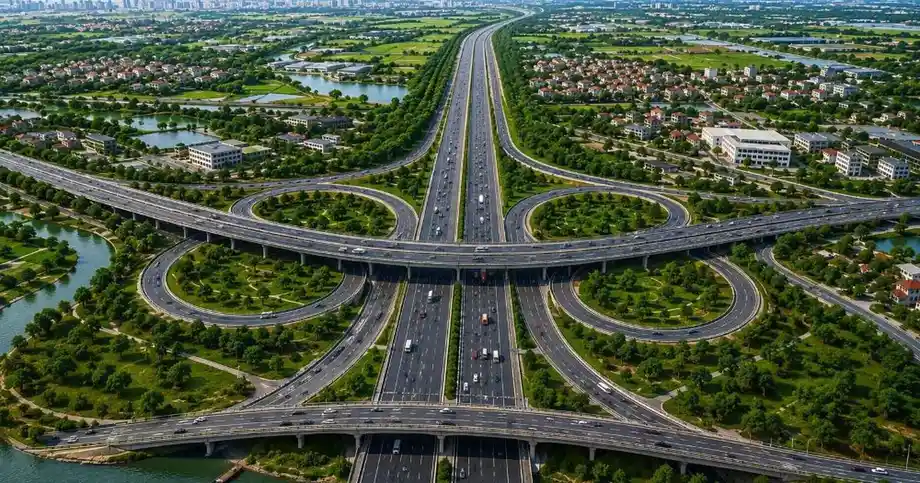
The planned system uses road, aviation, rail, maritime and inland waterway transport. Ten expressway routes are completed, under construction or planned. Links are being prioritised between industrial parks, Phuoc An and Dong Nai ports, inland container depots, Hoa Lu border gate and Long Thanh airport, with further connections to Cat Lai, Cai Mep and Thi Vai.
Nguyen Duy Hung, director of Hung Thinh Phat and vice chairman of the Dong Nai Logistics Association, said the airport's coming operation creates an opportunity to build an integrated logistics ecosystem with those seaports. The Department of Industry and Trade is connecting cargo owners with transport, warehouse and port operators, while promoting services that run from supplying and storing raw materials to customs clearance and distribution.
Specialised centres are planned for different cargo tasks. Long Thanh would focus on aviation logistics, cold storage and goods of high value. Phuoc An and Nhon Trach would handle port logistics and containers. Trang Bom, An Vien and Dau Giay would consolidate and distribute cargo. A separate logistics chain would connect Hoa Lu with the airport, Phuoc An and seaport group No. 4 in the southeast.
Duong Van Hieu, deputy director of the municipal Department of Construction, said planning must consider future cargo flows and connections between facilities. He identified digital data, artificial intelligence and shared platforms as tools for monitoring shipments, forecasting demand and coordinating operators.
At a 19 November preparation meeting, Vo Tan Duc, deputy secretary of the city Party Committee, asked departments to work with Airports Corporation of Vietnam on aviation services, warehouses, freight transport, commerce, tourism, hotels and support services. Vo Minh Trung, deputy director of the Department of Finance, said the city was studying a Long Thanh special economic zone linking the airport with seaports, logistics centres, free trade zones, advanced technology parks and modern urban districts.
Four economic corridors extend beyond the airport
Resolution 16 identifies corridors intended to give each part of the wider region a distinct role:
- Ho Chi Minh City, Bien Hoa and Long Thanh to Phuoc An Port, concentrating on aviation, maritime trade, logistics and modern services.
- Bien Hoa, Dau Giay and Tan Phu toward the Central Highlands, linking industry, agriculture, ecological tourism, energy and services.
- Phuoc Long, Dong Xoai, Chon Thanh and Hoa Lu toward Cambodia and mainland ASEAN, supporting border trade, international logistics and supporting industries.
- Long Thanh toward Lam Dong, the south central coast and the Central Highlands, connecting aviation, seaports, highland production and coastal markets.
The Department of Finance expects Dong Nai to provide manufacturing, advanced industry, aviation services and transshipment, while Cai Mep and Thi Vai serve as a maritime gateway for international trade. Other localities can supply agricultural products, raw materials, energy and industrial goods. Resolution 27 encourages this division of roles so that neighbouring provinces avoid duplicating the same industries.
Associate Professor Tran Quang Phu, former vice rector of the Ho Chi Minh City University of Transport, described Dong Nai as a new growth pole with the airport city as an important pillar. He explained its geographical advantage:
With its location bordering Ho Chi Minh City, Lam Dong, Tay Ninh and Cambodia, Dong Nai has a special advantage in developing transport infrastructure linking regions.
What will a city of several centres look like?
Dong Nai covers more than 12,737 square kilometres, has more than 4.5 million residents and contains 95 commune level administrative units. Its size makes a single urban centre impractical for the whole territory. Bien Hoa will remain the established urban centre, Long Thanh will develop around the airport, and Nhon Trach will use its connections to Ho Chi Minh City and the seaports. Trang Bom, Long Khanh and northern areas are assigned stronger roles in industry, advanced agriculture and tourism.
Urban railway projects linking Dong Nai with Ho Chi Minh City, especially routes serving Nhon Trach, Long Thanh and the airport, are expected to support movement between these centres. City officials and transport specialists say this can distribute population and employment more effectively, provided that land is reserved for public transport, social housing, schools, hospitals and parks.
One detailed proposal covers about 2,250 hectares at An Phuoc and Tam Phuoc, west of the airport city. It includes approximately 259 hectares facing the Dong Nai River. Housing, commerce and services are proposed for the west, with a university urban area and innovation centre under study for the north. At a public consultation on 13 November, residents requested clear information about land recovery, protection of their rights and early support for affected households.
Nguyen Kim Long, permanent vice chairman of the People's Committee, said the coming decade should bring an international aviation and logistics gateway as well as a green, smart and liveable urban area. The city's programme also calls for better drainage, wastewater and solid waste treatment, renovation of existing districts, public spaces beside rivers, walking routes and cultural facilities. Those measures connect the economic plan to everyday journeys, housing, education and access to open space.
Which projects and deadlines come next?
On 20 November, the Department of Construction said it was working with the Department of Finance to accelerate preparation, appraisal and approval of the city master plan. The department had been assigned 34 tasks across six fields for the final quarter of 2026. These include urban and rural planning, underground space, an urban development programme and architectural management rules. No approval date was announced for the master plan.
The Long Thanh special economic zone proposal and the Hoa Lu border gate economic zone proposal are being prepared for appraisal by the Ministry of Construction. A March 2026 review counted 85 projects covering 1,635 hectares in the Hoa Lu zone, with slow projects and land problems ordered to be reviewed. The Justice Department issued implementation guidance for Decree 422 on 27 November, while the Construction Department prepared a draft resolution on seaports, inland waterways and water transport.
Construction of component project 2 for the Cat Lai and Long Hung bridges began on 29 September 2026. The Cat Lai route is longer than 11.6 kilometres and connects the Cat Lai area with the Ben Luc to Long Thanh expressway at Dai Phuoc. The Long Hung route is about 9.8 kilometres and connects Long Phuoc in Ho Chi Minh City with An Phuoc in Dong Nai, meeting the Bien Hoa to Vung Tau expressway. Both are scheduled for completion in 2029.
The Ben Luc to Long Thanh expressway entered service in October 2026, while the Ho Chi Minh City to Long Thanh expressway is being widened to 10 lanes. Vice Chairman Ho Van Ha said the city was also pressing ahead with Ring Road 3, Ring Road 4 and the Cat Lai, Long Hung and Phu My 2 bridges. The next fixed markers are the 2027 tax incentives and public investment programme, the bridges in 2029, the economic targets for 2030 and the airport city and social goals for 2035, within the longer vision to 2065.
What to Know
- Decree 422 took effect on 1 December 2026, applying six groups of special urban policies to Dong Nai.
- Resolution 16 aims to make the city a national growth pole led by aviation, aerospace, advanced technology and logistics.
- Long Thanh airport covers about 5,000 hectares, with planned investment exceeding 16 billion USD and full capacity of 100 million passengers and 5 million tonnes of cargo annually.
- Eligible startups, experts and scientists can receive specified tax incentives beginning in the 2027 tax period.
- Dong Nai has 44 operating industrial parks and exported nearly 28 billion USD in goods in the first nine months of 2026.
- Four economic corridors will link the airport, seaports, industrial areas, the Central Highlands and Cambodia.
- The urban plan assigns distinct roles to Bien Hoa, Long Thanh, Nhon Trach and other centres, with public transport and public services central to implementation.
- The Cat Lai and Long Hung bridge projects are scheduled for completion in 2029, while dates for airport opening and master plan approval were not announced.