A sudden reversal reaches Vietnamese gold shops
Gold staged one of its sharpest rebounds of the year on Friday, November 27, 2026. At 2:30 p.m. in Vietnam, spot gold stood at $3,663 an ounce, up almost $94, or 2.62%, over 24 hours. The price had been $3,567 at 6:30 that morning, meaning it gained more than $92 in under eight hours. Across two days, bullion recovered more than $216 an ounce, almost 6.3%, from its weakest area in more than a year.
Contents
- A sudden reversal reaches Vietnamese gold shops
- The day's turning points
- Why did the selling pressure ease?
- Why could the Federal Reserve limit the rally?
- Why does SJC gold cost about 21 million dong more?
- The spread can exceed a full day's gain
- Where dealer prices settled
- Silver, oil and industrial metals joined the surge
- Crowds returned to Hanoi's gold street
- The next dates and price levels to watch
- The Bottom Line
Vietnamese prices followed. Saigon Jewelry Company, known as SJC, quoted its gold bars at 131 million dong per tael to buy and 136 million to sell at 2:30 p.m., with both prices up 1.5 million dong from early morning. Its gold rings reached 129.3 million and 135.3 million dong. By the 6:00 p.m. close, SJC and DOJI were quoting bars at 131 million to 136 million dong, while SJC rings had climbed to 130.8 million to 135.8 million dong.
The international rise continued after Vietnam's afternoon update. Gold was near $3,671 an ounce at 6:15 p.m., up $104.70, and a later Friday reading put it at $3,683.58, up 3.22%. The session's intraday high was $3,685. US gold futures for December delivery rose 3.6% to $3,662.10. Spot gold is priced for immediate settlement, while a futures contract specifies delivery at a later date.
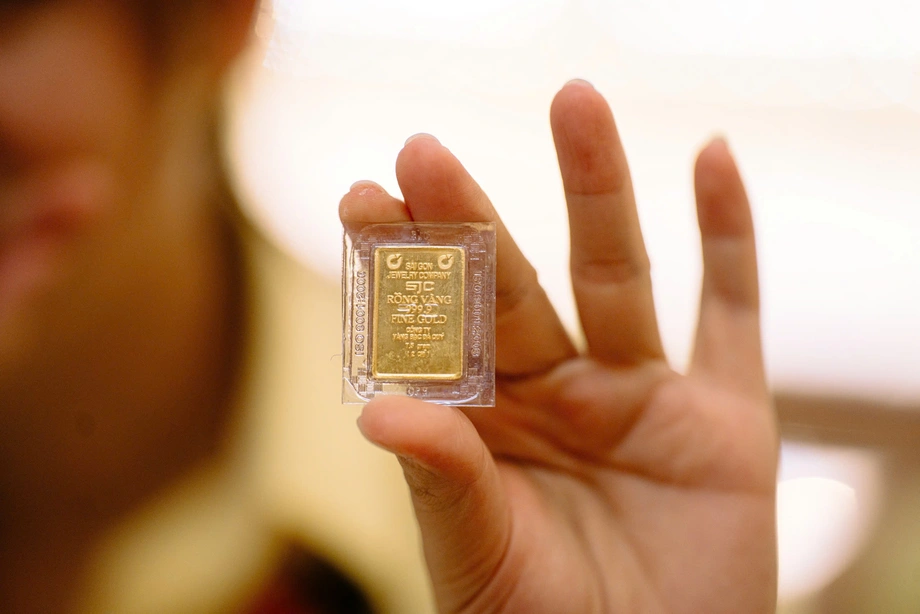
SJC's selling price was the highest since November 19 and finished the day 1.12% higher, with a gain of 1.87% for the week. Global bullion was heading for a weekly advance of about 3.6%. SJC bars are 99.99% pure and are stamped by the company. A Vietnamese tael weighs 37.5 grams, about 1.2 troy ounces, and contains 10 chi, the smaller unit often used in jewelry shops.
The day's turning points
- At 6:30 a.m., spot gold was $3,567 an ounce, up nearly $30, or 0.82%, over 24 hours. An early SJC quote put bars at 129.5 million dong to buy and 134.5 million to sell, both up 400,000 dong from the previous morning. Rings were 128.3 million and 134.3 million dong.
- During the opening flurry, some dealers trimmed prices before raising them again. SJC then recorded two consecutive increases. Near 11:30 a.m., its bars stood at 130.5 million to 135.5 million dong, up 1 million dong on each side from the November 26 close.
- At 11:14 a.m., world gold reached $3,629.80, up $64.30, or 1.8%, from the previous close. By 1:00 p.m. it was around $3,653, up nearly 2.4%. The common morning increase in domestic SJC bars was 0.74%, making the international percentage gain more than three times as large at that point.
- At 5:02 p.m., PNJ's Ho Chi Minh City board showed SJC bars at the equivalent of 131 million to 136 million dong per tael. Around 5:30 p.m., world gold was near $3,669, while Bao Tin Minh Chau quoted SJC bars at 129 million to 136 million dong.
- At 6:00 p.m., SJC and DOJI bars closed at 131 million to 136 million dong. SJC's ring buying price finished at 130.8 million dong, up 2.5 million from the early quote of 128.3 million. Its selling price rose 1.5 million dong over that span to 135.8 million.
Why did the selling pressure ease?
Technology and artificial intelligence shares provided the immediate trigger. Their recent fall had forced some investors to raise cash by selling gold and other liquid assets, helping cover losses in stock portfolios. When technology shares stabilized and Asian equities improved, that urgent need for cash subsided. Buying after a steep fall, together with short covering, added force to the recovery. Short covering means that traders who had bet on lower prices buy gold back to close their positions.
The US Thanksgiving holiday also changed trading conditions. American stock markets were closed on November 26 and were due to operate for a shortened session on November 27. Ross Maxwell, strategy director at VT Markets, said the break could reduce pressure on gold as technology share sales and broader asset liquidation paused.
The dollar supplied additional help, although its readings varied during the session. Vietnam's afternoon update put the dollar index at 103.75, down 0.03% for the day. Another session reading was 103.93, up 0.13%, but still below Monday's 104.53, its highest level in 20 months. The index measures the dollar against six major currencies. A weaker dollar generally makes gold cheaper for buyers using other currencies.
Carlo Alberto De Casa, an independent analyst at Swissquote, said calmer equity trading was positive for precious metals because investors had previously sold bullion to offset stock losses. He gave this assessment of the recovery:
Even though gold is unlikely to return immediately to $5,000 an ounce, it is entirely feasible for the market to move toward the $4,000 to $4,200 range.
Jewelry and investment buying in India and China provided further support. The rebound therefore drew on more than a single headlines-driven move: forced selling eased, bargain buyers returned, the dollar cooled from its peak and physical demand remained active.
Why could the Federal Reserve limit the rally?
American economic figures released during the week strengthened the case for higher borrowing costs. The core PCE figure came in the BEA's Personal Consumption Expenditures Price Index release, with the current release dated November 25, 2026, and the next release due December 23, 2026. Core personal consumption expenditures inflation, a measure watched closely by the Federal Reserve that excludes food and energy, rose to 3.3% in October from a year earlier. That was its fastest pace since late 2023. The same release listed September 2026 at 3.1%, August 2026 at 3.0% and July 2026 at 3.0%. Core PCE is released as part of the monthly Personal Income and Outlays report and is closely watched by the Federal Reserve as it conducts monetary policy. Economic growth in the third quarter was revised upward to an annualized 4.3%, from 3.4%. Annualized growth shows the full year pace if the quarter's rate continued.
The 4.3% third-quarter GDP figure belongs to the GDP release; there was no dedicated BEA release solely for it. Quarterly and annual data are included in the GDP release. The cited 4.3% was in a report published November 25, 2026, which summarized the Personal Income and Outlays release and the GDP release together. The BEA page also references Table 2.8.7 interactive dataset and NIPA Handbook documentation.
The CME FedWatch Tool's own posted probabilities put a 25 basis point increase at the Fed's December 8 and 9 meeting at 99.4%. A basis point is one hundredth of a percentage point, so this would mean an increase of 0.25 percentage point. The same posted probabilities put another increase in January at about 65%. No decision has yet been taken.
Higher rates hurt gold through two channels. Gold pays no interest, so deposits and bonds can become more attractive when their returns rise. Expectations of higher US rates can also support the dollar, raising the cost of bullion for international buyers. Han Tan, a market analyst at Bybit, said gold would struggle to sustain a recovery until the Fed signaled an end to its rate increases.
Darshan Desai, chief executive of Mumbai based Aspect Bullion and Refinery, also urged caution about the coming sessions:
Instability is likely to continue over the coming days.
Desai linked that warning to expectations of further US rate increases and persistent inflation. Energy prices add another complication. Attacks on tankers in the Strait of Hormuz and on Saudi energy infrastructure have renewed concern about oil supplies. Costlier energy can feed inflation, encouraging central banks to keep policy tight even when investors want relief.
Why does SJC gold cost about 21 million dong more?
At the 2:30 p.m. exchange rate conversion, world gold was worth about 114.9 million dong per tael before taxes and fees. That was almost 21.1 million dong below SJC's 136 million dong selling price. Early in the morning, when international gold was much lower, the converted world price was about 111.85 million dong and the gap to SJC's selling quote was roughly 22.6 million.
A separate morning calculation that included taxes and fees placed the SJC premium at 19.68 million dong. Gold rings were between 16.68 million and 19.48 million dong above the converted international price at most surveyed dealers, while Ngoc Tham's lower ring quote produced a gap of 8.18 million dong. The tax treatment, exchange rate and timestamp must therefore accompany any comparison.
The premium means that a percentage move in New York or London does not translate directly into the same retail movement in Vietnam. Dealers also set their own buying prices, selling prices and product quotes. A customer purchasing an SJC bar is paying the domestic shop price, not simply multiplying the international ounce price by an exchange rate.
The spread can exceed a full day's gain
The gap between a dealer's buying and selling prices is the immediate cost faced by someone who purchases gold and then sells it back. SJC's bar spread was 5 million dong per tael through much of the day, while its afternoon ring spread reached 6 million dong. Bao Tin Minh Chau's bar spread widened to 6.5 million dong in the morning, its largest since the start of the year, and reached 7 million dong by around 5:30 p.m. Phu Quy's closing bar spread was 6.5 million dong.
A customer paying Bao Tin Minh Chau's 136 million dong selling quote while its buying quote remained 129 million dong would face a 7 million dong reduction on an immediate resale. That equals about 5.1% of the purchase outlay before any market movement. At SJC's closing quotes of 131 million and 136 million dong, the corresponding gap was 5 million dong, or about 3.7%. Both were larger than the 1.5 million dong daily increase in the bar price.
Longer term holders have also experienced severe swings. SJC's selling price reached 191.3 million dong per tael on January 29. Using the late morning quotes on November 27, that selling price had fallen by 55.8 million dong. Someone who bought at the January peak and resold at the quoted buying price of 130.5 million dong would have lost 60.8 million dong per tael.
Where dealer prices settled
Closing boards showed that the same SJC brand could carry substantially different terms depending on the shop. The principal quotes were:
- SJC and DOJI listed bars at 131 million dong to buy and 136 million to sell at 6:00 p.m., a spread of 5 million dong. Bao Tin Manh Hai also reached 131 million to 136 million dong earlier in the evening.
- Phu Quy listed bars at 129.5 million to 136 million dong. Its buying side rose 700,000 dong and its selling side gained 1.5 million dong, leaving a spread of 6.5 million.
- Bao Tin Minh Chau quoted 129 million to 136 million dong at about 5:30 p.m. DOJI, PNJ and Asean had earlier posted 130.5 million to 135.5 million dong, demonstrating how quickly boards changed during the afternoon.
- SJC rings closed at 130.8 million to 135.8 million dong. DOJI rings were 129.5 million to 134.5 million, and Phu Quy rings were 129.5 million to 133.5 million. Their respective spreads were 5 million, 5 million and 4 million dong.
The dealers' own published price boards dated November 27 provided the record behind those quotes. SJC's official site listed bars at 131.0 million dong to buy and 136.0 million to sell per tael, and rings at 130.8 million dong to buy and 135.8 million to sell per tael. PNJ's official site listed SJC bars at 13,100 thousand dong per chi to buy and 13,600 thousand to sell, and SJC rings at 13,080 thousand dong per chi to buy and 13,580 thousand to sell. DOJI's official site listed SJC bars at 131 million dong to buy and 136 million to sell per tael, SJC rings at 129.5 million dong to buy and 134.5 million to sell per tael, and DOJI gold at 130.6 million dong to buy and 136 million to sell per tael.
The official PNJ price board, timestamped 5:02:06 p.m. for Ho Chi Minh City, listed prices in thousands of dong per chi. Its SJC bar quote of 13,100 to buy and 13,600 to sell converts to 13.1 million and 13.6 million dong per chi, or 131 million and 136 million per tael. Plain PNJ rings, Kim Bao, Phuc Loc Tai and Phuong Hoang products were all listed at 12.68 million dong per chi to buy and 13.3 million to sell.
PNJ's board also illustrates why jewelry cannot be compared directly with bullion. Jewelry of 99.99% purity was quoted at 12.53 million dong per chi to buy and 13.08 million to sell. Quotes for 22K and 18K jewelry were lower, while 8K jewelry stood at 3.736 million and 4.356 million dong per chi. For outside jewelry accepted as raw material at participating stores, PNJ listed buying prices of 11.8 million dong per chi for 99.99 purity and 11.607 million for 99 purity, subject to its purchasing needs.
Silver, oil and industrial metals joined the surge
Silver rose even faster than gold in percentage terms. At 2:15 p.m. in Vietnam, spot silver reached $44 an ounce, up $2.60, or 6.27%, after touching $44.67 during the session. Its converted value was about 1.38 million dong per tael before taxes and fees. A later reading put silver at $44.43, up 6.97%. Platinum gained 5.4% and palladium added 4.6%.
Brent crude rose 1.2% to $97.71 a barrel, its fourth consecutive daily increase, while US West Texas Intermediate climbed 3.1% to $86.85. Supply concerns included attacks affecting Saudi Aramco's Jazan refinery, which has capacity of 400,000 barrels a day, and shipping routes through the Red Sea and Strait of Hormuz. Fires at the Slavyansk ECO facility in Russia, Bangchak in Thailand and Amuay in Venezuela added to concern about refined fuel supplies.
ANZ analysts Brian Martin and Daniel Hynes said Brent could return to $100 a barrel as the physical market tightened. OCBC's Sim Moh Siong pointed to falling inventories and slow repair work at refineries. OPEC and its allies were expected to keep production quotas unchanged at their November 29 meeting, potentially through at least the first quarter of 2027.
Industrial metals also advanced. Copper on the London Metal Exchange moved above $12,600 a metric ton after falling below $11,500 earlier in the week. US copper imports in July exceeded 200,000 tons, the highest monthly total in 12 years. Zinc rose more than 3% after Nyrstar announced plans to stop production at its Budel plant in the Netherlands, a facility with annual capacity of 300,000 tons, because of high European electricity costs.
Crowds returned to Hanoi's gold street
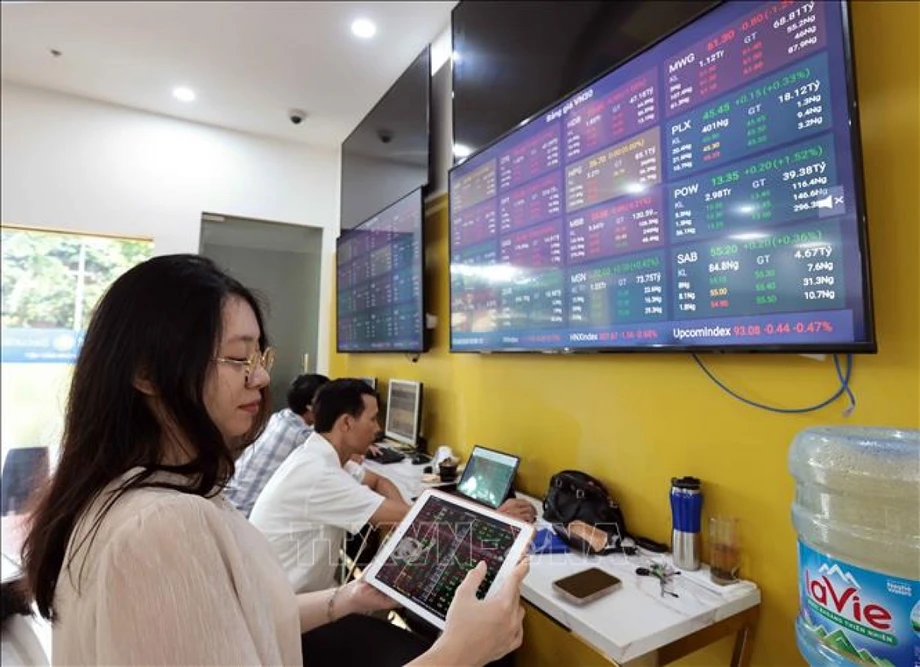
Tran Nhan Tông Street in Hanoi, where several major gold brands operate, became busy again after quiet trading during the previous weekend. The rebound coincided with discounts on jewelry at a number of brands as shops promoted sales near the end of the year. Customer traffic therefore included jewelry shoppers as well as people responding to rising bullion quotes. No citywide total for transaction volume was released.
For households, the practical choice depended on the product and the dealer's terms. A ring at Phu Quy carried a 4 million dong spread at the close, compared with 7 million dong for an SJC bar at Bao Tin Minh Chau's earlier evening quote. Those differences could outweigh several hours of price gains, especially for anyone expecting to sell quickly.
The next dates and price levels to watch
Gold remained below $4,000 an ounce, a level it has not regained since November 11, and was heading toward a third consecutive monthly decline. The technical picture also remained fragile. The relative strength index, a momentum measure running from zero to 100, was around 39, below the neutral mark of 50. Prices also remained beneath average levels calculated over 21, 100 and 200 days.
The first resistance area was $3,700, meaning a level where selling could slow the advance. The average price over 21 days stood near $3,833, while the averages over 100 and 200 days were $4,154 and $4,374. On the downside, support was identified at $3,500 and then near Wednesday's low of $3,427. A sustained fall below that low would expose the market to another decline.
Several dated events now frame the outlook. OPEC and its partners meet on November 29. US job openings and the manufacturing purchasing managers index are due on Tuesday, December 1, followed by the services index on Thursday, December 3. The main US employment report is scheduled for Friday, December 4, ahead of the Fed meeting on December 8 and 9.
Strong employment figures could reinforce expectations of tighter policy and pressure gold. Weaker labor data could reduce those expectations and give bullion more room to recover. For Vietnamese buyers, the domestic premium, the dollar and each shop's buying spread will remain just as consequential as the international headline price.
The Bottom Line
- Spot gold rebounded from Wednesday's $3,427 low and reached $3,683.58 in a later Friday reading, up 3.22%.
- SJC and DOJI gold bars closed at 131 million dong to buy and 136 million to sell per tael on November 27.
- SJC rings closed at 130.8 million to 135.8 million dong, with the buying price up 2.5 million dong from early morning.
- The converted world gold price was about 21.1 million dong below SJC's afternoon selling quote before taxes and fees.
- Dealer spreads reached as much as 7 million dong per tael, exceeding the day's domestic price increase.
- US inflation of 3.3% and revised third quarter growth of 4.3% strengthened expectations of a Fed rate increase in December.
- US employment data on December 4 and the Fed meeting on December 8 and 9 are the next major tests for the recovery.