A December checkpoint for the chain
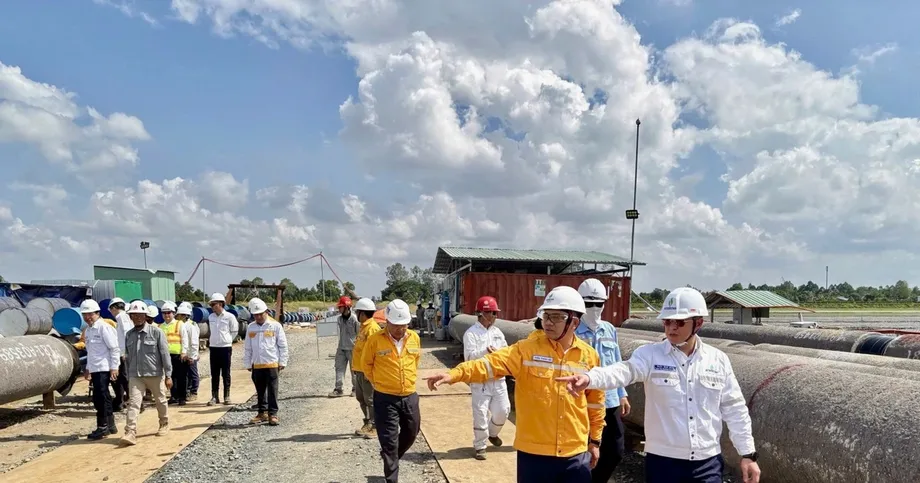
Petrovietnam leaders inspected three sites in Can Tho on November 17, led by Tran Binh Minh and Vu Dao Minh. Tran Binh Minh is a member of Petrovietnam's Board of Members and head of the steering committee for the Block B–O Mon gas to power chain; Vu Dao Minh is a deputy general director. They visited the TTC20B pipeline construction site in Dong Thuan commune, the O Mon Gas Distribution Centre and the O Mon IV thermal power plant site. They then held a steering committee meeting at the O Mon gas distribution centre to press for faster work and closer coordination.
Contents
- A December checkpoint for the chain
- What the inspection team saw in Can Tho
- The pipeline that carries gas from sea to shore
- A timeline of milestones
- Who is building the offshore route
- O Mon 4 turns gas into electricity
- What must be fixed before December 2026
- Vietnamese fabrication reaches the floating system
- Turbines widen the O Mon buildout
- What changes for the Mekong Delta
- A wider test of Petrovietnam's execution
- Key Points
The Block B–O Mon chain stretches from offshore gas fields to pipelines, gas distribution facilities and power plants in the Mekong Delta. For a household or factory in southwestern Vietnam, the project is meant to do something simple but difficult: take gas from fields under the sea, move it safely through a pipeline and turn it into electricity near where people live and work. Petrovietnam calls the chain vital to national energy security and to its growth from 2026 to 2030.
The timetable is tight. The whole chain is aiming for first gas in late August 2027 to supply the O Mon power plants, with additional gas for the Ca Mau Gas–Power–Fertiliser Complex expected in early 2028. Petrovietnam's company statement puts the wider first gas target at Q3 2027, the quarter that includes late August. An October 2024 directive from the Prime Minister asked Petrovietnam and Vietnam Electricity to prepare for first gas in 2026, so the schedule has moved while the physical work has accelerated.
What the inspection team saw in Can Tho
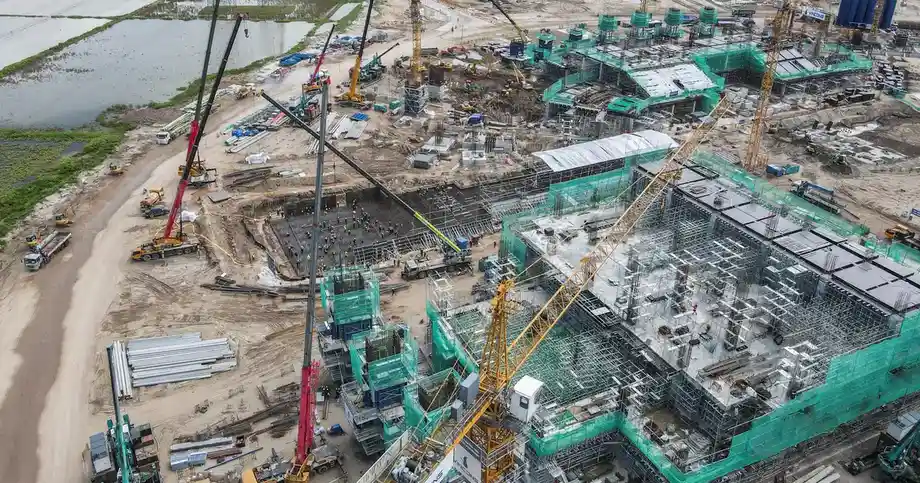
The TTC20B worksite in Dong Thuan commune gave the delegation a ground view of pipeline work in the Can Tho area. The route includes onshore sections that must be joined smoothly to offshore sections. A gap at the shore, a canal crossing or a land access dispute can hold up a line that is designed to operate as one continuous system.
The O Mon Gas Distribution Centre is where gas can be received, measured, controlled and sent onward. O Mon IV is the end user in this part of the chain: a plant that will burn gas to make steam and drive a generator. At the meeting, Phu Quoc Petroleum Operating Company (PQPOC), Southwest Pipeline Operating Company (SWPOC), Power Project Management Board (PVPMB), Petrovietnam Exploration Production Corporation (PVEP), Petrovietnam Gas Corporation (PV GAS) and Petrovietnam Technical Services Corporation (PTSC) discussed progress against schedules, difficulties and proposed fixes.
The pipeline that carries gas from sea to shore
The Block B–O Mon gas pipeline is about 431 km long, connecting offshore production facilities with power plants in the southwestern region. It is often rounded to about 430 km. Its job is to bring gas from Block B fields off southwest Vietnam to the mainland. In 2026, the project entered a peak construction phase, with the onshore route, offshore route and associated stations built according to plan.
More than 100 km of onshore pipeline crosses Ca Mau, Kien Giang and Can Tho. Compensation and land clearance have been carried out on a rolling schedule so work can continue from shore to sea. The investment estimate for the pipeline project in the 2021 to 2025 period is USD 283.48 million. The onshore EPC package, signed in December 2023 with a joint venture of PTSC and Lilama 18, had reached 18 percent completion by the end of the first quarter of 2025; no updated percentage was given at the November inspection.
A timeline of milestones
The main milestones now shape the schedule.
- December 2023: The onshore EPC package was signed with a joint venture of PTSC and Lilama 18; it was 18 percent complete by the end of the first quarter of 2025.
- June 6, 2025: The EPC contract for O Mon 4 was signed with Doosan Enerbility and Power Engineering Consulting JSC 2.
- June 30, 2025: SWPOC signed the PC1 and PC2 offshore pipeline contracts in Ho Chi Minh City.
- November 17, 2026: Petrovietnam inspected TTC20B, the O Mon Gas Distribution Centre and the O Mon IV site.
- November 19, 2026: Mitsubishi Power announced two M701JAC turbines for O Mon 3.
- November 25, 2026: PTSC POS completed the Block B Turret for connection to a floating storage vessel.
- December 2026: CPP equipment delivery, LQ platform work, land leasing and pipeline crossing points are due to match the plan.
- Late August 2027 or Q3 2027: First gas is targeted for the O Mon plants.
- Early 2028: Additional gas is expected for the Ca Mau Gas–Power–Fertiliser Complex.
- December 2028: O Mon 4 commercial operation is targeted.
- 2030: O Mon 3 is scheduled for completion in Mitsubishi Power's plan.
Who is building the offshore route
Southwest Pipeline Operating Company signed the PC1 and PC2 pipeline contracts on June 30, 2025 in Ho Chi Minh City. PC1, the shallow water package, went to a joint venture of Vietsovpetro and Thien Nam Offshore. It covers nearly 80 km of 28 inch pipeline, 38.5 km of 18 inch pipeline, the connection at point KP213 and precommissioning support. PC2, the deepwater package, went to a joint venture of Vietsovpetro, TIMAS and Tan Cang Offshore Services. It covers 213 km of 28 inch deepwater pipeline, from fabrication and installation to connection and handover.
The contract pieces add up to roughly the full route: nearly 80 km plus 38.5 km plus 213 km offshore, and more than 100 km onshore. Vietsovpetro brings more than 40 years in oil and gas and offshore construction. Thien Nam Offshore has nearly 15 years in infrastructure work, including Nam Con Son 2 Phase 2 and Dai Hung. TIMAS has completed more than six offshore pipeline projects totaling over 300 km, while Tan Cang Offshore Services contributes a marine fleet and subsea survey capability.
O Mon 4 turns gas into electricity
O Mon IV, also written O Mon 4, is the clearest downstream piece of the chain. Petrovietnam signed the EPC contract on June 6, 2025 with a joint venture of South Korea's Doosan Enerbility and Vietnam's Power Engineering Consulting Joint Stock Company 2. EPC means engineering, procurement and construction: the contractor designs the plant, buys equipment and builds it. The plant will use combined cycle gas turbine technology with a designed capacity of 1,155 MW and is expected to operate in December 2028, matching the late 2028 target given during the inspection.
In a combined cycle plant, a gas turbine burns fuel first and the hot exhaust makes steam for a second turbine, raising efficiency. Petrovietnam has said the plant will lift its installed capacity to over 93,000 MW, about 10 percent of Vietnam's power capacity. The project faced delays for nearly two decades. In 2023, the Prime Minister assigned Petrovietnam to lead O Mon 3 and O Mon 4 so downstream plants would be synchronized with upstream gas supply.
What must be fixed before December 2026
Tran Binh Minh praised project management units and contractors across the upstream, midstream and downstream segments. He then set a practical agenda. Upstream work must accelerate delivery of equipment for the central processing platform (CPP) and progress on the living quarters (LQ) platform. The CPP treats gas before export; the LQ platform provides accommodation for workers offshore. Both must be ready if first gas is to become a steady flow rather than a one day event.
For the midstream segment, Tran Binh Minh focused on the onshore pipeline under the onshore EPC contract, especially land leasing for construction and the handling of pipeline crossing points. A crossing point is a place where the line passes a road, canal or utility, so it needs safe design and access during construction. The steering committee did not give a count of unresolved land leasing issues or crossing points. It set December 2026 as the month by which these items should match the plan. Contractors were told to finish the 2026 plan in the remaining weeks and prepare conditions for key milestones in 2027.
Vietnamese fabrication reaches the floating system
On November 25, 2026, PTSC POS completed manufacture, precommissioning and handover of the Block B Turret for the chain operated by PQPOC. A turret sits on a floating storage and offloading vessel, often called an FSO, and lets the vessel rotate 360 degrees around its mooring point as wind, waves and currents change. Precommissioning means checking that the equipment is ready before it is passed to the customer.
PTSC POS made and precommissioned both the Lac Da Vang turret in 2025 and the Block B turret in 2026 in Vietnam. The Block B system travelled more than 2,000 nautical miles from a petroleum and renewable energy services port to Nantong Strongwind Port in China for connection to the FSO. Earlier in 2025, Nghiem Thuy Lan, head of the oil and gas labour union, set a target of the end of 2025 for the CPP, living quarter platform and infield pipeline, plus a November 30 deadline for seismic work. Le Ngoc Son, Petrovietnam's general director at the time, said those efforts would help meet first gas and support energy security.
Turbines widen the O Mon buildout
Mitsubishi Power announced on November 19, 2026 that it will supply two M701JAC gas turbines to the 1,155 MW O Mon 3 plant in Can Tho. Petrovietnam awarded the EPC contract for O Mon 3 to a consortium of Doosan Enerbility and PTSC, and Doosan contracted Mitsubishi Power for the turbines. The schedule now puts O Mon 3 completion in 2030, while O Mon 3 was once listed for 2027.
The deal follows an August 2025 agreement to supply two M701JAC turbines for O Mon 4, giving Mitsubishi Power four units across O Mon 3 and O Mon 4. The company also announced a November 2025 contract to support conversion of O Mon 1 from oil to natural gas. JAC turbines are air cooled gas machines used in combined cycle plants; Mitsubishi Power says the type has combined cycle efficiency above 64 percent and more than 3.7 million operating hours worldwide.
Akihiro Ondo, CEO and managing director of Mitsubishi Power Asia-Pacific, said the two turbines for O Mon 3 build on the company's work at O Mon 4. He framed the four units as part of Vietnam's energy and economic development and praised cooperation with Petrovietnam and partners.
We are honoured to bring our advanced JAC gas turbine technology to O Mon 3, building on our involvement in O Mon 4. The four units to be supplied across these two power plants reflect our continued commitment to Vietnam's energy and economic development. We look forward to working closely with Petrovietnam and our partners to ensure the successful delivery of the project and contribute to world-class reliability and efficiency.
The turbine timetable means O Mon 4 and O Mon 3 will feed the same gas chain on different schedules, with O Mon 4 due in 2028 and O Mon 3 in 2030.
What changes for the Mekong Delta
The O Mon complex has four plants and a designed capacity of 3,810 MW. O Mon 1 already operates but not with Block B gas. O Mon 2, O Mon 3 and O Mon 4 were once described for starts in 2026, 2027 and 2028; the current turbine schedule puts O Mon 3 in 2030, and O Mon 4 remains tied to December 2028. The first Block B gas will therefore serve plants and consumers able to take it in 2027 and early 2028 while the wider O Mon buildout continues.
The wider chain is designed to supply roughly 5 billion cubic metres of gas a year and about 22 billion kWh of electricity annually. Gas output is also put at 5.06 billion cubic metres a year. The early flow target of 16.3 to 18 million cubic metres per day is a rate for first gas, while the annual number describes expected deliveries over the life of the project. Block B is Vietnam's second largest upstream gas project after Blue Whale, with shareholders including Petrovietnam, Petrovietnam Exploration and Production, Mitsui Oil Exploration and PTT Exploration and Production.
A wider test of Petrovietnam's execution
Petrovietnam's president and CEO Le Manh Cuong said in the company statement that the chain is valued at nearly USD 12 billion and will bring ashore roughly 5 billion cubic metres of natural gas a year to fuel around 3,800 MW in the Mekong Delta. He presented the project as proof that an integrated company can turn resources into power, from offshore fields to subsea pipelines and generation complexes. The statement also notes Petrovietnam placed 11th in the 2026 Fortune Southeast Asia 500, with assets approaching VND 1,200 trillion, and aims to enter the world's 500 largest companies before 2030 under Politburo Resolution No. 79-NQ/TW.
The CEO said Middle East crude supply disruptions tested the group in 2026. Petrovietnam kept the Dung Quat and Nghi Son refineries running at up to 125 percent of design capacity and met more than 70 percent of Vietnam's fuel demand. Within ten months, revenue and profit before tax passed annual targets. About 41 percent of the revenue increase came from prices, with the rest from higher output, expanded market share and new products and services.
Petrovietnam recorded six domestic oil and gas discoveries in ten months, matching the total for 2021 to 2025. October 2026 marked the 18th consecutive month of gains in domestic crude output compared with a year earlier, after an 11 year decline. Overseas, the group won the EPIC-1 package at the Maydan Mahzam field, worth more than USD 3 billion, and was selected to fabricate more than 60 modules totaling 18,500 tons for the Commonwealth LNG project in Louisiana. Those wins build on more than USD 10 billion of products and services delivered to international markets and the entry of Nhon Trach 3 and 4, Vietnam's first power plants powered by LNG, into commercial operation. Taken together, the figures show why the group is pressing contractors now: Block B is both an energy project and a test of Petrovietnam's ability to deliver several large programmes at once.
Le Manh Cuong, Deputy Secretary of the Party Committee, Member of the Board of Members, President and CEO of Petrovietnam, said the group's history spanning 65 years rests on skills built by its workforce. He said young engineers entering the company will steward Block B gas flows, plants powered by LNG and offshore wind work for decades, and he thanked nearly 60,000 officials, engineers and workers. He linked the corporate push to a simple lesson from 2026:
energy security is national security, and resilience must be forged during times of normalcy.
Key Points
- Petrovietnam inspected TTC20B, the O Mon Gas Distribution Centre and the O Mon IV site on November 17.
- First gas is targeted for late August 2027 or Q3 2027, with extra gas for Ca Mau in early 2028.
- The 431 km pipeline links offshore Block B gas to power plants in southwestern Vietnam.
- December 2026 is the checkpoint for CPP equipment delivery, LQ platform work, land leasing and pipeline crossings.
- O Mon 4 is a 1,155 MW combined cycle plant due in December 2028.
- Mitsubishi Power will supply four M701JAC turbines across O Mon 3 and O Mon 4, with O Mon 3 scheduled for 2030.