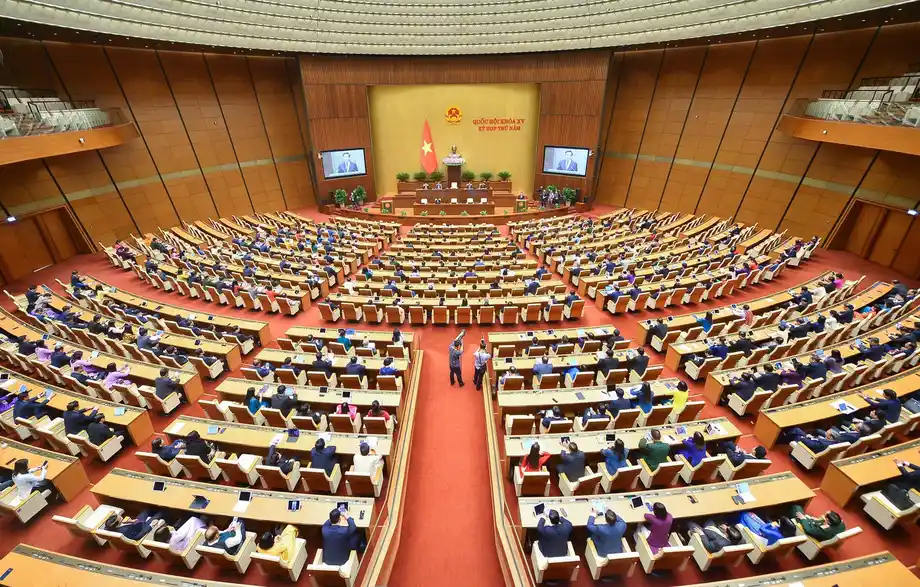
National Assembly Approves Comprehensive Land Law Revisions
Vietnam took a major step toward modernizing its legal framework on November 21, 2026, when the National Assembly passed sweeping amendments to the country's land laws. Lawmakers voted overwhelmingly in favor of the legislation, with 466 out of 479 participating deputies casting affirmative votes, representing 95.99 percent of the legislature. The newly approved Land Law revisions span 13 chapters and 112 articles, designed to streamline site clearance procedures, attract investment, and accelerate infrastructure development. The broader legislative push supports Vietnam in its economic target of achieving high-income status by 2045, addressing longstanding bottlenecks that have delayed major industrial and public works projects across the country.
Contents
- National Assembly Approves Comprehensive Land Law Revisions
- Accelerated Land Recovery for Priority Infrastructure Projects
- New Livelihood Restoration and Compensation Guarantees
- Overhauling Land Valuation and Market Transparency
- Expanding Legal Recognition for Undocumented Land
- Timeline of Legislative Implementation and Key Milestones
- At a Glance
Implementation of the new legislation is scheduled to occur in stages to allow authorities and citizens time to adapt. Most provisions of the revised land law will take effect on July 1, 2027, replacing the previous framework enacted in 2024. Meanwhile, a completely overhauled land pricing mechanism and new adjustment rates will become applicable starting January 1, 2028. These reforms arrive as the Southeast Asian nation pursues aggressive double-digit economic growth and invests heavily in national infrastructure, aiming to balance rapid development with enhanced protections for displaced property owners.
Agricultural land and major urban projects are expected to see the most immediate impact from the legislative updates. In recent years, site clearance disputes have frequently stalled large-scale developments due to discrepancies between state-offered compensation and prevailing market values. The legislative package attempts to resolve these tensions by granting local authorities greater management powers while introducing structured safeguards for affected residents. Speaking about the technical design of the legislation, Chris Luong, a partner at CNC Counsel, explained how the new framework balances competing priorities.
From a technical standpoint, the provision appears designed to facilitate timely implementation of priority projects while retaining procedural safeguards.
Accelerated Land Recovery for Priority Infrastructure Projects
Under previous regulations governed by older legal articles, local governments were required to fully finalize and approve detailed compensation, support, and resettlement plans before initiating any land acquisition. The newly passed legislation introduces a notable exception to this sequence for specific categories of high-priority developments. Authorities may now issue formal land acquisition decisions before compensation plans receive final approval, provided the project does not require physical household relocation and the proposed compensation terms have been publicly disclosed.
This expedited clearance mechanism is strictly limited to nationally important infrastructure projects, urgent public investment initiatives, and developments that secure formal consensus from more than 75 percent of the affected land users. Government officials emphasize that this rule is crafted to prevent individual holdouts from indefinitely paralyzing projects that serve the broader public interest. Provincial People Councils retain the authority to determine whether specific proposals meet the stringent criteria required for compulsory acquisition under these accelerated terms.
Agricultural landholders will experience the most pronounced operational changes under the faster clearance process. Rural property acquisitions typically involve fewer residential relocations than urban housing developments, making them prime candidates for early clearance protocols. At the same time, the Ministry of Agriculture and Rural Development has overseen the restructuring of land categories to simplify administrative procedures. The new framework consolidates agricultural land into streamlined groups, allowing farmers to convert land uses within the same agricultural category without navigating complex bureaucratic approval processes.
New Livelihood Restoration and Compensation Guarantees
To address historical grievances surrounding inadequate compensation, the revised legislation explicitly shifts the state philosophy away from merely compensating physical assets toward actively reconstructing the livelihoods of affected citizens. When the state acquires residential land for public or socioeconomic development, displaced residents are entitled to a wider array of compensation options. The primary method involves receiving replacement land or housing of equivalent use, but the law also permits compensation in different land categories or commercial properties if local land funds permit.
Financial compensation remains available if property owners decline alternative land or housing, or if local authorities lack suitable replacement plots, though cash payouts are restricted in certain residential cases. Furthermore, the legislation establishes mandatory livelihood support mechanisms lasting at least three years following an acquisition decision. Local commune authorities must conduct annual income surveys and fund vocational training programs to ensure displaced workers regain their financial footing. For families with lingering difficulties, the state provides temporary housing and permits deferred payments for new resettlement land allocations.
Property owners also gain protection against bureaucratic delays through strict financial penalties imposed on slow-paying agencies. If government bodies miss the disbursement deadlines specified in approved compensation plans, they must pay additional fees calculated using the tax arrears formula defined in Vietnam tax management regulations. Additionally, provincial authorities must ensure that all technical and social infrastructure within designated resettlement areas is fully operational before executing physical displacement procedures.
Overhauling Land Valuation and Market Transparency
Valuation procedures governing property acquisitions will undergo a fundamental transformation when the new land pricing mechanism takes effect on January 1, 2028. Historically, discrepancies between official state price lists and fast-rising market values fueled widespread public discontent and legal disputes. The updated framework mandates data-driven, transparent pricing models designed to reflect actual market conditions while preventing artificial price inflation and land speculation.
Provincial People Councils will take charge of issuing local land price lists and adjustment coefficients, updating them every three years based on infrastructure improvements, zoning changes, and localized economic factors. When calculating compensation payouts, the law requires authorities to apply whatever land or asset valuations prove most advantageous to the displaced property owner. Real estate transactions will simultaneously face tighter regulatory oversight, requiring notarization for key property contracts under guidelines coordinated by the Ministry of Justice and implemented ahead of schedule on January 1, 2028.
Developers holding idle land or failing to execute approved projects within specified timelines will face financial penalties under newly introduced punitive provisions. The legislation mandates additional land use and rental fees specifically targeting the uncompleted portions of delayed commercial projects. These financial encumbrances will accumulate continuously until the respective developers either resume active construction or face formal termination of their investment certificates under national regulatory statutes.
Expanding Legal Recognition for Undocumented Land
Resolving long-standing ownership ambiguities represents another cornerstone of the legislative reform, offering a pathway to legal recognition for millions of households currently holding undocumented property. Families utilizing land without formal paper certificates can now apply for official red books, provided they occupied the plots continuously prior to July 1, 2014, and the usage conforms to local zoning plans. This provision directly targets historical administrative backlogs where properties changed hands informally over decades without formal registration.
The legal amnesty extends to land parcels transferred through private agreements before August 1, 2024, even if the previous owners never completed the mandatory transfer paperwork. Property owners facing boundary disputes may still secure official certification for the undisputed portions of their land, provided those segments meet minimum subdivision size requirements. Furthermore, first-time applicants receiving property titles are granted the legal right to defer payment of land use fees if they experience financial hardship.
Unintended land use violations committed before July 1, 2014, are similarly eligible for regularization if they comply with current municipal planning guidelines. For infractions occurring between that date and the enactment of the new rules, applicants must satisfy strict environmental, national security, and structural safety criteria. These administrative pathways aim to bring informal real estate transactions into the formal economy, reducing civil litigation and securing legal certainty for ordinary citizens.
Timeline of Legislative Implementation and Key Milestones
The rollout of Vietnam's updated land framework follows a structured implementation calendar across 2026 and subsequent years. Reviewing the legislative timeline clarifies when specific regulatory changes become operational for citizens and investors alike.
- November 17, 2026: Ministry of Agriculture and Rural Development outlines farmer protection measures and agricultural land consolidation plans at a national agricultural forum.
- November 21, 2026: National Assembly passes the comprehensive Land Law revisions with 466 affirmative votes during its second session.
- January 1, 2027: Revised notary law provisions take effect, mandating stricter legal validation for major property transactions under Ministry of Justice oversight.
- July 1, 2027: The core provisions of the amended Land Law, Housing Law, and Real Estate Business Law officially take effect, replacing previous regulatory frameworks.
- January 1, 2028: New data-driven land pricing mechanisms, updated provincial price lists, and revised adjustment coefficients become fully applicable nationwide.
At a Glance
The revised land administration framework introduces profound structural changes designed to accelerate national development while attempting to safeguard citizen property rights. The following points summarize the essential developments:
- The National Assembly approved the comprehensive land law amendments on November 21, 2026, with an overwhelming 95.99 percent approval rating among voting deputies.
- Accelerated land acquisition permits early site clearance before compensation plan approval, strictly for nationally critical projects or developments backed by more than 75 percent of local users.
- Displaced property owners are guaranteed mandatory livelihood restoration support spanning at least three years, alongside expanded options for land-for-land or commercial property compensation.
- Brand new land valuation mechanisms managed by provincial authorities will replace legacy price lists starting January 1, 2028, ensuring compensation calculations favor property owners.
- Undocumented land plots occupied prior to July 1, 2014, and uncompleted private property transfers executed before August 1, 2024, qualify for formal red book certification.