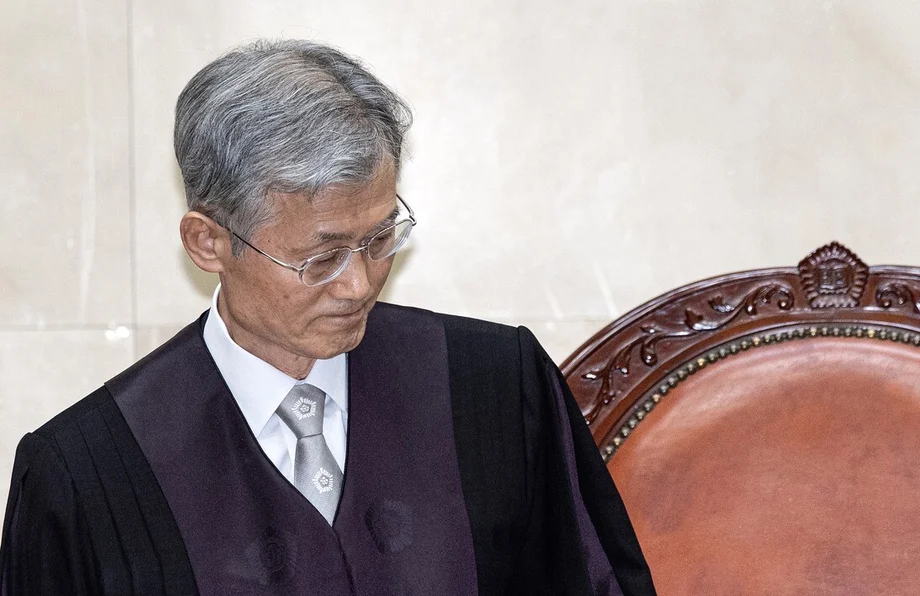
A 9 to 3 Decision, 716 Days After Martial Law
South Korea's Supreme Court on November 19, 2026, issued its first judgment on an insurrection charge arising from the December 3, 2024, martial law declaration. The full bench voted 9 to 3 to quash the guilty portion of former Prime Minister Han Duck-soo's appeal judgment and return case 2026Do7341 to the Seoul High Court. The decision came 716 days after troops and police were deployed around the National Assembly.
Contents
- A 9 to 3 Decision, 716 Days After Martial Law
- What the Court Actually Sent Back for Retrial
- Why 27 Minutes Mattered to the Majority
- Why the Dissent Called It a Coup by the Incumbent
- Did the Majority Recognize December 3 as an Insurrection?
- A Strict Intent Test Reaches Other Courtrooms
- Seventy Five Defendants and a Crowded Trial Calendar
- A Perjury Acquittal Adds a Contradiction Claim
- Judges Question the Reasoning as the Public Divides
- Impeachment Politics Cannot Erase the Precedent
- The Cabinet Duty at the Center of the Retrial
- Key Points
Han had received 23 years in prison from the Seoul Central District Court on January 21, 2026, eight years more than prosecutors requested, followed by 15 years on appeal. Justice Oh Kyung-mi was responsible for presenting the Supreme Court case. Chief Justice Cho Hee-dae and eight other justices formed the majority, while Oh, Shin Sook-hee and Kim Sung-soo dissented.
The majority separated the legality of martial law from Han's personal criminal responsibility. Its description of the declaration itself was unequivocal:
No national emergency had occurred, nor was it remarkably difficult to carry out administrative and judicial functions. Nevertheless, the declaration was made without substantial Cabinet deliberation, an essential constitutional procedure, and with the intention of taking control of the National Assembly and media outlets by mobilizing the military and police. It is contrary to the constitutional order and infringes the people's basic rights, and there is no room for doubt that it is unconstitutional and illegal in itself.
For Han, however, the court required strict proof that he possessed the purpose of subverting the constitutional order at the time of each act. That distinction shaped everything that followed.
What the Court Actually Sent Back for Retrial
The charges divided Han's conduct into three groups:
- Before the declaration, recommending a Cabinet meeting and checking whether enough ministers had arrived to create the appearance of deliberation.
- After the declaration, pressing Cabinet members to sign documents connected with martial law.
- Discussing with Interior and Safety Minister Lee Sang-min how to implement blockades of major institutions and cut electricity and water to selected media outlets.
The majority found the evidence insufficient to establish the required purpose for the first group. For the second and third, it said there was ample room to recognize that purpose. It did not simply affirm two convictions and acquit Han on the third. Its order quashed the entire guilty portion of the appeal judgment because the first group could not be separated from the others for sentencing. They were connected as one offense or as concurrent offenses under the first part of Article 37 of the Criminal Act.
The Seoul High Court must now state clearly in its criminal findings whether the required purpose existed for the later acts, decide the insurrection charge again and determine a sentence. The Supreme Court left the appellate treatment of the false martial law proclamation, presidential records offenses and the perjury finding concerning Han's denial that he had received martial law documents undisturbed in its reasoning. Those allegations included Han signing a document prepared after the event by former presidential aide Kang Eui-gu, alongside Yoon Suk Yeol and former Defense Minister Kim Yong-hyun, and later requesting its disposal.
The ruling also answered the approaching detention deadline. Han's Supreme Court custody period had been due to expire at midnight on November 20. His detention was extended by two months. Rule 57, Paragraph 2 of the Criminal Procedure Rules allows detention periods to be applied and renewed again after a case is remanded.
In a separate full bench judgment that day, the court confirmed four years in prison and a fine of 50 million won for Kim Keon-hee over the three allegations involving Deutsch Motors shares, opinion polls and Unification Church gifts. Convictions on stock manipulation and church gifts stood. Ten justices concluded that receiving poll results free of charge was insufficient by itself to establish receipt of political funds, while Oh and Kim Sung-soo dissented on part of that issue.
Why 27 Minutes Mattered to the Majority
Yoon initially planned to declare martial law at 10 p.m., according to the majority's findings. Han's recommendation that a Cabinet meeting was necessary contributed to a delay, and the declaration came at about 10:27 p.m. As ministers gathered, some urged Yoon to reconsider. The majority therefore said Han's recommendation had delayed swift execution and created an opportunity for objections.
A prime minister asking a president to follow the Constitution and Martial Law Act would ordinarily be performing a proper official duty, the court reasoned. Knowledge that the proposed declaration was unconstitutional was not enough by itself to establish an intention to subvert the constitutional order. The evidence also left room to doubt whether Han knew the concrete execution plan or intended from the outset to manufacture only an appearance of legality. The majority even accepted that he had expressed moderate opposition in his own manner during a short and urgent period.
Why the Dissent Called It a Coup by the Incumbent
Justices Oh, Shin and Kim occupied more than half of the 59 page judgment with their dissent. They agreed with the majority's general formulation of the intent test but rejected its application to Han. Their opening description of December 3 used language the majority avoided:
The declaration of emergency martial law in this case, the issuance of the decree, and a series of acts including the deployment of armed soldiers and police to seal off the National Assembly have the character of insurrection as a self-coup, in which the incumbent ruler uses state power to neutralize constitutional controls over himself.
The dissent said Han had received Yoon's address, decree and related instructions at least one to two hours before the declaration. His recommendation for a meeting, requests for signatures and discussions about utility cutoffs occurred in a continuous flow at the same place. Dividing them at the exact declaration time, the three justices argued, artificially detached the opening conduct from everything that followed.
A coup led by an incumbent also arrives through meetings, signatures, orders and reports rather than through armed force alone. Official procedure can therefore become part of the takeover. The dissent recalled Cabinet meetings during the 1952 Busan political crisis, the 1972 October Yushin and the nationwide expansion of martial law on May 17, 1980, saying those bodies supplied procedural cover for unconstitutional power.
The three justices further invoked the Supreme Court's 1997 judgment against Chun Doo-hwan and Roh Tae-woo. That judgment treated outwardly lawful Cabinet approval and presidential proclamation as insurrectionary violence when used as means to subvert the constitutional order. Their argument was that the substance of an official's contribution must matter more than the lawful appearance of the paperwork.
Did the Majority Recognize December 3 as an Insurrection?
The wording has produced two sharply different readings. Democratic Party Representatives Noh Jong-myeon and Lee Yong-woo, deputy heads of the party's impeachment task force, argued that the majority decided only one element of the offense. Noh said the phrase ample room to recognize left Han's purpose as a question mark, while Lee objected that the judgment contained no separate ruling on whether a riot had occurred.
Other passages cut in the opposite direction. The majority referred to Yoon and others' insurrection acts while recounting the case. On page 20, it stated that the core execution acts of insurrection, including mobilizing troops, deploying them to the National Assembly and issuing the decree, followed plans made in advance by Yoon, Kim Yong-hyun and others, independently of Cabinet deliberation. Justice Kwon Young-jun read a passage in court describing the attempt to paralyze the Assembly as proceeding to insurrectionary acts.
Lawyer Yang Hong-seok said that such language from a full bench amounted to an intention to recognize guilt on the later acts, subject to the retrial supplying the necessary findings. The riot element also had not been a live Supreme Court dispute because Han had not contested it since his first trial. The special counsel investigating the insurrection accordingly called the judgment the first decision firmly establishing that December 3 was an insurrection.
The most precise reading lies between a final conviction and an acquittal. Both lower courts had called the declaration an insurrection. The Supreme Court repeated facts and used language consistent with that finding, but its operative decision returned Han's individual liability to the Seoul High Court.
A Strict Intent Test Reaches Other Courtrooms
The judgment states that a defendant must at least recognize the possibility of subverting the constitutional order, aim toward its realization and, at minimum, be willing to accept that result. Judges must consider the defendant's authority, relationship with the insurrection leader, assigned duties, awareness, statements, conduct and the surrounding circumstances. Critics say this formulation raises the threshold after investigations and prosecutions were already under way. The dissent accepted the wording but disputed the majority's decision to assess each point in time separately.
Former Colonel Kim Hyun-tae's lawyers put that reasoning to work seven days later. Kim, the former commander of the Army's 707th Special Mission Group, received 12 years in prison in August for his role in the deployment to the National Assembly. At his second appeal hearing on November 26, his counsel argued that following instructions from the Special Warfare commander deserved the same presumption of regular official duty that Han received for recommending a Cabinet meeting.
The defense said Kim had not plotted martial law in advance or known about the declaration, and that each alleged act required separate proof of purpose. It asked the Seoul High Court to stop the trial until Yoon's insurrection case became final and to release Kim. The appeal panel had already rejected both bail and cancellation of his detention.
The same judgment could cut differently for Lee Sang-min. The majority placed discussions about blockading institutions and cutting power and water after the declaration and found ample room to recognize Han's purpose. Lee's own insurrection case remains before the full bench, making its treatment of that conduct especially consequential.
Seventy Five Defendants and a Crowded Trial Calendar
A count of court records and indictments as of November 22 found 75 people prosecuted over December 3. The group included 32 from the military or Defense Ministry, 16 officials from agencies including the police, prosecution, intelligence service and fire authorities, 13 from the presidency or presidential office, six Cabinet members, six politicians and two civilians.
Because some defendants face several cases, the count produced 95 prosecutions. Forty were at first instance, 38 at appeal, seven at the Supreme Court and one at remand, while nine had become final. None of the finalized cases involved an insurrection conviction. Fifty three defendants faced insurrection offenses, meaning Han's remand left 52 others whose trials would proceed under the standards discussed by the full bench.
Thirteen insurrection defendants had already been acquitted at first instance. They included eight military officers cleared on October 30 in the case known as the hamburger meeting, after the court found insufficient proof of the required purpose. Separately, former Justice Minister Park Sung-jae's sentence fell from 25 years to nine on appeal, with an instruction to cooperate with a prosecution request described as too general to sustain one conviction.
The next scheduled decisions are:
- November 30, 2026: sentencing for two fire agency commanders.
- December 24, 2026: first instance sentencing for four officers from the Joint Chiefs of Staff and martial law command.
- January 26, 2027: appeal sentencing for Yoon Suk Yeol and seven others.
- No date has been announced for Han's remand hearing or for the full bench decision in Lee Sang-min's case.
A Perjury Acquittal Adds a Contradiction Claim
On November 26, the Supreme Court's First Division, with Justice Ma Yong-ju responsible for the case, finalized Yoon's acquittal of perjury over testimony that he had planned to convene the Cabinet before declaring martial law. The judgment treated that account as falling within his subjective understanding.
Critics immediately set it beside the Han ruling. The full bench had found that Yoon planned a 10 p.m. declaration, that Han's Cabinet recommendation contributed to a delay, and that Yoon had indicated a Cabinet meeting was unnecessary because martial law was an exercise of supreme governmental authority. Democratic Party chief spokesperson Park Sung-joon called the two outcomes an absurd double standard. Rebuilding Korea Party spokesperson Lim Myung-hee and the civic group People's Solidarity for Participatory Democracy also said the accounts could not comfortably coexist.
Yoon's lawyers celebrated the acquittal. Attorney Kim Kye-ri thanked the special counsel for supplying an opportunity to litigate the facts, while Bae Eui-cheol called the prosecution account fiction. Fellow lawyer Song Jin-ho went further and suggested that the decision offered some recognition of martial law's legitimacy.
Judges Question the Reasoning as the Public Divides
Song Seung-yong, a senior judge at the Seoul Central District Court with nearly 25 years on the bench, posted excerpts on the judiciary's internal CourtNet network and said parts of the majority opinion were difficult to interpret. He noted that Supreme Court decisions commonly endorse the lower court's stated reasons, whereas this judgment used only the ample room formulation for the acts after the declaration.
If a ruling is hard to understand even for someone who has been a judge for nearly 25 years, can ordinary citizens really understand what it means?
Song also wondered why November 19 changed from a planned deliberation date into the judgment date, suggesting that delay, public criticism and the custody deadline might have influenced the timing. He later acknowledged that this part of his account was speculation based on the circumstances. Changwon District Court senior judge Lee Bong-soo said he shared the questions and found the court's caution puzzling in an insurrection case.
Other judges defended the decision. Seoul Central District Court senior judge Choi Nu-rim said definitively recognizing Han's purpose at the final appeal would create legal problems when that purpose had not been stated in the lower court's criminal findings. Suwon District Court senior judge Yang Si-ho said the majority had instead guided the remand court to add those findings. Their disagreement concerns a basic division of labor: appeal courts review law, while trial courts establish the facts.
A Korea Gallup survey of 1,000 adults conducted from November 24 to 26 found that 46 percent considered Han's remand a wrong judgment and 31 percent considered it right, with 23 percent withholding an opinion. Among progressives, 74 percent called it wrong; among conservatives, 52 percent called it right. Moderates split 48 percent against and 29 percent in favor.
The same poll found that 57 percent considered December 3 an insurrection and 31 percent did not. The share calling it insurrection had fallen from 71 percent during the immediate crisis and 64 percent in February 2025. The survey used interviewer calls to randomly selected mobile numbers and had a margin of error of plus or minus 3.1 percentage points at 95 percent confidence, with a response rate of 10.9 percent.
Impeachment Politics Cannot Erase the Precedent
The Democratic Party made impeaching Chief Justice Cho its party position on November 20 and publicly presented its plans on November 23. Party leader Kim Min-seok said there were more than enough grounds involving violations of the Constitution and law. The party later excluded the Han judgment itself from its proposed grounds, citing concern about punishing a judge for a decision. Its stated grounds instead include alleged misuse of official funds and the Supreme Court's handling of President Lee Jae Myung's election law case.
Democratic Party officials have discussed introducing and bringing forward an impeachment motion during December. Rebuilding Korea Party leader Shin Jang-sik and floor leader Kim Jun-hyung have demanded a vote in November, calling the later timetable too leisurely.
Passage by the National Assembly would suspend Cho's authority pending a Constitutional Court decision. It would not suspend the Han judgment. The other eight justices in the majority would remain on the court, the Seoul High Court would still be bound by the reasons for remand, and the other insurrection trials would continue.
Legal associations have concentrated on that distinction between accountability and disagreement with judgments. The Korean Bar Association urged reconsideration, describing impeachment as a legal rather than political accountability procedure. The Law Association for Asia and the Pacific, which represents legal organizations across about 40 jurisdictions, urged extreme caution. On November 27, the International Bar Association, representing about 80,000 legal practitioners in 170 countries, joined that appeal. Its president, Claudio Visco, said:
Scrutiny of the judiciary is legitimate and necessary, but it must respect constitutional safeguards and not turn disagreement with judicial decisions into grounds for removal.
Public support for that course is also divided. Gallup found 35 percent in favor of Cho's impeachment, 42 percent opposed and 23 percent undecided. Support reached 63 percent among Democratic Party supporters, while 77 percent of People Power Party supporters opposed it.
The Cabinet Duty at the Center of the Retrial
Article 89, Clause 5 of South Korea's Constitution requires Cabinet deliberation for emergency martial law. During Yoon's impeachment proceedings, the Constitutional Court explained that such deliberation should bring different perspectives into government, support careful decisions and restrain presidential arbitrariness. The dispute over Han is therefore about more than whether a meeting lasted long enough or had a quorum. It concerns whether the country's second highest official used that procedure as a safeguard or helped supply cover for an unlawful declaration.
The Seoul High Court must now examine the facts across the declaration, make express findings on Han's purpose for the signature requests and utility cutoff discussions, and determine whether those acts amount to performing important duties in an insurrection. It must then sentence the connected offenses together. No retrial date has been given.
The majority has supplied a demanding route for proving purpose, while the dissent has supplied a detailed account of why official form cannot settle that question in a coup led by an incumbent. Han remains in custody, Yoon and dozens of other defendants still await decisions, and Lee Sang-min's pending full bench case offers the Supreme Court its next opportunity to clarify how those two approaches should operate.
Key Points
- The Supreme Court voted 9 to 3 on November 19, 2026, to quash Han Duck-soo's guilty appeal judgment and return it to the Seoul High Court.
- Han's earlier sentences were 23 years at first instance and 15 years on appeal; his detention was extended after the remand.
- The majority found insufficient proof of insurrectionary purpose for creating the appearance of Cabinet deliberation before the declaration.
- The later signature requests and discussions of blockades and utility cutoffs were returned for express findings and a fresh decision.
- Three dissenting justices explicitly called December 3 a self-coup with the character of insurrection and cited earlier abuses of Cabinet procedure.
- Kim Hyun-tae's defense has already invoked the ruling, while 52 other insurrection defendants remain in the court system.
- A separate acquittal for Yoon on perjury has intensified claims that the court's account of the Cabinet meeting is inconsistent.
- Cho Hee-dae's impeachment would suspend his duties but would not undo the judgment or stop the remaining trials.