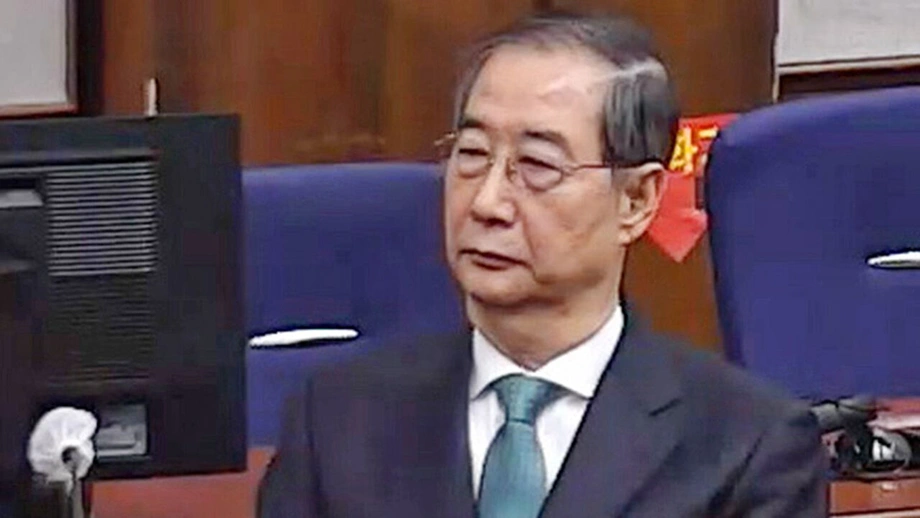
A November 19 deliberation puts the court against the clock
South Korea's Supreme Court has scheduled a second full bench deliberation in former Prime Minister Han Duck-soo's insurrection appeal for November 19, 2026, one day before his detention period expires. Han received a prison sentence of 23 years in January, reduced to 15 years on appeal on May 7, but his final appeal has remained unresolved for more than six months.
Contents
- A November 19 deliberation puts the court against the clock
- What the Supreme Court has said about a ruling
- How Han's case reached this point
- Why both sides challenged the 15 year sentence
- When does a Cabinet procedure become participation in insurrection?
- What conditional release would mean
- A separate November 30 verdict could affect custody
- The missed deadline and the dispute over court speed
- Lee Sang-min, Yoon and growing political pressure
- Key Points
The court has already used all three permitted renewals of his detention during the Supreme Court proceedings. If no judgment providing for continued imprisonment or new detention warrant intervenes, Han could leave Seoul Detention Center on November 20, nearly 10 months after judges ordered his immediate detention.
A decision before that deadline could become the Supreme Court's first judgment on whether former President Yoon Suk Yeol's December 3, 2024, martial law declaration was unlawful and amounted to insurrection. Lower courts have already convicted Han over his role in the episode.
Special prosecutor Cho Eun-seok's team has asked the Supreme Court to impose restrictions if Han is released, including limits on where he lives, whom he contacts and which rallies he attends. A separate criminal case, with a verdict scheduled for November 30, provides another possible route to continued or renewed detention.
The immediate question is whether the justices will announce a judgment before the custody deadline. Their decision also carries wider consequences: Han's case could define when a senior civilian official's participation in an unlawful declaration becomes criminal involvement in an insurrection.
What the Supreme Court has said about a ruling
The Supreme Court announced the November 19 deliberation on November 10. Three days later, it cautioned reporters against concluding that a judgment before November 20 was impossible and that Han would therefore be released immediately.
The court addressed those predictions in a notice to reporters on November 13:
Such definitive reports may cause misunderstandings, so we ask for restraint.
A Supreme Court official also addressed the possibility of a judgment on November 19:
It is not yet known whether a ruling will be delivered on that day.
The court was expected to announce its ruling schedule and the cases to be decided early in the following week, potentially as soon as November 16. That makes the scheduling announcement the next immediate development to watch.
A full bench deliberation is a meeting at which the justices discuss the case. A judgment session is when the court delivers its decision. The Supreme Court does not hold a separate closing hearing for a defendant's final statement, as lower courts do. Once deliberations are complete, it can set a judgment date. Delivering a ruling on the same day as a full bench deliberation is unusual.
How Han's case reached this point
Han was taken into custody on January 21 after the Seoul Central District Court convicted him and imposed a sentence exceeding the prosecution's request of 15 years. Judge Lee Jin-kwan presided over the ruling, which treated the martial law attempt as an insurrection.
The January insurrection conviction placed Han's conduct as prime minister at the center of the criminal proceedings. His defense maintained that he had privately opposed martial law and was trying to moderate Yoon's actions.
The principal dates in the appeal are:
- January 21, 2026: Han received a sentence of 23 years and was detained in court.
- May 7: The appeals court reduced his sentence to 15 years.
- May 11 and May 13: Han's lawyers and the special counsel, respectively, filed final appeals.
- May 21, July 21 and September 21: The Supreme Court renewed his detention.
- Early August: The case moved from the Supreme Court's second division to its full bench.
- September 29: The full bench held its first deliberation.
- November 19 and November 20: The second deliberation is scheduled, followed by the detention deadline.
The November 19 session will take place about 50 days after the first full bench deliberation. The court referred Han's case to the larger bench because of public interest, its historical importance and its connection with the prosecution of former Interior and Safety Minister Lee Sang-min.
Why both sides challenged the 15 year sentence
The appeals court upheld Han's conviction for performing an important role in an insurrection, while rejecting parts of the prosecution's case. Its sentence was eight years shorter than the original term, a reduction of about 35% from 23 years.
The special counsel's May 13 appeal challenged the acquittal on a charge involving the use of a forged official document, along with findings that rejected certain alleged conduct within broader charges. Prosecutors argued that the appeals court had misinterpreted the law and breached rules governing the assessment of evidence.
A central difference between the lower courts concerned responsibility for failing to act. The first court found that Han had a duty to notify all Cabinet members and work toward meaningful deliberation before martial law was declared. It held him responsible for failing to fulfil that duty.
The appeals court concluded that the legal requirements for treating those omissions as separate criminal conduct had not been met. It also rejected parts of the case concerning responsibility for failures to act over Cabinet signatures and discussions about cutting electricity and water to media outlets.
Criminal responsibility for an omission means liability for failing to take an action the law required. The Supreme Court must examine the legal duties attached to Han's office and how those duties relate to the offenses charged. Han's own appeal challenges the judgment against him, while the prosecution seeks to restore findings rejected on appeal.
When does a Cabinet procedure become participation in insurrection?
Prosecutors accuse Han of proposing a Cabinet meeting to make the martial law declaration appear to have undergone Cabinet deliberation. They also accuse him of trying to obtain Cabinet members' signatures after the declaration.
The appeals court found that Yoon had initiated a riot with the purpose of disrupting the constitutional order and that Han played a key role in giving the unlawful declaration an appearance of procedural legitimacy.
The legal issue is the meaning and reach of performing an important role in an insurrection. For Han, that requires examining what he did, what he intended and whether his actions helped carry out the attempt to overturn constitutional government.
A Cabinet meeting ordinarily provides a forum for senior officials to consider government decisions. The accusation here is that the meeting and signature efforts helped present an unlawful act as a properly considered government decision. Han's defense disputes the criminal assessment of his conduct.
The issue has been contested since before trial. A court examining his detention warrant in August 2025 identified room for dispute over important facts and the legal assessment of his actions. The final appeal now puts those questions before the country's highest court after two convictions.
What conditional release would mean
Cho Eun-seok's special counsel team submitted an opinion on November 13 concerning Han's custody when the detention period expires. Prosecutors said unrestricted release could make it difficult to keep track of his whereabouts.
The requested conditions would restrict his residence, prohibit contact with people connected to the case and bar attendance at related rallies. Conditional bail could also involve a financial guarantee. The court would decide which restrictions, if any, to impose.
Han's detention limit concerns custody while his appeal is pending. His sentence concerns the punishment imposed following conviction. If he is released while the appeal continues, the Supreme Court will still have to decide the legal challenges brought by both sides.
The court's options therefore depend on more than whether it completes deliberations on November 19. A final judgment sustaining imprisonment could keep Han in custody. Conditional release could place him outside detention under restrictions. Expiry of the existing detention period could lead to release if no other custody order applies.
The special counsel's request focuses on maintaining contact with Han and limiting his interactions while proceedings continue. The proposed restrictions would directly affect where he could live and his ability to meet people involved in the prosecution.
A separate November 30 verdict could affect custody
The Seoul Central District Court is also trying Han on allegations involving failure to appoint Constitutional Court justices and disputed nomination decisions. Criminal Division 33, presided over by Judge Lee Jin-kwan, is scheduled to deliver its first judgment on November 30.
Prosecutors have requested a sentence of five years in that case. On November 12, the special counsel submitted an opinion warning that Han's release could disrupt proceedings, including his attendance at the sentencing hearing.
The district court could issue a separate detention warrant before the Supreme Court custody period ends. A conviction and detention decision at the November 30 hearing could also return Han to custody after an intervening release.
Judge Lee also presided over Han's January insurrection trial and ordered his detention after imposing the sentence of 23 years. His division's handling of the separate appointments case is therefore another immediate factor in whether Han remains behind bars.
Han has also faced an election law prosecution, in which he was acquitted at first instance. The November 30 appointments judgment is the next scheduled verdict identified in the proceedings that could affect his custody.
The missed deadline and the dispute over court speed
Article 11 of the special prosecutor law requires related trials to receive priority and proceed promptly. Its timetable calls for a first judgment within six months of indictment, followed by appeal and final appeal judgments within three months of the preceding ruling. The arrangement is commonly called the 6-3-3 principle.
Han's May 7 appellate judgment put the final appeal deadline in August. By mid November, the Supreme Court proceedings had lasted more than twice the three months specified for that stage.
Han Sang-hee, a professor at Konkuk University Law School, has argued that the case should have moved more promptly because it concerns the constitutional order. The delay has also drawn comparisons with President Lee Jae-myung's election law case, which the Supreme Court decided 36 days after the appellate judgment and nine days after referral to its full bench.
Full bench proceedings can take much longer. Figures covering 180 full bench judgments over a decade put the average period from receipt of a case to judgment at 994 days. The two comparisons measure different stages: nine days covers the period after referral in Lee's case, while 994 days covers the entire Supreme Court process.
Han's case combines a statutory demand for speed with questions that may guide other insurrection prosecutions. The justices must determine the reach of the offense while addressing a custody deadline that has become the focus of public attention. Kim Yong, a former Democracy Institute vice president, was also released near his detention limit while awaiting a Supreme Court judgment, showing that such releases have occurred in other appeals.
Lee Sang-min, Yoon and growing political pressure
Former Interior Minister Lee Sang-min's appeal is also scheduled for deliberation on November 19. He received a sentence of nine years on appeal for conduct including instructing the National Fire Agency chief to cooperate in cutting electricity and water to media outlets. His detention period expires on December 18.
Yoon's own insurrection case is at an earlier appeal stage. Prosecutors had sought the death penalty, but the first court imposed life imprisonment in February. His appellate judgment is scheduled for January 26, 2027. Waiting to consider his case alongside Han's would extend the proceedings beyond Han's current detention limit.
The legal debate concerns whether the Supreme Court should assess the martial law episode through the cases together. The charge against Han separately defines responsibility for an important role in an insurrection, giving the court a legal basis to assess his conduct before Yoon's conviction becomes final.
Democratic Party politicians have directed mounting criticism at Chief Justice Cho Hee-dae. During a November 11 visit to Honam, party leader Kim Min-seok attacked the pace of proceedings. On November 12, floor leader Han Byung-do demanded an explanation for the lack of a judgment date despite the known detention deadline.
Former National Assembly Speaker Woo Won-shik warned that the public would hold the Supreme Court responsible if Han were released without a final judgment. Some lawmakers have called for Cho's impeachment, while Woo has also urged caution about action lacking public support or a practical result.
Cho Kuk, head of the Rebuilding Korea Party's Innovation Policy Institute, added pressure on November 15, criticizing Democratic Party hesitation over impeachment. Democratic Party lawmaker Kim Jun-hyuk planned a solo protest outside the Supreme Court at 8 a.m. on November 16, calling for an immediate ruling. The court's scheduling announcement, November 19 deliberation and November 30 district court verdict now form the next sequence of decisions affecting Han.
Key Points
- The Supreme Court will deliberate on Han Duck-soo's appeal on November 19, one day before his detention period expires.
- Han received 23 years in prison at trial and 15 years on appeal. Both his lawyers and prosecutors challenged the appellate ruling.
- The court has cautioned against assuming that release on November 20 is certain.
- Prosecutors want residence, contact and rally restrictions if Han is released.
- A separate Constitutional Court appointments case has a verdict scheduled for November 30 and could affect his custody.
- The final appeal has exceeded the special prosecutor law's three month timetable.
- The judgment could define criminal responsibility for senior officials involved in the December 3, 2024, martial law attempt.