Twelve Cases Put Prosecutors and the Presidency Under Scrutiny
South Korea's National Assembly opened debate on November 5, 2026, on a bill authorizing an investigation into alleged fabricated prosecutions under former President Yoon Suk Yeol. The proposed special counsel could lead a team of up to 309 people and operate for 200 days. Half of the 12 cases within its remit involve President Lee Jae-myung.
Contents
- Twelve Cases Put Prosecutors and the Presidency Under Scrutiny
- How the Bill Reached the Assembly Floor
- Why the Two Parties See Different Purposes
- Which Cases Involve Lee?
- North Korea Payments and Provincial Spending
- Why Lee's Trials Were Suspended
- Could Charges Still Be Withdrawn?
- A Large Team With Disputed Investigative Powers
- Who Would Choose the Investigator?
- Key Points
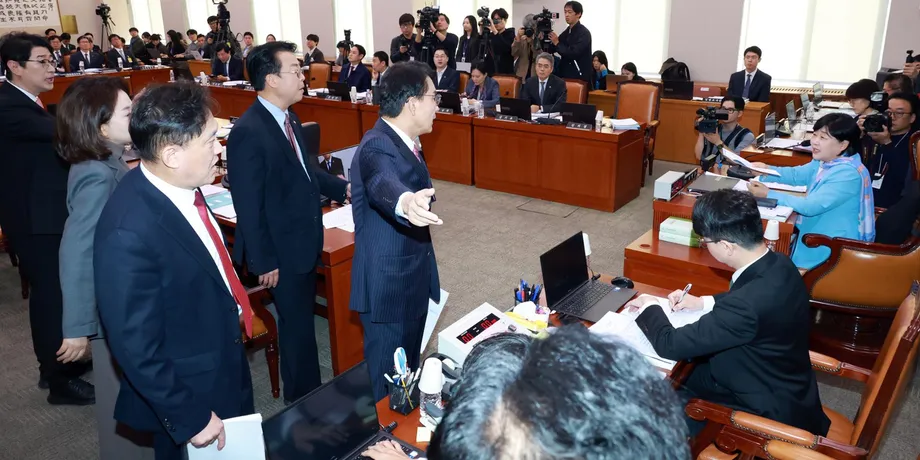
Assembly Speaker Cho Jeong-sik introduced the bill at a plenary session over objections from the opposition People Power Party (PPP), which began a filibuster at around 4 p.m. The ruling Democratic Party (DP), which holds a parliamentary majority, planned to end the delaying tactic after 24 hours and hold a vote on Friday, November 6.
The central dispute is whether an investigation into misconduct by prosecutors could also provide a route to ending criminal cases against the president. The DP removed an explicit provision allowing the special counsel to cancel indictments, but a parliamentary committee review identified a possible remaining route under criminal procedure law.
The bill would investigate allegations that prosecutors fabricated evidence, induced false testimony or otherwise abused their authority to pursue political opponents. Its scope also extends to alleged abuses by the National Intelligence Service and the Board of Audit and Inspection, the government body that examines public spending and administration.
For Lee, the stakes include cases involving property developments, football club donations, payments to North Korea and provincial expenses. For prosecutors, the proposed inquiry would turn attention toward how they assembled and pursued those cases. Both the underlying criminal accusations and the allegations of investigative misconduct remain contested.
How the Bill Reached the Assembly Floor
The Democratic Party first introduced the proposal in April. A subcommittee and the National Assembly's Legislation and Judiciary Committee approved it on November 4, clearing the way for debate by the full chamber the following day.
The PPP's filibuster delayed the expected vote from Thursday to Friday afternoon. A filibuster allows lawmakers to prolong debate to slow a decision. The DP said it would use the relevant parliamentary rules to end the tactic after 24 hours.
The main dates in the bill's progress are:
- April 2026: The Democratic Party introduced the special counsel proposal.
- November 4: A subcommittee and the Legislation and Judiciary Committee approved the bill.
- November 5: Speaker Cho Jeong-sik brought it before the full Assembly, and the PPP began a filibuster at around 4 p.m.
- November 6: The DP planned to end the filibuster and hold a vote in the afternoon.
The PPP also planned a large outdoor protest. Parliamentary passage had not been announced at the stage described here, and no starting date for the proposed investigation had been given.
Why the Two Parties See Different Purposes
The presidential office presented the proposal as a way to investigate prosecutors who might otherwise be responsible for examining the conduct of their own colleagues. Hong Ihk-pyo, senior presidential secretary for political affairs, explained that position during a parliamentary budget committee meeting:
"The purpose of the bill is to have a special counsel investigate allegations that prosecutors abused their authority and conducted politically motivated probes under the previous administration, given the difficulty prosecutors face in investigating their own colleagues," he said.
The PPP argued that the investigation would help remove Lee's criminal charges and place pressure on courts handling the cases. Its floor leader, Jeong Jeom-sig, made that objection at a party meeting earlier that day:
"The indictment cancellation special counsel bill is the worst anticonstitutional coup against parliament in constitutional history," he said.
"It is the worst trial-meddling special counsel investigation that presses the judiciary to produce an acquittal after predetermining that cases that are mostly on trial were fabricated indictments," he said.
The disagreement reaches beyond whether prosecutors should face scrutiny. It concerns who will investigate them, what powers that investigator will hold, and how the findings could affect prosecutions involving the president who appoints the special counsel.
Which Cases Involve Lee?
Six of the bill's 12 cases concern Lee, accounting for half of the proposed investigative workload by case count. They arise largely from his periods as mayor of Seongnam and governor of Gyeonggi Province, before he became president.
The matters include allegations involving the Daejang-dong, Wirye and Baekhyeon-dong development projects; alleged false statements about developments; alleged third party bribery involving Seongnam FC; payments to North Korea involving the Ssangbangwool group; alleged instigation of perjury involving Kim Jin-seong; and alleged misuse of Gyeonggi Province's corporate credit card.
In the development cases, prosecutors alleged that Lee granted favors to private developers while serving as Seongnam mayor. The Baekhyeon-dong indictment accused him of causing 20 billion won in losses to the Seongnam Development Corporation, the city's public development company.
The Seongnam FC case concerns a different alleged exchange. Prosecutors accused Lee of providing companies with administrative benefits in return for 13.35 billion won in donations to the football club. The legal issue is whether official decisions were improperly connected to money provided to a third party, in this case the club.
The proposed special counsel would examine whether prosecutors abused their powers in building these cases. That would place the conduct of investigators alongside the financial and administrative decisions at the center of the existing allegations.
North Korea Payments and Provincial Spending
The Ssangbangwool case concerns allegations that former company chairman Kim Seong-tae transferred $8 million to North Korea. Prosecutors divided the alleged payments into $5 million intended for a Gyeonggi smart farm project and $3 million connected to a proposed visit by Lee while he was provincial governor.
The corporate card case concerns alleged use of provincial resources for personal purposes between July 2018 and October 2021. Prosecutors accused Lee of using a government vehicle privately and charging expenses such as food and laundry to the provincial budget, alleging misappropriation of 106.53 million won.
Those allegations concern different uses of public authority: decisions about development, relationships with businesses, overseas payments and everyday government spending. The bill brings them within one inquiry focused on the methods and motives of investigators.
Why Lee's Trials Were Suspended
Lee's criminal trials were suspended after he became president in June 2025. Article 84 of South Korea's Constitution exempts a sitting president from criminal prosecution except in cases of insurrection or treason. The suspensions were attributed to that constitutional protection.
His snap election victory followed the political crisis triggered by Yoon's attempt to impose martial law in December 2024 and subsequent removal from office. Lee entered the presidency with the Democratic Party also controlling the National Assembly, giving his party the votes to advance legislation while his criminal proceedings were paused.
The perjury instigation case had already reached a different procedural stage from cases awaiting an initial verdict. Lee was acquitted at trial, and that case remained at the appeal stage. An appeal asks a higher court to review an earlier judgment.
The distinction matters to the dispute over withdrawing charges. A case that has not yet received its first judgment is at a different legal stage from one in which a court has already issued an acquittal and an appeal remains unresolved.
Could Charges Still Be Withdrawn?
The DP originally sought to give the special counsel explicit authority to cancel indictments. It removed that clause after criticism from within and outside the party. An indictment is the formal accusation that brings a criminal case before a court.
The Legislation and Judiciary Committee's review nevertheless said the Criminal Procedure Act could still be interpreted to permit withdrawal of a prosecution before the first court judgment. The review recommended considering an explicit exclusion of that authority in cases where the president is the defendant.
The PPP raised a second possibility: findings from the special counsel could be used by the Justice Ministry or the prosecution to drop charges. Its objection therefore covers both powers held directly by the special counsel and decisions other authorities might make after receiving the investigation's results.
Removing the explicit cancellation clause narrowed the bill's wording, while leaving a dispute over how its remaining provisions would work with existing law. For defendants, prosecutors and courts, the practical question is which authority could act on the findings and at what stage of a case.
A Large Team With Disputed Investigative Powers
The special counsel team could include up to 309 personnel, including 20 prosecutors temporarily assigned from their regular posts and 210 civil servants. Those two groups would account for 230 positions, about three quarters of the maximum team.
The Justice Ministry questioned the assignment of prosecutors because amendments to the Criminal Procedure Act had removed their investigative powers. The bill contains a supplementary provision allowing assigned prosecutors to exercise investigative and supervisory powers under the previous law.
That provision would give the special inquiry access to powers prosecutors had previously exercised, despite the broader changes to their role. The staffing dispute is therefore also a dispute about legal authority: who may gather evidence, direct investigative work and supervise others.
The maximum operating period would be 200 days, consisting of 20 days for preparation and up to 180 days of investigation. Preparation would account for one tenth of the total period. The deadline would require the team to organize staff and examine 12 cases within a limited window, although the cases differ considerably in subject and procedural history.
Who Would Choose the Investigator?
Lee would select the special prosecutor from three candidates recommended by the Democratic Party, the People Power Party and the minor Rebuilding Korea Party. The process would involve both the governing party and opposition parties, with the president making the final choice.
That arrangement places Lee in two roles central to the controversy: president responsible for selecting the investigator, and defendant in six cases the investigator would examine. The appointment process is consequently part of the debate over the inquiry's independence, alongside its legal powers.
The other six cases mostly concern events during former President Moon Jae-in's administration. They include allegations involving employment of Moon's former son-in-law, the shooting of a South Korean official in the West Sea and the repatriation of North Korean fishermen during Moon's presidency.
The bill would therefore extend scrutiny beyond Lee's prosecutions to investigations involving decisions and people associated with the previous Democratic administration. It would also reach beyond the prosecution service through its inclusion of intelligence and audit authorities.
If enacted and followed by an appointment, the proposal would produce the seventh independent counsel investigation since Lee took office. Earlier inquiries examined matters including Yoon's failed martial law attempt, alleged corruption involving his wife and a shortage of ballots during the June local elections.
The immediate next step was the planned November 6 vote. The longer dispute centered on whether the final law would give investigators a sufficiently clear mandate while resolving the contested routes for withdrawing charges against the president.
Key Points
- The National Assembly began debating the special counsel bill on November 5, 2026, with a vote planned for November 6 after a PPP filibuster.
- The proposed inquiry covers 12 cases, six involving President Lee Jae-myung and six mostly concerning the Moon Jae-in administration.
- The DP removed an explicit power to cancel indictments, but a committee review identified a possible route under the Criminal Procedure Act.
- Lee would choose the special prosecutor from three candidates recommended by the DP, PPP and Rebuilding Korea Party.
- The team could have up to 309 personnel and operate for 200 days, including 20 days of preparation.
- The presidential office says the inquiry would examine prosecutorial abuse; the PPP says it could help end Lee's criminal cases.