Essential workers, volunteer pay
Indonesia's campaign to prevent stunting depends on as many as 1.5 million community health workers, known as kader or cadres, who weigh toddlers, counsel parents and take food and health information into village homes. Most are women, and the state still treats much of their labour as volunteering. During official events in late November 2026, cadres were praised as heroes, frontline workers and the spearhead of community services. The economic reality described by researchers is considerably less generous.
Contents
- Essential workers, volunteer pay
- What 47 hours of care work is worth
- What stronger cadres change for families
- The work behind each monthly posyandu
- How a volunteer system grew to national scale
- What villages and research reviews say must improve
- November brought training, food and official praise
- Why outreach matters when families cannot travel
- The wider economy of invisible care
- What public budgets would need to recognise
- Key Points
Interviews with 130 cadres in two North Lombok villages found a median monthly incentive of USD 10.10. The women also spent a median of USD 2.90 from their own pockets, mostly on transport, and 52.31 percent said they were dissatisfied with the incentive scheme. Their median workload was 26 hours a month, although longer weeks worked by a minority brought the average to about 47 hours. These figures turn a familiar story about community spirit into a precise account of who finances Indonesia's village health services.
Stunting means that a child is too short for their age following sustained nutritional and health deprivation. It is associated with poorer physical growth, brain development and future health, which is why prevention concentrates on pregnancy and the first two years of life. Cadres carry that work into households through the posyandu, a monthly community health post, and through visits to families who need closer attention. New research now connects the capacity of these workers with better household knowledge and greater use of several health and nutrition services, even as inadequate incentives continue to drive many of them out of the role.
What 47 hours of care work is worth
The most detailed valuation comes from the CHW valuation study, published after academic peer review in Clinical Epidemiology and Global Health, Volume 33, May and June 2025, article 101982. Researchers interviewed 130 community health workers with a structured questionnaire; 92 percent were women. The study measured both the time cadres gave to stunting prevention and the money they surrendered while doing work described as voluntary.
The middle half of respondents worked between 16 and 59 hours a month. Using North Lombok district's 2023 minimum wage of IDR 2,367,323 a month, equivalent to about IDR 14,796 an hour when assuming 40 hours of work each week, the researchers valued the average monthly workload at IDR 691,076. That was approximately USD 46.54 at the World Bank's official exchange rate for 2022. A second calculation, based on what cadres reported earning in other work, produced a value of USD 13.81. The authors said this lower figure understates the value of their time because 55 percent had no other occupation from which an alternative income could be drawn.
Personal spending added another cost. The median payment from cadres' own pockets was USD 2.90 a month, with the middle half spending between USD 0.87 and USD 4.95. Against the median incentive of USD 10.10, USD 2.90 equals roughly 29 percent, almost one third of the money received before other costs of volunteering are considered. Most respondents nevertheless continued serving, citing gotong royong, Indonesia's tradition of mutual cooperation, even while many reported financial strain. The study's conclusion was direct: appropriate incentives are a main priority for better delivery of the stunting prevention program.
What stronger cadres change for families
A separate preprint examined what villages receive in return for this labour. The 1000 Days Fund, a nonprofit organisation working on stunting prevention, supplied program monitoring data, and a researcher from Udayana University in Bali analysed it. The study covered 1,819 households in 177 villages across six provinces. Only 45 percent of households had knowledge about stunting, and 43 percent had used posyandu services, with wide differences between villages.
The researchers constructed a cadre capacity score from five measurable elements: formal education, years of service, training received, knowledge of stunting and completeness of equipment. They compared that score with six household outcomes: stunting knowledge, posyandu service coverage, water, sanitation and hygiene practices, antenatal care, child feeding, and use of preventive services such as vitamin A supplementation, deworming and ownership of the Maternal and Child Health Handbook.
Households in villages with higher cadre capacity performed better on five of those six outcomes. The relationships remained after the researchers accounted for household income, education, age and employment. They also remained when villages where a single cadre supplied the capacity information were removed, and when the team excluded one village that made up a fifth of the sample. Results were expressed in relation to a standard deviation, a statistical unit describing the typical spread of scores, rather than as a promise that a particular training course would produce a fixed improvement.
Antenatal care was the exception. Nearly every respondent in that small group already had the highest score, leaving little variation from which to detect an association. The data captured one moment and therefore show association rather than causation; the preprint has also not yet completed peer review. Its authors nevertheless identify capacity as something governments can act on directly through training, equipment and retention.
The work behind each monthly posyandu
Ministry of Health technical guidelines for village health service units already place cadres alongside certified doctors, midwives and nurses. The requirements include physical and mental fitness, literacy, digital competence and previous experience. The ministry's curriculum for posyandu cadres specifies 25 basic skills and divides competency into three levels: basic, or purwa; intermediate, or madya; and advanced, or utama. The formal description resembles a professional job specification far more than occasional casual help.
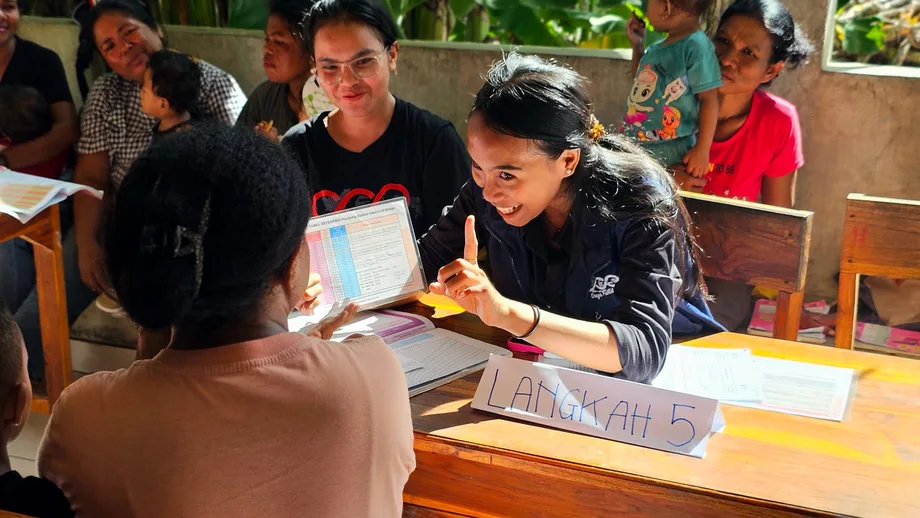
A traditional posyandu session moves mothers and children through five tables covering registration, weighing, recording results, counselling on growth and development, and health services such as immunisation or family planning. Four or five cadres commonly volunteer at each post. Each post serves approximately 100 children younger than five, or about 700 people in the wider community. By 2009, Indonesia had more than 250,000 posyandus, averaging 3.6 per village.
The monthly session is only part of the job. Cadres visit homes, update records, attend village committee meetings and check on mothers and children who miss services. When a mother or baby needs additional support, they may be asked to cook and deliver supplementary food, known as Pemberian Makanan Tambahan. Staff of the 1000 Days Fund describe cadres as the primary drivers of community nutrition. Historical program descriptions often put the workload at eight to ten hours a month with about a week of training or less; the North Lombok interviews show that some cadres now carry substantially longer hours, while the formal curriculum demands a broader set of skills.
How a volunteer system grew to national scale
The model grew from the women's Family Welfare Movement, or PKK, during the 1970s. The National Nutrition Survey in 1973 found that more than half of Indonesian children were undernourished. Village volunteers began combining growth monitoring, family planning supplies, discussions about child health and the preparation of nutritious shared meals. Mothers asking how they could tell whether their children were growing well helped prompt regular weighing sessions. Market scales called dacin and charts with green channels made changes in weight visible to parents, while local foods and recipes kept the advice close to household life.
- 1979 to 1984: The family planning and nutrition program expanded rapidly, reaching more than 30,000 villages.
- 1984: More than 80,000 posyandus in 34,000 villages were supplying basic nutrition and growth monitoring, run entirely by cadres.
- 1984 to 1998: The network eventually covered more than 65,000 villages, with about 250,000 posts and more than one million cadres.
- 1997: The economic crisis severely disrupted services, with some accounts indicating that as many as 70 percent of posyandus stopped functioning.
- 2001: A Ministry of Home Affairs ministerial letter called for revitalisation of the Posyandu Program.
The 2001 letter made three requests: sustain regular posyandu activities, strengthen local leaders and cadres through advocacy, orientation and training, and maintain posyandus as both physical and social institutions accountable to village communities. Limited resources directed revitalisation toward inactive posts and poorer communities.
Attrition was already visible in evaluations during the 1980s, which estimated annual cadre dropout at 20 percent and average service at three to five years. The more recent commentary associated with the 1000 Days Fund puts annual turnover at 20 to 30 percent, attributing it to inadequate incentives and an unmanageable workload. Each departure removes local experience that cannot immediately be replaced by a new scale or another training manual.
The historical figures also record major changes in child health alongside continuing need. Infant mortality, meaning deaths before a child's first birthday per 1,000 live births, fell from 142 in 1967 to 68 in 1990 and 32 in 2012. Historical program figures put undernutrition among children younger than five at 18 percent and stunting at 36 percent, while 68 percent of children in that age group were weighed in 2010.
What villages and research reviews say must improve
A ten researcher team at UIN Syarif Hidayatullah Jakarta, led by M. Kholis Hamdy, examined daily practice in Desa Sakambang, Wanayasa, Purwakarta Regency, West Java. Published on 31 December 2023 in Jurnal Ilmu Sosial Indonesia, the Sakambang field study used observation, interviews, documentation and participatory rural appraisal techniques, which involve residents in examining local conditions.
Cadres were educating families about stunting, measuring and weighing toddlers, visiting homes, and supplying additional food and vitamins to pregnant women and young children. Health workers and village officials supported them. The researchers nevertheless judged their role to be less than optimal because cadre knowledge and regular education were insufficient, posyandu infrastructure was inadequate, community participation and knowledge were low, and stunting prevention funding did not always arrive on time.
A wider review by Fita Oktaviani Aulia and Dewi Purnamawati of Universitas Muhammadiyah Jakarta examined 35 sources published between 2023 and 2025. The 2025 literature review, published on 27 March in Jurnal Ilmu Medis Indonesia, found that structured training, community education and support from local health authorities improved growth monitoring and nutrition counselling. It also identified benefits from collaboration across sectors and from digital health tools.
The review recommended investment in training, incentives, digital equipment and interventions using local food. Its authors included only Indonesian and English literature from the previous three years and did not conduct a quantitative meta analysis, meaning they did not statistically combine the studies into one numerical estimate. Read beside Sakambang's delayed funding and North Lombok's personal spending, its conclusions point to the same practical requirements: capable cadres need knowledge, tools, workable budgets and a reason to remain in service.
November brought training, food and official praise
On 24 November 2026, an event at Balai Desa Nongkodono in Kauman, Ponorogo, combined technical briefings for cadres with nutritious food packages for children younger than five. The Ponorogo Community and Village Empowerment Office organised the activity under a 2026 program for posyandu institutional strengthening, cadre empowerment and supplementary food, backed by the East Java provincial government. Cadres received instruction on recording, reporting and communicating effectively with residents.
Arumi Bachsin Emil Dardak, head of East Java's Posyandu Development Team, described cadres as the spearhead within communities and linked their skills to earlier detection of growth problems. Acting Ponorogo Regent Lisdyarita said progress required cooperation among village governments, cadres, health workers and families. The event addressed skills and food supplies; it did not change the underlying designation of participants as health volunteers.
One day later, Government Communication Agency head Syahganda Nainggolan addressed a regional technical coordination and advocacy meeting for Sulawesi, Kalimantan, Maluku and Papua. He said cadres and family assistance teams connected government policy with the needs of pregnant women, breastfeeding mothers and toddlers. His explanation of why their work matters went beyond the distribution of nutritious food, iron supplement tablets and health checkups.
No matter how good a program is, it is not finished until its benefits are understood, trusted, and carried out by the intended families.
Nainggolan warned that inconsistent messages from central agencies and field cadres could confuse residents and even delay health checkups. He also asked cadres to listen actively and return complaints about beneficiary lists, food quality and missing services to the government, citing President Prabowo Subianto's directive to heed grassroots voices. Regional heads were scheduled to sign a joint commitment on stunting prevention and accelerated reduction during the meeting.
On 26 November, Eddy Cahyono Sugiarto, a deputy at the Vice Presidential Secretariat responsible for policy support, welfare improvement and human resource development, visited Posyandu Seruni in Bonto Bunga village, Moncongloe, Maros. He called cadres heroes and said stunting prevalence in Maros had fallen from 34 percent to 22 percent in 2024, a reduction of 12 percentage points. The visit gathered input from cadres and family assistance workers for the regional meeting, and Eddy presented the Mamminasata area as a potential model for other places. Across the November announcements, officials described training, food, communication and political commitments, but did not set out a national wage, funding formula or payment timetable for cadres.
Why outreach matters when families cannot travel
Deputy Health Minister Dante Saksono Harbuwono used a case in Merauke to explain why a monthly health post cannot reach everyone by itself. A two-year-old girl with severe malnutrition had received special therapeutic food, yet her family struggled to reach basic services because it had no vehicle. Speaking on 26 November 2026, Dante urged cadres to strengthen jemput bola, an outreach approach in which workers go to families instead of waiting for families to come to them.
Dante described a triple burden of malnutrition: undernutrition, overnutrition and deficiencies in micronutrients such as vitamins and minerals. He placed particular weight on the first 1,000 days of life, from pregnancy until a child's second birthday, because nutrition during that period influences physical growth, brain development and later health. His three priorities were community nutrition literacy, continuous collection and monitoring of nutrition surveillance data, and food safety monitoring from ingredient selection through consumption. Surveillance, he said, should identify who has a nutrition problem, where it occurs, why it is happening and what assistance would be most suitable.
That warning adds a household dimension to the government's October kitchen expansion. On 14 October 2026, the National Nutrition Agency activated 980 nutrition service units across 16 provinces, following another 480 on 2 October. The expansion prioritised remote communities and stunting hotspots, with pregnant women, breastfeeding mothers and children younger than five among the intended beneficiaries. Kitchens can increase the supply of meals, while cadres can identify families missing from lists, explain services and report food that never arrives. Dante framed nutrition as a shared agenda requiring central and regional governments, universities, businesses, civil society and families.
The wider economy of invisible care
Indonesia's cadres sit within a much larger pattern. The International Labour Organization estimated in 2018 that people perform 16.4 billion hours of unpaid care work every day, with women responsible for 76.2 percent of it. Valued at the minimum wage, that labour would equal 9 percent of global gross domestic product. The organisation described unpaid care as largely invisible, unrecognised and absent from decisions about policy and resources.
Economists Balwant Singh Mehta and Aasha Kapur Mehta identify one basic reason: labour statistics often do not count people providing unpaid care as workers. Women in Global Health estimates that at least six million women worldwide work unpaid, or underpaid if they are fortunate, in community health roles carrying the title of volunteer. Indonesia's separate struggle over domestic worker protection shows how slowly recognition can arrive. Advocacy extended across 22 years from the first draft bill in 2004 until parliament recognised protection in law in April 2026.
Gotong royong helps explain why cadres continue despite the personal cost, but community spirit does not pay for transport or replace hours unavailable for other work. When district and village budgets assume that skilled labour will be supplied almost free, women and their families absorb the difference. Peace researcher Johan Galtung called this form of harm structural violence. His description of the harm was:
built into the structure and shows up as unequal power and consequently as unequal life chances
The North Lombok figures give that abstract idea a monthly budget: an incentive of USD 10.10, personal spending of USD 2.90 and work whose value was estimated at as much as USD 46.54 under the regional minimum wage model.
What public budgets would need to recognise
The research points toward a connected package rather than a single training day. Regular instruction and complete equipment can build the capacity measured in the household study. Reliable incentives and reimbursement for costs such as transport can reduce the personal penalty documented in Lombok. Manageable workloads and timely program funding can address reasons cadres leave, while a voice in program decisions can turn their complaints about food quality, beneficiary data and inaccessible services into corrections.
No national salary rate or total payroll cost has been established by these studies. The large difference between the median and average hours in North Lombok also shows why a fair system would need reliable information about local workloads rather than assuming that every cadre performs the same short monthly shift. The practical measure of reform is concrete: whether trained women can afford to remain, whether villages retain their knowledge, and whether children receive monitoring and nutrition support before growth faltering becomes entrenched. Cadres are volunteers on paper and a workforce in practice; public budgets have yet to reflect that reality.
Key Points
- As many as 1.5 million Indonesian health cadres support stunting prevention, largely under a volunteer model.
- A study of 130 North Lombok cadres found a median monthly incentive of USD 10.10 and median personal spending of USD 2.90.
- The average monthly workload was valued at USD 46.54 using the regional minimum wage and USD 13.81 using cadres' other reported earnings.
- A preprint covering 1,819 households in 177 villages linked higher cadre capacity with better results on five of six household outcomes.
- Field research and a 35 source review identified needs for regular training, adequate equipment, timely funding, incentives and stronger local support.
- Officials praised cadres during November 2026 events, while Maros reported stunting falling from 34 percent to 22 percent in 2024.
- The government is promoting household outreach for families unable to travel, but the November announcements did not establish a national cadre wage or payment timetable.
- Researchers argue that retention, fair payment and a voice for cadres are central to sustaining Indonesia's village nutrition services.