Jakarta's ban and the national gap
Jakarta Regulation No. 36 of 2025 took effect on 24 November 2025, giving Indonesia's capital a broad prohibition on the trade for food of animals that can carry rabies. Governor Pramono Anung announced the measure the following day, presenting it as protection for public health, animal welfare and Jakarta's long campaign against rabies.
Contents
- Jakarta's ban and the national gap
- What does Jakarta's regulation actually prohibit?
- Why rabies sits at the centre of the debate
- The scale and mechanics of a hidden trade
- Which Indonesian laws can be used now?
- Tradition, livelihoods and opposition to prohibition
- Local bans and the national bill that could change the legal map
- What the Jatinegara market operation reveals about enforcement
- Public pressure and demands for better scrutiny
- Timeline and the questions still open
- Key Points
The capital's action also exposes a national legal gap. Indonesia still has no nationwide regulation that explicitly bans the trade in dog and cat meat. Officers can pursue theft, illegal transport, falsified veterinary documents, quarantine breaches and food violations, but those powers generally address offences surrounding the trade rather than creating a single national prohibition on selling the meat itself.
The consequences extend beyond the treatment of animals. Pet owners can lose animals to theft, diners can encounter meat outside normal safety controls, and health authorities must consider the movement of animals whose disease status is unknown. For Jakarta, the immediate task is enforcing its own rule. For national lawmakers, the wider question is whether a proposed animal protection law will turn local restrictions into consistent national protection.
What does Jakarta's regulation actually prohibit?
The regulation covers dogs, cats, monkeys, bats, civets and similar species capable of transmitting rabies. They cannot be traded for consumption as live animals, carcasses, or raw and processed products. The animals also cannot be slaughtered or killed for human consumption. Framing the rule around disease carrying species makes its reach considerably broader than a prohibition limited to dog and cat dishes.
Its penalties increase with repeated violations. A first offence can bring a written warning, while animals or carcasses being sold can be confiscated for observation, particularly when rabies is a concern. Further breaches can lead to additional confiscation, business closure and revocation of a business license. The regulation was already legally in force when announced, although officials allowed a grace period of six months before active enforcement.
Hasudungan Sidabalok, head of Jakarta's Food Security, Marine and Agriculture Agency, said during the announcement that the administration was publicising the prohibition and preparing more detailed enforcement rules and sanctions. He also identified a remaining market for the meat, saying that 19 restaurants still served it and at least two slaughterhouses were operating.
Governor Pramono Anung linked the regulation to animal welfare campaigners who had petitioned him in October. He described the commitment he had made to them in these words:
When receiving the animal lovers, I promised them to establish a governor regulation.
Pramono credited their advocacy with prompting the policy and said he hoped it would protect and improve the health of Jakarta residents while reducing rabies infections. The transition period was intended to give businesses time to adjust and authorities time to prepare monitoring arrangements.
Why rabies sits at the centre of the debate
Rabies is a zoonosis, meaning a disease that can pass between animals and humans. Once clinical symptoms appear, it is almost always fatal. That makes prevention, animal health controls and careful management of animal movement far more effective than waiting for illness to appear. An unmonitored meat trade can involve handling, transporting and slaughtering animals without reliable health documentation.
Indonesia's Health Ministry recorded 25 rabies deaths between January and March 2025 alone. The World Health Organization separately attributes several dozen deaths each year to rabies across the archipelago. Benedikta Erica, policy drafting coordinator for Dog Meat Free Indonesia (DMFI), warned that the trade could obstruct Indonesia's ambition to become free of rabies by 2030.
Jakarta has been officially free of rabies since 2004 and is one of only 11 of Indonesia's 38 provinces with that status. Hasudungan described the ban as one effort to preserve it. The risk is not confined within the capital's borders because animals have been brought in from elsewhere, including West Java, where rabies is endemic.
The city agency head warned that slaughtering or consuming dog meat could expose slaughterers and consumers to rabies. His concern helps explain why officials discuss the issue alongside food safety and disease control, rather than treating animal welfare as a separate matter with no bearing on the public.
The scale and mechanics of a hidden trade
A DMFI study published in 2022 estimated that 9,500 dogs were brought into Jakarta for consumption during that year. Most were caught on the streets, and most came from West Java. The estimate provides an unusual view of the supply route into the capital at a time when much of the trade was already moving out of public sight.
During the October policy debate in 2025, when the regulation was still being drafted, animal protection advocates estimated that 8,000 to 9,000 dogs were still being slaughtered for food each month. On 29 October, Pramono said the rule should be finalised within a month. The two estimates cover different years and different stages of the supply chain, one counting dogs brought into Jakarta and the other estimating slaughter. Nationwide figures for dog and cat meat consumption are unavailable.
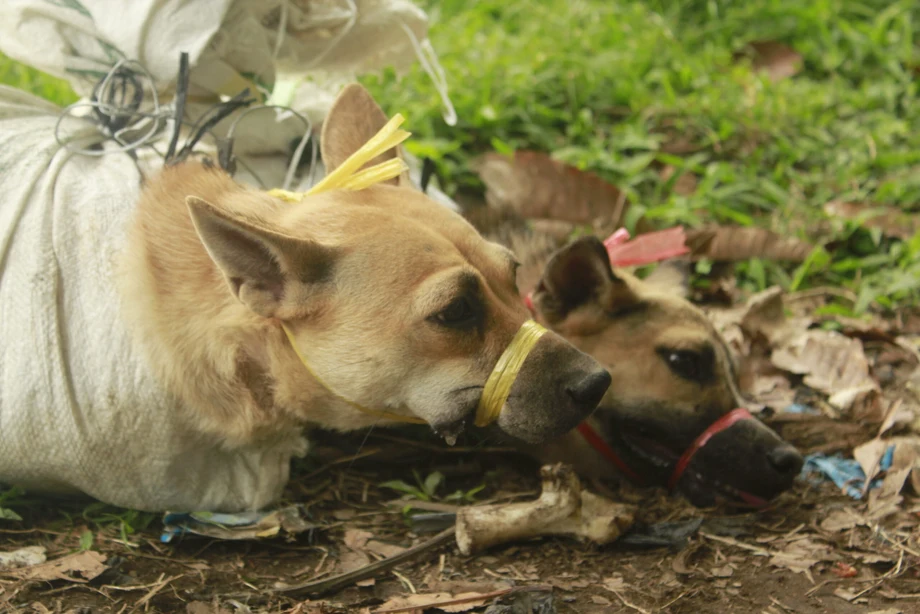
DMFI investigations have found that some dogs and cats entering the trade were obtained through theft, snaring or poisoning. Animals were then transported in poor conditions and treated in ways that failed to meet animal welfare principles. These findings explain why a report of a stolen pet can become connected to wider concerns about criminal conduct, meat safety and disease surveillance.
Increased oversight had already made open sales less common before Jakarta announced its ban. Restaurants stopped publicly advertising dog dishes, owners became reluctant to discuss the trade with outsiders, and meat disappeared from open market displays. Consumer Sunggul Sagala said purchases were increasingly confined to trusted customers and that the meat had become more expensive than beef.
Which Indonesian laws can be used now?
Benedikta said enforcement has generally relied on the Animal Quarantine Law, the Food Law, the Criminal Code and the Animal Husbandry and Animal Health Law. Depending on the circumstances, these provisions can address stolen animals, unlawful movement, fraudulent veterinary paperwork, quarantine violations or other conduct that accompanies the trade.
The legal classification of the animals also matters. Dogs and cats are not classified as livestock in Indonesia, and a 2018 Agriculture Ministry directive stated that dog meat was not categorised as food. Those positions give administrations a regulatory basis for action, but they do not amount to one nationwide criminal prohibition covering every dog or cat meat transaction.
This distinction is central to DMFI's campaign. A trader might be prosecuted because an animal was stolen or transported without the required documents, while the absence of an explicit national ban leaves the underlying trade without a uniform offence. Benedikta regards that gap as a major obstacle to ending the practice across provincial boundaries.
Tradition, livelihoods and opposition to prohibition
Dog and cat meat are not widely consumed across Indonesia, where most people are Muslim. Dog meat nevertheless remains popular in some communities, where consumption is described as a tradition. Some consumers also regard canine meat as a home remedy for dengue fever. Indonesia remains among a small number of countries where dog or cat meat is still sold for consumption.
Alfindo Hutagaol, who is 36, spoke before the ban was announced after eating rice, green sambal and grilled dog meat at a Jakarta stall. He rejected the coming restriction and defended his meal:
God created it to be eaten. Don't only look for the negative side, but also look for its benefits too.
Sunggul Sagala, who is 43, similarly described consumption as a tradition for some communities and said the trade could not suddenly be eliminated. He compared buying dog meat under increased scrutiny to looking for drugs. Alfindo also argued that prohibition could push some consumers towards Jakarta's stray dog population.
Business concerns were visible before the regulation took effect. Lastri, who runs a small Jakarta eatery, feared that a ban could end her business overnight. She said her sales had risen as competing stalls quietly removed dog dishes, and she maintained that her animals were wild dogs rather than stolen pets. Her account shows why campaigners and officials face an adjustment problem involving traders and employees as well as diners.
Local bans and the national bill that could change the legal map
Jakarta was not the first Indonesian administration to act. Semarang in Central Java banned the trade in 2022. In 2024, authorities there intercepted a truck carrying more than 200 dogs bound for a slaughterhouse and arrested five people. Karanganyar, Salatiga, Sukoharjo and Tomohon are among the other regencies and cities that had already taken local action before Jakarta's regulation.
The capital's rule does not extend to other regions where consumption remains popular. Its wider legislative significance instead depends on whether local action can be matched nationally. A potential route emerged on 19 September 2025, when the House of Representatives (DPR), the government and representatives of the Regional Representative Council (DPD) agreed on the priority legislative programme for 2026.
The programme contains 67 draft laws, of which 44 are continuations from the 2025 programme. The Animal Protection and Welfare Bill is among them. The proposed draft includes a special chapter explicitly prohibiting the dog and cat meat trade, with the stated aims of protecting companion animals from cruelty and exploitation and safeguarding public health from zoonotic diseases such as rabies.
Advocates had pressed for the legislation since the previous year and encountered obstacles during its submission and deliberation. Inclusion on the priority list places it on the legislative agenda, but does not enact it. No date for a final vote was given. Karin Franken, coordinator of Jakarta Animal Aid Network (JAAN), has argued that broader regulation is needed because cruelty occurs in many forms beyond the meat trade.
What the Jatinegara market operation reveals about enforcement
An integrated Jakarta team secured 10 cats suspected of having been stolen during an operation at the Jatinegara animal market on 20 November 2026. The cats lacked ownership and animal health documentation. Officers also secured five owls, which were released into the wild. The operation followed public complaints about stolen animals being sold and animals being mistreated at the East Jakarta market.
Pramono had instructed the Food Security, Marine and Agriculture Agency, known as KPKP, to investigate and regulate the market. He said he issued the instruction after a woman approached him while he was using public transport. Chico Hakim, a special staff member to the governor, later connected the operation to the governor's animal welfare commitments.
City agencies also prepared to relocate 71 animal traders to Training Centre Klender in Duren Sawit, a site managed by KPKP. Of those traders, 47 operated in Gang Kemuning and 24 occupied pavements or road shoulders along Matraman Raya. The relocation plan was discussed with regional agencies on 19 November 2026; it was a planned move, not a completed relocation at the time of the operation.
Chico said the arrangement was intended to restore public space while making animal trading more orderly and consistent with welfare principles. Traders were asked not to accept animals suspected of being stolen while they waited for relocation. The city also pointed to rules covering animals that cannot be consumed and animal sterilisation, alongside plans for five animal health centres known as puskesmas hewan, or community clinics for animals. No opening dates for those centres were given.
Public pressure and demands for better scrutiny
A poll commissioned by DMFI in 2021 found that 93 percent of Indonesian respondents rejected the dog meat trade and wanted it banned. Musician and environmental campaigner Melanie Subono said a petition opposing the trade had gathered more than 700,000 signatures. Activists then took their campaign directly to Pramono before he announced Jakarta's regulation.
Merry Ferdinandez of DMFI welcomed the capital's decision and suggested that it could encourage action elsewhere. She described its significance for the coalition in these words:
This is a real example and real commitment from the Jakarta government as a global city that also advances animal welfare.
DMFI also said the policy aligned with the constitutional mandate to protect all Indonesians and to build a just and civilised nation. That support coexists with the objections from consumers and traders, leaving officials to manage both public backing and the practical consequences for businesses.
Themmy Doaly, chair of Masyarakat Jurnalis Lingkungan Indonesia (SIEJ), said media coverage of domestic animals still too often concentrates on viral incidents and cruelty. He called for constructive journalism that verifies claims, explains the legal and public health context, includes different perspectives and examines possible solutions. In this case, that approach means following stolen animal reports, disease controls, restaurant enforcement and the national bill as connected parts of the same story.
Timeline and the questions still open
Several decisions over five years explain how Jakarta reached its current position:
- 2021: A DMFI commissioned poll recorded 93 percent opposition to the dog meat trade.
- 2022: DMFI estimated that 9,500 dogs entered Jakarta for consumption, and Semarang introduced its own ban.
- 19 September 2025: National legislative representatives placed the Animal Protection and Welfare Bill on the priority programme for 2026.
- October 2025: Activists petitioned Pramono, who then said Jakarta's regulation should be completed within a month.
- 24 and 25 November 2025: Jakarta's regulation took effect and was publicly announced, with a grace period of six months before active enforcement.
- 19 and 20 November 2026: Officials discussed relocating Jatinegara traders, then secured 10 cats and five owls during the market operation.
No explicit plan had been set out for animals that might lose their buyers when Jakarta's ban was announced. South Korea's experience with a similar dog meat prohibition offers a cautionary comparison: traders there were left with animals that could no longer be sold and were difficult to rehome. Jakarta's grace period addresses business adjustment, but the sources do not provide a detailed animal placement programme.
The national position also remains incomplete. The priority bill could create an explicit prohibition and strengthen supervision, enforcement and public education, but its listing alone changes no penalties. Until lawmakers complete that process, Indonesia will continue to rely on a combination of local bans, public health rules and laws targeting the crimes and safety violations associated with the trade.
Key Points
- Jakarta Regulation No. 36 of 2025 took effect on 24 November and covers dogs, cats, monkeys, bats, civets and similar animals that can carry rabies.
- Sanctions progress from warnings and confiscation to business closure and license revocation, with a grace period of six months before active enforcement.
- Indonesia still lacks an explicit nationwide ban, although a bill on the 2026 priority agenda contains a special chapter prohibiting the dog and cat meat trade.
- The Health Ministry recorded 25 rabies deaths from January to March 2025, while Jakarta has been free of rabies since 2004.
- City officials identified 19 restaurants serving dog meat and at least two operating slaughterhouses when the ban was announced.
- A 2021 DMFI poll found 93 percent support for banning the trade, and a petition has collected more than 700,000 signatures.
- In November 2026, a Jatinegara market operation secured 10 cats suspected of being stolen and five owls, while 71 traders were prepared for relocation.