A 15 Kilometre Journey Before a Car Could Reach Him
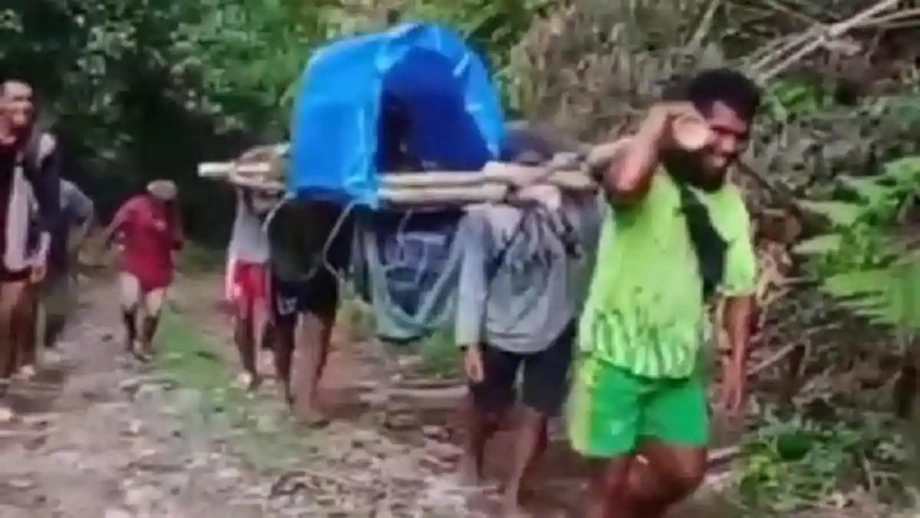
Residents of Baruru village in Indonesia's West Sulawesi province carried an elderly man on a bamboo stretcher for about 15 kilometres over seven hours on November 2, 2026, because a damaged road prevented a vehicle from reaching his home, according to village official Habel. The patient, Petrus, had a swollen leg and recurring lower back pain that made movement difficult.
Contents
- A 15 Kilometre Journey Before a Car Could Reach Him
- Bamboo, Sarongs and Seven Hours of Carrying
- A Route Other Patients Have Taken
- Why the Emergency Repair Did Not Last
- The Warning Came Before the Viral Video
- From 30 Percent to a Target of 60 to 70 Percent
- Residents Want Road Access to Shape Spending
- Key Points
The journey took place in Aralle district, Mamasa regency. Habel said villagers carried Petrus from Baruru to the boundary of Ralleanak Utara village, where a car could pick him up for the journey to Aralle Community Health Centre. A community health centre, known in Indonesia as a puskesmas, provides basic medical services close to where people live.
Habel identified Petrus as 78 and described a carry of approximately 15 kilometres to the vehicle access point. Baruru village head Rusman gave his age as 70 and described approximately 20 kilometres by stretcher all the way to the health centre, starting around 8 a.m. and ending in the afternoon.
Rusman said on November 6 that Petrus had been referred to a hospital in Mamuju. His diagnosis, subsequent treatment and condition after the referral were not disclosed.
The evacuation brings a specific human cost into a wider dispute over road spending in Mamasa. Less than six weeks earlier, Regent Welem Sambolangi had publicly warned the provincial government that residents were still being carried several kilometres to obtain medical care. Habel said Baruru's road had received emergency filling work about four months before Petrus's journey, only for holes to return after a few spells of rain.
Bamboo, Sarongs and Seven Hours of Carrying
Villagers made the stretcher from bamboo poles and sarongs, with a tarpaulin above Petrus to protect him from sun and rain. Video of the evacuation circulated widely on social media by November 6.
The footage showed men taking turns carrying the stretcher across rocky, muddy ground, with other residents following. The arrangement depended on neighbours supplying both the equipment and the physical effort needed to move a patient who could barely move himself.
Habel, a Baruru village official, described the distance and time to journalists on November 5:
Ditandu sekitar 15 kilometer. Sekitar 7 jam.
His description means Petrus was carried about 15 kilometres over approximately seven hours. Using those estimates, the group advanced at an average of roughly 2.1 kilometres an hour, including any pauses. Every kilometre required people to support the patient while negotiating the uneven surface.
For Petrus, reaching the point accessible to a car was itself a substantial journey. Habel identified Aralle Community Health Centre as the intended destination beyond that point.
A Route Other Patients Have Taken
Baruru residents have repeatedly carried sick neighbours along the same difficult access route, both Habel and Rusman said. Habel described the road damage as a longstanding problem and said some residents had died while being carried towards medical care.
Rusman singled out women about to give birth as another group who have needed stretchers. His account places Petrus's evacuation within a recurring problem affecting people who cannot wait comfortably for road conditions to improve.
Neither official gave a total number of evacuations or deaths, or dates for the earlier cases. Their descriptions nevertheless identify the practical burden on families: when vehicles cannot reach a home, neighbours must organise the first stage of transport themselves.
Why the Emergency Repair Did Not Last
Habel said workers had filled damaged sections of the road about four months earlier. According to his account, holes returned after rain fell two or three times, leaving residents facing much the same conditions again.
Filling holes can restore a surface temporarily. A lasting repair also depends on the condition of the road beneath it and how water leaves the surface. Habel's description points to the short life of this particular intervention, although he gave no engineering assessment or details of the material used.
Rusman described the road as passable only by a Hartop, a rugged off road vehicle. Habel said a car could be reached at the Ralleanak Utara boundary. Both descriptions underline how restricted vehicle access was when Petrus needed transport.
The immediate demand from Baruru is therefore more specific than simply asking for another visit by repair crews. Residents need a route that remains usable when someone falls ill, including after rain. The earlier filling work had not provided that reliability by November 2.
The Warning Came Before the Viral Video
Mamasa Regent Welem Sambolangi raised the problem at an event marking West Sulawesi's 22nd anniversary at the governor's office on September 22, 2026. He called for greater provincial attention to roads and bridges in Mamasa and described residents being carried to health centres.
Welem said the provincial road routes he was discussing fell under the provincial government's authority. Responsibility matters because the government that manages a road is central to planning its repairs and allocating money. His remarks addressed provincial routes across Mamasa; the specific administrative classification of the Baruru access road was not identified.
Welem also called for cooperation between the regency and provincial governments on suitable housing, extreme poverty and stunting, a condition in which children's growth is impaired by prolonged poor nutrition and related factors. He presented transport and basic services as connected needs for Mamasa's residents.
The sequence shows that carrying patients was already a public concern before Petrus's evacuation attracted attention:
- About four months before November 2: Baruru's access road received emergency filling work, according to Habel.
- September 22, 2026: Welem urged the provincial government to improve roads and described residents being carried to health centres.
- November 2: Villagers carried Petrus from Baruru towards medical care.
- November 5: Habel described the journey and recurring road damage to journalists.
- November 6: Rusman confirmed the evacuation and said Petrus had been referred to a hospital in Mamuju.
From 30 Percent to a Target of 60 to 70 Percent
Welem put the share of provincial roads in Mamasa classified as being in satisfactory condition, described in Indonesian as mantap, at just 30 percent. He said he hoped that proportion would rise to between 60 and 70 percent over the remaining three years.
Those figures describe a substantial proposed change. Reaching 60 percent would double the current share; reaching 70 percent would add 40 percentage points. Put another way, if the total road network stayed the same size, the share meeting that condition category would rise from three tenths to between six and seven tenths.
The target offers a way to measure progress across Mamasa, while Baruru's residents face a more immediate test: whether a vehicle can reach a sick person at home. A larger share of satisfactory roads would matter locally only when improvements reach the routes residents depend on.
No construction start date, approved budget or completion deadline for the Baruru route was announced in the statements describing Petrus's evacuation.
Residents Want Road Access to Shape Spending
Habel urged the government to prioritise the road and proposed redirecting money from MBG, Indonesia's Free Nutritious Meals programme, and Kopdes, village cooperatives. Alternatively, he suggested returning village funds for road construction.
His proposal was a demand for a change in spending priorities. No budget transfer or approval was announced alongside it. Decisions about which funds could be used would have to be made by the authorities responsible for those programmes and the road.
Habel also said the damaged access route was making economic activity harder for residents. His account supplied no figures for lost income or transport costs, but it connected the difficulty of reaching medical care with the wider difficulty of moving into and out of Baruru.
Petrus's journey makes that connection concrete. A road normally allows a vehicle to carry a patient; here, residents had to carry the patient to the vehicle. The immediate response came from neighbours working together for hours. The unresolved task for government is to provide dependable access so that the same effort is not required each time someone needs care.
Key Points
- Villagers carried Petrus from Baruru on November 2, 2026, because damaged road access prevented a vehicle from reaching his home.
- Habel described about 15 kilometres and seven hours to a vehicle access point; Rusman described about 20 kilometres to Aralle Community Health Centre.
- Rusman said Petrus was referred to a hospital in Mamuju.
- Village officials said similar evacuations had happened repeatedly, including for women about to give birth.
- Emergency filling work about four months earlier deteriorated after rain, according to Habel.
- Regent Welem Sambolangi said only 30 percent of provincial roads in Mamasa were in satisfactory condition and sought 60 to 70 percent within three years.
- No approved repair schedule for the Baruru route was announced.