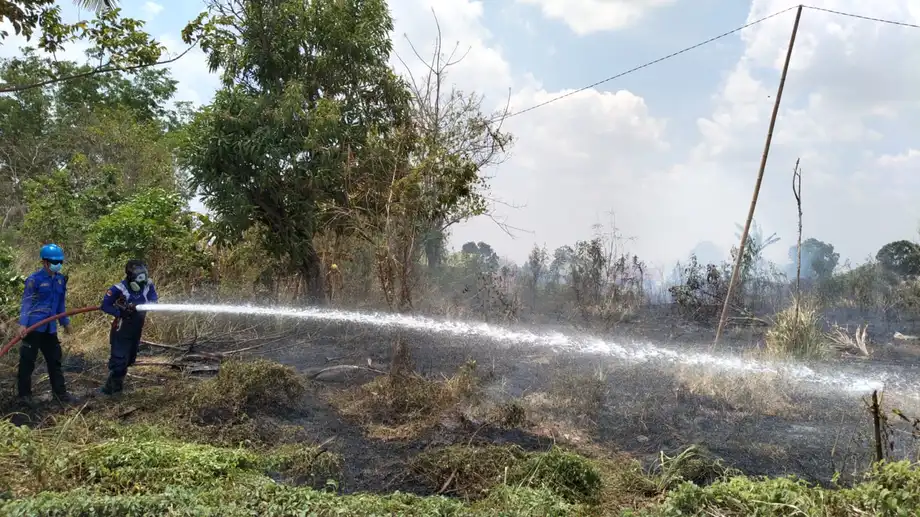
September pollution linked to an estimated 5,310 deaths
An estimated 5,310 people in Indonesia died from the effects of short periods of exposure to fine particle pollution in September 2026, up 42% from 3,740 in August, according to an assessment released on October 29 by the Centre for Research on Energy and Clean Air (CREA). Smoke from forest and land fires accounted for 3,560 of the September estimate, more than twice August's 1,700.
Contents
- September pollution linked to an estimated 5,310 deaths
- How researchers calculated the health toll
- Kalimantan and Sumatra carry the heaviest smoke burden
- Children and health services face mounting pressure
- What treatment and protection are available?
- Why this fire season spread so widely
- A smaller budget and growing demands for action
- Java faces a pollution problem beyond the fires
- Rain could bring relief and a new danger
- Restoring peatlands becomes a central demand
- Key Points
The increase was driven by a fire season that burned an estimated 1.92 million hectares between January and September, exposed communities across Sumatra and Kalimantan to thick haze, and carried smoke into neighbouring countries. CREA estimated that 57.8 million Indonesians experienced unhealthy, very unhealthy or hazardous air in September, compared with 41.3 million in August.
Indonesia's Health Ministry also recorded 333,470 acute respiratory infection cases across 68 cities and regencies in seven affected provinces between August 18 and October 21. Children aged five and younger accounted for 75,172 cases, or about 23%.
The government faced growing demands to declare a national disaster while operating with a sharply reduced disaster response budget. As the rainy season approached, authorities warned that landscapes damaged by fire could expose some of the same communities to flooding and landslides.
CREA's mortality figures are estimates calculated from pollution exposure and health research. The government had not released a tally of individually verified deaths attributed to haze. The assessment nevertheless gives a measure of the possible health burden extending beyond people diagnosed with respiratory infections.
How researchers calculated the health toll
CREA used daily pollution information from Tsinghua University's Tracking Air Pollution system, adjusted against measurements from 186 monitoring stations across 118 Indonesian cities. Researchers combined those readings with population data, provincial mortality figures and research connecting pollution exposure with the risk of death.
PM2.5 means particles no more than 2.5 micrometres across. These particles are small enough to travel deep into the lungs, and some can enter the bloodstream. Exposure can worsen respiratory and cardiovascular conditions, increasing the risk of serious illness and premature death.
CREA separated pollution from landscape fires from pollution produced by other activities. Its September estimate comprised 3,560 deaths associated with fire smoke and 1,750 associated with sources such as power generation, industry and transport. Fires therefore represented about 67% of the estimated total.
On October 30, BNPB disaster communications chief Berton SP Panjaitan requested clarification of the methodology, data sources, calculation period and division between fire and other pollution. He said assessments of deaths required the involvement of health and air quality authorities, with BNPB incorporating that information into disaster coordination.
Berton also called for the response to consider public health, education, daily activities, economic disruption and environmental quality alongside burned land and fire hotspots. His proposed approach would place the consequences for residents within the same response framework as firefighting.
Kalimantan and Sumatra carry the heaviest smoke burden
West, South, Central and East Kalimantan together had an estimated 1,470 deaths associated with air pollution in September, compared with 700 in August. Fire smoke accounted for between 94% and 99% of estimated pollution deaths in those four provinces.
Across South Sumatra, Riau, Lampung, Jambi and West Sumatra, the estimated total rose from 760 to 1,420. Fires accounted for more than 90% of pollution deaths in Riau, Jambi and West Sumatra.
Kalimantan's average PM2.5 concentration more than doubled, from 57 micrograms per cubic metre in August to 120 in September. Concentrations reached 196 on September 21. Daily averages in Palangka Raya, Central Kalimantan, and Pontianak, West Kalimantan, reached 372 and 327 respectively.
The national average, weighted to reflect where people live, was 36 micrograms per cubic metre in September. That was 7.2 times the World Health Organization's annual guideline of 5. The WHO figure is a benchmark for exposure over a year; September's reading shows how heavily polluted that month was.
Children and health services face mounting pressure
The Health Ministry's October 21 figures covered 258,298 respiratory infection cases among people older than five, alongside 75,172 among younger children. Then Suyanti, the ministry's director of environmental health, said cases were spread across seven provinces affected by forest and land fires.
Earlier ministry figures included 50,891 cases during July and August; Deputy Health Minister Dante Saksono Harbuwono had announced 13,500 cumulative cases on August 28, with 4,082 people still ill. Those earlier figures were presented with different reporting cutoffs and unspecified differences in geographic coverage, making the August 18 to October 21 total the clearest measure of the later caseload.
Children are a particular concern because their lungs are still developing. CREA cited Indonesian Pediatric Society respiratory specialist Wahyuni Indawati's warning that particles from forest fires could be up to 10 times more dangerous to developing lungs. Health specialists Herawati Supolo-Sudoyo and Feni Fitriani Taufik also warned of lasting risks from repeated exposure, including reduced lung function, cardiovascular disease, developmental effects and cancer risk.
In Balikpapan, a father identified as Michael said his daughter, aged 20 months, developed coughing and shortness of breath in early October and was diagnosed with pneumonia. He described the explanation given to the family:
We were told that one factor that could have contributed to the illness was the smoke, which has also been getting thicker in Balikpapan.
The family limited the child's time outdoors. Across affected communities, such decisions have become part of daily life as parents weigh schooling, travel and other activities against changing air quality.
What treatment and protection are available?
The Health Ministry listed 1,691 community health centres, 360 referral hospitals, 87 public health laboratories and 491 facilities providing oxygen support as part of the response. It also identified 18,547 general practitioners and specialists within the health service capacity available.
The government said in late October that more than 2,100 doctors and health workers had been activated in the hardest affected areas and 5.3 million masks distributed. It also supplied oxygen concentrators and other medical equipment.
Suyanti urged residents to check air quality through ISPUnet, which is integrated into the SATUSEHAT application, reduce outdoor activity, wear masks and limit smoke entering homes. People experiencing breathing difficulty or a worsening cough were advised to seek medical care promptly.
Firefighters face concentrated exposure close to burning land. Nurdin, a volunteer firefighter aged 51 in South Kalimantan, died on October 21 after developing chest pain and shortness of breath while fighting a blaze. Clinic head Dr. Amalia Dewi suspected smoke poisoning based on the circumstances and information from his colleagues, and said he appeared to have worn an ordinary dust mask.
Why this fire season spread so widely
Nusantara Atlas estimated that 1.92 million hectares burned in the first nine months of 2026. That was about 38% above the 1.39 million hectares recorded over the same period in 2019 and more than twice the 886,172 hectares recorded in 2023. The government had neither confirmed nor rejected the 2026 estimate.
FireWatch data showed that the 2026 hotspot count had already exceeded every full year from 2019 through 2025. Hotspots are satellite detections of unusual heat used to locate possible fires; burned area measures the extent of land affected.
Indonesia's Meteorology, Climatology and Geophysics Agency, BMKG, said in September that a very strong El Niño and the Indian Ocean Dipole were reducing rainfall. It reported that 61.91% of Indonesia's land area was experiencing the dry season.
Dry weather makes land clearing by fire more dangerous, especially on drained peatlands. Peat consists of partly decomposed plant material that normally holds substantial water. Once drained and dried, it can burn beneath the surface for weeks, producing smoke and making extinguishing efforts difficult.
The crisis extended beyond the usual fire centres in Sumatra and Kalimantan. South Papua recorded the most hotspots during October 28 and 29, while South Papua, West Kalimantan and East Nusa Tenggara were among the provinces showing the largest escalation between July and September.
A smaller budget and growing demands for action
BNPB's allocation fell from Rp2 trillion in 2025 to Rp491 billion in 2026, a reduction of about 75%. CREA said the cut constrained emergency response resources as the fires worsened.
The government defended its operations, saying more than 72,000 people had been deployed for firefighting and cloud seeding, a process intended to encourage rain. Its communications office also said companies connected with fires had been prosecuted and aid sent to affected provinces.
Agus Sari, chief executive of environmental consultancy Landscape Indonesia, argued that preparedness had fallen short for a disaster he described as predictable and avoidable. He said:
Indonesia should be able to prepare for what is going to happen. The fact that we are not prepared at all is purely a matter of lacking the will.
Officials resisted declaring a national disaster because regional administrations and local response task forces remained operational. CREA argued that provinces could still be left managing a crisis with inadequate resources. Demonstrators sought a national declaration and stronger protection for public health.
The pressure developed over several weeks:
- October 12: President Prabowo Subianto met his cabinet, with BNPB reporting 639 hectares still burning across six priority provinces.
- October 20: Demonstrators marking the administration's second anniversary demanded stronger action on the fires and haze.
- October 27: Indonesia and Singapore said they would explore a joint task force to address haze.
- October 28 to 30: Students and civil society groups continued protests in Jakarta and other cities.
- October 29: CREA released its assessment of September's pollution and estimated deaths.
Java faces a pollution problem beyond the fires
Java's health burden followed a different pattern. CREA attributed an estimated 1,530 deaths there in September to pollution from sources other than fires, including industry, vehicle emissions and waste burning. Such sources accounted for roughly 73% to 80% of pollution deaths across the Java areas assessed.
In West Java, Central Java, Jakarta and Banten, about four in five estimated pollution deaths were associated with these continuing emissions. Residents therefore face a substantial pollution burden even when seasonal smoke clears.
CREA called for stricter emissions standards alongside a comprehensive clean air law requiring nationwide monitoring, public access to pollution data, binding air quality standards and stronger accountability for companies and regional authorities.
Across the region, haze reached Malaysia, Singapore, the Philippines and Timor-Leste. Singapore initiated action under its Transboundary Haze Pollution Act, while the October 27 discussion between the Indonesian and Singaporean foreign ministers opened the possibility of joint coordination.
Rain could bring relief and a new danger
BMKG forecast that the rainy season would begin in most of Indonesia during November and December, although El Niño could delay its peak into the following year. Intermittent rainfall had already helped suppress some fires and disperse haze in Sumatra and Kalimantan.
BNPB spokesperson Berton Panjaitan warned that the damaged landscape could make the arrival of rain dangerous:
We also need to anticipate an increased risk of flooding, particularly in areas where blazes have destroyed tree covers and degraded the soil.
Pantau Gambut's 2025 assessment identified high flood risk across roughly a quarter of Indonesia's 24 million hectares of peatland hydrological units, areas connected by shared peatland water systems. That amounts to approximately 6 million hectares. Central Kalimantan, West Kalimantan, South Sumatra and Riau faced the highest risks.
Degraded peat can lose its ability to absorb and hold water. Some dried peat becomes water repellent, allowing rainfall to run off quickly into surrounding areas. Climate and disaster specialist Edvin Aldrian, who serves on the Intergovernmental Panel on Climate Change, connected the danger to plantation expansion.
Edvin explained:
Oil palm roots cannot store or retain water as effectively as a natural peatland or forest.
Riau allocated Rp2.1 billion to repair the Sontang-Duri highway after flooding from the Rokan River inundated the route in Bengkalis regency. The damage illustrates the additional transport and repair costs facing communities as weather conditions change.
Restoring peatlands becomes a central demand
President Prabowo revived a national peatland body during the fire season. The National Peatland and Mangrove Management Agency, known as BPGMN, replaces the former Peatland and Mangrove Restoration Agency.
Environmental advocates have questioned whether the replacement will have sufficient authority and resources to limit land conversion and hold plantation companies responsible for damage. Pantau Gambut senior campaigner Putra Saptian called for mandatory restoration by corporations involved in destroying peatland ecosystems.
CREA's recommendations connect immediate health protection with changes to land management: restore drained peatlands, enforce rules against illegal burning and strengthen responsibility for companies holding land concessions. Restoring water to peatlands would address the dry conditions that allow underground fires to persist.
For residents, the priorities are concrete: breathable air, accessible treatment, reliable warnings and landscapes that can retain water when the rains return. Indonesia's response must now contend with continuing industrial pollution, the damage from this fire season and the approaching risk of floods.
Key Points
- CREA estimated 5,310 deaths associated with short periods of pollution exposure in September, up 42% from August.
- Fire smoke accounted for an estimated 3,560 deaths, while other pollution sources accounted for 1,750.
- The Health Ministry recorded 333,470 respiratory infection cases between August 18 and October 21, including 75,172 among children aged five and younger.
- Nusantara Atlas estimated 1.92 million hectares burned between January and September, about 38% more than during the same period in 2019.
- BNPB's annual budget fell by about 75%, while protesters demanded a national disaster declaration.
- November and December rains were expected to ease fire conditions but increase flood risks in damaged landscapes.