58 Million Beneficiaries, With Kitchen Safety Under Scrutiny
Indonesia's National Nutrition Agency (BGN) has outlined an overhaul of its free nutritious meals program after verifying more than 58 million beneficiaries and 26,723 kitchens. The changes target food poisoning risks, inflated procurement costs and weak supervision across a network of 27,485 kitchens.
Contents
- 58 Million Beneficiaries, With Kitchen Safety Under Scrutiny
- What the Kitchen Numbers Reveal
- Procurement Changes Target Brokers and Inflated Prices
- How the Rp44 Trillion Claim Breaks Down
- Cold Storage Is a Weak Point Beyond Java
- Certificates, Early Checks and Cameras
- What Happens When Something Goes Wrong?
- Public Menus and a Possible Change at School
- What the First 100 Days Set in Motion
- Key Points
BGN head Sudaryono presented the changes in Jakarta on October 29, 2026, during a review of his first 100 days in office. Called MBG 2.0, the overhaul combines tighter spending controls, mandatory hygiene certification, improved food storage, public access to program information and stronger coordination with local governments.
The agency reported Rp165 trillion in budget spending for 2026 and described another Rp44 trillion as public money returned to the state treasury through savings and recoveries. Its figures also show the program's economic reach: 1.03 million active workers, including employees and volunteers, and 80,315 local suppliers.
Sudaryono said the program's size must be matched by proper management. He described three priorities: fighting corruption, strengthening governance and supervision, and improving transparency and cooperation.
His central message was that MBG must be both large and properly run. The BGN head put it this way:
MBG ini program besar, tidak hanya besar tapi harus benar. Itu targetnya.
The practical changes reach from the purchase of raw chicken to the moment a child receives lunch. They include checks on kitchen managers before dawn, seals and labels on meals, and a trial of cameras intended to flag unsafe food handling.
What the Kitchen Numbers Reveal
BGN's verification figures leave 762 kitchens outside the verified total. The 26,723 verified kitchens represent about 97.2 percent of the 27,485 kitchens listed by the agency. Verification checks program records; BGN separately requires kitchens to hold a hygiene and sanitation certificate known as SLHS.
Sudaryono described a supervision structure that had struggled to keep pace with expansion. About 700 BGN staff had been overseeing roughly 27,000 kitchens with very limited monitoring infrastructure, he said. Those approximate figures amount to nearly 39 kitchens for each agency staff member.
The 1.03 million active workers cover the wider program workforce, while the much smaller figure cited by Sudaryono concerns the agency personnel overseeing it. The gap helps explain why BGN is turning to remote monitoring, local cooperation and public complaints alongside physical inspections.
Kitchen conditions are also under review. Sudaryono said weaknesses covered buildings, staff capability, procurement and service. One complaint received by BGN described cooking taking place beneath a section of a building used for swiftlet nesting, illustrating why the suitability of kitchen locations is part of the overhaul.
Procurement Changes Target Brokers and Inflated Prices
Sudaryono alleged that kitchen operating locations had been traded, funding requests inflated and ingredient prices controlled through monopolistic practices. He said suspected corruption reached several levels of the organization, including kitchens, and that some individuals were facing legal proceedings.
BGN's response includes closing kitchens that fail requirements and renewing cooperation agreements with foundations and Satuan Pelayanan Pemenuhan Gizi (SPPG), the nutrition service units that operate the kitchens. Sudaryono also pledged action against foundations acting as brokers and against problematic procurement.
Daily financial reporting is becoming a condition for continued funding. Kitchens that fail to report how they use money each day will have disbursements stopped, according to the agency's announced approach. Foundation incentives are being reset to Rp2,000 per portion.
BGN is also developing LokaMBG, a platform for purchasing ingredients. Its stated aims are to prevent inflated prices and monopolies, record transactions and make product origins easier to trace. For a kitchen buying food every day, a recorded purchasing trail would allow supervisors to compare what was ordered, what was paid and where the ingredients came from.
How the Rp44 Trillion Claim Breaks Down
BGN attributed its Rp44 trillion savings and recovery figure to four categories: Rp38 trillion in agency budget savings, Rp2.5 trillion in foundation incentives, Rp3 trillion in kitchen operating funds and about Rp500 billion recovered from balances in fictitious virtual accounts. Those components add up to Rp44 trillion.
The measures combine reductions in planned expenditure with the recovery of account balances. Sudaryono said the purpose was to protect public money while preserving meals for children. Action against hundreds of fictitious SPPG accounts was also described as part of the financial cleanup.
One part of the budget explanation needs clarification. Sudaryono cited an allocation of Rp268 trillion and a revised requirement of Rp229 trillion, while saying Rp38 trillion had been returned. The difference between those two quoted amounts is Rp39 trillion, leaving Rp1 trillion unexplained in that calculation.
The Rp165 trillion spending figure describes budget execution reported for 2026. Readers need that figure alongside the savings breakdown to understand both the money used to run the program and the reductions BGN says it has made.
Cold Storage Is a Weak Point Beyond Java
Sudaryono identified limited cold storage as a particular problem outside Java, where supplies of animal protein must move through areas with uneven storage and distribution facilities. He linked health problems at several locations in Sulawesi to chicken that had not been kept cold.
A cold chain means keeping food at an appropriate controlled temperature through storage and transport. Chicken that becomes too warm can allow bacteria to multiply before cooking and serving. Sudaryono stressed that both time and temperature matter when handling meals and their ingredients.
BGN has discussed the need for cold storage and distribution facilities with the Indonesian Chamber of Commerce and Industry (Kadin) and the Indonesian Young Entrepreneurs Association (HIPMI). Sudaryono described opportunities for local businesses to supply ingredients, move food and operate storage facilities.
Local enterprises already play a large role in the program. BGN said 82.83 percent of its 80,315 suppliers were micro, small or medium enterprises, equivalent to roughly 66,525 suppliers. Better refrigeration would therefore affect both meal safety and the businesses expected to deliver food reliably.
For regions outside Java, the operational challenge is concrete: expanding meal distribution requires somewhere suitable to store perishable food and a way to keep it cold during delivery. Kitchen oversight and investment in the supply chain must advance together.
Certificates, Early Checks and Cameras
BGN says every SPPG kitchen must have an SLHS hygiene and sanitation certificate and competent or experienced cooking staff. Standard operating procedures are being tightened across purchasing, preparation, storage and distribution, supported by unannounced inspections and daily briefings.
Kitchen managers' attendance is monitored online each day between 2 a.m. and 8 a.m. Western Indonesian Time. Staff who fail to follow the requirements can receive warning letters. The early monitoring window places supervision during the hours when kitchens are preparing food for delivery.
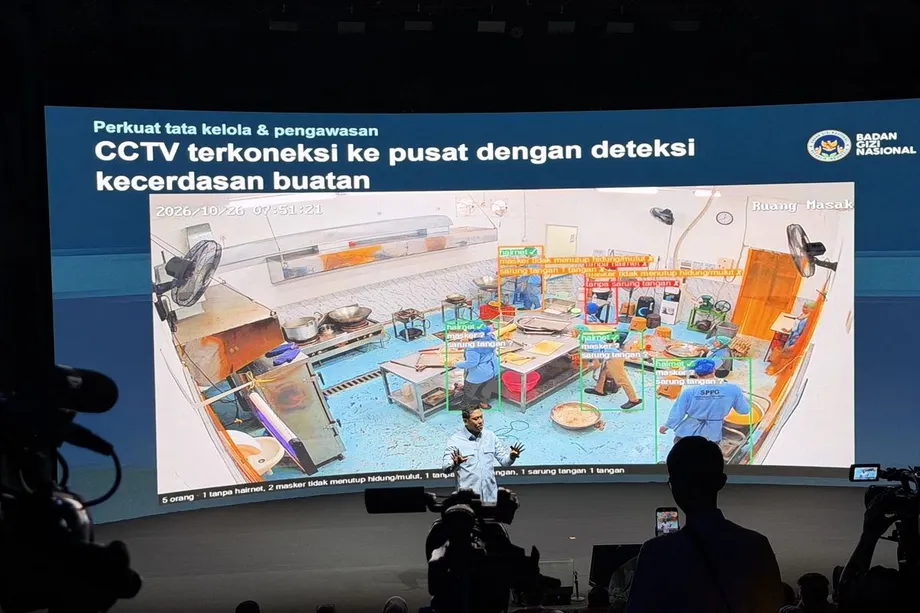
About 70 kitchens were participating in a CCTV trial, with roughly 300 more planned. BGN intends to connect cameras to central monitoring and use artificial intelligence to identify possible violations, such as ingredients placed on the floor, staff working without gloves or vegetables being cut in unhygienic areas.
The initial 70 kitchens represent about 0.25 percent of the full network. Adding 300 would bring coverage to roughly 1.35 percent, showing how much further the camera system would need to expand to reach all listed kitchens. No timetable was given for nationwide installation.
Food seals and labels are another planned safeguard, intended to provide information about whether meals are suitable for consumption. BGN is placing these measures alongside temperature controls and handling rules throughout the food preparation process.
What Happens When Something Goes Wrong?
BGN has established technical guidance for risk management and crisis response covering suspected food poisoning and accidents during program operations. The guidance is intended to organize the immediate response, investigation and follow through when an incident occurs.
Kitchens can face temporary suspension, inspection and permanent closure where deliberate and serious violations are established. Sudaryono also said employees who breach requirements would face firm action.
Parents, teachers, school principals, community health volunteers and other residents are being invited to help monitor delivery. BGN says it is strengthening complaint handling so reports can be received, examined and acted upon.
Sudaryono has also called for ministries and local governments to become involved before problems emerge. He criticized an earlier approach in which local leaders were sometimes drawn in only after poisoning incidents, despite having had little involvement in choosing kitchen locations or recipient schools.
Earlier local involvement would bring decisions about buildings, distribution routes and school needs into the planning stage. Those are practical matters that determine whether a kitchen can serve its assigned children safely and on time.
Public Menus and a Possible Change at School
Radar MBG is intended to let the public examine daily menus, nutritional content, kitchen locations and the names of kitchen heads. Sudaryono described the platform as part of making the use of public money more transparent.
For families, that information could make a meal service easier to check: which kitchen supplies the school, who is responsible and what food is supposed to arrive. Public access is being paired with the agency's promise to follow up complaints.
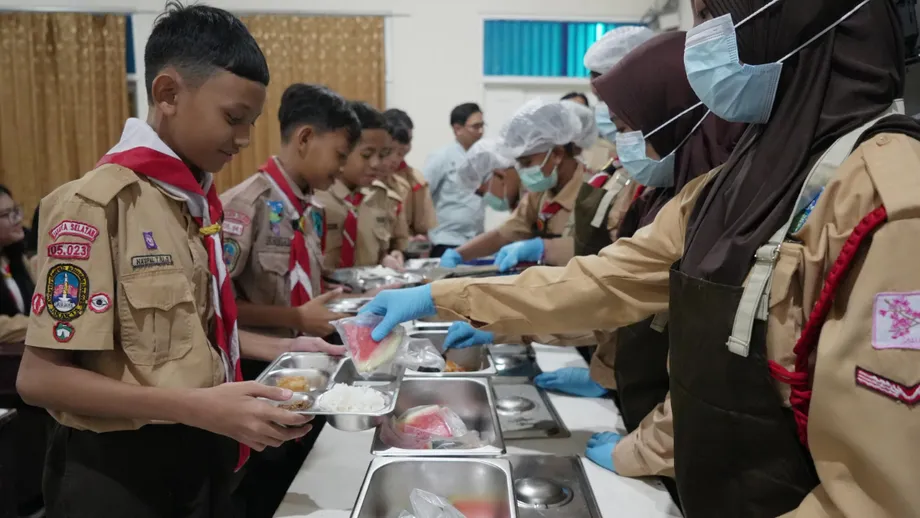
BGN is also developing buffet service in schools. Under the approach described, pupils could take food according to their needs while following serving rules and working within the food available. The aim is to match portions more closely to appetite and reduce leftovers.
The proposal depends on schools and kitchens being ready to manage serving, distribution and food safety. With suitable supervision, BGN also sees communal meals as a chance for pupils to practice queuing, cleanliness and responsibility for their surroundings.
Evaluation would track food quality, how much children eat, leftovers, the accuracy of beneficiary records and cost efficiency. Together, those measures would help show whether meals reach the intended children and are actually consumed.
What the First 100 Days Set in Motion
Sudaryono's review connected a change in leadership with a broader attempt to move MBG from rapid expansion toward more closely supervised operations. The key dates and steps are:
- July 22, 2026: Sudaryono was appointed BGN head by President Prabowo Subianto.
- During his first 100 days: BGN pursued verification, spending reviews, revised kitchen agreements and stronger monitoring.
- October 29, 2026: Sudaryono presented the MBG 2.0 overhaul and performance figures in Jakarta.
- Next operational steps: BGN plans to add about 300 kitchens to its CCTV trial and continue developing purchasing and public monitoring tools.
Local government incentives form another part of the discussion. Sudaryono said a Rp1 trillion Ministry of Home Affairs incentive program covers broader local government performance, with MBG potentially becoming one assessment criterion alongside inflation, unemployment and poverty. Measures related to stunting, or impaired growth associated with prolonged undernutrition, were still being developed.
Sudaryono argued that success should include menu quality, food consumption and children's nutrition, rather than meal distribution alone. He also said changes in children's growth and development take time to emerge. MBG 2.0 therefore sets out two connected tasks: make today's meals safer and build a service capable of supporting nutrition consistently.
Key Points
- BGN reported more than 58 million verified beneficiaries and 26,723 verified kitchens out of 27,485.
- MBG 2.0 prioritizes action against corruption, stronger supervision, transparency and cooperation.
- BGN described Rp44 trillion in savings and recoveries, although one quoted budget calculation contains a Rp1 trillion gap.
- Cold storage shortages, particularly outside Java, are a central food safety concern.
- Kitchen safeguards include hygiene certification, experienced cooks, daily monitoring, inspections and a CCTV trial.
- Radar MBG is intended to publish menus and kitchen information, while buffet service is being developed to improve portions and reduce waste.