Expansion targets places still waiting for nutritious meals
Indonesia's National Nutrition Agency, known as BGN, activated 980 nutrition service units across 16 provinces on October 14, 2026, expanding its Free Nutritious Meals program toward remote communities and areas with high rates of stunting. The main ceremony took place in Aceh Besar, with 691 kitchens in Sumatra and another 289 across Kalimantan and Bali.
Contents
- Expansion targets places still waiting for nutritious meals
- Official reviews show where access remains weakest
- School eligibility is being redirected toward greater need
- How the expansion developed
- Riau Islands kitchens face checks before serving meals
- Aceh and Sebatik show different local needs
- Why geography and food prices shape each meal
- Stunting priorities extend beyond schoolchildren
- Food safety begins before full operation
- Financing and oversight accompany the rollout
- Key Points
The expansion follows the activation of 480 kitchens on October 2. Together, the two rounds cover 1,460 facilities, although newly inaugurated kitchens must still complete preparations before serving their full allocation of meals. In the Riau Islands, officials said new facilities would begin with trials of 100 to 200 portions after meeting operating requirements.
BGN head Sudaryono said local governments would help identify where additional facilities were most needed. Schoolchildren, pregnant women, breastfeeding mothers and children under five are among the intended beneficiaries of the program, known by its Indonesian abbreviation, MBG.
The priority areas are known as 3T, an Indonesian designation covering disadvantaged, frontier and outermost regions. Across an archipelago, reaching those communities requires more than constructing a kitchen: officials must also arrange staff, ingredients and routes that can deliver food safely.
Sudaryono described the October expansion as a continuing effort rather than a final round. During online discussions accompanying the launch, regional leaders raised requests for more nutrition services and described local conditions. Simalungun deputy regent Benny Gusman Sinaga put his district's stunting prevalence at 24 percent, while Riau Islands deputy governor Nyanyang Haris Pratamura called for continued attention to other underserved island communities.
Official reviews show where access remains weakest
The expansion follows a parliamentary examination of large gaps in coverage. At an October 6 meeting documented in the DPD committee review, representatives from Papua, East Nusa Tenggara and Maluku described communities still waiting for meals, difficult delivery routes and unequal purchasing power.
Southwest Papua senator Hartono said his province had 12,000 beneficiaries, representing less than 10 percent coverage, with services still concentrated in urban areas. Papua Highlands senator Arianto Kogoya reported only 14 nutrition service units and five districts without coverage.
Arianto also raised a registration problem: some residents were absent from lists recording each beneficiary's name and address, and some lacked an Indonesian identity card, known as a KTP. Identifying eligible residents is therefore part of the work required alongside opening kitchens.
BGN deputy head Agustina Arumsari told the committee that 3,318 units in 3T areas remained under development and that 26,476 units across urban agglomerations and 3T areas were operating on October 6. Sudaryono had cited 27,022 operating kitchens nationally on October 2. The reason for the lower total in the later official statement was not explained.
School eligibility is being redirected toward greater need
BGN has also changed which schools receive meals. In its school eligibility statement, the agency said it had removed 1,653 schools of international standing that were financially independent and did not depend on government School Operational Assistance, known as BOS.
The same statement identified around 15,000 schools in Maluku and Papua that remained unserved. BGN said new kitchens would open gradually according to local needs and readiness, with safety, efficient management and accurate targeting guiding the process.
For families, the practical change is a stronger focus on places with limited access and high nutritional need. Local recommendations can help locate those places, while beneficiary registration determines who will actually receive meals.
How the expansion developed
MBG began on January 6, 2025, as a major initiative of President Prabowo Subianto's administration. Its early growth reached tens of millions of people, but successive announcements have used different measures, including national beneficiaries, operating kitchens and facilities needed specifically in remote regions.
The main milestones show how attention has shifted toward areas that are harder to serve:
- September 8, 2025: MBG had reached 509 regencies and cities across all 38 provinces.
- October 20, 2025: The program reported 36,773,520 beneficiaries, with a goal of establishing 6,000 service units in 3T areas.
- January 20, 2026: Then BGN head Dadan Hindayana told House Commission IX that regional mapping identified a need for 8,617 units in 3T areas, with 542 completed and operating across 36 provinces.
- October 2, 2026: BGN activated 480 units across 116 regencies and cities in 16 provinces. Sudaryono said the activation ended a moratorium on opening kitchens.
- October 6, 2026: DPD Committee III reviewed coverage gaps, food costs and distribution problems with BGN.
- October 13, 2026: BGN spokesperson Tysa Novenny outlined plans for more than 40 units in Aceh.
- October 14, 2026: BGN activated another 980 units across Sumatra, Kalimantan and Bali.
The January identification of 8,617 needed facilities was 2,617 above the earlier goal of 6,000. That comparison shows the scale of the mapped requirement grew beyond the initial construction ambition, while the October figures describe later stages of development and operation.
Riau Islands kitchens face checks before serving meals
BGN deputy head Trenggono gave a detailed breakdown of 35 new kitchens in the Riau Islands: 10 in Batam, nine each in Natuna and the Anambas Islands, four in Karimun, two in Tanjungpinang and one in Lingga. Those district figures add up to 35; Nyanyang was also cited as welcoming 37 additional units in remarks accompanying the wider launch.
Trenggono said the inauguration marked a stage of operational preparation. Each kitchen still needed suitable equipment, staff, a hygiene and sanitation fitness certificate, known as SLHS, and a wastewater treatment installation, known as IPAL. These requirements cover both the handling of food and the disposal of water used in kitchen work.
After meeting the requirements, each kitchen would test distribution with 100 to 200 portions before increasing service. Trenggono instructed the regional MBG head to record which facilities were ready, particularly in 3T areas, and highlighted Lingga as a district with high stunting prevalence needing further attention.
Nyanyang said the Riau Islands program already served about 594,000 people through 230 kitchens across seven regencies and cities, reaching 87 percent of its target. That leaves roughly 13 percent of the stated target still to be reached. The six areas receiving new kitchens account for only part of the province's existing service network.
Aceh and Sebatik show different local needs
In Aceh, Tysa Novenny said more than 40 service units were planned across regencies and cities. Speaking during a public dialogue on October 13, the BGN spokesperson stressed training, operational preparation and continuing support before facilities began serving beneficiaries.
Tysa said a building alone was insufficient. Managers and food handlers needed preparation to meet nutrition and food quality standards, while meals also needed to be acceptable to the children receiving them. Her account connects the expansion target with the everyday work of preparing food that people can safely eat and will want to finish.
On October 14, a launch in East Sebatik, Nunukan regency, North Kalimantan, brought the program's expansion to a border community. The facility is in Sungai Nyamuk village on Jalan Bhakti Husada.
Nurjaeni, BGN's director for provision and distribution in Region II, described the ceremony as an important early moment for developing services in North Kalimantan and central Indonesia. She credited construction partners with helping provide facilities at a scale that would otherwise place a heavy burden on government resources. Provincial and regional officials, school representatives, partners and military and police personnel attended.
Why geography and food prices shape each meal
East Nusa Tenggara senator Maria Stevi told the October 6 parliamentary meeting that mountain and hillside settlements could remain difficult to reach even when their distance from a kitchen appeared manageable. A short distance on a map can still involve a demanding route for food delivery.
Maluku senator Ana Latuconsina raised another practical problem: Rp10,000 buys different quantities and quality of ingredients in Java and Maluku. She asked that kitchens planned for Maluku receive attention so their meals could match the quality available in Java.
Agustina said BGN was adapting operations to infrastructure, staffing, access to nutritionists, supply chains, price differences and extreme weather. The agency was also preparing rules to encourage local suppliers and locally available food.
Earlier implementation offers concrete examples. MBG had reached 1,860 students on Kelapa Island by September 2025. In the Sula Islands and Nduga, distribution involved local authorities and military units. Food mapping in Morotai identified surplus fish as a possible protein source, alongside local agricultural produce. Such arrangements address what each place can supply and how meals can reach its residents.
Stunting priorities extend beyond schoolchildren
The 2024 Indonesian Nutritional Status Survey recorded stunting prevalence of 37 percent in East Nusa Tenggara, 35.4 percent in West Sulawesi and 30.5 percent in Southwest Papua, the three highest provincial rates cited. Eleven provinces recorded increases even as the national rate declined.
Stunting means a child is too short for their age because growth has been restricted over time, often involving inadequate nutrition and repeated illness. Preventing it requires attention early in life, which helps explain why MBG includes pregnant women, breastfeeding mothers and children under five as well as pupils.
Doddy Izwardy, chair of the Indonesian Nutritionists Association, or Persagi, said those three groups should receive priority when the program aims to reduce stunting. He called for accurate beneficiary data and assessments of nutritional condition before kitchens expanded service.
Doddy also urged coordination with posyandu, community health posts, and puskesmas, public primary health centres. For pregnant women and young children, those links can connect food provision with existing health services and help match support to nutritional need.
His suggested local menu examples for East Nusa Tenggara included corn rice, rumpu rampe made from local vegetables, and locally caught tuna. Using familiar ingredients can connect nutrition planning with foods available nearby, while procurement and menu decisions still need to meet nutritional requirements.
Food safety begins before full operation
BGN recorded at least 70 food poisoning incidents involving 5,914 people through September 2025. Those figures give a concrete reason for the current focus on food handler training, sanitation, kitchen inspections and controlled trials before increasing production.
Doddy called for supervision of the entire route from kitchen to recipient, including menu cycles and standard recipes. He suggested preparing food in school kitchens as one option and using refrigerated vehicles where meals continued to travel from central service units.
Sudaryono has asked governors, regents and local leadership coordination forums to inspect kitchens regularly using BGN checklists. His instructions included inspections during the early morning hours when food preparation takes place.
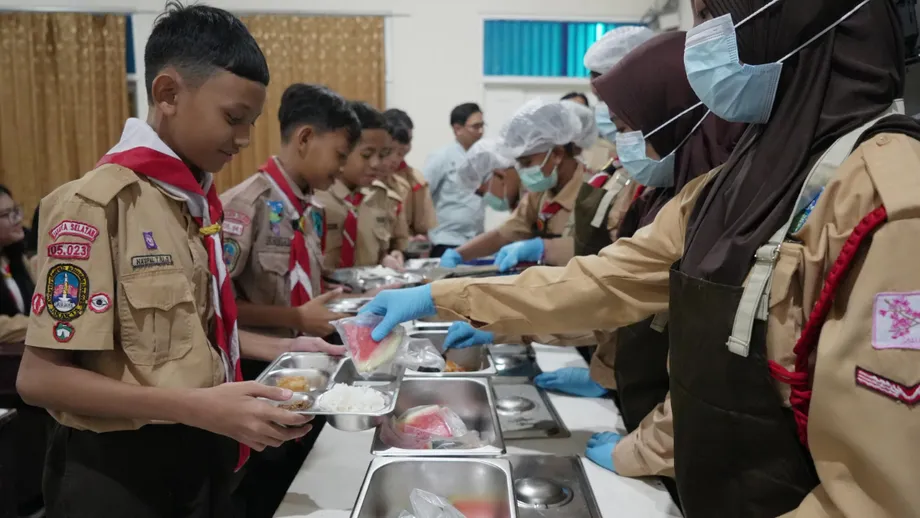
BGN is also testing buffet service at several locations in Java. Tysa said early monitoring suggested it could speed delivery, keep food warmer and reduce the individual portioning involved in meal trays. Kitchens wishing to adopt it must apply for BGN verification, prepare operating procedures and train staff. Measuring utensils and hygiene practices remain necessary to provide adequate portions and control contamination.
Financing and oversight accompany the rollout
BGN Regulation Number 13 of 2026 changed kitchen incentives to Rp2,000 per portion from October 5. Under the allocation described by Sudaryono, Rp15,000 per beneficiary consists of Rp10,000 for food, Rp3,000 for operations and Rp2,000 for incentives. Previously, kitchens received a flat incentive of Rp6 million daily regardless of beneficiary numbers.
The new incentive is paid when kitchens provide service. Sudaryono said suspended kitchens and facilities not serving beneficiaries during holidays or disruptions would receive no incentive for those periods.
Construction support in remote areas has involved other arrangements. At the January hearing, Dadan said partners could receive full construction cost reimbursement following appraisal with the Directorate General of State Assets. He also described a 20 percent developer profit margin and investor incentives of up to 70 percent.
Sudaryono warned during the October expansion that BGN had authorized no intermediaries to arrange kitchen activation. He urged people to report anyone claiming to represent the agency or its leadership while demanding payment. Program questions and complaints can also be directed to BGN's Sahabat Gizi service, known as SAGI, on 127.
Spending oversight is also in focus following the MBG motorcycle procurement case. Prosecutors reported audited state losses of about Rp863.8 billion, and five suspects and evidence were transferred for prosecution on October 9. Investigators said 5,585 of 19,269 electric motorcycles lacked batteries and that all vehicles in that procurement group lacked registration plates.
For the new kitchens, the immediate work is completing readiness checks, testing distribution and extending meals to registered beneficiaries. Local governments have been asked both to identify underserved communities and to supervise the facilities intended to serve them.
Key Points
- BGN activated 980 nutrition service units across 16 provinces on October 14, following 480 on October 2.
- Remote communities and areas with high stunting prevalence are priorities for further expansion.
- Official parliamentary scrutiny identified major coverage gaps in Papua and delivery and cost problems elsewhere.
- New Riau Islands kitchens must complete operating requirements before trials of 100 to 200 portions.
- BGN removed 1,653 financially independent schools from eligibility while identifying about 15,000 unserved schools in Maluku and Papua.
- Nutrition specialists called for priority attention to pregnant women, breastfeeding mothers and children under five.
- Food safety checks, local supply planning and direct official activation channels are central to the next stage.