A Safer Mission Replaces a 2031 Landing
JAXA announced on November 17, 2026 that Hayabusa2 will abandon its planned 2031 rendezvous with asteroid 1998 KY26 and aim instead for a flyby of asteroid 2015 BM510 in April 2028. The decision came one day after the Japan Aerospace Exploration Agency reported the change to a Cabinet Office space policy subcommittee on November 16. The new plan keeps the spacecraft flying but drops the landing, after the last normally functioning ion engine failed in mid August.
Contents
- A Safer Mission Replaces a 2031 Landing
- What a Flyby Can Still Do
- A Short Timeline of a Long Mission
- Why the Engines Gave Out
- How Engineers Kept the Probe Moving
- Why 2015 BM510 Became the Choice
- The Navigation Challenge in the Final Minutes
- What Scientists Hope to Learn
- The Asteroid Hayabusa2 Will Not Visit
- What Comes Next for the Spacecraft
- Key Points
Hayabusa2 has already completed the job it was built for. It left Earth on December 3, 2014, reached asteroid Ryugu in June 2018, collected material from the surface and from an artificial crater, and returned a capsule containing 5.4 grams of Ryugu rock and dust in December 2020. The main spacecraft stayed in space. Japan's space agency used fuel left aboard to send it on an extended mission toward small asteroids that spin fast.
JAXA said that by November 27 in that extended voyage Hayabusa2 had travelled more than 5.8 billion kilometres since leaving Earth again and was about 92 million kilometres from Earth. Hayabusa2's target change followed the August engine fault, the abandoned 2031 arrival and the choice of a closer, easier to reach flyby. The spacecraft is now being asked to do one demanding pass, not to stop beside an asteroid.
What a Flyby Can Still Do
A flyby is a close pass. A rendezvous means slowing down until a spacecraft can travel alongside an asteroid, and a landing means touching it. Hayabusa2 used the same basic manoeuvre for observation and navigation in the past, but the words carry different weight: flybys emphasise taking data during a pass, while swingbys emphasise using gravity to change a path.
The old route asked a lot from the engines. Reaching 1998 KY26 in 2031 required an Earth swingby in December 2027 and about 650 metres per second of additional velocity change after the Torifune encounter. The new route to 2015 BM510 needs about 24 metres per second, roughly 27 times less, and no Earth swingby. JAXA estimates the chemical thrusters can still deliver about 30 metres per second.
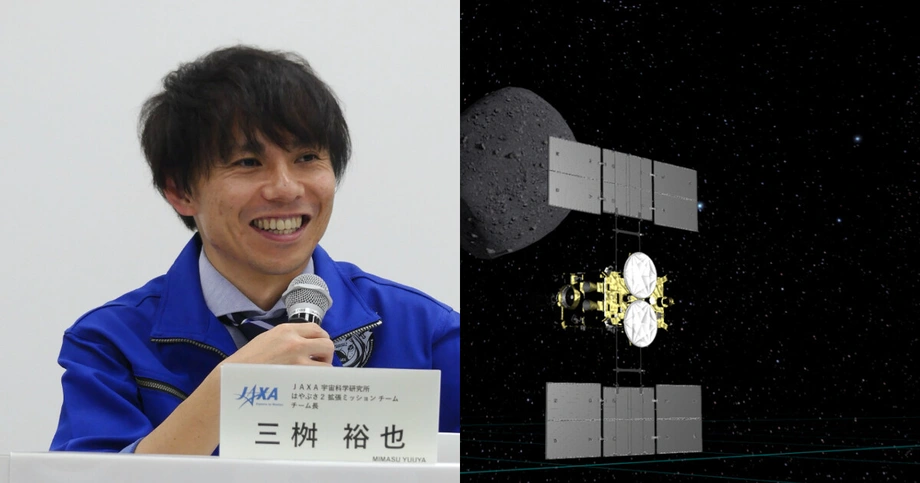
Yuya Mimasu, leader of the extended mission team at JAXA's Institute of Space and Astronomical Science, said the team chose a plan that matched the hardware still available. He described the condition of the spacecraft this way:
The deterioration of the onboard equipment... is becoming increasingly evident.
Mimasu, leader of the extended mission team, said the revised route kept the science within reach of the spacecraft. He told the briefing that the team had picked a pass it could carry out with confidence:
We have made the decision to carry out a new exploration via a flyby of asteroid 2015 BM510.
A Short Timeline of a Long Mission
Hayabusa2's route has been shaped by hardware, gravity and luck. The main events in the changed mission are:
- December 3, 2014: Hayabusa2 launches from Tanegashima Space Center aboard an H-IIA rocket.
- June 2018: The probe arrives at Ryugu. In 2019 it touches down twice and fires an impactor to expose subsurface material.
- December 2020: A capsule returns Ryugu samples to Earth. The spacecraft continues flying.
- 2022: The extended mission begins, using remaining xenon and chemical propellant for further encounters.
- July 5, 2026: Hayabusa2 flies past Torifune about 400 metres from its surface, a distance also described as about 744 metres from the asteroid's centre.
- July 9, 2026: Thrusting resumes with engine B to set up the Earth swingby needed for 1998 KY26.
- Mid August 2026: Engine B suffers repeated electrical discharges. JAXA later finds that the power supply feeding its ion source has failed.
- September 28, 2026: JAXA confirms a workaround joining engine D's ion source to engine B's neutralizer.
- Late October 2026: Burns toward the new target begin and are planned to last one to two months.
- November 16 and 17, 2026: The Cabinet Office subcommittee is briefed, then JAXA announces the new target.
The sequence shows how little margin remained. The probe had enough propellant for more flying, but the machines that turn propellant into controlled motion had reached an uncertain stage.
Why the Engines Gave Out
Hayabusa2 carries four xenon ion engines named A, B, C and D. An ion engine does not roar like a rocket. It turns xenon gas into charged particles and accelerates them out of the spacecraft, creating a tiny push that can build up over years. A neutralizer sends out electrons so the spacecraft does not build up an electric charge that would pull the ions back.
The IEPC academic paper Hayabusa2 Ion Engine System said each thruster was designed to produce 6.3 to 9.0 millinewtons of thrust, with specific impulse of 2,740 to 2,890 seconds and a total system impulse of 1.2 million newton seconds. Specific impulse is a measure of fuel efficiency. The system carried 66.5 kilograms of xenon.
That paper also described the work done before launch to avoid the failures of the first Hayabusa. Its improved neutralizer had a magnetic field 20 percent stronger than the earlier design. A ground endurance test reached 20,000 hours by December 2014 and 24,000 hours by May 2015, beyond the mission requirement of 14,000 hours. Hayabusa's own neutralizers had lasted 9,579 to 14,830 hours in flight.
Space changed the picture. A sensor added to Hayabusa2 detected unexpected erosion on the spacecraft surface. Engineers concluded that surplus electrons and ion plasma wore away layers around the engines. Once a lower insulating layer was exposed, it could no longer collect excess electrons properly, so the neutralizers degraded. Engines A, C and D reached the ends of their useful lives. Engine B was kept for the extended mission.
From September 2023, the team raised the xenon flow by 1.5 times to protect the part absorbing electrons. That slowed the rise in neutralizer voltage to one tenth of the earlier rate and helped engine B last through the Torifune flyby. The price was wear on the other end of the engine: the power supply feeding the ion source failed in mid August.
How Engineers Kept the Probe Moving
JAXA's answer was a rescue method with a precedent. The first Hayabusa used parts from more than one failed engine to get home in 2010. Hayabusa2's team paired the healthy neutralizer of engine B with the working ion source of engine D. This is called cross operation. It works as a thruster, but no one can say how long it will last.
The scale of the wear is stark. Each engine has accumulated roughly 7,000 to 10,000 hours, and the system's total impulse has passed the first Hayabusa's record. Engine B had logged 8,143 operating hours by June 9, 2026. Hayabusa2 has consumed 57.3 kilograms of xenon, with about 19 kilograms left.
Those numbers explain why the spacecraft can still be steered but cannot safely chase the old plan. A cross setup may keep Hayabusa2 alive and allow small corrections. It does not give engineers the confidence needed for years of precise thrust, a December 2027 Earth swingby, a 2031 rendezvous and a landing on an asteroid about 11 metres across.
Why 2015 BM510 Became the Choice
JAXA looked for a target reachable without an Earth swingby and found three serious candidates. The team chose 2015 BM510 because it combines a low fuel requirement with a scientific payoff that fits the extended mission. The object is a D-type asteroid, a dark class thought to preserve primitive material from the early solar system, and a fast rotator.
Estimates put 2015 BM510 at 17 to 74 metres across. Its rotation period is 0.81 hours, about 49 minutes. Its orbit stays relatively close to Earth's path, with a perihelion of 0.83 astronomical units and an aphelion of 1.06 astronomical units. An astronomical unit is the average distance from Earth to the Sun.
The comparison with 1998 KY26 is sharp. The old target was about 11 metres across and was due in 2031. The new one is at least six metres wider and perhaps up to 63 metres wider, with an encounter three years earlier. NASA's Lucy spacecraft is due to fly by a D-type asteroid on April 18, 2028, close to Hayabusa2's own April window. The same rock is also the primary target of a proposal for the European Space Agency's mini-Fast mission series.
The Navigation Challenge in the Final Minutes
The flyby will be fast and brief. Hayabusa2 will pass 2015 BM510 at about 6 kilometres per second. Because the asteroid is small and dark, the onboard camera is not expected to see it until roughly 10 hours before closest approach. Torifune could be spotted about two weeks ahead, so the new encounter gives the team roughly 34 times less warning.
A flyby at that speed needs constant refinement. The asteroid's position has some uncertainty. Operators on Earth plan to use optical observations to refine the path, send trajectory corrections, and then hand control to the spacecraft when ground commands would arrive too late. The target closest approach is a few hundred metres from the asteroid's centre. At 100 metres or so, cameras could resolve surface rocks.
Ryudo Tsukizaki, a member of the Hayabusa2 extended mission team and its propulsion specialist, compared the approach to a rider shooting at a target after the blindfold comes off at the last instant. He said:
It's a bit like loosing an arrow while taking off a blindfold just at the very last moment.
The Torifune pass set a record for a close asteroid flyby at about 400 metres from the surface. Mimasu said the team wants to beat that smallest distance if it can. The new pass will use whatever ion operation remains, plus chemical hydrazine thrusters, to keep the aim true.
What Scientists Hope to Learn
D-type asteroids are dark and reddish. Scientists think many formed far from the Sun and contain organic material and compounds containing water. They sit somewhere between asteroids and comets in their chemistry. A close look at 2015 BM510 could show whether a primitive body with that makeup can spin once every 49 minutes without breaking apart.
The question is simple to picture. A spinning body throws surface material outward. Gravity and the strength of the material pull it together. If the spin is too fast, loose material can fly off. A small D-type fast rotator gives scientists a chance to test that balance with images and measurements.
Makoto Yoshikawa, a member of the Hayabusa2 extended mission team, said a very close pass would transform the images. He said:
If we manage to get within a few hundred meters, we will be able to obtain images of the asteroid at very high resolution.
The team also plans to release a remaining target marker after the flyby. Release of a marker lets engineers practise rendezvous techniques around an extremely small object, including hovering and careful orbit control. Hayabusa2 will continue other science on the cruise, including observations of zodiacal light and exoplanets.
The Asteroid Hayabusa2 Will Not Visit
1998 KY26 had become a target of curiosity before the engine failure. Observations from its 2024 appearance revised its diameter to 11 plus or minus 2 metres and its spin to 5.3516 minutes. Earlier estimates had been 30 plus or minus 10 metres and about 10.7 minutes. Its path also showed nongravitational acceleration, meaning a small push that gravity alone did not explain.
Darryl Z. Seligman, who led the 2022 work identifying that odd motion, has described objects like 1998 KY26 as dark comets: bodies that move as if material is escaping but show no obvious tail. Davide Farnocchia of NASA's Jet Propulsion Laboratory led a 2025 study that reproduced the motion using sunlight pressure and heat radiated from an irregular surface. Korbin Hansen and Masatoshi Hirabayashi of Georgia Tech modelled the interior and found an orbit averaged bulk temperature of 225.737 kelvin, above the 145 kelvin threshold used for buried ice that lasts over long periods.
Avi Loeb, an astrophysicist at Harvard University, has argued that 1998 KY26 could be the lost Soviet spacecraft Phobos 1, launched toward Mars in 1988. He cited a spin near five minutes, reflectivity near 50 percent and the object's odd acceleration. Jared Isaacman, NASA Administrator, rejected the idea in plain terms:
I've not seen any evidence to suggest this is ... anything other than an asteroid.
The planned Hayabusa2 visit would have given scientists close images of that object. The loss is scientific, but the reason for the change remains practical. JAXA's team could no longer count on the propulsion needed for a rendezvous in 2031.
What Comes Next for the Spacecraft
Burns toward 2015 BM510 began in late October and are planned for one to two months. Telescopes on Earth are expected to observe the asteroid around the turn of the year to refine its size and spin before the flyby. JAXA has not given an exact day in April 2028, a final closest approach distance, or a complete list of instruments that will be available for the pass.
April 2028 will be busy for small body science. Lucy will fly by a D-type asteroid on April 18. JAXA's Destiny+ mission is scheduled to launch in fiscal 2028, sharing an H3 rocket with ESA's Ramses mission to asteroid Apophis. Destiny+ is due to study Apophis in 2029 and asteroid 3200 Phaethon later.
Hayabusa2's failures will also feed forward. Data from its ageing ion engines are being used in the design of the ion engine system for Destiny+, where thrust is being raised from 30 to 40 millinewtons. The spacecraft that brought Ryugu home is no longer on course for a landing. It is still providing engineering lessons for the missions that follow.
Key Points
- JAXA announced on November 17, 2026 that Hayabusa2 will fly past 2015 BM510 in April 2028 instead of landing on 1998 KY26 in 2031.
- The change followed failure of the last normally functioning ion engine in mid August and the uncertain life of a cross operation using parts from engines B and D.
- The new route needs about 24 metres per second of velocity change, compared with about 650 metres per second for the old route.
- 2015 BM510 is 17 to 74 metres across, spins once every 49 minutes and belongs to the primitive D-type class.
- The flyby will be difficult because the dark asteroid may be visible only about 10 hours before closest approach.
- 1998 KY26 remains an unusual object, but the mission change was driven by Hayabusa2's hardware.